

If your project is a building, land or long-lived equipment and your business is not tied to a rural location, the SBA 504 loan is usually the more direct fit. The USDA Business & Industry (B&I) guarantee is built for rural projects and can also cover working capital, which 504 cannot. The deciding questions are where the property sits, what you need to fund, and how you want your rate and term structured.
Below, we compare the two programs on the points that change your monthly cost and your closing timeline, then show how to decide for a New England project.
TL;DR
- Location decides USDA eligibility. B&I projects generally must be in rural areas, outside any city or town with more than 50,000 inhabitants. SBA 504 is not limited by rural status.
- Use of funds differs. SBA 504 finances major fixed assets such as buildings, land and long-term equipment. B&I can also fund working capital, acquisitions and refinancing.
- Rates work differently. The CDC portion of a 504 loan is fixed for the life of the loan. B&I rates are negotiated with the lender and may be fixed or variable.
- Fees and terms differ. B&I carries a guarantee fee and an annual fee. 504 offers 10-, 20- and 25-year terms.
Table of Contents
- SBA 504 and USDA B&I at a glance
- How each program works
- Who qualifies, and where
- What you can finance
- Rates, terms and fees
- Refinancing existing debt
- Our perspective
- How to choose for your New England project
- Talk to us about your project
- FAQ
- Sources
SBA 504 and USDA B&I at a glance
| SBA 504 | USDA Business & Industry guarantee | |
|---|---|---|
| What it is | Long-term, fixed-rate financing for major fixed assets, delivered through a community-based nonprofit CDC | A government guarantee on a lender’s loan to a rural business |
| Location rule | Operating, for-profit U.S. business | Generally rural, not in a city or town over 50,000 people |
| Typical uses | Buildings, land, long-term machinery and equipment | Acquisitions, construction, equipment, working capital, refinancing |
| Rate | CDC portion fixed for the life of the loan | Negotiated, fixed or variable |
| Terms | 10, 20 or 25 years | Up to 7 years working capital, 15 years or useful life for equipment, 30 years real estate |
| Program fees | Set by SBA rules and your CDC | 3% initial guarantee fee and 0.55% annual fee in FY 2026 |
Sources for each row are cited in the sections that follow.
How each program works
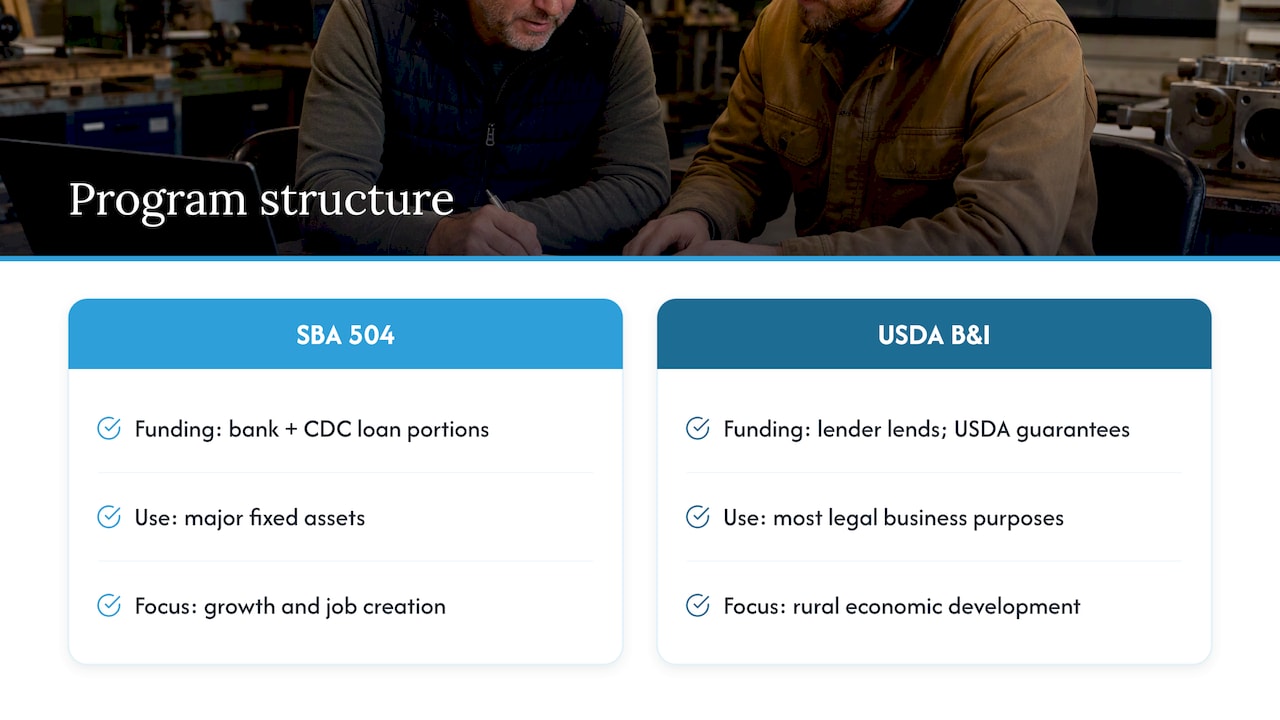
The SBA 504 program finances major fixed assets that promote business growth and job creation. Certified Development Companies (CDCs) are community-based nonprofit partners authorized to originate the loans and help borrowers work through program rules. In a typical deal, a bank provides the first mortgage and the CDC provides a second, debenture-backed portion. That is the structure behind the low equity requirement: the borrower’s injection can be as little as 10%. Our page on the 50/40/10 SBA 504 structure shows who pays what and when.
The USDA B&I program works differently. It is a loan guarantee that helps credit-worthy rural businesses obtain credit for most any legal business purpose. The USDA does not lend the money directly. A commercial lender makes the loan and the government backs a portion of it. The program emphasizes job creation and rural economic development and works through state and area offices alongside lenders.
That difference in design explains most of what follows. 504 is a real estate and equipment tool open to businesses wherever they are. B&I is a rural development tool with a wider menu of uses.
Who qualifies, and where
SBA 504 eligibility
SBA 504 requires an operating, for-profit business located in the U.S. that meets SBA size requirements and is not an ineligible type of business. Owner-occupancy matters too. For real estate, the business generally has to occupy a majority of the property. We explain the occupancy rule in 51% Occupancy Required: SBA 504 Eligibility, and our guide to SBA 504 loan requirements in New England covers the rest of the checklist.
USDA B&I eligibility
For B&I, geography comes first. Financed projects must generally be in rural areas, not in a city or town with more than 50,000 inhabitants. In New England, that line matters. A property in a small town in northern Vermont or western Massachusetts may qualify, while a site in a larger city or its close-in suburbs likely will not. Because the program leans so heavily on rural-area definitions, confirm your address with your USDA Rural Development state office before you commit to a purchase contract or pay for appraisals and environmental work.
If the property fails the rural test, the comparison ends there and 504 becomes the practical choice.
What you can finance
SBA 504 is deliberately narrow. It provides long-term, fixed-rate financing for buildings or land and long-term machinery or equipment with a remaining useful life of at least 10 years. It does not fund inventory, payroll or other working capital. Our article on the 10 year rule for 504 and equipment loans explains how to tell which equipment qualifies.
USDA B&I is broader. Proceeds may be used for business acquisitions, construction, equipment, working capital and debt refinancing when it improves cash flow and creates or saves jobs.
In practice:
- Buying or building a facility you will occupy: both programs can work, subject to location.
- Buying heavy equipment with a long useful life: both can work.
- Funding payroll or inventory alongside the project: B&I covers it. With 504, you pair the loan with a separate working capital source.
- Acquiring a business: B&I lists acquisitions as an eligible use.
Many owners pair a 504 loan with a separate line for operating cash. If you are an early-stage company, see SBA 504 for startups, which covers combining 7(a) and 504.
Rates, terms and fees
Interest rates
On a 504 loan, the interest rate on the CDC portion is fixed for the life of the loan and pegged to market rates for 10-year U.S. Treasury issues, with 2026 rates updated quarterly. That means your payment on that portion cannot rise, which makes budgeting simple for an owner-occupant planning a 20- or 25-year hold.
USDA B&I rates are negotiated between lender and borrower. They may be fixed or variable, and variable rates cannot adjust more often than quarterly. A variable rate can start lower, but you carry the risk of upward resets.
For reference, the rates published on our site when this article was written were 6.58% for our Equipment 10-Year Fixed, 6.73% for Real Estate 20-Year Fixed and 6.77% for Real Estate 25-Year Fixed. Rates change, so check our current rate page before you plan around them.
Repayment terms
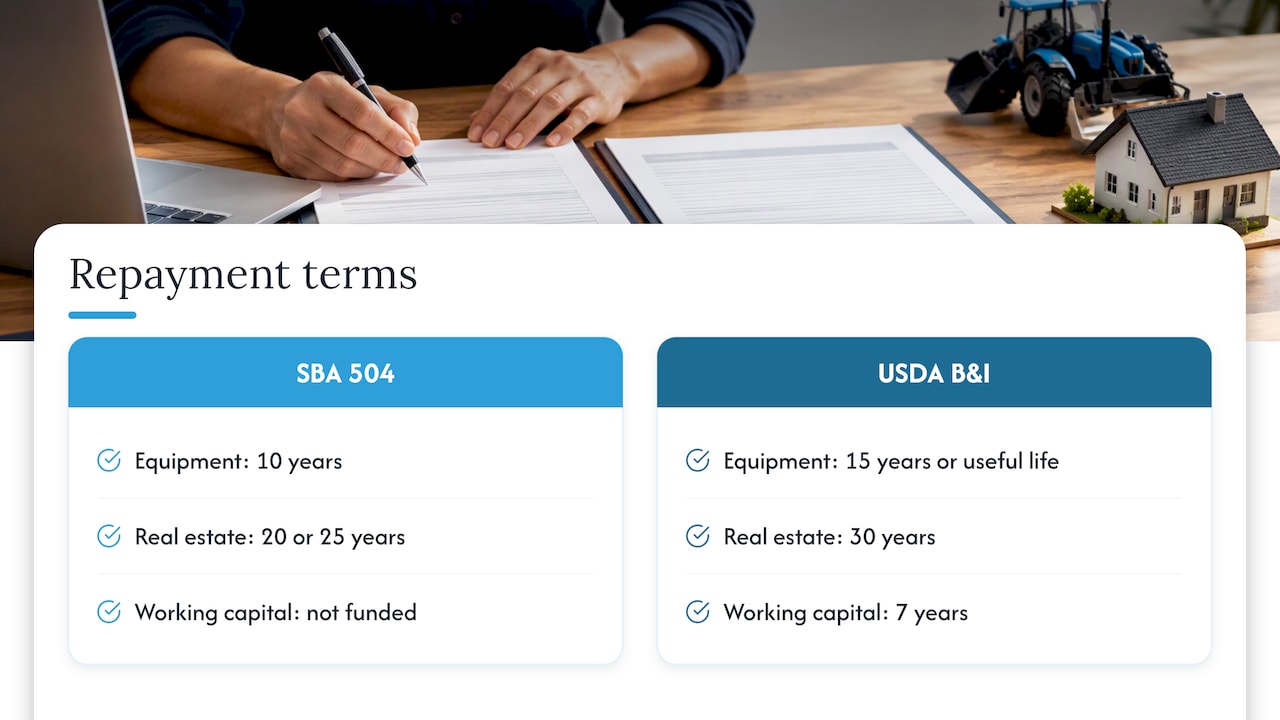
SBA 504 offers 10-, 20- and 25-year maturities. Match the term to the asset: 10 years for equipment, 20 or 25 for real estate. Our guide to 10, 20 or 25 year SBA 504 terms walks through the tradeoffs.
USDA B&I terms are negotiated, with maximums of 7 years for working capital, 15 years or useful life for machinery and equipment, and 30 years for real estate. The 30-year real estate ceiling is longer than 504’s 25 years, and the 15-year equipment maximum is longer than the 10-year 504 equipment term. Longer amortization lowers the payment, though it also means more total interest.
Guarantee and program fees
B&I carries its own cost layer. In FY 2026, the initial guarantee fee is 3% of the guaranteed amount and the annual renewal fee is currently 0.55% of outstanding principal, as of November 2026. The same page sets the government guarantee at 85% for loans under $5 million and 80% for loans of $5 million or more. That guarantee protects the lender, and it is one reason a bank may be willing to lend on a project it would otherwise decline. It is not a discount for you.
With 504, ask your CDC for a full closing cost sheet up front. Our VetLoan Advantage program lists a 1.0% processing fee, and we show you all costs before you commit.
Down payment
On 504, our programs require as little as 10% down. Where a buyer is short, our Down Payment Assistance Program can help with the gap. For B&I, the borrower’s required equity is set in negotiation with the lender, so ask early what contribution a given lender will expect for your project type.
Refinancing existing debt
Both programs can refinance, with different conditions. B&I allows debt refinancing when it improves cash flow and creates or saves jobs.
On the SBA side, rule changes that streamlined 504 debt refinancing, with or without expansion, took effect November 15, 2024. The updates were meant to give borrowers more flexibility with existing debt and physical property. If you carry a balloon note or a variable-rate mortgage on an owner-occupied building, read how to refinance commercial real estate with an SBA 504 loan and compare it with a 25-year fixed rate versus a fast recast. Our SBA 504 Refinance Program is built for this.
Our perspective
We see the same pattern with New England owners again and again. A company finds a building, signs a letter of intent, and only then asks which program fits. The owners who do best reverse that order.
For an owner-occupied building or long-lived equipment, we believe 504 offers the strongest combination of low equity, a fixed rate on the CDC portion and a 25-year horizon. It lets you keep working capital in the business instead of tying it up in a down payment, and it does not depend on whether your town is rural.
USDA B&I has real strengths for rural projects, especially when working capital is part of the request. But eligibility turns on geography, so confirm it before you spend money on the deal.
Our team has been financing regional businesses for more than 70 years and has invested more than $2.3 billion in New England companies. That experience is why we start every conversation with your address, your use of funds and your timeline, then show you the structure that fits. If it is a 504, we can help with down payment gaps, veteran terms and refinancing.
PHENYX
How to choose for your New England project
Work through these steps in order:
- Confirm the location. If the property sits in a city or town over 50,000 people, B&I is generally out. If it is in a small town, keep both options open.
- List every dollar you need. If the request is only a building, land or equipment, 504 fits. If it includes working capital or an acquisition, B&I may cover more in one loan, or you can pair 504 with a separate operating line.
- Decide how you want the rate to behave. If a fixed payment on the long-term portion matters, 504 gives you that on the CDC share. If you are comfortable with a negotiated or variable structure, B&I is open to it.
- Compare the full cost. Add the guarantee and annual fees on B&I, and the closing costs on 504, to the rate. A lower rate with higher fees can cost more over a shorter hold.
- Check equity. Ask each lender what cash you must bring. A 10% injection on 504 can leave far more working capital than a larger required contribution.
- Ask about timing. A CDC with Premier Certified status can offer faster approvals on 504 deals. Ask any lender how long approval and closing take for a project like yours.
If you are also weighing a bank construction loan for a ground-up build, our construction loan versus 504 comparison shows how much the structure can change your total cost.
Talk to us about your project
We finance owner-occupied real estate and equipment across Massachusetts, Rhode Island, Vermont, New Hampshire and Connecticut, with fixed-rate options of up to 25 years and as little as 10% down. Veterans and their spouses can look at our VetLoan Advantage Program, and buyers who need help with the equity can see our Down Payment Assistance Program.
Tell us the property, the use of funds and your timeline at cdcnewengland.com, and we will tell you whether 504 is the right structure.
FAQ
Can a business get a USDA loan anywhere?
No. B&I-financed projects must generally be located in rural areas, outside any city or town with more than 50,000 inhabitants. Confirm the specific address with USDA Rural Development before you commit. SBA 504 has no rural requirement.
Can I use a USDA B&I loan for working capital?
Yes. Proceeds may be used for working capital, along with acquisitions, construction, equipment and refinancing, when the loan meets program purposes. The maximum term for working capital is 7 years. SBA 504 cannot fund working capital, so owners often pair it with a separate line.
Which program has a fixed interest rate?
On SBA 504, the CDC portion is fixed for the life of the loan. USDA B&I rates are negotiated between you and the lender and may be fixed or variable. If a predictable payment matters most, ask for the fixed option in writing.
What do I need to qualify for an SBA 504 loan?
You need an operating, for-profit business in the U.S. that meets SBA size standards and is not an ineligible type of business. For real estate, the business generally must occupy a majority of the property. Our requirements guide covers the details for New England borrowers.
Can I refinance with either program?
Yes, with conditions. B&I allows debt refinancing when it improves cash flow and creates or saves jobs. SBA 504 refinancing rules were streamlined effective November 15, 2024, with or without an expansion.
Sources
- 504 loans, U.S. Small Business Administration
- Business and Industry Guaranteed Loan, USDA Rural Development
- OneRD Guarantee, USDA Rural Development
- USDA Rural Development Business and Industry Loan FAQs
- 3rd Quarter Optional Peg Rate, Direct Interest Rate and Maximum Interest Rate, SBA information notice
- SBA finalizes rule to lower costs for small businesses, September 30, 2024


