SBA 504 refinancing is usually the right move when you want a long fixed rate, fully amortizing payments, and freed-up working capital on commercial real estate or equipment debt. Recasting isn’t part of the commercial toolkit the way it is for residential mortgages, so the real comparison is 504 refinancing against conventional commercial refinancing. Expect stricter documentation, seasoning rules, and a timeline of two to four months in exchange for rate certainty.
TL;DR:
- SBA 504 refinancing provides long-term fixed rates and full amortization, which eliminates balloon risk, unlike conventional loans that often have shorter terms and balloon payments.
- Qualifying requires a debt seasoning of at least six months, at least 75% of proceeds used for eligible assets, and a meaningful reduction in monthly payments after costs.
- The process typically takes two to four months and requires comprehensive documentation, including proof of original use of proceeds and recent payment history.
- Informal lender re-amortizations may offer faster and cheaper lower payments but lack rate certainty, maturity extension, and cash-out options that refinancing guarantees.
- Refinancing is generally more beneficial for businesses seeking fixed long-term rate certainty, maturity relief, and cash-out flexibility, especially when holding the asset long-term.
Table of Contents
- Refinance vs Recast: Quick Comparison for Commercial Loans
- What Are the SBA Rules for Qualifying a 504 Refinance?
- Costs and Trade-Offs: What to Model Beyond the Rate
- When Should You Choose SBA 504 Refinance vs Other Options?
- How Long Does an SBA 504 Refinance Take to Close?
- Is Recasting a Commercial Loan Even Possible?
- Weighing the Pros and Cons of an Informal Recast vs Refinancing
- When Does an Informal Recast Make More Sense Than Refinancing?
- What Would the Process Look Like If Your Lender Offers It?
- Refinance vs Informal Recast: Which Helps Your Business More?
- How Does CDC New England Evaluate Refinance Candidates?
- Ready to Explore Your SBA 504 Refinance Options?
- Sources
Refinance vs Recast: Quick Comparison for Commercial Loans
The phrase “refinance vs recast” gets searched a lot, but in commercial lending, recasting isn’t a standard tool the way refinancing is. What you’re really weighing is one refinancing structure against another: SBA 504 versus conventional commercial refinancing. The differences show up in how the loan is funded, how it amortizes, and how much cash you need on day one.
An SBA 504 loan works in two parts. A third-party lender funds roughly half the project through a conventional mortgage, and a Certified Development Company (CDC) like Cdcnewengland funds another chunk through a CDC debenture that carries a long-term fixed rate. That debenture is fully amortizing over 10, 20, or 25 years, which eliminates balloon risk on that portion of the debt entirely.
Conventional commercial refinancing usually looks different:
- Many commercial mortgages carry a 5, 7, or 10-year balloon structure, meaning the full balance comes due long before the loan is paid off.
- Borrower contribution on 504 deals typically runs as low as 10% for owner-occupied properties, versus roughly 20% to 30% commonly required on conventional commercial refinances.
- Occupancy rules apply to 504: the business generally must occupy at least 51% of the property being refinanced.
- Rate resets on conventional variable loans can hit cash flow hard if rates climb before your next renewal.
Those structural gaps matter because a balloon maturity date is a forced decision point. You either refinance again, on whatever terms the market gives you then, or you sell. A fully amortizing 504 debenture removes that clock.
What Are the SBA Rules for Qualifying a 504 Refinance?
Qualifying for SBA 504 debt refinancing comes down to a handful of objective tests, not lender discretion. Get familiar with these before you spend money on an appraisal.
- Debt seasoning. The debt being refinanced must be at least half a year old, and you’ll need to show a clean recent payment history.
- The “substantially all” test. At least around three quarters of the original loan proceeds must have been used for 504-eligible fixed assets like real estate or heavy equipment. This threshold was clarified and aligned at 75% in the SBA’s 2024 rule update, which also expanded options for refinancing with and without an accompanying expansion project.
- Substantial benefit. Your new loan generally needs to deliver a meaningful reduction in your monthly installment once fees and financing costs are factored in. The 2024 rule changes eased this test in certain contexts, which opened the door for more refinancing scenarios than the program previously allowed.
- Loan-to-value and collateral limits. The refinanced debt, plus any cash-out through Eligible Business Expenses, has to stay within program LTV caps tied to the appraised value of the collateral.
- Documentation of original use of proceeds. Lenders and CDCs will ask for the paperwork proving where the original loan money went.
That last point trips up more borrowers than any other. The Third-Party Lender SBA 504 debt refinancing checklist spells out exactly what’s expected: payment history on the existing note, invoices or cleared checks tying the original proceeds to eligible equipment or property, and a clear paper trail a CDC can underwrite against. If you bought a building eight years ago and can’t produce the closing documents, start digging now. It’s usually the single biggest source of delay in an otherwise straightforward file.
Costs and Trade-Offs: What to Model Beyond the Rate
The headline rate on a refinance offer tells you almost nothing about what the deal actually costs over time. Experts advise comparing total financing cost across your expected holding period, not just the starting number on the term sheet, and the fixed CDC portion of a 504 refinance is especially valuable when rates are elevated because it locks in certainty a variable conventional loan can’t match.
Run the math using the SBA’s own “substantial benefit” method: take your current installment, add in the new financing fees and any prepayment penalty, then compare that total against your new installment. If the reduction isn’t meaningful once those costs are folded in, the refinance may not clear the bar.
Budget for these line items before you commit:
- CDC processing fee
- SBA guarantee fee on the debenture
- Third-party lender fees and closing costs
- Appraisal and environmental report costs
- Interim or bridge financing costs while the CDC debenture is being permanently funded
- Any prepayment penalty on the debt you’re retiring
One underused feature worth flagging: Eligible Business Expenses (EBEs) let you pull operating cash out of the refinancing transaction itself, as long as you can document the expenses and stay inside LTV limits. That’s real working capital, not a loan add-on, but underwriters will want invoices and proof the expenses are legitimate business costs, not a blank check. Use the SBA 504 loan calculator to model your specific numbers before you talk to a lender, and read up on lowering your commercial mortgage costs for more on where fees typically hide.
When Should You Choose SBA 504 Refinance vs Other Options?
Answering “refinance vs recast” for your business really means answering a shorter question: does your situation reward long-term rate certainty, or does it need speed and flexibility? Work through this checklist before you call anyone.
- How long do you plan to hold the asset? If you’re past the five-year mark on a typical horizon, a fixed 504 debenture protects you from a rate reset conventional loans can’t avoid.
- Can you tolerate a process that takes a few months? SBA 504 refinancing takes longer than a conventional refi because it involves a third-party lender, a CDC, and SBA sign-off.
- Does your property or equipment meet occupancy and eligibility rules? Owner-occupancy above 51% and eligible asset classes are non-negotiable program tests.
- What would a prepayment penalty cost you today? If you’re mid-way through a 504 debenture’s prepayment period, run the number before assuming a new refinance saves money.
- Do you need cash out, and does it fit under EBE and LTV rules? If your cash need exceeds what EBEs and program limits allow, conventional refinancing might be the cleaner path.
- What questions should you bring to a lender or CDC? Ask for a side-by-side modeled installment comparison, a full fee schedule, and a written explanation of how the substantial benefit test was calculated for your file.
Pro Tip: Ask any lender to show you the modeled installment comparison in writing before you order an appraisal. If they can’t produce one, or the fee disclosure is vague, treat that as a red flag and get a second opinion.
Review when to refinance your commercial property for scenario-specific guidance, and for a comparison of SBA program structures generally, this analysis of SBA 504 versus 7(a) financing is a useful companion read.
How Long Does an SBA 504 Refinance Take to Close?
Start with your existing bank, then bring in a CDC early. Coordinating both from the outset avoids the back-and-forth that stalls most files.
Timelines commonly run two to four months from application to closing, and the biggest source of delay is almost always documentation gaps, not underwriting disagreements. Ordering appraisals and environmental reports before your file is complete is a common, expensive mistake.
Prioritize gathering these early:
- Two to three years of business tax returns
- Complete payment history on the debt being refinanced
- Invoices or cleared checks proving original use of proceeds
- Existing appraisal or a fresh one ordered once eligibility is confirmed
- Environmental reports if required for the property type
Run a quick pre-screen with a CDC before ordering a full appraisal. It costs nothing and can save you a $2,000 to $4,000 mistake if the file doesn’t clear seasoning or the substantially-all test.
Is Recasting a Commercial Loan Even Possible?
Recasting, as most borrowers understand the term, is a residential mortgage tool: you make a lump-sum payment toward principal, and the lender re-amortizes the remaining balance at the same rate without a new loan or new underwriting. Commercial lending doesn’t offer an equivalent product in any standardized way.
Some commercial lenders will informally re-amortize a loan after a large principal curtailment, especially on portfolio loans they hold in-house, but this isn’t a codified SBA program feature and isn’t something a CDC extends on a 504 debenture. Terms, fees, and even willingness to do it vary lender by lender, and there’s no regulatory framework guaranteeing you the option the way there is for residential recasting.
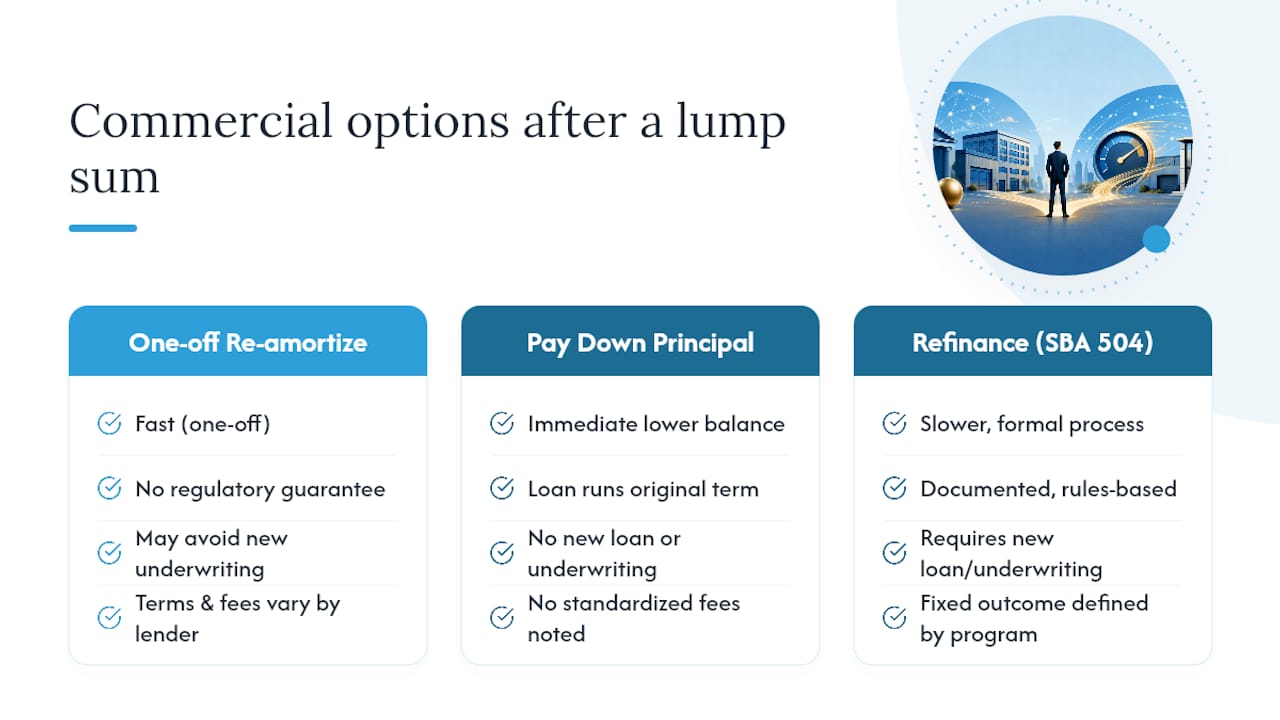
If you have a lump sum of cash and want lower payments without a full refinance, your realistic options in commercial lending are: negotiate directly with your current lender for a one-off re-amortization (if they allow it), pay down principal and let the loan run its existing term at a lower balance, or refinance into a new structure entirely. Refinancing, particularly through SBA 504, gives you a documented, rules-based path with a fixed outcome. An informal lender-specific recast gives you speed but no guarantee of favorable terms, and you’re negotiating from a position where the lender holds all the leverage.
Weighing the Pros and Cons of an Informal Recast vs Refinancing
An informal principal curtailment and re-amortization, where your lender agrees to it, has real appeal on paper. There’s typically no new closing, no fresh underwriting, and no origination fees. If your lender says yes, you could see a lower payment within days rather than months.
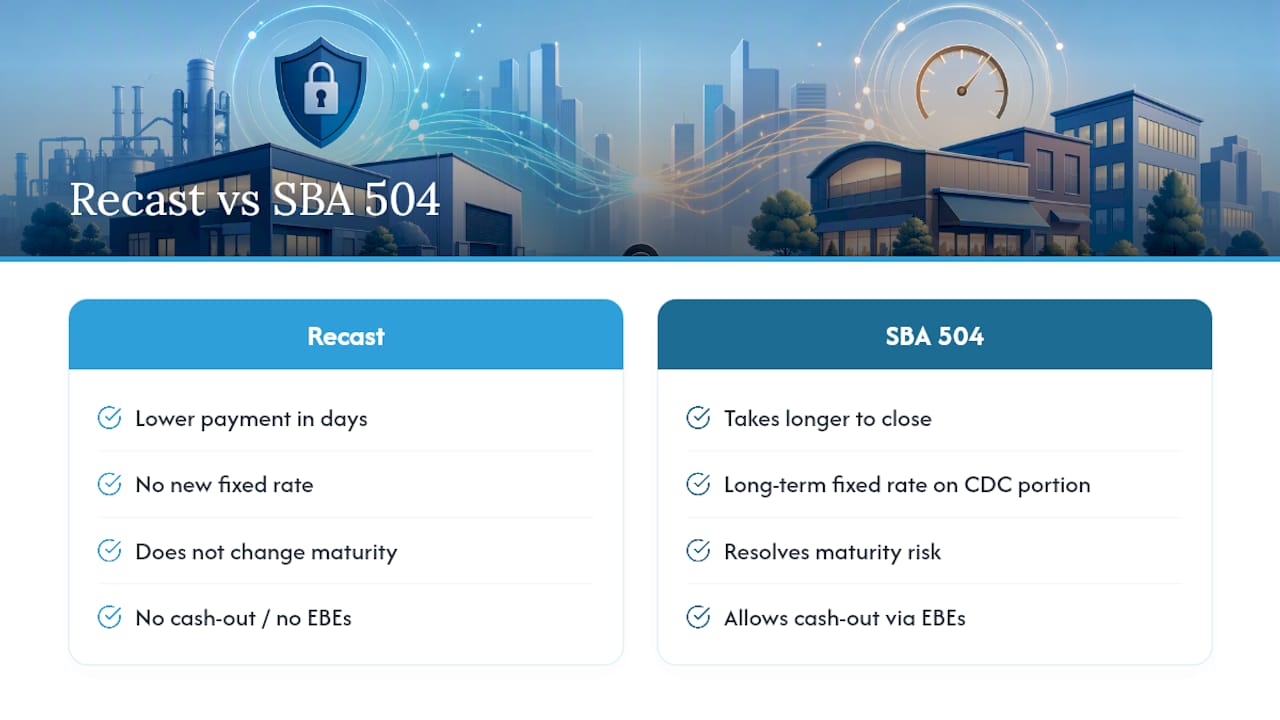
The downsides are significant for a business borrower, though. You don’t get a new fixed rate, so if you’re on a variable conventional loan, a recast-style curtailment doesn’t protect you from future rate increases. You also don’t get access to Eligible Business Expenses or any cash-out mechanism. And because it’s not a standardized product, there’s no requirement that your lender offer it at all, on any terms.
Refinancing through SBA 504 costs more upfront in fees and takes longer to close, but it delivers things an informal recast structurally cannot: a long-term fixed rate on the CDC portion, a documented and enforceable set of terms, and the ability to pull cash out through EBEs when you have real capital needs beyond just lowering a payment. For a borrower sitting on a balloon loan approaching maturity, refinancing also resolves the underlying maturity risk. A recast, even where available, does nothing to change a loan’s maturity date.
When Does an Informal Recast Make More Sense Than Refinancing?
An informal recast style arrangement, where a lender agrees to re-amortize after a principal payment, tends to make sense in narrow circumstances. If you just received an insurance settlement, sold an unrelated asset, or had an unusually strong year and want to apply that cash directly to your existing loan without disturbing its rate or covenants, asking your current lender about a curtailment is worth a phone call.
It also fits better for borrowers who are happy with their current rate and don’t want to reopen underwriting, pay new closing costs, or risk a rate environment that’s worse than what they locked in originally. If your existing loan is already fixed and favorable, and your only goal is a lower monthly payment, there’s no reason to trigger a full refinance and its associated fees just to get there.
Where it falls short: if your loan has a balloon maturity coming up, if you’re on a variable rate in a rising-rate environment, or if you need to pull cash out for a business purpose beyond debt reduction. In every one of those cases, refinancing, and specifically an SBA 504 refinance if you qualify, addresses the actual underlying problem. A curtailment only ever lowers your payment. It never changes your rate structure, your maturity date, or your access to capital.
What Would the Process Look Like If Your Lender Offers It?
Because there’s no standardized commercial recast product, the process is whatever your individual lender’s internal policy allows. Generally, you’d contact your existing lender, ask whether they permit re-amortization after a lump-sum principal payment, and request their specific requirements in writing.
Expect the lender to set a minimum curtailment amount, often a meaningful percentage of the remaining balance, before they’ll agree to re-run the amortization schedule. Some lenders charge an administrative fee for the recalculation, typically far less than refinancing closing costs, but this varies enormously and isn’t guaranteed to exist as an option at all. Timeline, where offered, tends to run days to a few weeks rather than the months a full SBA 504 refinance requires, since there’s no new underwriting, no CDC involvement, and no SBA approval needed.
The catch is that none of this is enforceable the way a 504 refinance’s terms are. Your lender can change their internal policy, decline your request, or set terms you don’t like, and you have no recourse beyond taking your business elsewhere. That unpredictability is the core trade-off against a formal refinance.
Refinance vs Informal Recast: Which Helps Your Business More?
For most commercial borrowers, refinancing beats an informal recast on nearly every dimension that matters beyond speed. A recast style curtailment might shave a few months off your process and skip origination fees, but it leaves your rate, your maturity date, and your access to capital exactly where they were.
Refinancing, particularly through SBA 504, changes the fundamentals. You get a fixed rate for up to 25 years on the CDC portion, a fully amortizing structure that removes balloon maturity risk entirely, and, if you need it, the ability to access cash through Eligible Business Expenses. Those are structural improvements, not just a smaller payment.
The operational benefit compounds over time too. A business running on a fixed 504 debenture can budget with confidence years out. A business relying on a lender’s goodwill for an informal recast, or sitting on a variable conventional loan, is planning around uncertainty it doesn’t have to accept. For a borrower with real growth plans, that predictability is often worth more than the extra weeks a refinance takes to close.
How Does CDC New England Evaluate Refinance Candidates?
Cdcnewengland has invested more than $2.3 billion across more than 70 years serving New England businesses, and that history shapes how the team screens files. The strongest refinance candidates typically hold owner-occupied real estate or equipment, have clean payment history on seasoned debt, and want fixed-rate certainty over a long holding period. Run your numbers through the 504 loan calculator before your first conversation.
— PHENYX
Ready to Explore Your SBA 504 Refinance Options?
If you’ve been weighing an informal lender recast against a full refinance, the math above usually points toward refinancing once you factor in rate certainty and cash-out flexibility. Cdcnewengland gives you a documented, rules-based path to a fixed rate for up to 25 years, something no informal recast arrangement can promise, with only 10% down for qualifying owner-occupied properties.
Start by running your current loan numbers through the SBA 504 loan calculator to see what a fixed-rate refinance could do to your monthly installment. If you qualify for extra help closing the equity gap, ask about down payment assistance, and veteran-owned businesses should look into the VetLoan Advantage program for additional benefits. From there, visit the SBA 504 loans page and connect with Cdcnewengland’s refinance team to pre-screen your file before you spend a dollar on an appraisal.