The borrowing base formula is simple at its core: Borrowing Base equals the sum of each eligible collateral category multiplied by its advance rate. The result sets the maximum amount you can draw under an asset-based credit facility at any given time. Lenders control the inputs, eligible assets, advance rates, and reporting rules, through the loan agreement and the borrowing base certificate you submit.
TL;DR:
- Exclude receivables more than 90 days past due, invoices from related parties, and customer balances above lender concentration caps before applying advance rates.
- Reporting may be monthly, weekly, or daily, while eligibility rules are reset annually or at renewal; cure any excess balance promptly to avoid default provisions.
- A certificate lists receivables aging, inventory values and reserves, exclusions, applied advance rates, and the officer’s certification; lenders may request reconciliations or invoice copies.
- Receivables from creditworthy, diversified customers generally receive higher advance rates than inventory, while equipment often qualifies at lower rates or is excluded.
- Faster collections and resolved invoice disputes can increase eligible receivables and borrowing availability without changing the lender’s advance rates under the facility terms.
Table of Contents
- What a borrowing base is and why lenders use it
- How the borrowing base works inside a loan agreement
- Borrowing base formula and a step-by-step worked example
- Eligible collateral types and how lenders adjust values
- Borrowing base certificate: required fields and reporting cadence
- Common advance rates, sub-limits, and lender monitoring practices
- CDC New England: a practical checklist for accurate monthly borrowing-base reporting
- Author perspective and recommended next steps for borrowers
- FAQ
- Sources
What a borrowing base is and why lenders use it
A borrowing base is not your raw book value of receivables and inventory. It is an adjusted figure that strips out risk: past-due invoices, concentrated customer exposure, and slow-moving stock all get discounted or excluded before a lender counts them as collateral.
This distinguishes asset-based lending (ABL) from cash-flow lending. Cash-flow lenders size a loan around your earnings and project repayment from future revenue. ABL lenders size your credit line around collateral you hold today and track that collateral continuously, often monthly.
The Comptroller’s Handbook on asset-based lending describes borrowing base monitoring as a control mechanism that gives lenders an early-warning system. Strong collateral discipline can translate into more flexible covenant terms for you, since the lender is relying on tangible, verifiable assets rather than projections alone.
How the borrowing base works inside a loan agreement
Your loan agreement defines everything that feeds the calculation: which assets count as eligible, what advance rate applies to each category, any sub-limits on specific asset types, and how often you must report. These terms are negotiated upfront and rarely change mid-term without an amendment.
Reporting cadence varies by facility size and risk profile. Many borrowers submit a borrowing base certificate monthly, while some facilities require weekly or even daily reporting during periods of tighter liquidity. Redetermination, when the lender reviews and resets eligibility rules, happens less frequently, often annually or at renewal.
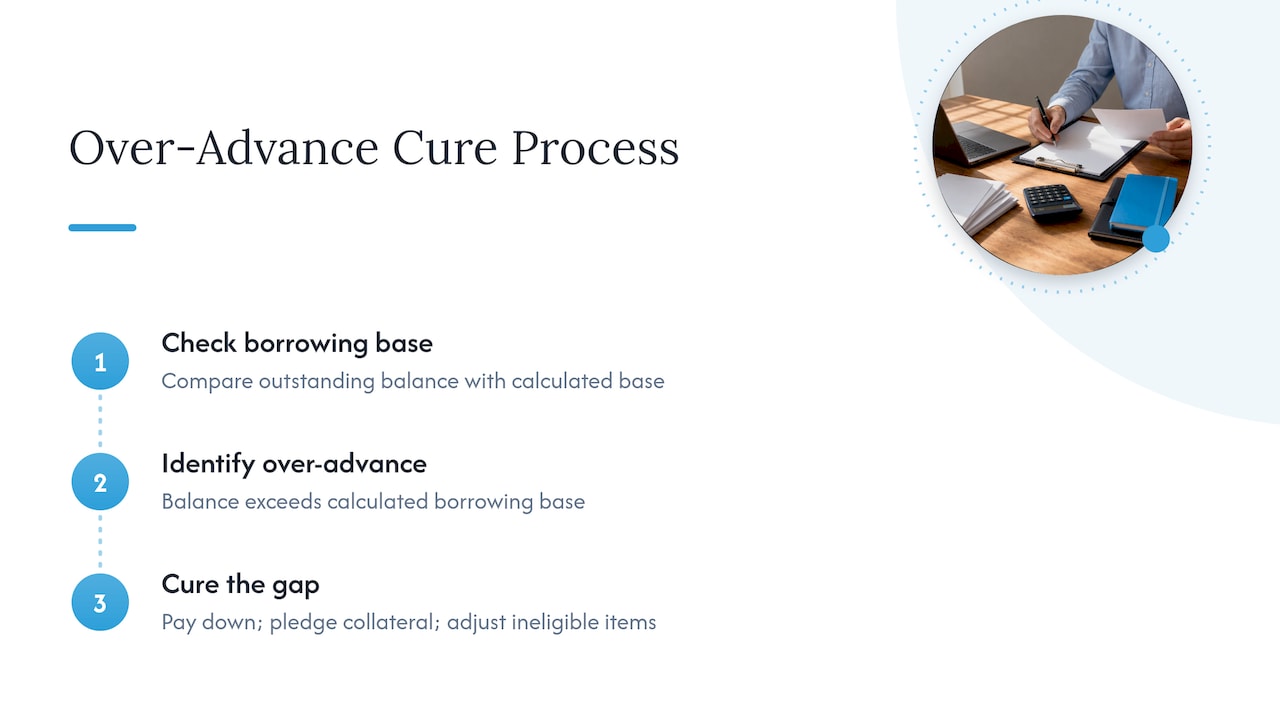
When your outstanding balance exceeds the calculated borrowing base, you have an over-advance. Loan agreements typically require you to cure this within a short window, either by paying down the balance, pledging additional eligible collateral, or adjusting ineligible items. Persistent over-advances can trigger default provisions, so catching the gap early through accurate monthly reporting matters more than it might seem at first glance.
Borrowing base formula and a step-by-step worked example
The formal formula looks like this:
Borrowing Base = (Eligible AR × AR advance rate) + (Eligible Inventory × Inventory advance rate) + (Eligible Equipment × Equipment advance rate, where applicable)
Each term represents one collateral category after ineligible items have already been removed. Here is how to build it:
- Pull your accounts receivable aging schedule and subtract invoices over 90 days past due, related-party receivables, and any amounts concentrated with a single customer beyond the lender’s cap.
- Value your inventory and subtract obsolete, slow-moving, or in-transit stock that your lender excludes.
- Apply the advance rate your lender assigns to each remaining category, respecting any sub-limit caps.
- Sum the category contributions, then subtract your current outstanding balance to see what is still available to draw.
A worked example makes this concrete. Say your eligible accounts receivable, after removing past-due and concentrated invoices, amount to a substantial sum, and your lender applies a high advance rate, resulting in a significant contribution. Your eligible inventory, after excluding obsolete stock, also contributes at a lower advance rate. Your borrowing base is the sum of these contributions. If your current outstanding balance is well within this amount, your available credit will be the difference between the borrowing base and your outstanding balance.
Eligible collateral types and how lenders adjust values
Lenders typically draw a borrowing base from three categories: accounts receivable, inventory, and, less commonly, equipment. Each carries its own eligibility screen before advance rates apply.
- Accounts receivable gets reduced for invoices aged past a cutoff, often 90 days, and for amounts tied to a single customer beyond a concentration cap.
- Inventory gets reduced for obsolete or slow-moving stock, work-in-progress that is hard to liquidate, and goods held on consignment.
- Related-party invoices, whether between affiliated entities or owners, are routinely excluded regardless of age.
- Equipment, when included, is usually appraised and advanced at a lower rate than receivables because it is harder to convert to cash quickly.
The OCC’s handbook on accounts receivable and inventory financing details these category caps and the audit controls lenders use to verify them before each advance.
Borrowing base certificate: required fields and reporting cadence
The certificate is the document that turns your raw numbers into a lender-ready calculation. It is typically signed by a financial officer who certifies the figures are accurate.
- An accounts receivable aging schedule broken into current and past-due bands.
- An inventory listing with valuation method and any reserves for obsolescence.
- A line itemizing ineligible amounts removed from each category.
- A calculation worksheet showing advance rates applied and the resulting borrowing base.
- An officer certification confirming the figures reflect your books as of the reporting date.
Supporting documentation often includes bank reconciliations, physical inventory counts, and copies of large invoices your lender wants to verify directly. According to Corporate Finance Institute, the certificate functions as the lender’s early warning system for credit deterioration, which is why submission dates tend to be firm. A borrowing base reporting workflow walks through this process field by field for controllers preparing their first few certificates.
Common advance rates, sub-limits, and lender monitoring practices
Advance rates vary by asset quality rather than following a fixed industry number. Seasoned, well-diversified receivables from creditworthy customers tend to draw higher advance rates than inventory, which is harder to liquidate quickly and typically draws a lower rate. Equipment, when eligible at all, usually sits at the lower end of the range.
Lenders also layer sub-limits onto the formula to prevent over-reliance on any single asset class or customer. A facility might cap inventory’s total contribution to the borrowing base regardless of how much eligible inventory you hold, or limit how much one customer’s receivables can count toward the total.
Monitoring routines reinforce these caps. Expect periodic aging report reviews, occasional field audits of your inventory and receivables, and availability adjustments that can shift between reporting periods. A sudden drop in collections or a spike in past-due invoices can trigger a lender call well before your next scheduled certificate is due. Our guide on protecting your ABL borrowing base and this primer on collateral and advance rates cover these monitoring patterns in more depth, and this collateral explainer offers a useful general primer if you are new to how lenders think about collateral.

CDC New England: a practical checklist for accurate monthly borrowing-base reporting
Accurate monthly reporting comes down to consistent habits more than complicated math. Our checklist for controllers:
- Pull AR aging and inventory reports on the same cutoff date every month to avoid timing mismatches.
- Reconcile AR aging against your general ledger before applying any exclusions.
- Flag related-party and over-concentration invoices early, rather than discovering them during certification.
- Route the completed worksheet to your signing officer with enough lead time for review before the submission deadline.
Pro Tip: Tighten your collections cadence and resolve invoice disputes faster, since this reduces ineligible AR and increases your available borrowing base without any change to your advance rates.
When a borrowing base facility feels too constrained for a real estate purchase or major equipment acquisition, SBA 504 programs and an asset-based lending primer outline complementary paths worth discussing with your lender. Manufacturers often pair ABL with SBA financing to extend their total borrowing capacity, as described in a guide for manufacturers.
Author perspective and recommended next steps for borrowers
The borrowing base formula rewards discipline more than it rewards clever structuring. Borrowers who reconcile their books monthly and resolve AR disputes quickly consistently report higher availability than those with similar revenue but looser collections habits. The certificate is not paperwork for its own sake. It is the tool that lets you forecast cash with real precision instead of guessing.
Three steps worth taking this week: run the worked example above with your own numbers, pull your current certificate alongside your bank reconciliation to check for gaps, and schedule a call with your lender if your available credit feels tighter than your sales pipeline suggests it should.
— PHENYX
This article is general information, not a substitute for advice from a qualified financial advisor. Consult a qualified financial professional about your own circumstances before acting on anything here.
FAQ
What does a borrowing base do?
A borrowing base sets the maximum amount you can borrow under an asset-based credit facility at a given point in time, based on eligible collateral multiplied by advance rates. It adjusts as your receivables and inventory change, so your available credit moves with your business.
What are the 5 C’s of borrowing?
Lenders commonly evaluate character, capacity, capital, collateral, and conditions when assessing a borrower, though the exact framework can vary by lender. Collateral is the component most directly tied to the borrowing base formula, since it determines which assets count toward your credit limit.
Can you provide an example of a borrowing base certificate?
A typical certificate includes an accounts receivable aging schedule, an inventory listing with valuation, a line for ineligible items, a calculation worksheet applying advance rates, and an officer certification. According to Corporate Finance Institute, these fields let lenders verify the borrowing base calculation and monitor credit risk over time.
What is base rate borrowing?
Base rate borrowing refers to a loan priced off a reference interest rate, such as a prime or benchmark rate, rather than to the borrowing base collateral calculation. The two concepts are related but distinct: one prices your loan, and the other sets how much you can draw against collateral.