

Collateral is an asset you pledge to secure a business loan, and it works as a trade: you get access to more capital at lower rates, but the lender can seize that asset if you default. Lenders typically lend only a percentage of an asset’s value, not its full price, and record their claim through a legal filing like a UCC-1 or a mortgage. That filing, not the loan agreement alone, is what gives the lender an enforceable right to the asset.
TL;DR:
- Commercial real estate typically supports loans at 70% to 90% of its appraised value, providing the highest borrowing leverage.
- Lenders usually advance close to 100% of cash or marketable securities’ value, but only 50% to 70% for equipment and inventory.
- Filing a UCC-1 or mortgage to perfect a security interest is necessary, and a termination statement is required after loan repayment to clear the lien.
- SBA loans under $50,000 often do not require collateral, but higher amounts must pledge available assets plus personal guarantees.
- Collateral documentation, including titles, invoices, and receivables aging reports, should be prepared ahead of application to streamline approval.
Table of Contents
- What Counts as Collateral for a Business Loan?
- How Do Lenders Value Collateral?
- How Do Security Interests Attach and Get Perfected?
- Do Collateral Requirements Vary by Loan Type?
- What Happens If You Default on Secured Debt?
- How Should You Prepare Collateral Documentation?
- When Does an SBA 504 Loan Make Sense for Collateral-Heavy Purchases?
- What Should You Actually Pledge First?
- Ready to Finance Real Estate or Equipment the Right Way?
- Where to Learn More
- Sources
What Counts as Collateral for a Business Loan?
Lenders rank collateral by how quickly and predictably they can convert it to cash if you stop paying. That ranking shapes both what they’ll accept and how much they’ll lend against it.
- Real estate: Commercial property is the gold standard because it holds value and rarely disappears overnight.
- Equipment: Machinery and vehicles qualify, though specialized gear draws steeper discounts since resale markets are thinner.
- Inventory: Accepted more often for retail or wholesale operations, but perishable or trend-sensitive stock gets far less favorable treatment.
- Accounts receivable: Unpaid invoices from creditworthy customers can serve as collateral for business loans, particularly for lines of credit.
- Cash and investments: Savings accounts, CDs, and marketable securities are the easiest assets to liquidate, so lenders favor them heavily.
- Personal assets: Homes, personal vehicles, or investment accounts sometimes back a loan when business assets fall short.
- Intangible assets: Patents or trademarks occasionally count, though most lenders treat them as weak security.
Some lenders skip itemizing assets altogether and instead file a blanket lien claiming a security interest in everything the business owns or later acquires. That’s faster to set up, but it can box you in when you try to borrow again elsewhere.
How Do Lenders Value Collateral?
Lenders don’t lend against the sticker price of an asset. They apply an advance rate (also called a haircut) that reflects how much they’d actually recover if they had to sell it fast. The gap between full market value and what a lender will advance is the built-in cushion that protects them against a forced, rushed sale.
Loan-to-value (LTV) is the loan amount expressed as a percentage of the collateral’s appraised value. A lower LTV means the lender is taking less risk relative to what the asset is worth.
Typical advance-rate ranges run roughly:
- Commercial real estate: 70% to 90% LTV
- Equipment: 50% to 70% LTV
- Accounts receivable: 70% to 85% of eligible invoice value
A property appraised at $500,000 might support a loan between $350,000 and $450,000, depending on the lender’s advance rate and how conservative their appraisal comes in. Cash and marketable securities behave differently. Because they can be liquidated at a near-certain price, lenders often advance close to 100% of their value.
How Do Security Interests Attach and Get Perfected?
A lender’s claim on your collateral isn’t automatic. It has to attach first, then get perfected, and both steps follow specific legal rules.
- Attachment happens when three conditions are met under UCC Article 9: the lender gives value (the loan funds), you have rights in the collateral, and you sign a security agreement describing the pledged asset.
- Perfection for personal property usually means the lender files a UCC-1 financing statement with the state, putting other creditors on notice.
- Perfection for real estate works differently: the lender records a mortgage or deed of trust with the county recorder’s office.
Pro Tip: Once you pay off a secured loan, confirm the lender actually files a termination statement. If they don’t, the old lien can sit on record and complicate financing down the road, so ask for written proof.
Be careful with cross-collateralization clauses, too. They can let a lender apply one pledged asset toward multiple loans, which quietly expands their reach over your business.
Do Collateral Requirements Vary by Loan Type?
Yes, and the differences are significant enough to shape which lender you approach first.
- Traditional banks tend to want full or near-full coverage and often ask for collateral across multiple asset categories before approving larger loans.
- SBA loans follow a distinct framework: the Small Business Administration does not require collateral for loans of $50,000 or less, but for anything above that, lenders must pledge whatever collateral is available, plus a personal guarantee in most cases.
- Equipment and commercial real estate loans often use the financed asset itself as the primary collateral, which simplifies the pledge process.
- Lines of credit and asset-based lending run on a borrowing base, where your available credit fluctuates with the value of pledged receivables or inventory month to month.
- Online and alternative lenders frequently default to blanket liens rather than itemized collateral, trading flexibility for broader claims on your assets.
What Happens If You Default on Secured Debt?
Default triggers a defined sequence, and understanding it now beats learning it under pressure later.
- The lender repossesses or forecloses on the pledged asset, then sells it to recover the outstanding balance.
- If the sale doesn’t cover the full debt, the lender can pursue a deficiency judgment against you for the remaining amount.
- In some states, you retain a right of redemption, letting you reclaim the asset by paying the debt before the sale finalizes.
- Filing for bankruptcy triggers an automatic stay, which pauses collection efforts temporarily but doesn’t erase the underlying debt.
A personal guarantee changes the stakes considerably. It extends the lender’s reach beyond the business itself, making you personally liable even after the company’s assets are exhausted.
How Should You Prepare Collateral Documentation?
Lenders move faster when your paperwork is organized before you apply, not scrambled together mid-process.
- Gather clear titles or deeds for real estate and vehicles.
- Pull recent equipment invoices and current inventory counts.
- Prepare an accounts receivable aging report that separates current invoices from older, riskier ones.
- Collect recent bank statements and any existing appraisals.
- Order a fresh appraisal when your existing valuation is outdated or the asset type is unusual.
Most lenders exclude invoices older than 90 days from an A/R-based borrowing base, so a clean aging schedule directly affects how much credit you can access.
Pro Tip: When negotiating, push for a narrower lien scope instead of accepting a blanket lien by default. Ask for carve-outs that let you sell inventory in the ordinary course of business or transfer specific assets without lender sign-off.

When Does an SBA 504 Loan Make Sense for Collateral-Heavy Purchases?
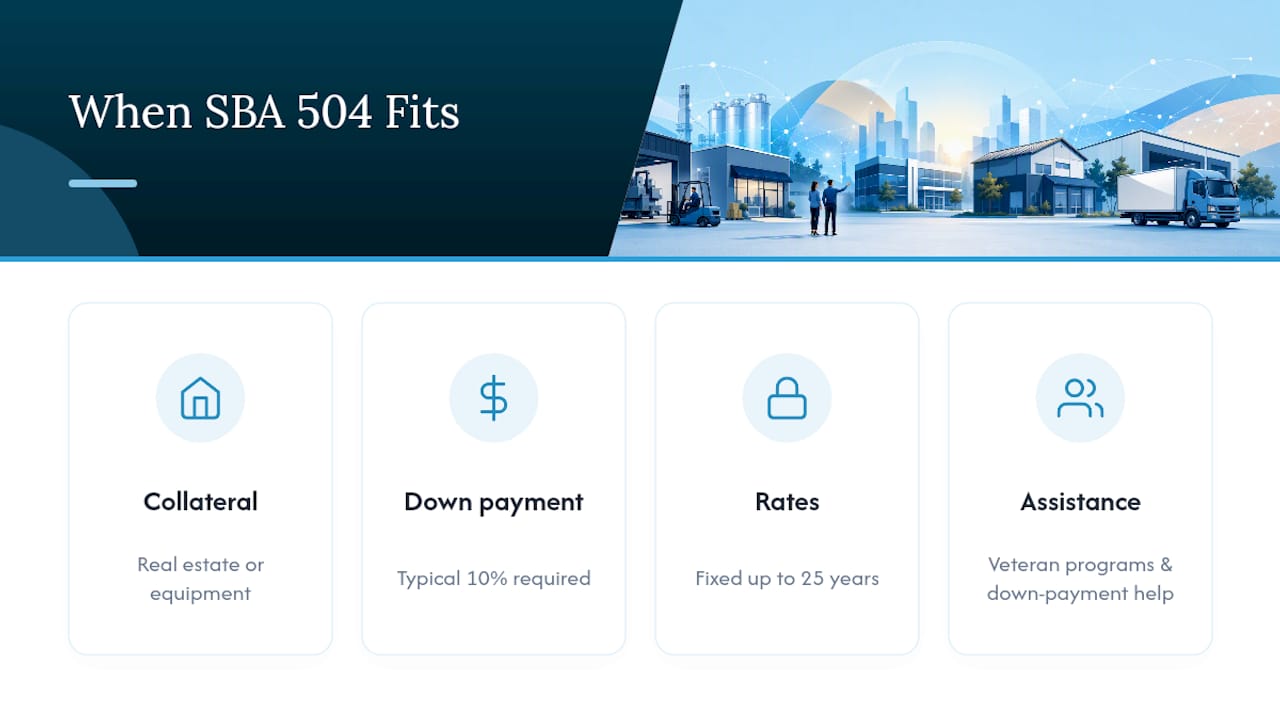
SBA 504 loans typically use the real estate or equipment you’re financing as the primary collateral, which keeps the process straightforward compared to loans that require you to pledge unrelated assets. Cdcnewengland structures these loans with a 10% down payment in common program offerings and fixed rates locked for up to 25 years, so you’re not stacking personal assets on top of the property itself. Some lenders also run veteran-specific programs and down payment assistance for borrowers who need more flexibility on the upfront cost. If you’re weighing appraisal requirements or want to see how the numbers pencil out, the SBA 504 Loan Calculator is a practical starting point before you talk terms.
What Should You Actually Pledge First?
Avoid putting your home on the line unless every other option is exhausted, as explained by Lending Gurus for a clear understanding of lender practices regarding collateral. It’s rarely worth the risk when business assets or receivables can cover the same ground.
Liquidity matters more than most borrowers realize going in. Cash and near-cash assets preserve your flexibility, while illiquid property ties you down long after the loan closes. And if a lender pushes for a blanket lien, negotiate the scope down before you sign. A narrower lien today keeps your options open for the financing you’ll need next year.
— PHENYX
Ready to Finance Real Estate or Equipment the Right Way?
If you’re weighing a bank loan that demands broad collateral coverage against a program built around the asset you’re actually buying, some lenders offer a third path. The SBA 504 loan program uses the commercial property or equipment itself as primary collateral, paired with a 10% down payment and fixed rates for up to 25 years, so you’re not layering personal guarantees or unrelated assets on top of the deal.
That structure matters most when you’re trying to preserve cash for operations rather than tying it up in a bigger down payment. Run your numbers through the SBA 504 Loan Calculator to see what a 10% down payment looks like for your specific purchase, then connect with a Cdcnewengland advisor to walk through what documentation your collateral will need before you apply.
Where to Learn More
For deeper reading, the SBA’s loan overview covers collateral thresholds directly, LegalClarity breaks down UCC attachment and default mechanics, and Cornell LII explains blanket lien risk in plain legal terms.
Sources
- Loans - Small Business Administration
- What is collateral in business? Definition and examples - LegalClarity
- Collateral and business loans guide - eBoostPartners


