

SBA 504 loans can be a realistic financing route for startups, but mainly when a founder needs to buy owner-occupied real estate or long-lived equipment rather than fund early operating costs. The program favors businesses that can document occupancy plans, personal financial strength, and cash flow projections. A July 2026 policy update, which lets qualified borrowers combine 7(a) and 504 loans for up to $10 million, gives capital-intensive startups a new way to structure larger projects.
TL;DR:
- Startups with long-lived equipment or owner-occupied real estate are the best candidates for SBA 504 loans, especially if they can document occupancy and financial stability.
- The program typically finances 40% to 50% of the project through a CDC-backed debenture and 50% through a private lender, with the borrower contributing 10% to 20%.
- New businesses operating less than two years usually need to contribute at least 15%, and special properties may require contributions of 20% or higher, increasing upfront cash requirements.
- The application process takes several months, requiring detailed documentation including tax returns, financial statements, and proof of occupancy, with fees added to the loan budget.
- As of July 2026, borrowers can combine SBA 7(a) and 504 loans for up to $10 million, enabling larger projects by pairing working capital with long-term fixed assets.
Table of Contents
- What the SBA 504 Loan Program Actually Finances
- Is a 504 Loan the Right Fit for Your Startup?
- Eligibility Rules and Borrower Contribution Requirements for Startups
- How a 504 Loan Is Structured and What Terms to Expect
- Applying for a 504 Loan: Steps, Timeline, and Documents
- Costs, Repayment, and Risks Founders Should Model
- How the 2026 SBA Policy Change Expands Startup Financing Options
- Why CDC New England Works Closely With Early-Stage Borrowers
- Ready to Explore 504 Financing With CDC New England
- Sources
- FAQ
What the SBA 504 Loan Program Actually Finances
The 504 loan program delivers long-term, fixed-rate financing for major fixed assets, and it works through Certified Development Companies rather than the SBA directly. A CDC is a certified, community-based nonprofit that packages, processes, closes, and services the loan on the SBA’s behalf, which means your primary point of contact throughout the process is the CDC, not a federal office.
The program is built around assets that support growth over decades, not months. Eligible uses typically include:
- Purchasing or constructing owner-occupied commercial real estate
- Buying heavy machinery or long-lived equipment
- Renovating or expanding an existing facility
- Refinancing eligible existing debt tied to fixed assets
Working capital, inventory, and short-term operating costs generally fall outside what a 504 loan can cover, which is a distinction every founder should understand before applying.
Is a 504 Loan the Right Fit for Your Startup?
A 504 loan tends to fit startups that are past the idea stage and ready to commit to a physical location or a piece of equipment they will use for years. Before pursuing one, run through a quick fit check:
- Do you have enough runway to survive a multi-month approval process?
- Will the property be owner-occupied, or does the equipment have a long useful life?
- Can you provide personal financial statements, tax returns, and credible projections?
Founders buying a facility they will operate from, or investing in equipment central to their production process, are usually good candidates. A startup still validating its product, burning cash on research and development, or needing flexible short-term capital is usually better served by equity financing, an SBA 7(a) loan, or a line of credit. The 504 program rewards borrowers with a clear, long-term use for the asset, not those solving a cash-flow gap.
Eligibility Rules and Borrower Contribution Requirements for Startups
SBA eligibility starts with the basics: your business must operate for profit, meet size standards, and fall under the net worth and income caps described on the SBA’s 504 program page. Beyond that, the borrower contribution, often called the down payment, is where startups feel the most pressure.
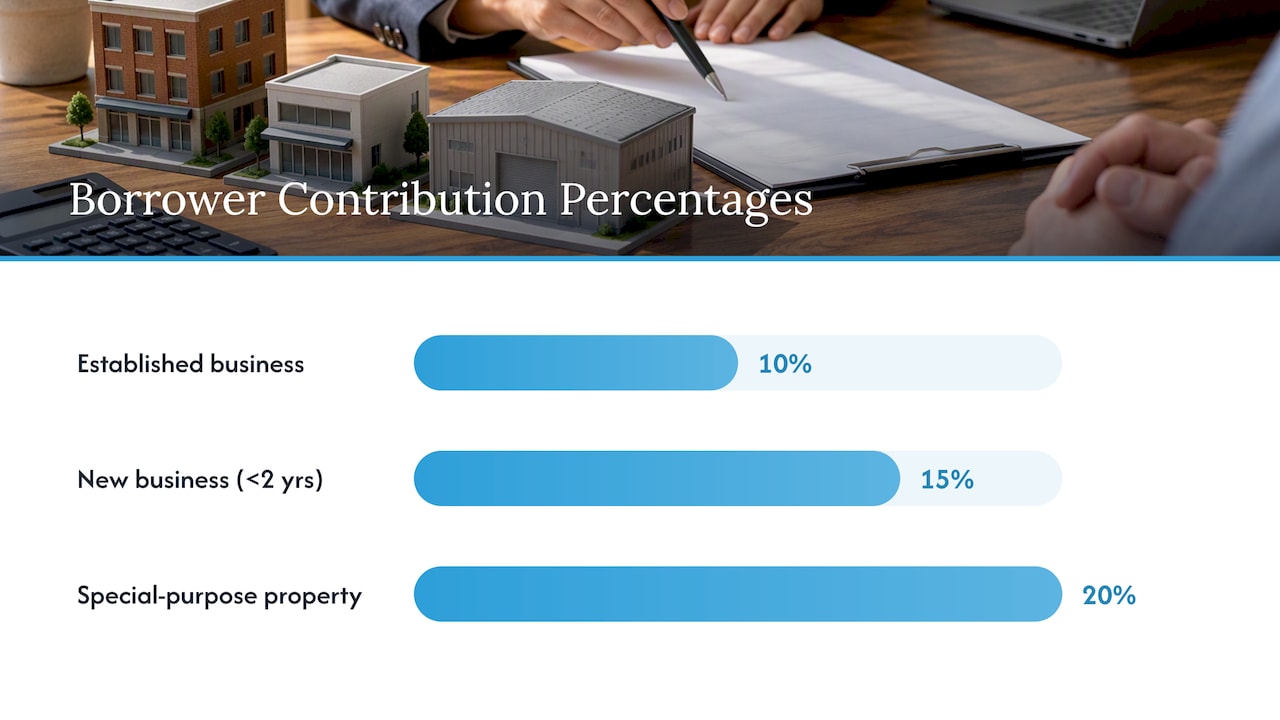
- Established businesses with strong cash flow often contribute 10% of the project cost.
- New businesses, defined as operating less than two years, are commonly asked for 15% because lenders have less operating history to evaluate.
- Special-purpose properties, such as car washes, hotels, or gas stations, can push the contribution to 20% or higher when combined with new-business status.
The SBA’s regulations under 13 CFR Part 120 subpart H set out these contribution rules along with a list of ineligible project costs.
A startup’s borrower contribution can rise from a standard 10% to 15% or even 20% depending on how long the business has operated and whether the property is special-purpose, according to federal 504 loan-making policies. That difference can represent a substantial swing in upfront cash a founder needs before closing.
Documentation matters as much as the numbers. Expect to prepare SBA Form 1244, two to three years of tax returns if the business has them, personal financial statements, and realistic cash flow projections that show how the new asset supports repayment.
How a 504 Loan Is Structured and What Terms to Expect
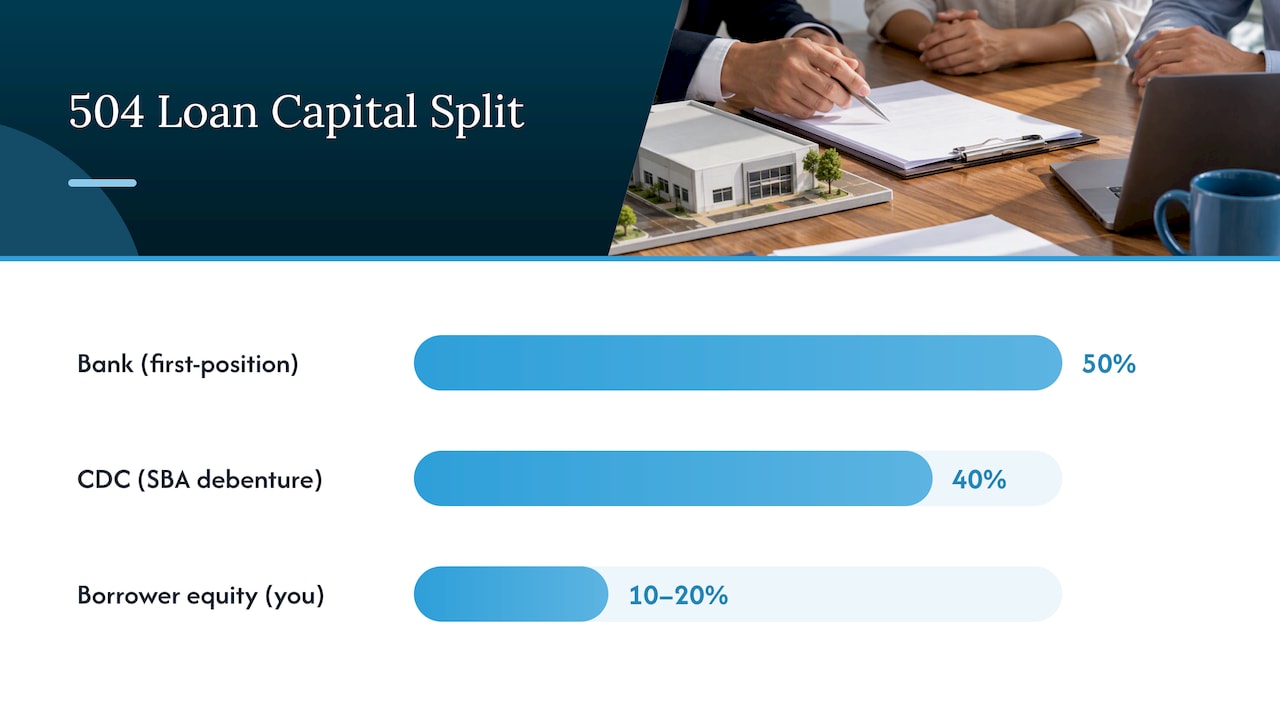
A 504 loan is not a single loan from a single lender. It is a three-party structure that splits the financing between a private lender, a CDC, and you.
- A bank or credit union typically funds about 50% of the project through a first-position loan.
- The CDC funds roughly 40% through an SBA-backed debenture, usually in second position.
- You contribute the remaining 10% to 20%, depending on your business’s age and the property type.
Terms on the CDC debenture commonly run 10, 20, or 25 years, and the rate is fixed for the life of the loan. That fixed rate matters for startups because it locks in a known occupancy or equipment cost for decades, removing one variable from an already uncertain early-stage budget. The bank portion, by contrast, often carries its own amortization schedule, covenants, and sometimes a variable rate, so it deserves separate scrutiny before you sign.
Pro Tip: Compare the bank tranche’s covenants and prepayment terms as carefully as the CDC debenture’s rate, since the bank loan often has more flexibility to negotiate.
Applying for a 504 Loan: Steps, Timeline, and Documents
The application process follows a fairly consistent sequence, even though timing varies by CDC and bank.
- Secure a commitment letter from your primary lender, since most CDCs require this before they will package a deal.
- Work with the CDC to assemble the full application, including SBA Form 1244 and its exhibits.
- Submit the package for review, which can involve SBA’s loan processing center before final authorization.
- Close on both the bank loan and the CDC debenture, typically at the same time.
Founders should plan for a process that often takes several months from initial application to funding, since underwriting a startup with limited operating history tends to require more back-and-forth than a loan for an established business.
A primary lender commitment is usually the first checkpoint a CDC looks for before it will begin packaging a 504 application.
Have these ready before you start: personal financial statements, two to three years of tax returns, cash flow projections, evidence of intended occupancy, and a property appraisal if real estate is involved.
Costs, Repayment, and Risks Founders Should Model
Beyond the down payment, a 504 loan carries fees that founders should build into their budget. CDCs typically charge packaging and closing fees, and the SBA assesses fees tied to issuing the debenture. There are also ongoing costs such as servicing fees, third-party costs like appraisals and legal fees, and standard loan closing costs shared across the bank and CDC portions.
Repayment follows a fixed monthly schedule over the debenture’s term, and missing payments can eventually lead to default and loss of the pledged asset. Founders should calculate debt service coverage before committing, meaning your projected cash flow needs to comfortably exceed the combined bank and CDC payments.
A fixed-rate debenture locked in for up to 25 years, as described on the SBA’s program page, can stabilize a startup’s biggest occupancy or equipment cost for the life of the loan, which matters when every other line item in an early-stage budget tends to move.
How the 2026 SBA Policy Change Expands Startup Financing Options
As of July 4, 2026, the SBA allows qualified borrowers to combine 7(a) and 504 loans for up to $10 million in total SBA-backed financing, doubling the prior combined limit. This gives founders a new way to structure growth.
- Use a 7(a) loan for working capital, inventory, or staffing needs.
- Pair it with a 504 loan to finance the real estate or equipment tied to that same expansion.
- Consider this combination when a single project requires both liquidity and a long-term fixed asset, such as opening a new production facility that also needs launch capital.
For a capital-intensive startup, this pairing can unlock projects that a 504 loan alone would not fully cover.
Why CDC New England Works Closely With Early-Stage Borrowers
CDC New England has invested more than $2.3 billion in regional businesses over more than 70 years of operation, giving it direct experience packaging 504 loans across a range of industries and business ages. Founders exploring 504 financing can expect programs built around common startup pain points, including the Down Payment Assistance Program and the VetLoan Advantage Program for veteran-owned businesses.
When you contact CDC New England, expect a conversation focused on your occupancy plans, projections, and how your business fits the program’s structure, along with guidance on assembling the documentation a CDC and lender will require.
— PHENYX
Ready to Explore 504 Financing With CDC New England
Some founders choose this CDC because the packaging process can be hands-on, and assistance programs may reduce the upfront cash a startup needs to close. Veteran-owned businesses may also qualify for specific support programs.
Before reaching out, gather your recent tax returns, a draft of your projections, and basic details on the property or equipment you want to finance. If you are carrying existing debt tied to a fixed asset, the SBA 504 Refinance Program may also be worth reviewing.
- Explore rate options through Equipment 10-Year Fixed, Real Estate 20-Year Fixed, and Real Estate 25-Year Fixed programs.
- Review down payment support through the Down Payment Assistance Program.
- Check veteran-specific terms through the VetLoan Advantage Program, which carries a 1.0% processing fee.
| Program | Term or rate |
|---|---|
| Equipment 10-Year Fixed | 6.58% |
| Real Estate 20-Year Fixed | 6.73% |
| Real Estate 25-Year Fixed | 6.77% |
| VetLoan Advantage processing fee | 1.0% |
If a 504 loan is not the right fit today, founders can also look into seller financing structures, which some acquisition specialists describe as a useful bridge when down payment capital is tight. Visit CDC New England’s main program page to start a conversation about your specific project.
Sources
- Small Businesses Now Eligible for $10 Million in SBA Financing | U.S. Small Business Administration
- 504 loans | U.S. Small Business Administration
- U.S. Small Business Administration Application for Section 504 Loans
- eCFR :: 13 CFR Part 120 Subpart H - Loan-Making Policies Specific to 504 Loans
FAQ
Who are the top lenders for SBA 504 loans?
504 loans are issued through Certified Development Companies working alongside a participating bank or credit union, rather than through a single national lender list. CDC New England is one such CDC, offering programs including Equipment 10-Year Fixed, Real Estate 20-Year Fixed, and Real Estate 25-Year Fixed financing for businesses across its New England service area.
What is the 20% rule for SBA?
The 20% figure refers to the higher borrower contribution some startups face when a special-purpose property, like a hotel or car wash, is combined with limited operating history. Standard borrowers often contribute 10%, while new businesses and special-purpose properties can see that rise to 15% or 20%.
Is it hard to get a 504 SBA loan?
Getting approved depends heavily on documentation quality, personal financial strength, and having a credible plan for the asset, which can make the process demanding for a business with little operating history. It is not impossible for startups, but expect more scrutiny of your projections and personal financial statements than an established business would face.
Did the SBA pass a policy change for small business loans in 2026?
Yes, the SBA announced on July 7, 2026 that qualified borrowers can now combine 7(a) and 504 loans for up to $10 million in total financing, effective July 4, 2026. This replaced a lower combined limit and gives capital-intensive startups more room to pair working capital with long-term asset financing in a single strategy.


