

If you need long-term, fixed-rate financing for commercial property or heavy equipment, an SBA 504 loan is usually the strongest option. If you need working capital or a smaller, more flexible loan, a 7(a) loan or Microloan may fit better. Expect a paperwork-heavy process, and note that citizenship and residency rules now shape who qualifies.
TL;DR:
- Borrowers seeking real estate or equipment financing should consider 504 loans, which typically offer fixed rates and lower down payments to preserve cash flow.
- Starting from March 2026, only U.S. citizens and nationals with a U.S. residence qualify for SBA loans, excluding foreign-owned businesses from 7(a) and 504 programs.
- Compiling comprehensive financial and ownership documents early can significantly speed up application processing and avoid delays, especially for 504 loans.
- Combining 7(a) and 504 loans enables borrowing up to $10 million for larger projects, with each program’s limit now set at $5 million per individual loan.
- Working with an experienced, preferred lender or CDC can cut approval time markedly, with typical timelines ranging from a few days for Express loans to several months for standard programs.
Table of Contents
- Types of SBA loans and what each one does best
- Eligibility rules, ownership reporting, and paperwork you’ll need
- How to apply: steps, timelines, and ways to avoid delays
- Loan amounts, fees, and what changed under the new financing limits
- Choosing a lender or CDC to work with
- What borrowers underestimate about the SBA process
- Get started with CDC New England’s SBA 504 financing
- Sources
- FAQ
Types of SBA loans and what each one does best
Matching your funding need to the right SBA program is the fastest way to avoid wasted application time. Each program serves a distinct purpose, and the differences in size, structure, and speed matter more than they might seem at first glance.
The SBA’s loan programs are guaranteed in part by the federal government, which lets participating lenders offer more competitive rates and longer repayment terms than they typically could on their own. That guarantee is the backbone of every program below.
- 7(a) loans cover working capital, debt refinancing, and general business purposes, with standard and small 7(a) options plus an Express track for faster decisions.
- 504/CDC loans pair a Certified Development Company with a private lender to finance owner-occupied real estate or major equipment, using fixed rates locked in for the long term.
- Microloans run through nonprofit intermediaries and cap out at $50,000, making them useful for very small startups or working capital needs that don’t justify a larger loan.
- SBA Express trades loan size for speed, giving lenders delegated authority to respond quickly, though maximum amounts are smaller than standard 7(a) loans.
- Disaster loans are issued directly by the SBA rather than through a lender, and apply only when a business needs recovery financing after a declared disaster.
For real estate or equipment purchases, 504 financing tends to preserve working capital better than a 7(a) loan would, since the fixed-rate structure and lower down payment reduce the cash a business has to put down upfront.
Eligibility rules, ownership reporting, and paperwork you’ll need
Qualifying for an SBA loan starts with the basics: your business must operate for profit, meet SBA size standards, and do business in the United States. A significant recent change affects who clear that bar. As of March 2026, SBA guidance requires borrowers to be U.S. citizens or U.S. nationals with a principal U.S. residence; businesses owned even partly by foreign nationals no longer qualify for 7(a) or 504 loans.
Before you apply, work through this list:
- Confirm your business meets SBA size standards and operates for profit.
- Verify every owner’s citizenship or residency status against the current rules.
- Prepare to disclose beneficial ownership details, since SOP updates require accurate reporting for anyone holding 20% or more of the business, covering at least 51% of total ownership.
- Gather two to three years of business and personal tax returns, current financial statements, and a clear business plan.
- Complete SBA-specific forms and identification documents your lender requests.
- Plan for a down payment, typically around 10% on 504 deals, and be ready to pledge collateral when the lender requires it.
Lenders use these documents to verify both your ability to repay and your legal eligibility, so gathering them early shortens underwriting later.
How to apply: steps, timelines, and ways to avoid delays
Applying for an SBA loan follows a predictable sequence once you understand the order of operations.
- Choose the program that matches your need (7(a), 504, or Microloan).
- Find a lender or CDC experienced with that program.
- Assemble your application package, including tax returns, financials, and a business plan.
- Complete SBA forms such as Form 1919, Form 413 (personal financial statement), Form 1244 (for 504 loans), Form 912 (statement of personal history), and IRS Form 4506-T for tax transcript verification.
- Submit to underwriting, where the lender and, for 504 loans, the CDC review your file.
- Receive a commitment letter once terms are approved.
- Close and fund the loan.
Timelines vary widely by program. SBA Express lenders typically respond within about 36 hours of receiving a complete application, though final funding still takes longer. Standard 7(a) loans commonly take several weeks to a few months, depending on how quickly documentation comes together. 504 loans generally run 60 to 90 days from application to closing, since they involve coordination between a private lender and a CDC.
Pro Tip: Work with a Preferred Lender Program (PLP) lender when speed matters. Since PLP lenders can approve many 7(a) loans using delegated authority without full SBA review, decisions move noticeably faster for qualified applicants.
Getting an appraisal and environmental review started early, and having a certified public accountant organize your financials in advance, prevents the most common closing delays.
Loan amounts, fees, and what changed under the new financing limits
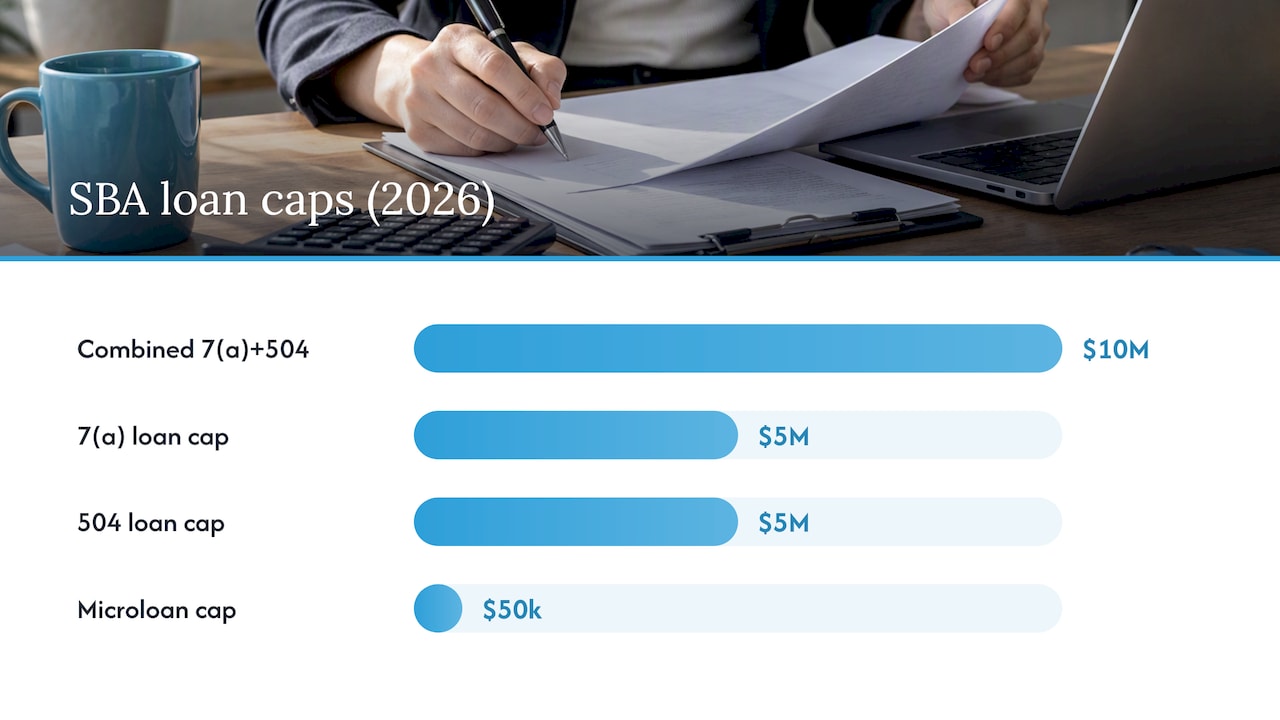
In July 2026, the SBA announced that businesses can now combine 7(a) and 504 loans for up to $10 million in total SBA-backed financing, with a maximum of $5 million available through each individual program. That change gives growing businesses more room to finance a larger expansion, such as buying a building and equipping it, without exceeding a single program’s ceiling.
- 7(a) loans max out at $5 million under standard program rules.
- 504 loans also cap at $5 million per project for most borrowers.
- Microloans are capped at $50,000 per intermediary lending rules.
- Combined 7(a) and 504 financing now reaches up to $10 million total.
Combined SBA financing capacity rose to $10 million as of July 2026, according to the SBA, giving borrowers more flexibility to structure larger projects across two programs at once.
Guaranty fees and annual servicing fees apply on top of your interest rate, and both scale with loan size, so checking current SBA fee tables before you apply helps you budget accurately. A 504 loan’s fixed rate over 20 or 25 years generally produces a lower, more predictable monthly payment than a 7(a) loan’s shorter term, even when the 7(a) rate looks comparable at first glance.
Choosing a lender or CDC to work with
The lender or CDC you choose affects your timeline as much as your terms. A lender with deep SBA experience and PLP status moves applications faster and catches documentation gaps before they cause delays. For 504 loans specifically, the CDC handles the debenture portion of financing and works alongside your private lender, so a CDC with strong local knowledge and closing experience simplifies a process that otherwise involves two separate parties.
Before committing, ask a few direct questions:
- How long does your typical 504 closing take from application to funding?
- What fees, beyond SBA-mandated ones, should I expect?
- Do you have delegated authority, and what does that mean for my timeline?
- Can you provide references from businesses you’ve closed loans for recently?
They have invested significant capital in regional businesses over many years, offering SBA 504 financing alongside programs like Down Payment Assistance and benefits for veteran-owned businesses.
What borrowers underestimate about the SBA process
The biggest bottleneck in most SBA applications isn’t the interest rate or even eligibility. It’s the sheer volume of documentation and how early ownership and citizenship details need to be nailed down. Borrowers who assemble their financial package before they ever contact a lender consistently move through underwriting faster, and working with a CDC that closes 504 loans regularly removes a lot of the guesswork about what happens next.
— PHENYX
Get started with CDC New England’s SBA 504 financing
If a 504 loan fits your plans for real estate or equipment, CDC New England structures that financing with only a 10% down payment and fixed rates locked in for up to 25 years, an approach built to preserve working capital rather than tie it up in a large deposit. Current rates include 6.58% on Equipment 10-Year Fixed, 6.73% on Real Estate 20-Year Fixed, and 6.77% on Real Estate 25-Year Fixed terms.
- Businesses buying or refinancing commercial property or major equipment.
- Veteran-owned businesses eligible for the VetLoan Advantage Program.
- Borrowers who need help covering the down payment through the Down Payment Assistance Program.
Before reaching out, have your recent tax returns, a current financial statement, and a short business plan ready. Visit the CDC New England 504 loan programs page to review current terms and request a consult.
Sources
- SBA bans foreign nationals from accessing SBA-backed loans | U.S. Small Business Administration
- Loans | U.S. Small Business Administration
FAQ
Is it hard to get a small business loan from the SBA?
SBA loans require more documentation than a typical bank loan, including tax returns, financial statements, and a business plan, which makes the process feel demanding rather than simply difficult. Working with an experienced lender or CDC and organizing your paperwork early makes approval considerably more manageable.
What is the monthly payment on a $50,000 business loan?
The monthly payment depends on the interest rate, term length, and program you choose, since a 504 loan’s fixed long-term rate produces a different payment than a shorter 7(a) term. Check current rate tables, such as CDC New England’s Equipment 10-Year Fixed rate of 6.58%, and use an amortization calculator with your specific loan amount and term.
What disqualifies you from an SBA loan?
Businesses owned in whole or in part by foreign nationals are ineligible under SBA rules updated in March 2026, which require borrowers to be U.S. citizens or U.S. nationals with a principal U.S. residence. Other common disqualifiers include operating a non-profit, exceeding SBA size standards, or failing to meet a lender’s credit and cash flow requirements.
What is the 20% rule for SBA?
The 20% rule refers to beneficial ownership reporting: anyone who owns 20% or more of the business applying for an SBA loan must be disclosed, and SBA procedural guidance requires this disclosure to cover at least 51% of total ownership. This reporting confirms who controls the business and verifies that every owner meets citizenship and eligibility rules.


