

An SBA 504 loan splits a project into three pieces: a third-party lender covers 50%, a Certified Development Company (CDC) covers 40% through an SBA-guaranteed debenture, and you contribute 10%, though start-ups and special-use properties often require 15% to 20%. The CDC debenture caps at $5.0 million for standard projects and $5.5 million for qualifying green or manufacturer projects, while the bank’s portion has no SBA-imposed ceiling. In practice, this means your bank usually funds both pieces temporarily until the debenture sells, and every dollar must go toward long-term fixed assets, never working capital.
TL;DR:
- The SBA 504 loan splits project costs with the bank covering 50% and taking the first lien, while the CDC provides 40% through a debenture in second lien position, capped at $5.0 million.
- The remaining 10% contribution can be cash, land, or other assets, with higher requirements of 15% to 20% for special-use properties like hotels or gas stations.
- Debenture interest rates are set when the SBA sells the pooled debentures on the secondary market, not at loan application time, affecting final borrowing costs.
- 504 loans fund long-term fixed assets such as land, buildings, and machinery, but cannot be used for working capital, inventory, or intangible expenses.
- Combining 504 with other SBA or bank financing, such as an SBA 7(a) loan, is common for covering costs outside the 504 scope and expanding total project funding.
Table of Contents
- How the three-party funding split and lien positions work
- SBA debenture caps and how 504 pairs with other financing
- What 504 funds can and cannot pay for
- When your contribution is 10% versus 15% or 20%
- Timing, interim funding, and the debenture sale process
- How the CDC debenture rate gets set
- Refinancing rules and limits under the 504 program
- How CDCs turn the 504 structure into a working loan
- How CDC New England can help you structure your 504 loan
- Sources
- FAQ
How the three-party funding split and lien positions work
The structure works because three parties each take on a defined role and a defined risk position. Your bank or credit union funds half the project and takes the first lien, giving it priority claim on the collateral if things go wrong. Because that position is well protected, banks can offer competitive terms and some flexibility in structuring the first mortgage, whether that means a shorter amortization or a blended rate.
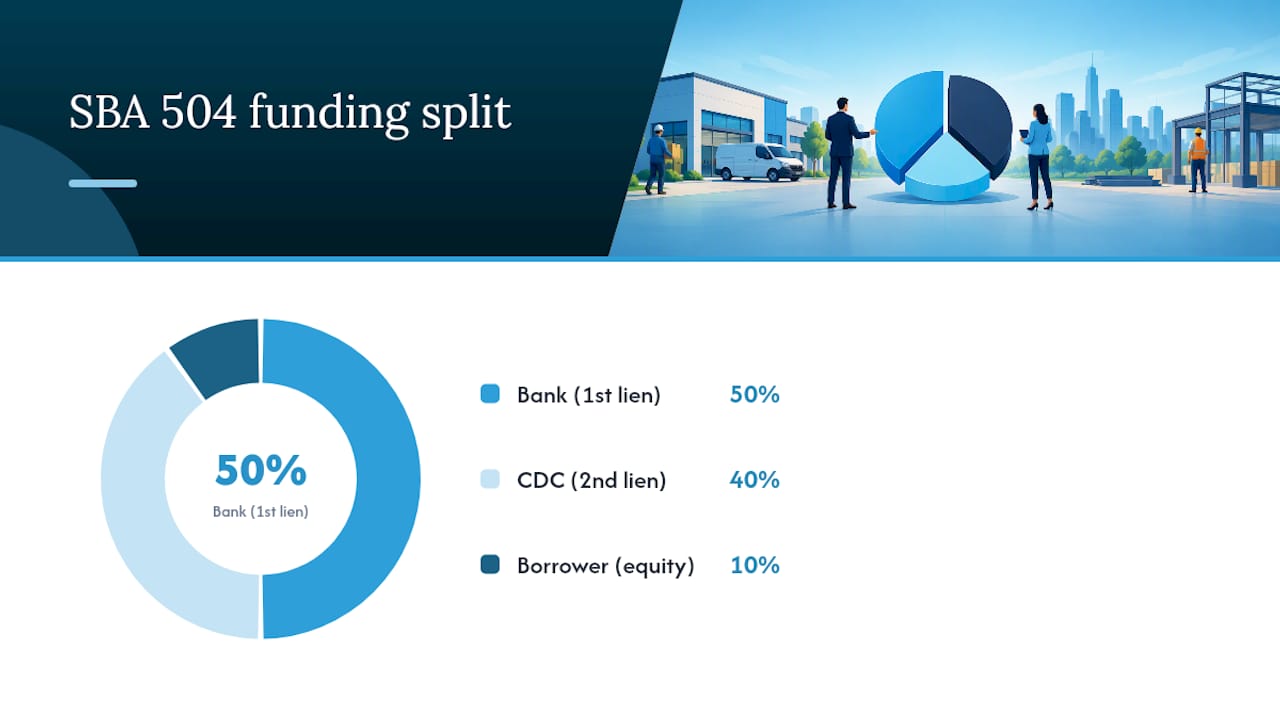
The CDC provides 40% of the cost through a debenture that carries a full SBA guarantee, and it sits in second lien position. The debenture is pooled with others nationally and sold to investors, which is how the CDC’s portion gets funded, and it’s this pooling that lets the CDC offer a fixed rate for the life of the loan.
You supply the remaining 10%, typically as cash, though land or other eligible assets you already own can sometimes count.
On a $1,000,000 project, the math looks like this:
- Third-party lender: $500,000, first lien, priority in a default.
- CDC debenture: $400,000, second lien, SBA-guaranteed.
- Borrower contribution: $100,000, your equity stake in the deal.
If the business defaults, the bank recovers first from the sale of collateral. The CDC, and by extension the SBA guarantee behind it, absorbs risk only after the first lien is satisfied, which is part of why the government backing supports this second lien position for CDC loans.
SBA debenture caps and how 504 pairs with other financing
The CDC debenture caps at $5.0 million for most projects and $5.5 million for qualifying green energy or manufacturing projects, a limit that shapes how large a 504-backed deal can get. That cap applies only to the CDC’s 40% share.
This structure gives you more room than the debenture cap alone suggests. A project with a $5 million CDC debenture could still carry a much larger bank loan on top of it, depending on what your lender is willing to underwrite. Some borrowers also combine 504 financing with an SBA 7(a) loan for a separate purpose, such as working capital, since 7(a) proceeds can cover costs that 504 funds cannot touch. Used together, the two programs let a growing business finance real estate and operating needs without exhausting a single credit line.
What 504 funds can and cannot pay for
SBA 504 loans exist to finance long-term, fixed assets, not day-to-day operations. Under 13 CFR Part 120, eligible costs include:
- Land and existing building acquisition for owner-occupied use.
- New construction, renovation, or expansion of a commercial facility.
- Long-term machinery and equipment with a useful life of at least ten years.
- Soft costs tied directly to the project, including architect fees, engineering, and closing costs.
Ineligible uses include working capital, inventory, most intangible assets, and owner draws. None of those can be financed through the 504 structure, regardless of how the rest of the project is put together.
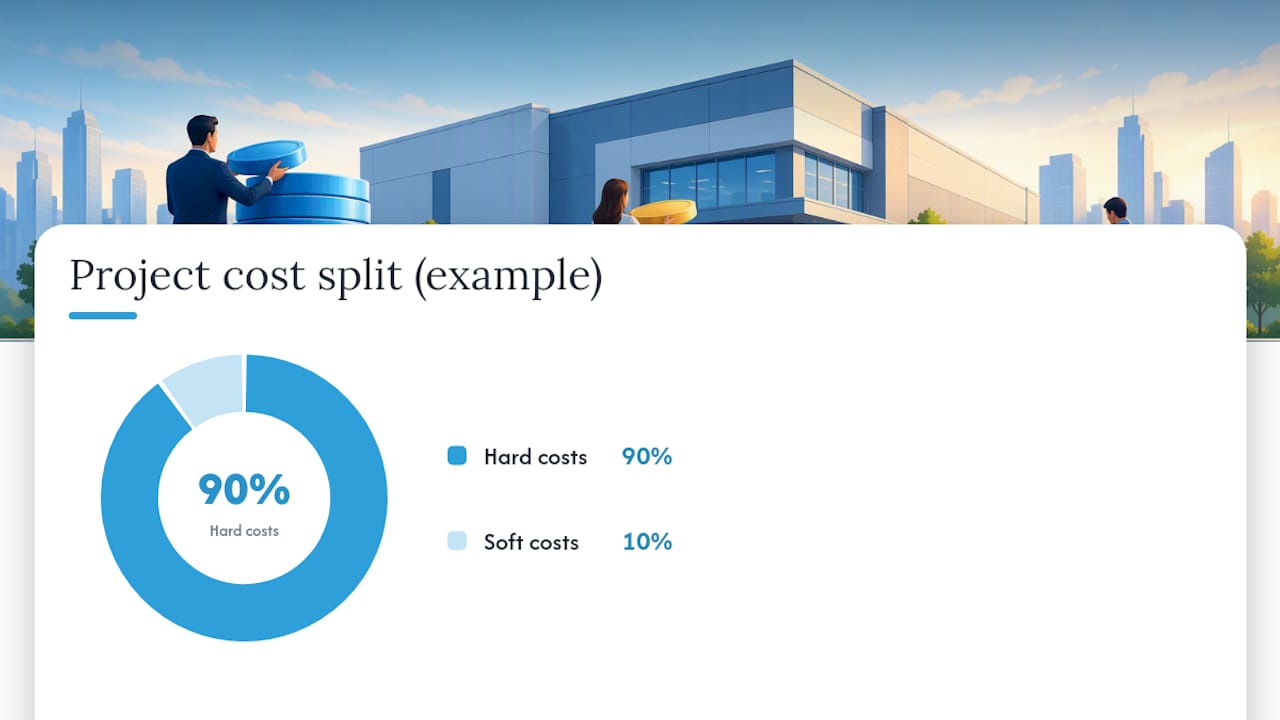
Soft costs deserve attention because they’re easy to underestimate. A project that looks like $900,000 in hard costs can quietly become $1,000,000 once soft costs are added, and your equity injection scales with that larger number.
When your contribution is 10% versus 15% or 20%
If the property is a limited or special-use facility, a gas station or a hotel, for example, the requirement rises to 15%.
Your contribution can be cash, land, or other fixed assets, though non-cash contributions need an independent appraisal to establish value. If you borrow your injection rather than fund it directly, that loan typically must be on standby, subordinated to both the bank and the CDC, and carry a reasonable rate. Lenders will want appraisals, proof of funds, and documentation of any subordinated loan terms before closing.
Timing, interim funding, and the debenture sale process
Once the debenture sale closes, the CDC’s portion is repaid to the bank, and the bank’s exposure drops back to its permanent 50% share.
The SBA publishes a debenture funding schedule that sets the cadence for these sales, typically monthly pools for 10-year debentures and separate pools for 20-year terms. Your final closing date often depends on which pool your loan lands in, which is why timing conversations with your lender and CDC early in the process matter. Construction projects add another layer, since interim funding may need to cover the bank’s exposure for months while the building is completed and only then move to permanent, pooled financing. Ask your lender directly how long they expect to carry that bridge before you sign anything.
How the CDC debenture rate gets set
The CDC’s fixed rate isn’t set when you apply. It’s set when your debenture is pooled and sold on the secondary market, which happens on the schedule described above. That means you know you’ll get a long-term fixed rate for the CDC portion, but the exact number depends on market conditions at the time of sale, not at the time you signed your loan documents.
Your bank’s first-lien portion works differently. Banks can offer fixed or variable rates on their share, and how they structure that interim financing affects your total cost while you wait for the debenture to close.
Pro Tip: Check a historical rate tool before you apply so you can model a range of outcomes rather than being surprised by where debenture rates land at sale.
Refinancing rules and limits under the 504 program
Refinancing existing debt through 504 is allowed, but only under specific conditions. Under 13 CFR §120.882, the debt must be qualified, tied to eligible fixed assets, and the project must meet a “substantially all” test showing most of the original debt financed eligible costs.
Refinancing tends to make sense when a business is carrying a maturing balloon payment or a high-rate loan on real estate it already occupies. A common pitfall is assuming any existing loan qualifies. Loans that financed working capital or inventory typically won’t.
How CDCs turn the 504 structure into a working loan
It packages your application, coordinates SBA processing, services the loan over its life, and manages the debenture sale that ultimately funds its portion. That coordination is what keeps a three-party structure from becoming three separate, disconnected processes.
CDC New England has operated in this space for over 70 years and has invested more than $2.3 billion in regional businesses, offering 10% down payment options, fixed rates for up to 25 years, and dedicated programs for veterans and down payment assistance. Working with an experienced CDC generally means fewer surprises and a faster path through underwriting than trying to coordinate a bank, the SBA, and a debenture sale on your own.
— PHENYX
How CDC New England can help you structure your 504 loan
Understanding the 50/40/10 split is one thing. Executing it in Massachusetts, Rhode Island, Vermont, New Hampshire, or Connecticut is another, and that’s where a regional CDC’s experience pays off. CDC New England offers the full range of products that fit the structure described above:
- SBA 504 Refinance Program for businesses looking to restructure existing debt.
- VetLoan Advantage Program for veteran and spouse-owned businesses, with a 1.0% processing fee.
If you’re still scoping a project, start with the SBA 504 loan calculator to model your own split and estimated payments. From there, pull together your project cost estimates, land, construction, equipment, and soft costs, and reach out to CDC New England for a pre-qualification conversation. The team also offers a down payment assistance program for borrowers who need help covering the 10% injection, and full details on current loan products are available on the SBA 504 loans page.
Sources
- 504 loans | U.S. Small Business Administration
- eCFR :: 13 CFR Part 120 Subpart H - Loan-Making Policies Specific to 504 Loans
FAQ
What are SBA 504 rates right now?
CDC debenture rates are set at the time the debenture sells on the secondary market, not when you apply, so the exact rate depends on market conditions at sale. CDC New England publishes current product rates, including Real Estate 25-Year Fixed at 6.77%, on its rate pages.
What is the 20% rule for SBA?
Standard projects require 10% borrower equity, while limited-use properties require 15%.
Are SBA 504 loans hard to get?
They involve more documentation than a conventional loan because three parties, a bank, a CDC, and the SBA, must all approve the deal, but working with an experienced CDC generally simplifies the process. Eligibility hinges on meeting owner-occupancy rules, job creation or public policy goals, and the borrower contribution thresholds set by SBA regulation.
Can SBA 504 loans be refinanced?
Yes, under 13 CFR §120.882, existing qualified debt tied to eligible fixed assets can be refinanced through the 504 program, provided it meets the “substantially all” test. CDC New England’s refinance program is built specifically for businesses restructuring this kind of debt.


