For most Massachusetts small business owners buying a building they will occupy, the SBA 504 loan is the strongest option: as little as 10% down, a fixed rate for up to 25 years, and no balloon payment to refinance. Conventional bank loans, SBA 7(a) loans and non-bank lenders each fit certain situations, though. Below we compare them on the things that decide whether a purchase works: down payment, rate structure, term, speed and eligibility.
TL;DR
- SBA 504 is built for owner-occupied buildings and major equipment. We publish fixed rates of 6.73% (20-year real estate) and 6.77% (25-year real estate), with 10% down.
- Conventional bank loans can close quickly for strong borrowers, but they often ask for 20% to 30% down and shorter terms.
- SBA 7(a) is more flexible on use of proceeds, and since July 2026 it can be combined with a 504 loan for up to $10 million in total SBA-backed financing.
- Non-bank and online lenders are a fallback when speed matters more than cost, and they usually price accordingly.
Table of Contents
- What “best” means for a Massachusetts building purchase
- The four main options, side by side
- SBA 504 loans: the owner-occupier’s default
- SBA 7(a): flexible, and now combinable with 504
- Conventional bank and credit union loans
- Non-bank and online lenders
- Do you have to put 20% down on a commercial loan?
- Our perspective: why we steer most owner-occupiers to the 504
- Fees and programs worth asking about
- How to finance a commercial building in Massachusetts: five steps
- Ready to see what 10% down looks like?
- FAQ
- Sources
What “best” means for a Massachusetts building purchase
The best loan is not the one with the lowest advertised rate. It is the one that leaves you with enough cash to run the business after closing. Massachusetts property is expensive, so the down payment is usually the biggest hurdle, followed by the term. A shorter term means a higher monthly payment on the same balance, and that payment comes out of the same cash flow that pays your staff.
When you compare offers, line them up on these criteria:
- Down payment: how much cash leaves your account at closing.
- Rate structure: fixed for the whole term, fixed for a few years and then adjustable, or variable from day one.
- Term and amortization: how long the payments are spread out, and whether a balloon payment comes due earlier.
- Allowed uses: purchase, construction, renovation, equipment, refinancing.
- Occupancy rules: whether you must use the building yourself.
- Fees and prepayment terms: what you pay to close, and what leaving early costs.
- Timeline: how long until funding, and how certain the approval is.
The four main options, side by side
| Option | Typical down payment | Rate type | Best for |
|---|---|---|---|
| SBA 504 | 10% (our program) | Fixed, up to 25 years on real estate | Owner-occupied buildings, heavy equipment |
| SBA 7(a) | Varies by lender | Often variable | Mixed uses: building plus working capital, business acquisition |
| Conventional bank or credit union loan | Often 20% to 30% | Fixed for a period, then adjustable, or variable | Borrowers with significant cash and an existing banking relationship |
| Non-bank or online lender | Varies widely | Usually higher cost | Speed, or properties and borrowers that banks decline |
The down payment range for conventional loans comes from our comparison of 504 and conventional financing and from what we see in the market. Individual lenders set their own limits. For example, some Massachusetts credit unions publish loan-to-value caps around 80% on commercial real estate loans, which implies about 20% down.
SBA 504 loans: the owner-occupier’s default
The SBA describes the 504 program as long-term, fixed-rate financing of up to $5 million for major fixed assets that promote growth and job creation. A Certified Development Company, such as us, works alongside a participating lender to deliver it. The lender funds the first mortgage, and the CDC funds a second piece, backed by an SBA-guaranteed debenture. That second piece is what carries the fixed rate for the long term and what shrinks your down payment.

What it costs
As published on our site as of September 16, 2026:
- Equipment, 10-year fixed: 6.58%
- Real estate, 20-year fixed: 6.73%
- Real estate, 25-year fixed: 6.77%
Those are the rates on our programs and they move with the market, so confirm them when you apply. For a closer look at how the three terms differ, see our guide to 10, 20 and 25 year 504 terms.
Who qualifies
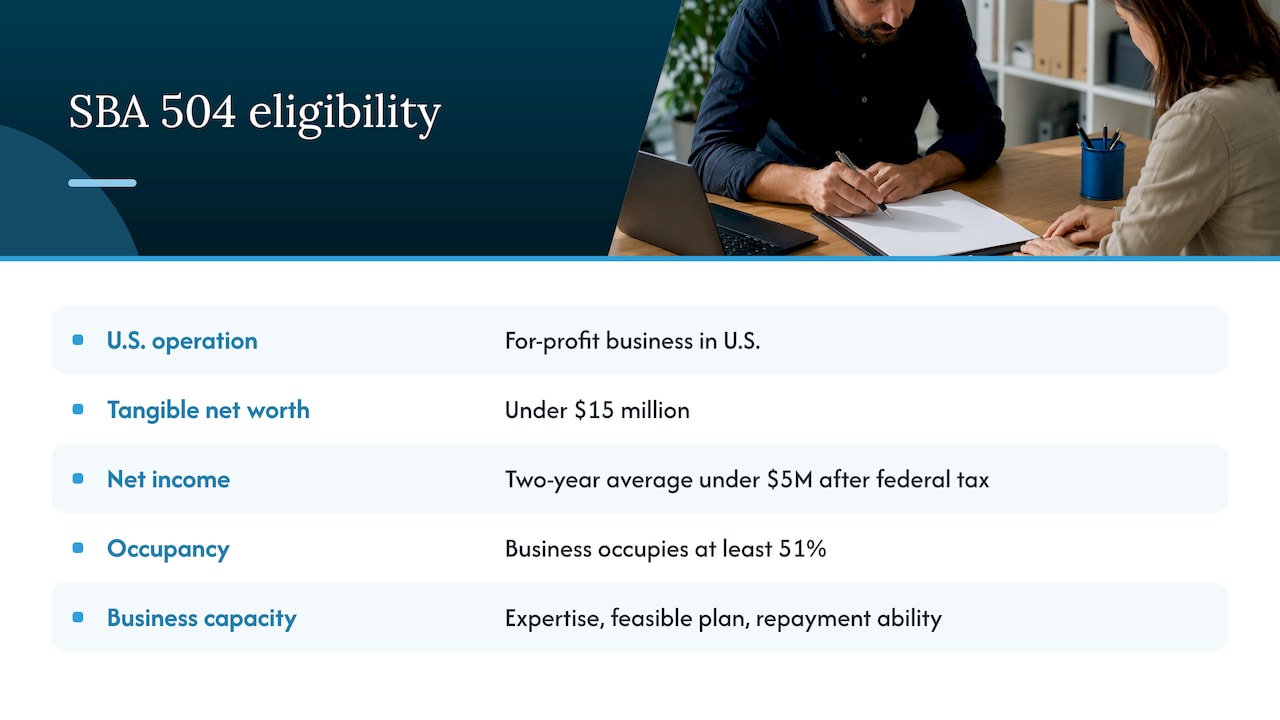
Per the SBA, a 504 borrower must operate for profit in the U.S., have a tangible net worth under $15 million, and show average net income under $5 million after federal taxes for the two years before applying. You also need management expertise, a feasible business plan and the ability to repay the loan (SBA 504 requirements).
The other rule that surprises buyers is occupancy. 504 loans are for owner-occupied property, and the business must occupy a majority of it. Our eligibility guide explains the 51% occupancy test. If you plan to lease out the remaining space, it helps to think through the landlord side early. This list of questions landlords should answer is a useful starting checklist, though the occupancy rule still governs how much you can rent out.
Where 504 is the weaker fit
The 504 is not meant for working capital, for buying a building purely as an investment, or for a business that will occupy only a small share of the property. If you need cash for inventory or payroll alongside the purchase, you may pair it with a different product, which is where the 7(a) comes in.
SBA 7(a): flexible, and now combinable with 504
The 7(a) is the SBA’s general-purpose program. It can fund real estate, but also working capital, a business acquisition or debt refinancing. Rates are often variable, and the lender sets the down payment, so it can be higher than the 504’s.
A 2026 rule change matters if your project is large. As of July 2026, borrowers may combine 7(a) and 504 loans for up to $10 million in SBA-backed financing, where the two programs previously shared a single cap. In practice, a company could use the 504 for the building and a 7(a) for working capital or renovation costs, without one loan eating into the other’s limit. Our overview of up to $10M SBA loans and the 2026 rules walks through how that plays out.
Conventional bank and credit union loans
A conventional commercial real estate loan from a community bank, a regional bank or a credit union is the right answer for some buyers. If you have 25% to 30% in cash, strong global cash flow and a long banking relationship, a local lender can move quickly and may offer relationship pricing.
The trade-offs are structural:
- Higher down payment. Tying up 20% to 30% of a Massachusetts purchase price in the building leaves less for hiring, inventory and the unexpected.
- Shorter fixed periods. Many conventional loans fix the rate for five or seven years, then reset, or come due with a balloon payment. That puts refinancing risk in your future.
- Amortization. Many are amortized over 20 to 25 years, but the loan term itself can be much shorter.
Our comparison, SBA 504 vs. conventional financing, breaks this down with sample numbers. A useful exercise is to ask any lender for the same three figures: cash needed at closing, rate for the first five years, and what happens at maturity.
Non-bank and online lenders
Private and online lenders can fund fast, sometimes in a few weeks, and they will look at deals a bank passes on: unusual property types, thin credit history, or a tight timeline. That convenience tends to show up in the rate, shorter terms and fees. For a long-held, owner-occupied building, that cost compounds over many years. These lenders are best used as a bridge, with a plan to refinance into long-term fixed financing later.
Do you have to put 20% down on a commercial loan?
No. Twenty percent is common with conventional lenders, not a legal requirement. The 504 structure is designed around a smaller equity contribution: 10% in our program. Some situations can lift it, such as special-purpose properties or startups, so ask early. And if even 10% is a stretch, our Down Payment Assistance Program exists to help bridge that gap. For a deeper look at how lenders measure leverage, see our explainer on commercial loan-to-value.
Our perspective: why we steer most owner-occupiers to the 504
We have spent more than 70 years financing New England businesses and have invested over $2.3 billion in the region, so we see the same pattern repeatedly. A business owner finds a building, a conventional lender asks for a quarter of the price in cash, and the deal either dies or drains the working capital the company needs to grow into the space. The 504 changes the arithmetic. With 10% down and a fixed rate for up to 25 years, your payment is known on day one and stays the same for the life of the loan. That predictability is worth as much as the rate.
We also think owners underuse the other tools around the 504. Premier Certified status means we can move faster on approvals. Our SBA 504 Refinance Program can restructure existing debt on a building you already own. The VetLoan Advantage Program offers special terms for veterans and their spouses. And with the 2026 change that lets 504 and 7(a) balances sit side by side, larger projects have more room than they did a year ago.
Our honest advice is this: if you will occupy the building and plan to hold it, start with the 504 and then test every alternative against it. If another lender beats the 504 on your numbers, take it. In our experience, it rarely does for buyers who need to preserve cash.
— PHENYX
Fees and programs worth asking about
Fees vary by program, so request a full cost sheet from every lender. A few specifics:
- On our VetLoan Advantage Program, the processing fee is 1.0%.
- For fiscal year 2026, which ends September 30, 2026, the SBA waived upfront and annual service fees on 504 manufacturing loans. That waiver covers loans in the manufacturing sectors through that date, so ask whether a similar waiver applies to your timeline.
- Manufacturers should also ask about the 90% Made in America Loan Guarantee, part of an enhanced International Trade Loan program.
- Projects that include solar or energy retrofits: the SBA removed caps on 504 loans for clean energy projects, so those costs can sit inside your property financing.
- Expect the SBA to enforce clear eligibility. Its 2025 annual report describes reinstated lender fees and more prudent underwriting, so a complete, well-documented application matters.
How to finance a commercial building in Massachusetts: five steps
- Define the use. Will your business occupy at least 51%? If so, the 504 is on the table.
- Gather documents. Two to three years of business and personal tax returns, current financial statements, a debt schedule and a business plan.
- Estimate cash to close. Down payment, closing costs, any renovation budget and a working-capital cushion.
- Compare written terms. Ask each lender for the same details: down payment, rate type, term, fees, prepayment terms and maturity.
- Talk to a CDC early. Before you sign a purchase and sale agreement, a quick conversation can tell you whether the deal fits 504 rules.
Ready to see what 10% down looks like?
If you are buying or refinancing an owner-occupied property in Massachusetts, CDC New England can walk you through the 504 numbers on your specific deal, including down payment assistance and veteran programs where they apply. We serve businesses across Massachusetts, Rhode Island, Vermont, New Hampshire and Connecticut.
FAQ
Can I get a small business loan to buy property?
Yes. SBA 504 loans, SBA 7(a) loans, conventional commercial mortgages and non-bank loans can all finance a building purchase. For an owner-occupied property, the 504 typically has the lowest down payment and the longest fixed rate.
Which loan is best for a small business buying real estate?
For a building your business will occupy, we think the 504 is best because of its 10% down payment and fixed rate of up to 25 years. If you also need working capital or are buying a business along with the property, a 7(a), or a 7(a) combined with a 504, may fit better.
Can I use a 504 loan to buy an investment property?
No. The 504 program is for owner-occupied property, and your business must occupy a majority of it. If you want to rent out the remaining space, our eligibility guide explains how the occupancy rule works.
Are rates on the 504 fixed?
Yes. Our 20-year and 25-year real estate rates are fixed for the full term, at 6.73% and 6.77% as published on September 16, 2026. Confirm current rates with us before you apply, as they change with the market.
Sources
- SBA: 504 loans
- SBA: Small businesses now eligible for $10 million in SBA financing
- SBA: Waives loan fees for small manufacturers in fiscal year 2026
- SBA: Support for veteran manufacturers
- SBA: Actions to advance the clean energy economy
- SBA 2025 Annual Report
- Commercial Building for Rent: 8 Questions for Landlords