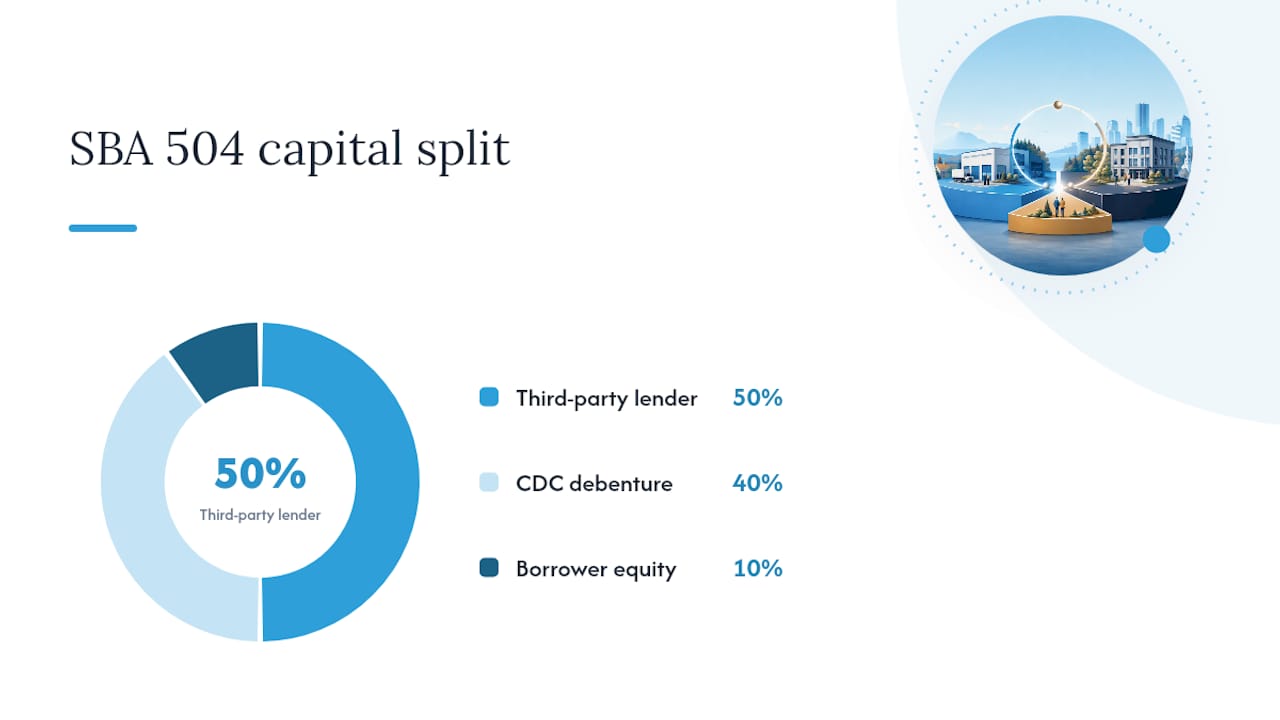
SBA 504 terms boil down to a 50/40/10 capital stack: a bank funds roughly half the project as a first-lien loan, a Certified Development Company (CDC) funds up to 40% through a fixed-rate debenture, and you put down at least 10%. The CDC portion carries a fixed rate for the life of the loan, in terms of 10, 20, or 25 years, while the bank sets its own rate and repayment schedule.
TL;DR:
- SBA 504 loans finance up to 50% of fixed assets with fixed-rate debentures, while the bank funds around 50% with a potentially variable first lien.
- The CDC portion is fixed for the loan’s entire term, typically 10, 20, or 25 years, but the bank loan may reset or float, affecting total payments.
- The maximum debenture amount is generally $5 million, with real estate loans often lasting 20 or 25 years, and equipment loans lasting 10 years.
- Prepayment premiums apply only to the CDC debenture, declining after the midpoint of the term, making early exit decisions financially significant.
- Eligibility depends on business size, occupancy, and documentation standards, with the process involving both your bank and CDC working together over several weeks.
Table of Contents
- What Is the SBA 504 Loan Structure and Who Funds Each Piece?
- What Are the Key SBA 504 Loan Terms Borrowers Should Know?
- What Are SBA 504 Eligibility Requirements?
- What Can You Use SBA 504 Loan Proceeds For?
- How Does SBA 504 Repayment and Prepayment Work?
- How Do You Apply for an SBA 504 Loan?
- How Cdcnewengland Helps Borrowers Navigate 504 Terms
- When Does an SBA 504 Loan Actually Make Sense?
- Ready to Finance Your Next Commercial Property or Equipment Purchase?
- Sources
- FAQ
What Is the SBA 504 Loan Structure and Who Funds Each Piece?
Three parties sit at the table on every 504 deal, and each one takes a different slice of risk. A conventional bank or credit union, referred to as the third-party lender, typically finances 50% of the project as a first-lien loan. A CDC, a nonprofit certified by the Small Business Administration, funds up to 40% through a debenture that carries the SBA’s guaranty. You, the borrower, cover the remaining 10% or more as equity.
That math shifts in two common situations.
Lien position matters more than most borrowers realize going in. The bank holds the first lien on the property, giving it priority if things go wrong. The CDC debenture sits in second position, which is part of why the SBA guarantee exists: it makes that riskier second-lien position attractive enough for CDCs to fund it at a fixed rate. In practical terms:
- The bank services its own loan and controls the primary lien.
- The CDC pools your debenture with others into a monthly bond sale, which sets your fixed rate.
- The SBA guarantees the CDC debenture, not the bank’s first-lien loan.
- You make two separate monthly payments, one to each lender, unless your CDC offers combined servicing.
CDCs don’t hold your loan on their own balance sheet and wait for repayment. They aggregate dozens of 504 loans nationally into a debenture pool, then sell that pool to investors once a month. The proceeds fund your portion of the project, and the rate investors demand at that sale becomes your fixed rate for the entire term. Understanding this mechanism explains why your CDC rate isn’t negotiable the way a bank rate might be. It’s set by the market on a specific sale date, not by the CDC underwriting your file.
What Are the Key SBA 504 Loan Terms Borrowers Should Know?
Loan amounts, maturities, and rate mechanics determine what a 504 deal actually costs and how long you’re committed. Here’s what the numbers mean in practice.
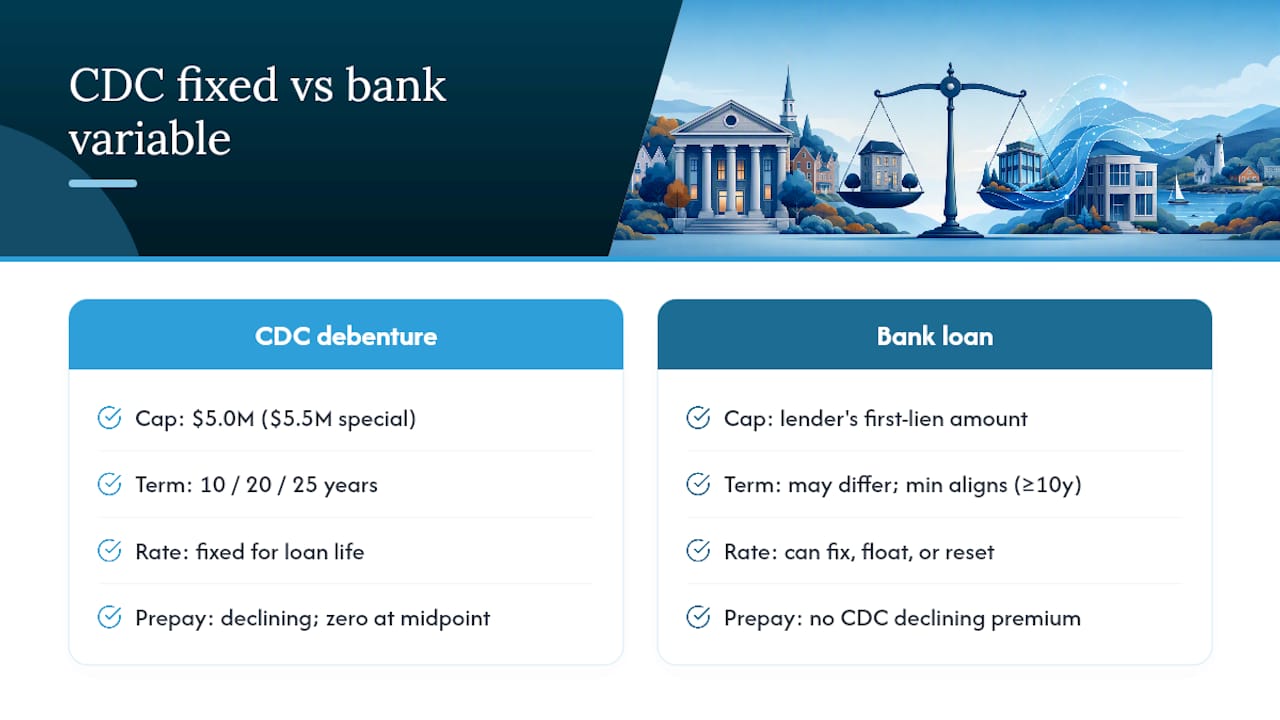
Loan caps and project size. The CDC debenture caps out at $5 million for most small businesses and $5.5 million for manufacturers and projects meeting specific energy-efficiency or public-policy goals, according to the SBA’s 504 program page.
Maturities by asset type. The CDC debenture repays over 10, 20, or 25 years, fully amortized with no balloon payment, per the 504 Loan Program Factsheet. Real estate purchases typically use the 20 or 25-year term, matching the long useful life of a building. Equipment financing usually falls under the 10-year term, reflecting shorter equipment lifespans. The bank’s first-lien loan can carry a different term and rate structure, and under 13 CFR § 120.921, it must have a minimum term that aligns with the debenture, generally at least 10 years when your CDC portion runs 20 or 25 years.
Rate mechanics. This is where borrowers most often get confused. Only the CDC debenture is fixed for the entire term. That rate gets locked in at the monthly debenture sale, priced as a spread over comparable Treasury yields. The bank portion is a separate animal entirely. It might carry a fixed rate for five years and then reset, or float with an index the whole time. Model both halves of your payment separately, because assuming your “504 rate” is fixed across the board is one of the most common planning mistakes borrowers make.
Fixed for life applies only to the CDC debenture. The bank’s first-lien loan can reset, float, or renew on its own schedule, so your total monthly payment isn’t locked the way many borrowers assume.
Fees. Expect an SBA guaranty fee, a CDC processing fee, and a servicing fee on the debenture, plus the bank’s own origination charges. Most 504 programs allow these fees to be financed into the loan itself rather than paid out of pocket at closing, which helps preserve your working capital during a purchase or buildout.
Prepayment premium. The declining prepayment premium applies only to the CDC debenture, never to the bank’s first-lien portion. It starts highest in year one and steps down annually, hitting zero once you pass the midpoint of your term (year 5 of a 10-year loan, year 10 of a 20-year loan, and so on). If you’re planning to sell the property or refinance before that midpoint, factor the premium into your exit math now, not later.
What Are SBA 504 Eligibility Requirements?
Qualifying for a 504 loan involves size tests, occupancy rules, and documentation that CDCs verify before your debenture ever reaches the market. Here’s the sequence borrowers typically move through.
- Confirm your business meets SBA size standards. Most 504 borrowers qualify under the SBA’s alternative size standard, meaning tangible net worth under $20 million and average net income after taxes under $6.5 million over the two years prior, though industry-specific size standards can apply instead.
- Verify occupancy requirements. For existing buildings, you must occupy at least 51% of the space yourself. For new construction, that threshold rises to 60%, with a defined ramp-up period to lease out or occupy the remainder over time, a distinction confirmed in current SBA borrower checklists.
- Confirm ownership and citizenship status. Every owner with 20% or more equity must sign a personal guarantee, and the SBA requires documentation of citizenship or lawful permanent resident status for principal owners.
- Prepare your ownership and financial forms. You’ll complete SBA Form 1244 and Form 413 (Personal Financial Statement), covering ownership structure, business history, and personal financial disclosures for every guarantor.
- Gather supporting documentation. CDCs will request three years of business and personal tax returns, current financial statements, a business debt schedule, a property appraisal, and an environmental Phase I report on the real estate.
The SBA’s SOP 50 10 7.1 notice updated several of these documentation and citizenship requirements, so if you’re working from an older guide or a lender’s outdated checklist, confirm the current version with your CDC before assuming your paperwork is complete.
What Can You Use SBA 504 Loan Proceeds For?
The 504 program funds fixed assets your business will occupy and use, not cash reserves or inventory. Eligible uses include:
- Purchasing land and existing buildings for owner-occupied use
- Constructing new facilities or renovating existing ones
- Buying long-life machinery and equipment (generally a useful life of 10 years or more)
- Covering related soft costs like architectural fees, appraisals, and closing costs
- Refinancing certain existing qualified debt tied to fixed assets, within limits set by 13 CFR § 120.882
The program draws a hard line against a few common requests. Working capital, inventory financing, and speculative or purely rental real estate investments don’t qualify, no matter how strong the borrower’s credit looks. If you’re buying a building to occupy and run your business, you’re eligible. If you’re buying it to lease out to unrelated tenants, you’re not. A full breakdown of eligible assets can help you map your specific project against these categories before you apply.
One notable flexibility: certain public-policy goals, like job creation in a designated area, energy efficiency upgrades, or minority and veteran business ownership, can relax some standard requirements, including the debenture cap and, in some cases, job-creation ratios.
How Does SBA 504 Repayment and Prepayment Work?
Both loan pieces amortize monthly, but you’re managing two separate payment streams with two separate lenders. Your bank services its first-lien loan directly. Your CDC, or a third-party servicer working on its behalf, collects the debenture payment. Some CDCs offer combined billing to simplify this, but that’s a service-level choice, not a program requirement, so ask your CDC directly.
The prepayment premium only touches the CDC debenture, and it declines on a defined schedule that zeroes out at the halfway point of your term. On a 20-year debenture, that means the premium disappears entirely by year 10. Exit or refinance before that point, and you’ll pay a premium calculated as a percentage of the outstanding balance, stepping down each year you hold the loan.
Pro Tip: If you’re weighing an early sale or refinance, run the numbers both ways: paying the declining premium now versus waiting until you cross the midpoint. On a large debenture balance, waiting even a year or two can save tens of thousands of dollars.
Refinancing scenarios split into two categories, with some borrowers considering specialized options like Bank Statement Loans in Austin–Round Rock to address refinancing mechanics in their region. You can refinance just the bank’s first-lien portion independently, which is common when interest rates shift and your bank loan resets to a less favorable rate. Or you can pursue a full 504 refinance of existing qualified debt, which is governed by the “qualified debt” definitions in 13 CFR § 120.882. That regulation restricts eligible refinance to debt originally used for 504-eligible purposes, so you can’t roll working capital debt into a 504 refinance just because it’s convenient.
- Bank-only refinance: addresses the variable first-lien piece, leaves the CDC debenture untouched.
- Full 504 refinance: replaces existing qualified debt tied to fixed assets, subject to CFR eligibility limits.
- Cash-out refinance: available in limited circumstances tied to business expenses, capped as a percentage of property value.
How Do You Apply for an SBA 504 Loan?
Applying for a 504 loan runs through both your bank and a CDC simultaneously, not sequentially, which surprises borrowers expecting a single-lender process.
- Contact your bank first. Most 504 deals start with a conversation with a commercial lender about the project and a preliminary sense of whether it will support 50% financing.
- Get prequalified. Your bank and CDC will review basic financials to confirm the project fits SBA size standards and asset eligibility before you invest time in full documentation.
- Approach a CDC. In New England, that’s typically a regional CDC serving your state; the CDC coordinates the SBA guaranty piece alongside your bank’s first lien.
- Submit SBA Form 1244 and supporting documents, including tax returns, financial statements, ownership disclosures, and a property appraisal (appraisal requirements vary by asset type and deserve a close read).
- Move through underwriting. Both the bank and CDC review the file independently; the CDC also submits to the SBA for final approval.
- CDC debenture funding. Once approved, your CDC’s debenture joins the next monthly pool sale, which sets your fixed rate.
- Close on both loans. Bank and CDC funding typically close together, releasing full project financing.
Timelines vary, but a straightforward deal typically takes several weeks to a few months from application to closing. Common causes of delay include appraisal and environmental report timing, plus completeness of ownership documentation
How Cdcnewengland Helps Borrowers Navigate 504 Terms
Understanding 504 mechanics on paper is one thing. Executing a deal in New England’s commercial real estate and lending market is another. This company has extensive experience structuring 504 financing for businesses in the region.
- Down payment as low as 10%, with a dedicated down payment assistance program for borrowers who need it
- Fixed CDC debenture rates for longer terms
- Specialized support and benefits for veteran-owned businesses may be available
- Underwriting with knowledge of local property values, zoning, and appraisal norms
- Guidance through the necessary documentation checklist and appraisal coordination
When Does an SBA 504 Loan Actually Make Sense?
A 504 loan fits best when you’re buying real estate you’ll occupy or equipment with a long useful life, situations where a fixed rate for 20 or 25 years genuinely reduces your risk over decades of ownership. It’s the wrong tool if you need working capital, inventory financing, or short-term flexibility. If your real need is operating cash rather than a fixed asset, an SBA 7(a) loan or a line of credit will likely serve you better than forcing a 504 structure that wasn’t built for that purpose.
— PHENYX
Ready to Finance Your Next Commercial Property or Equipment Purchase?
Cdcnewengland puts real numbers behind these terms instead of leaving you to guess.
Start by exploring SBA 504 loan options for New England businesses, or run your own numbers with the 504 loan calculator to see how term length and down payment size affect your monthly payment. If you’re a veteran business owner, ask about VetLoan Advantage benefits when you reach out. A quick conversation with our team can tell you within days whether your project fits the 504 structure.
Sources
FAQ
What Are SBA 504 Rates Right Now?
The CDC debenture portion carries a fixed rate set at the monthly debenture sale, priced as a spread over comparable Treasury yields, while the bank’s first-lien portion is set independently and can be fixed or variable. Check with your CDC or bank for the current sale-date pricing, since it changes monthly.
What Are the Loan Terms for SBA 504 Loans?
The CDC debenture repays over 10, 20, or 25 years depending on asset type, fully amortized with no balloon payment, while the bank’s first-lien loan term is negotiated separately but must meet a minimum duration tied to your debenture term under SBA regulations.
What Are the Disadvantages of an SBA 504 Loan?
The 504 structure involves two separate lenders and two closings, occupancy requirements that restrict how you use the property, and a prepayment premium on the CDC debenture if you exit or refinance before the term’s midpoint. It also excludes working capital, inventory, and pure investment property, so it won’t fit every financing need.
Is It Hard to Get an SBA 504 Loan?
Approval depends heavily on meeting SBA size standards, occupancy rules, and providing complete documentation, including tax returns, financial statements, and a property appraisal. Deals with clean ownership disclosures and a cooperative bank partner tend to move through underwriting in roughly 60 days, while missing or delayed documents are the most common cause of a stalled application.
Recommended
- What Can You Finance with an SBA 504 Loan? A Complete Guide for New England Businesses
- SBA 504 Loan Appraisal Requirements: What New England Business Owners Need to Know
- SBA 504 Loan Program Explained: How Small Businesses Can Buy Commercial Real Estate With Just 10% Down
- SBA 504 vs. 7A Loans: Which is Right for Your Commercial Real Estate Purchase?