

Choose traditional equipment financing when the asset wears out sooner, the purchase is smaller, or you need funding in days rather than months. The right answer depends on the asset’s life span, not the sticker price.
TL;DR:
- Equipment financing closes faster, often within days, and is best suited for assets with a useful life of less than 10 years, especially for urgent or smaller purchases.
- SBA 504 loans require a minimum 10-year remaining useful life, involve longer approval times of 45 to 90 days, and are ideal for large, long-lasting assets like industrial machines or real estate.
- Fixed rates on SBA 504 debentures offer long-term rate stability, making them a cost-efficient choice for assets expected to last decades, whereas equipment loans often have variable or shorter terms.
- Equipment financing generally demands less documentation and has more flexible qualification standards, enabling quicker funding but typically with higher rates over shorter loan terms.
- Borrowers should start the application process early by confirming asset useful life and working with an experienced CDC to avoid delays and ensure a matching loan type to their project needs.
Table of Contents
- At-a-glance comparison: quick checklist for fast decisions
- How SBA 504 financing works (mechanics that matter)
- How traditional equipment financing works (speed and flexibility)
- Costs, terms, and repayment tradeoffs
- Eligibility, timeline, and application complexity
- Decision rules and scenarios: matching your purchase to the right loan
- Why CDC New England is positioned to help with SBA 504 loans
- A loan officer’s view: common borrower mistakes and how to avoid them
- How to start a 504 application with CDC New England
- FAQ
- Sources
At-a-glance comparison: quick checklist for fast decisions
Before you dig into the mechanics, run your purchase through this quick filter. The categories that matter most are speed, eligibility, cash required upfront, and how the rate behaves over time.
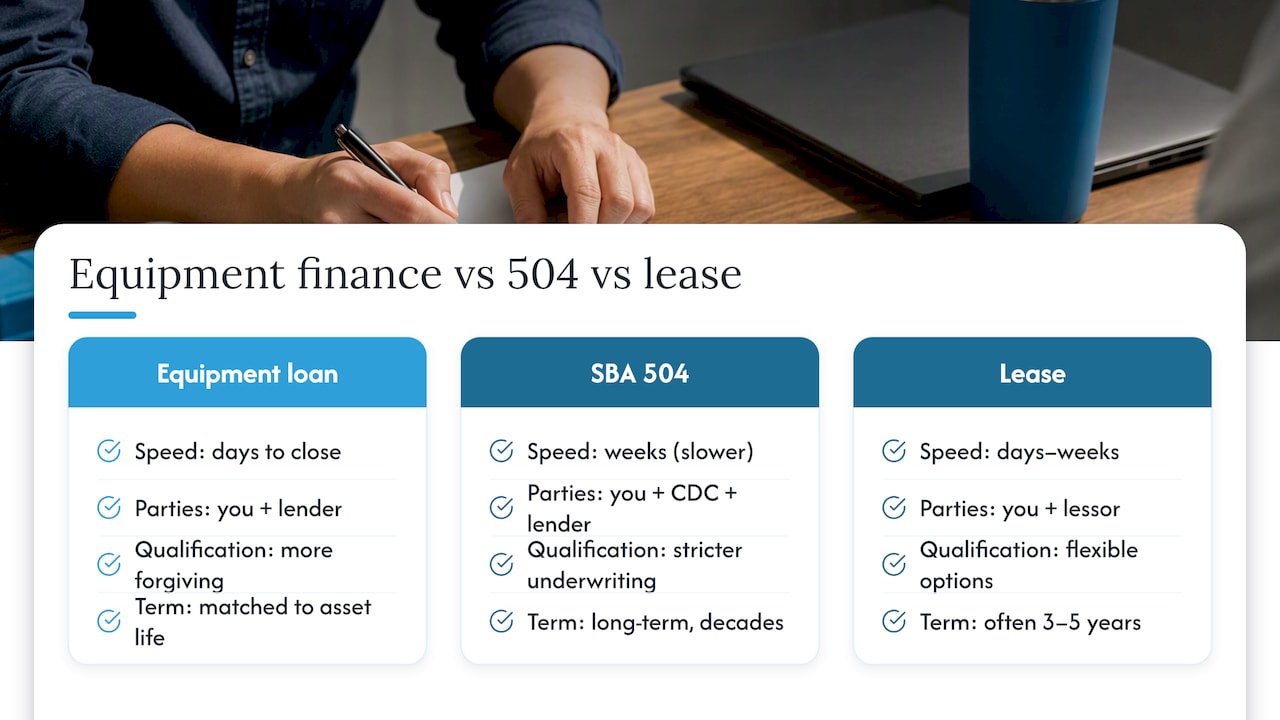
- Funding speed: Equipment financing can close in days; SBA 504 loans typically take 45 to 90 days because of the three-party structure.
- Useful life requirement: 504 financing requires the asset to have a remaining useful life of at least 10 years, per SBA eligibility rules.
- Down payment: 504 projects generally require 10% borrower equity, while some equipment lenders offer $0 down depending on credit and lender terms.
- Term and rate style: 504 debentures carry long-term fixed rates, while equipment loans often run shorter terms with a wider APR range.
- Loan size: 504 financing tops out at $5.5 million on its own, or up to $10 million when paired with a 7(a) loan.
If your purchase clears the 10-year useful-life bar and you have time to work through underwriting, 504 usually wins on cost. If it doesn’t, equipment financing is built for exactly that gap.
How SBA 504 financing works (mechanics that matter)
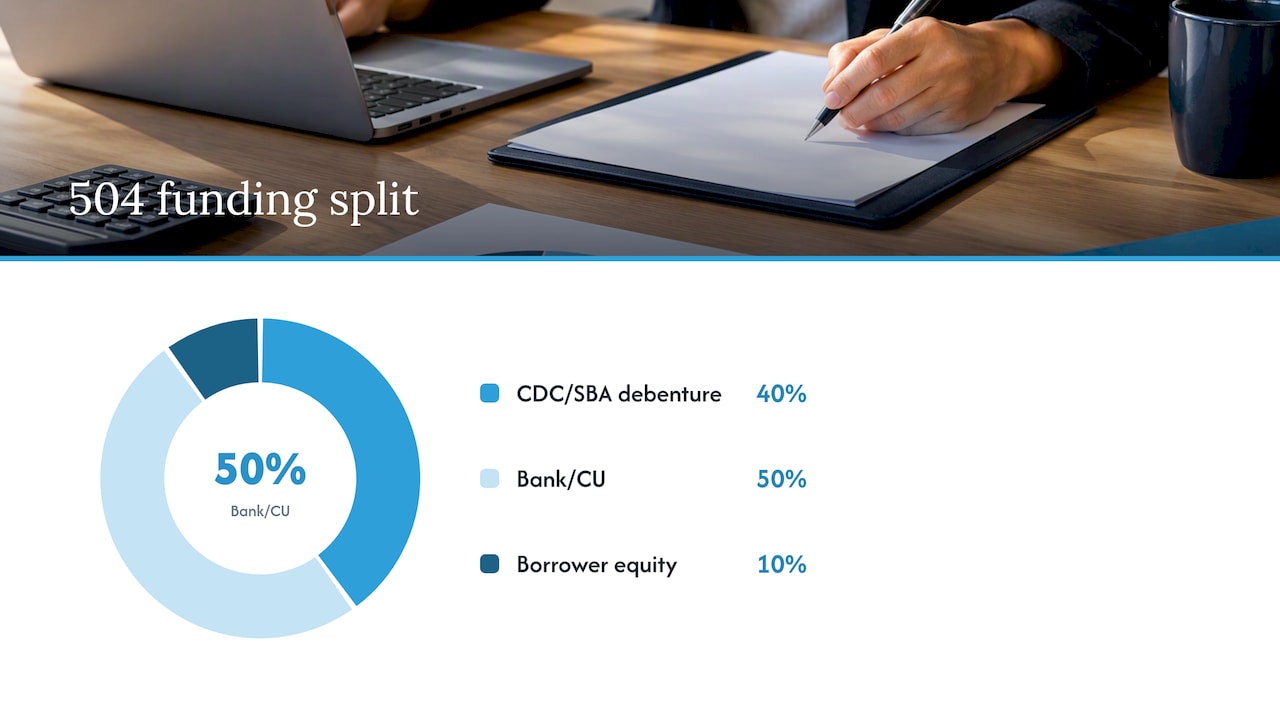
The 504 program is structured as a three-party deal, and understanding that structure explains both its strengths and its slower timeline. A Certified Development Company, like CDC New England, funds roughly 40% of the project through an SBA-backed debenture, and a participating bank or credit union covers around 50%. That split is what keeps your cash outlay low compared to a conventional commercial loan.
Not every asset qualifies. The eCFR regulations governing 504 loans require that financed fixed assets carry a remaining useful life of at least 10 years. That rule exists because the debenture itself is a long-term instrument, and the SBA wants the collateral to outlast the loan. Section 120.884 spells out what doesn’t make the cut: short-term equipment, furniture, and certain construction equipment are ineligible unless they’re integral to the project and meet that 10-year threshold.
On loan size, the 504 program caps out at $5.5 million for a standalone project. Starting July 7, 2026, the SBA allows borrowers to combine 7(a) and 504 financing for a cumulative total of up to $10 million, which opens the door to larger capital stacks for growing operations.
The fixed-rate stability is the real payoff. Because the CDC portion is funded through debentures sold in pools rather than priced by a single lender, the rate you lock in for the CDC/SBA share stays fixed for the life of the loan, often 10, 20, or 25 years. For a business buying a machine it plans to run for decades, that predictability can matter more than a slightly lower headline rate elsewhere.
How traditional equipment financing works (speed and flexibility)
Equipment financing is simpler by design. A lender secures the loan against the asset itself, which lets underwriting move faster because there’s less project complexity to evaluate. No CDC, no SBA debenture, no three-party coordination. Just you, a lender, and the equipment.
That speed shows up in funding windows. Depending on the lender and your credit profile, equipment financing can close in a matter of days rather than the weeks a 504 loan requires. Qualification standards tend to be more forgiving too, since the equipment itself serves as collateral and reduces the lender’s risk.
Down payment requirements vary widely. Some lenders offer $0-down options for borrowers with strong credit, while others ask for 10% to 20% depending on the asset and your financial history. Terms are typically shorter, often matched to the expected life of the equipment itself, which keeps the loan from outliving the asset.
Leasing is worth a separate mention here. For equipment that depreciates fast or that your business might upgrade in a few years, like computers, certain diagnostic tools, or rapidly evolving production equipment, a lease can beat ownership. Lower monthly payments, no resale hassle, and the flexibility to swap out equipment at the end of the term all favor leasing when the asset’s useful life doesn’t justify a long-term loan. If you’re financing a shorter-lived asset like a locker system or rental-service equipment, a financing approach built around a 3 to 5 year horizon often fits better than a long-term structure designed for decades of use.
Costs, terms, and repayment tradeoffs
The sticker rate on a loan tells you less than the total interest paid over the life of the loan. A longer fixed-rate term on a 504 loan can cost less overall than a shorter-term equipment loan with a higher APR, even when the equipment loan’s headline number looks more attractive at first glance. Term length and rate structure interact, and that interaction is where the real cost difference shows up.
Down payment size affects more than your closing costs. A 10% down payment on a 504 project preserves working capital you’d otherwise sink into a 20% or 25% down conventional loan, leaving that cash free for payroll, inventory, or the next opportunity.
Fees matter too. Processing fees, appraisal costs, and prepayment terms all factor into true cost, and they differ by lender and loan type. A loan with no prepayment penalty but a higher rate might cost more than a loan with a modest penalty and a lower fixed rate, depending on how long you plan to hold the asset.
Here’s a simple illustration. Say a business finances a $500,000 piece of equipment. Under a 504 structure with a long-term fixed rate, the monthly payment stays level for the full term, say 10 years, with no rate risk. Under a shorter-term equipment loan with a variable or higher APR, the monthly payment might start lower but climb if rates rise, and the loan matures faster, which raises the monthly obligation relative to a longer amortization. The better deal depends on how long you’ll keep the asset and how much rate certainty is worth to your business.
Eligibility, timeline, and application complexity
The paperwork load differs sharply between the two routes, and knowing what to prepare in advance saves weeks.
- 504 documentation: Expect to provide a detailed project budget, third-party appraisals, business and personal financial statements, and income projections for the financed asset.
- Equipment financing documentation: Usually just the equipment invoice, basic business financials, and sometimes a personal guarantee, which allows for much faster underwriting.
- Timeline comparison: Equipment loans can fund in days; 504 loans generally take 45 to 90 days from application to closing because of the CDC, bank, and SBA coordination involved.
- Speeding up a 504: Working with an experienced CDC that handles the debenture process routinely can shave real time off your closing, since they know which documents trigger delays and which don’t.
Starting your 504 application before you’ve finalized equipment selection can also help, since appraisals and project budgets often run concurrently with supplier negotiations rather than waiting on them.
Decision rules and scenarios: matching your purchase to the right loan
The fastest way to decide is to ask one question: does the asset have a remaining useful life of 10 years or more? If yes, 504 financing is worth the extra timeline and paperwork. If no, equipment financing is almost always the better fit, since 504 eligibility rules exclude short-lived assets outright.
- Urgent small purchase under $250,000: A delivery van or a replacement compressor that needs to be running next week calls for equipment financing. Speed wins over rate here.
- Large long-life machine over $500,000: A CNC machine or industrial press with a 15 to 20 year service life is a textbook 504 candidate, especially if you can absorb the longer approval window.
- Mixed project with real estate and equipment: A manufacturer buying a building and outfitting it with heavy machinery can pair a 7(a) loan with a 504 loan, combining for up to $10 million under the current SBA structure.
Pro Tip: When your project mixes real estate and equipment above the standalone 504 cap, talk to your CDC early about structuring a combined 7(a)/504 stack rather than trying to force everything into one loan type.
Why CDC New England is positioned to help with SBA 504 loans
A CDC with extensive experience often helps keep the bank, SBA, and borrower timelines moving together instead of stalling on paperwork. That history matters when you’re navigating a three-party loan structure, since a CDC that handles debentures routinely can keep the bank, SBA, and borrower timelines moving together instead of stalling on paperwork.
Some CDCs offer programs for veterans and down payment assistance to help borrowers clear the equity hurdle. For businesses juggling real estate and equipment needs in the same project, that kind of regional, hands-on coordination is often what separates a 45-day close from a 90-day one.
A loan officer’s view: common borrower mistakes and how to avoid them
The most common mistake borrowers make is underestimating the timeline. They assume a 504 loan moves like a bank loan and get caught off guard by the appraisal and documentation requirements. The second mistake is misclassifying the asset’s useful life, assuming something qualifies for 504 when it’s really a short-life purchase better suited to equipment financing.
The fix is simple: start the conversation with a CDC before you’ve finalized your purchase. Pull your financial statements together early, get a straight answer on whether your asset meets the 10-year rule, and build your timeline around 45 to 90 days rather than hoping for faster.
— PHENYX
How to start a 504 application with CDC New England
If your purchase clears the 10-year useful-life test, starting early is the single biggest thing you can do to protect your timeline. CDC New England’s Equipment 10-Year Fixed program is built for exactly this kind of purchase, with a 10% down payment and a fixed rate for the full term.
The first step is a conversation about your project: the asset, the budget, and whether programs for down payment assistance or veterans might apply to your situation. Then, the CDC coordinates with your bank and the SBA to keep the debenture process on track. Reach out through CDC New England to get a read on your eligibility and expected timeline before you finalize your purchase.
FAQ
What are the disadvantages of a 504 loan?
The biggest drawback is timeline: 504 loans typically take 45 to 90 days to close because of the three-party structure between the CDC, bank, and SBA. The program also only applies to fixed assets with a remaining useful life of at least 10 years, so it can’t be used for shorter-lived equipment.
How hard is it to get a 504 loan?
Getting a 504 loan requires solid documentation, including a project budget, appraisals, financial statements, and projections, which makes the process more involved than a standard equipment loan. Working with an experienced CDC, like CDC New England, can simplify the paperwork and keep the timeline on track.
What’s the difference between a 7(a) loan and a 504 loan?
A 7(a) loan is a general-purpose SBA loan that can cover working capital, inventory, and a wider range of business needs, while a 504 loan is specifically for major fixed assets like real estate and long-life equipment. As of July 2026, businesses can combine both for a cumulative total of up to $10 million.
What is the 20% rule for SBA?
Check the eCFR eligibility rules for the exact equity requirements tied to your project type.


