

If you’re buying owner-occupied commercial real estate or major equipment and want to preserve cash with long-term fixed payments, an SBA 504 loan is usually the stronger fit. If speed, flexible use of funds, or a single lender relationship matter more to you, a conventional commercial loan typically serves you better. The right choice comes down to how you weigh cash preservation and payment stability against closing speed and flexibility, which the sections below break down in detail.
TL;DR:
- SBA 504 loans typically require around 10% equity, have fixed rates tied to Treasury markets, and offer longer terms up to 25 years for real estate or equipment.
- Conventional loans usually demand higher down payments, flexible funding use, and faster closing timelines due to single-lender underwriting.
- The 504 process involves coordinating three parties, which can extend closing times, unlike the straightforward single-lender process of conventional loans.
- Borrowers should request comprehensive payment schedules, fee breakdowns, and prepayment terms to accurately compare loan options.
- The best financing depends on whether prioritizing cash preservation and fixed payments or speed and flexible use of funds aligns with your project needs.
Table of Contents
- At-a-glance comparison: headline differences to scan
- How SBA 504 is structured and why that matters
- Loan terms and costs: maturities, rates, fees, and prepayment
- Eligibility and permitted uses: what 504 can and can’t finance
- Pros and cons: practical tradeoffs for small business owners
- Decision checklist: which fit fits your project and the exact questions to ask
- Application steps and realistic timeline for 504 vs. conventional
- How CDC New England supports SBA 504 borrowers
- Author perspective and recommended next steps
- CDC New England: how we can help
- Primary sources and where to read the official rules
- Sources
- FAQ
At-a-glance comparison: headline differences to scan
The two financing paths differ in who lends the money, how much cash you need upfront, and how long you’ll be repaying it.
- Lender structure: SBA 504 loans involve a Certified Development Company (CDC), a third-party lender, and an SBA-backed debenture; conventional loans come from one bank or credit union.
- Down payment: 504 projects often start around a 10% equity requirement, though actual amounts depend on your financials and project type; conventional commercial loans frequently require higher down payments or private mortgage insurance when equity falls below 20%.
- Rate type: 504 debenture pricing is fixed and tied to Treasury markets; conventional loans may offer fixed or adjustable rates, sometimes with balloon terms.
- Maturities: 504 loans run 10, 20, or 25 years depending on asset type; conventional terms vary by lender and can be considerably shorter.
- Speed: Conventional loans generally close faster since only one underwriting process is involved.
How SBA 504 is structured and why that matters
The 504 program splits your financing into three pieces, and understanding that split explains both its benefits and its demands on your time. Typically, a third-party lender (often a bank) funds roughly half the project through a conventional first mortgage. That structure is what allows the lower headline down payment: you’re not asking one lender to carry the full risk.
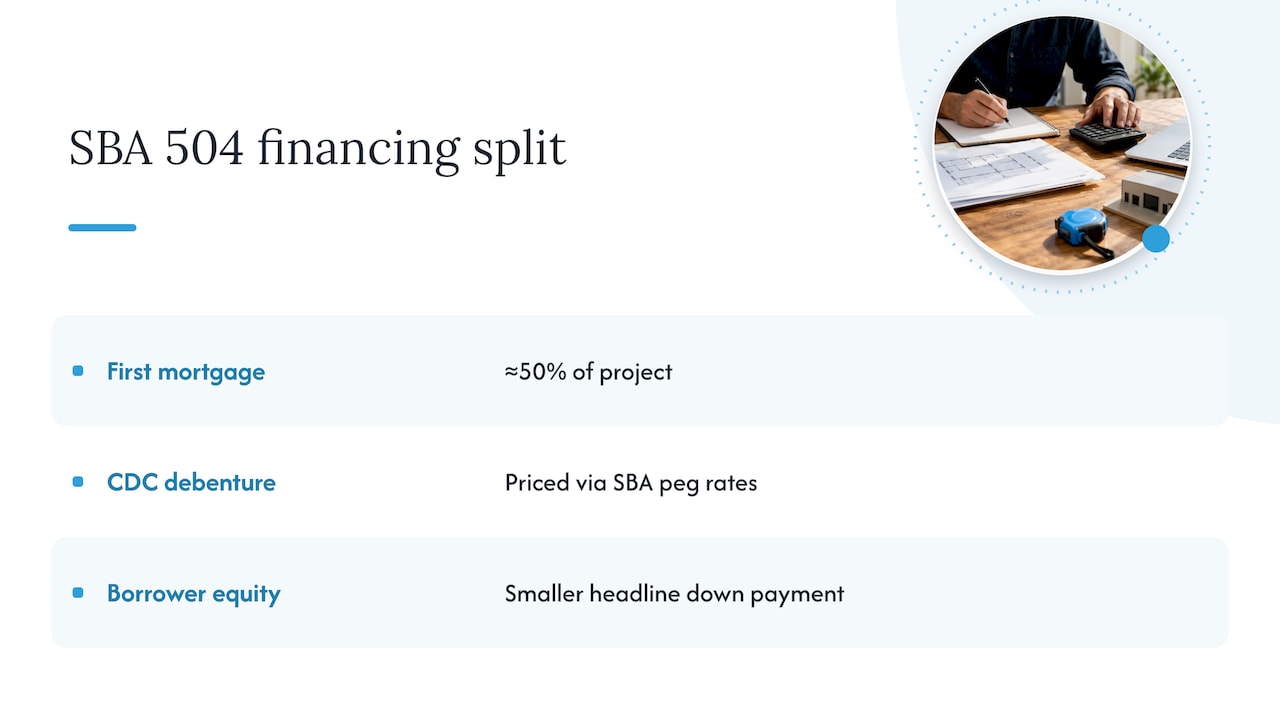
Each piece gets priced differently. The first-mortgage portion is negotiated directly with your bank under its own underwriting standards. The CDC debenture piece is priced through SBA peg-rate notices, which tie pricing to an increment above current 10-year Treasury yields. That means the rate you’re quoted today reflects a specific reference date, and two lenders quoting “the 504 rate” on different days may give you different numbers.
Coordination is the tradeoff for that lower equity requirement; working with expert capital advisors can help manage lender coordination and streamline your commercial property financing. A 504 transaction typically involves appraisals, sometimes an environmental review, underwriting from both the first lender and the CDC, and alignment on closing mechanics between three parties instead of one. None of this is unusual or disqualifying, but it does mean more moving parts than a conventional loan, and more documents to track before you reach a closing table.
Loan terms and costs: maturities, rates, fees, and prepayment
The 504 program offers maturities of 10, 20, or 25 years depending on whether you’re financing equipment or real estate, with a maximum loan amount of $5.5 million. Because the debenture rate is pegged to Treasury markets rather than set purely by individual bank policy, your fixed rate reflects broader market conditions at closing, not just your lender’s internal pricing.
Debenture fees on a 504 loan generally amount to a few percent of the debt, and those fees can often be financed into the loan rather than paid out of pocket, which matters when you’re already managing a 10% equity contribution.

Conventional commercial loans work differently on cost. Rates can be fixed or adjustable, and some carry balloon structures where a large payment comes due before full amortization. If your down payment falls below 20%, expect your lender to require private mortgage insurance, which adds to your monthly cost. Closing costs vary by lender and loan size, and because there’s no CDC or SBA debenture involved, there’s no peg-rate component to track, just your bank’s own underwriting and pricing.
Before committing to either path, ask for documentation that lets you compare apples to apples:
- Request an all-in amortization schedule combining the CDC debenture and first-mortgage pieces, not two separate estimates.
- Ask for an itemized fee worksheet showing every charge, including the debenture fee and any third-party lender fees.
- Confirm the peg-rate reference date used to price the CDC portion of a 504 quote.
- Get prepayment terms in writing for both pieces of a 504 loan, since penalties can differ between the CDC debenture and the conventional first mortgage.
Eligibility and permitted uses: what 504 can and can’t finance
SBA 504 eligibility starts with basics: you need a for-profit operating business in the United States that meets SBA size standards, along with management experience and a demonstrated ability to repay the loan. Beyond that, the program is specific about what it will and won’t finance.
Permitted 504 uses include owner-occupied commercial buildings, new facility construction, and long-life machinery or equipment purchases. What it excludes matters just as much: 504 financing cannot cover working capital, inventory, or speculative investment in rental real estate. That exclusion exists because the program is built around fixed-asset growth and job creation, not general operating funds.
- Owner-occupied commercial real estate (you must occupy a defined percentage of the property) qualifies.
- New construction and major renovations of business facilities qualify.
- Long-life equipment and machinery purchases qualify.
- Working capital, inventory financing, and passive rental investment do not qualify.
Conventional lenders typically allow broader use of funds, including working capital or investment property, but they apply stricter credit and down payment underwriting on commercial products. If your business doesn’t fit neatly into 504’s fixed-asset box, or if you need funds for purposes the program excludes, conventional financing may be your only realistic path regardless of its other tradeoffs.
Pros and cons: practical tradeoffs for small business owners
Each financing path asks you to give something up in exchange for what it offers.
- SBA 504 advantages: A lower headline down payment, long fixed-rate terms up to 25 years, and predictable payments that make multi-year budgeting easier.
- SBA 504 disadvantages: More coordination between a CDC and a third-party lender, program restrictions on eligible uses, and a closing timeline shaped by multiple approval stages.
- Conventional advantages: Faster closings through a single lender, simpler documentation, and flexibility to use funds for purposes 504 excludes.
- Conventional disadvantages: Higher down payment requirements or added private mortgage insurance costs, shorter terms or balloon structures, and exposure to rate variability if you choose an adjustable product.
- Red flags to watch for in either path: a lender who won’t produce an all-in payment schedule, a quote that omits prepayment penalty terms, or a CDC that can’t clearly explain its delegated authority and track record.
Neither path is universally better. The GAO’s review of the 504 program found that delegated authority, job-creation reporting, and project-stage controls shape how and when a 504 loan actually closes, which is useful context when a lender promises a timeline that sounds too fast for the structure involved.
Decision checklist: which fit fits your project and the exact questions to ask
A few simple rules can point you toward the right path before you request a single quote. If preserving cash and locking in predictable long-term payments matters most, lean toward 504. If you need speed, broader use of funds, or you’re buying an asset the program excludes, lean toward conventional.
Once you know your direction, bring the same set of questions to every lender or CDC you contact:
- Ask for an all-in payment schedule covering every piece of the financing, not an estimate for just one portion.
- Request the peg-rate reference date and source used to price any 504 quote.
- Get the first-mortgage amortization schedule in writing, separate from the CDC debenture terms.
- Ask directly whether prepayment penalties apply, and to which piece of the loan.
- Confirm whether the CDC holds delegated authority, since that can affect your closing timeline.
Pro Tip: Bring the same question list to every lender you compare. Inconsistent answers are often the clearest sign of a quote that isn’t fully disclosed.
Consider two common profiles. A manufacturer buying a $1.5 million facility with limited cash on hand and a preference for predictable payments fits the 504 path well. A retailer that needs to close in three weeks to secure a time-sensitive property, and plans to use part of the proceeds for inventory, is better served by a conventional loan.
Application steps and realistic timeline for 504 vs. conventional
The two paths follow different rhythms, and knowing them helps you schedule purchases, construction, and equipment delivery realistically.
- Prequalification: For 504, you’ll typically get a preliminary commitment from your first lender before the CDC begins its own underwriting.
- CDC underwriting and SBA debenture issuance: The CDC reviews your project, coordinates with SBA, and moves toward debenture issuance, a stage that can introduce delay if documentation is incomplete.
- Closing alignment: Construction or purchase milestones need to align with both the first lender’s closing and the CDC’s debenture timing, which is where most 504 delays originate.
- Conventional comparison: A conventional loan generally moves faster because it involves one lender and one underwriting track, without the added program-stage reviews that a 504 loan requires.
Whichever path you choose, ask for written milestone schedules early and align your purchase agreement or contractor timeline around them rather than assuming a best-case closing date.
How CDC New England supports SBA 504 borrowers
CDC New England offers several 504 products built around common borrower needs: Equipment 10-Year Fixed, Real Estate 20-Year Fixed, and Real Estate 25-Year Fixed loans for property and equipment purchases, along with an SBA 504 Refinance Program for businesses looking to move existing debt into a 504 structure.
For borrowers who don’t fit the standard mold, CDC New England also offers a VetLoan Advantage Program for veterans and their spouses, and a Down Payment Assistance Program for businesses working to meet the equity requirement on a project. As a regional CDC, the company coordinates the debenture process, works with delegated authority where it applies, and helps align the first lender’s piece with the CDC’s underwriting so a transaction moves without unnecessary back-and-forth. CDC New England has built its practice around this kind of multi-party coordination.
Author perspective and recommended next steps
The financing decision usually comes down to what you’re optimizing for. If cash preservation and long-term payment stability matter more than speed, 504 financing earns its complexity. If you need to close fast or use funds 504 won’t cover, conventional financing is the practical answer, even at a higher equity cost.
Before you commit, gather quotes from both paths, request all-in payment schedules from each, and ask a CDC for an eligibility pre-check. Confirm every fee and program rule in writing. Verbal assurances about timelines or costs rarely hold up once a transaction is underway.
— PHENYX
CDC New England: how we can help
Buying owner-occupied property or equipment on a 10% equity requirement and a fixed rate for up to 25 years changes what you can afford to keep in reserve for operations.
CDC New England offers Equipment 10-Year Fixed, Real Estate 20-Year Fixed, and Real Estate 25-Year Fixed loans, along with an SBA 504 Refinance Program for existing debt and a VetLoan Advantage Program for veterans and their spouses. If meeting the equity requirement is your main obstacle, the Down Payment Assistance Program is worth reviewing before you rule out 504 financing.
Before reaching out, gather recent financial statements, a project description, and the question list above. Visit CDC New England to start an eligibility conversation and request a quote tailored to your project.
Primary sources and where to read the official rules
Verify program rules and rates directly before comparing quotes, since peg rates and fee structures change by reference date.
- SBA peg-rate and information notices: shows how the CDC debenture rate is priced in a given quarter.
- SBA 504 funding programs page: explains the CDC role and servicing mechanics.
This article is general information, not a substitute for advice from a qualified financial advisor. Consult a qualified financial professional about your own circumstances before acting on anything here.
Sources
- 504 loans | U.S. Small Business Administration
- 2nd Quarter Optional Peg Rate, Direct Interest Rate and Maximum Interest Rate of a Third Party Lender Loan for a 504 Project | U.S. Small Business Administration
- Small Business Administration: Actions Needed to Ensure Planned Improvements Address Key Requirements of the Development Company (504) Loan Program | U.S. GAO
- 504 loans | U.S. Small Business Administration
FAQ
Are SBA loans better than conventional loans?
Neither is universally better: SBA 504 loans tend to fit borrowers prioritizing cash preservation and long-term fixed payments, while conventional loans tend to fit borrowers prioritizing speed or broader use of funds. The right answer depends on your project type, timeline, and how much equity you can contribute upfront.
What are the disadvantages of a 504 loan?
A 504 loan involves more coordination since a Certified Development Company and a third-party lender both underwrite the transaction, which can extend the closing timeline. The program also restricts use of funds to owner-occupied real estate or long-life equipment, excluding working capital, inventory, and speculative rental investment.
What is the SBA 504 rate today?
There’s no single universal rate: the CDC debenture portion is priced using quarterly peg-rate notices tied to Treasury yields, while the first-mortgage portion is set separately by your lender. Ask any lender or CDC for the specific peg-rate reference date used in your quote before comparing offers.
Are SBA 504 loans hard to get?
A GAO review found that 504 lending involves structured eligibility rules and multi-party underwriting, which makes the process more involved than a single-lender conventional loan, but not inherently difficult for qualified borrowers. Many businesses qualify when they come prepared with complete financials and work with an experienced CDC that understands delegated authority and timeline expectations.


