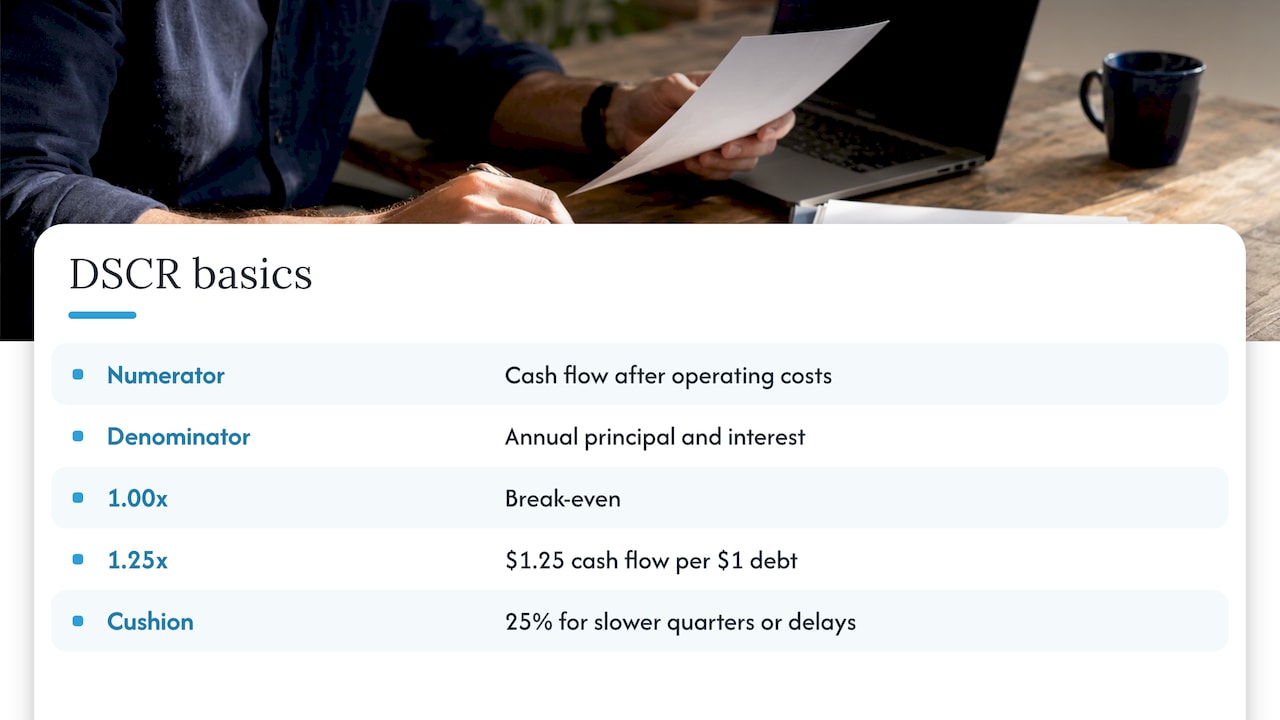
DSCR, the debt service coverage ratio, measures whether your business earns enough cash flow to pay all of its debt, including the new SBA 504 loan. The formula is cash flow available for debt service divided by total annual principal and interest. A result of 1.00x means cash flow exactly covers payments. Published summaries of SBA’s current rules put the 504 floor at 1.15x on historical results, and in practice lenders and CDCs often want a cushion above that. This guide shows the math, a worked example, and what to do if your ratio comes up short.
TL;DR
- DSCR = cash flow available for debt service ÷ total annual debt payments, existing debt plus the new 504 payments.
- Summaries of SOP 50 10 8.1 describe a 1.15x minimum for 504 loans, measured on historical results. Plan for 1.25x to be comfortable.
- A 504 project has two payments, the first-lien bank loan and the CDC debenture, and both count in the denominator.
- With the 504 structure’s 10% down payment, the ratio is usually the real test, so prepare your financials before you apply.
- If your ratio is thin, you can often improve it by paying down debt, documenting add-backs or adjusting the project size.
Table of Contents
- What DSCR means for an SBA 504 loan
- The minimum DSCR for SBA 504 loans
- How lenders calculate DSCR step by step
- Two payments, both counted
- A worked example
- What to do if your DSCR is too low
- Prepare your numbers before you apply
- Our perspective
- Talk to a New England CDC before you commit
- FAQ
- Sources
What DSCR means for an SBA 504 loan
Lenders use DSCR to answer one question: after your operating costs, is there enough money left to make every loan payment on time? Cash flow is the numerator. Annual debt service, the principal and interest you owe across all loans in a year, is the denominator.
A ratio of 1.00x is break-even. At 1.25x, you generate $1.25 of cash flow for every $1.00 of debt payments, a 25% cushion for a slow quarter, a late customer or a price increase from a supplier.
For an owner-occupied 504 project, the ratio is generally a test of the operating business, not of the building. Because you occupy the property, your company’s earnings pay the loan. That is why lenders look at your tax returns and financial statements rather than at market rents. The 504 program does allow limited leasing to tenants, but the business itself should carry the payments. Our guide to 51% occupancy and 504 eligibility explains how much of the building you must use.
The minimum DSCR for SBA 504 loans
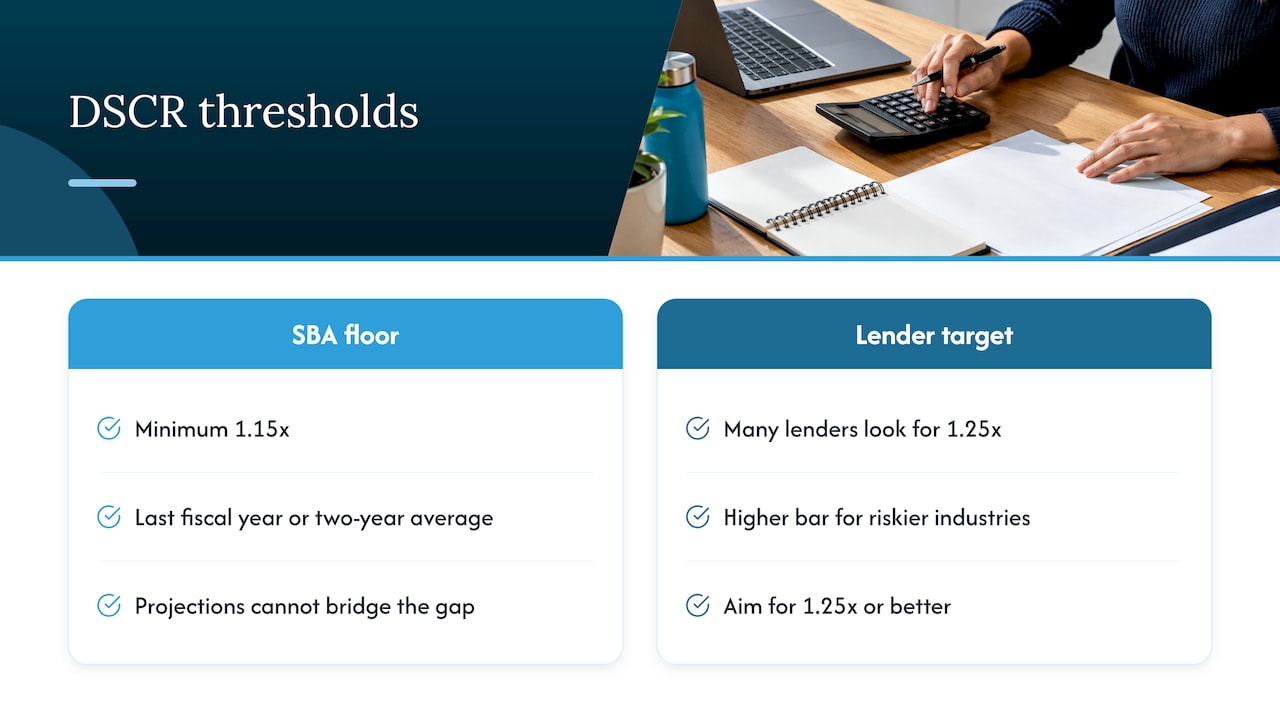
There are really two numbers to know: the SBA’s floor and the number your lender and CDC will want to see.
The SBA floor. SBA publishes its loan origination rules for 7(a) and 504 in SOP 50 10, Lender and Development Company Loan Programs, whose Section C covers 504 requirements. Summaries of the current version, SOP 50 10 8.1, describe a 1.15x minimum for 504 loans. That ratio is measured on your last fiscal year or the average of your last two fiscal years. Projections are not meant to carry you over the line.
The practical target. Underwriting is not only about the minimum. The first-lien lender sets its own credit standards, and the CDC reviews the whole package. Many commercial lenders look for 1.25x. Higher-risk or thin-margin industries may face a higher bar. If you are building a plan, aim for 1.25x or better and treat 1.15x as the lowest point you could defend.
Because rules change with each SOP revision, confirm the current requirement with your CDC before you build a projection around any single number.
How lenders calculate DSCR step by step
The version used in underwriting usually looks like this:
DSCR = (EBITDA + accepted owner add-backs) ÷ (existing annual debt service + new annual debt service)
- Start with earnings. Take net income and add back interest, taxes, depreciation and amortization to reach EBITDA.
- Add accepted owner adjustments. Owner compensation above market level, one-time expenses and non-cash items may be added back if you can document them. Underwriters decide what is accepted.
- Total your existing debt service. Include equipment loans, lines of credit payments, term loans and any lease obligations your lender treats as debt.
- Add the new 504 payments. This is the part many borrowers forget, which we cover next.
- Divide. Cash flow over total debt service gives the ratio.
One point that surprises owners: moving into a building you own usually removes your current rent. Lenders typically replace that rent expense with the new debt payments and property costs, so the move can improve cash flow even while it adds debt service. Ask your CDC how they treat your current rent in the calculation.
Two payments, both counted
A 504 project is built from three pieces. Per the Congressional Research Service, a third-party lender provides at least 50% of the financing, the CDC provides up to 40% through an SBA-backed debenture, and the borrower contributes at least 10%. You make two loan payments, one to each lender, and underwriting adds both to your debt service. Our breakdown of the 50/40/10 structure shows who is paid when.
The CDC portion is where the 504 earns its reputation. The same CRS report describes terms of 10 years for machinery and equipment and 20 or 25 years for real estate, at a fixed rate. A long, fixed term lowers the annual payment on up to 40% of the project, and that helps your DSCR. For a closer look, see 10, 20 or 25 year 504 terms.
As a reference point, the fixed rates published on our site when we last updated them were:
| Program | Fixed rate |
|---|---|
| Equipment, 10-year | 6.58% |
| Real estate, 20-year | 6.73% |
| Real estate, 25-year | 6.77% |
Rates change, so ask us for current numbers before you run your projection.
A worked example
Imagine a manufacturer buying a $2,000,000 building to occupy. The illustrative numbers below are not a quote.
| Item | Amount |
|---|---|
| Bank first lien (50%) | $1,000,000 |
| CDC debenture (40%) | $800,000 |
| Borrower down payment (10%) | $200,000 |
Suppose the annual payment on the bank loan is $85,000 and on the CDC debenture is $62,000. That is $147,000 of new debt service. The company also pays $30,000 a year on existing equipment debt, so total debt service is $177,000.
- Strong case: EBITDA plus accepted add-backs is $260,000. DSCR = 260,000 ÷ 177,000 = 1.47x. That clears both the 1.15x floor and a 1.25x target.
- Thin case: Cash flow is $200,000. DSCR = 200,000 ÷ 177,000 = 1.13x. That falls under 1.15x.
To reach 1.25x on $177,000 of debt service, the company needs $221,250 of cash flow. To reach 1.15x, it needs $203,550. Knowing these target figures before you apply lets you work backward to what must change.
What to do if your DSCR is too low
A thin ratio is a planning problem with practical fixes. Work through them in this order:
- Check your add-backs. Owner compensation above market, one-time legal or moving costs, and non-cash expenses may legitimately increase qualifying cash flow. Gather the documents that support each one.
- Retire or restructure existing debt. In the thin case above, paying off the $30,000-a-year equipment debt drops total debt service to $147,000. The same $200,000 of cash flow then produces 1.36x. Our SBA 504 refinance program may also help when existing debt can be restructured into longer fixed terms, and our guide to business debt consolidation explains how.
- Right-size the project. A smaller building or a phased equipment purchase lowers new debt service.
- Use the longest term the asset supports. Longer amortization lowers the annual payment, which raises the ratio.
- Let another year of earnings season in. Because history drives the test, one stronger fiscal year or a stronger two-year average can move you from marginal to comfortable.
- Reduce the cash you need up front. If down payment funds are the pressure point, our Down Payment Assistance Program is designed to help borrowers close that gap.
If you are refinancing, SBA’s rule changes have broadened what is possible. The Federal Register notice describes two paths, refinancing with expansion and refinancing without expansion, and for the latter allows the 504 and third-party loans to cover up to 90% of the fair market value of the collateral fixed assets in qualifying projects.
Prepare your numbers before you apply
A clean package shortens the review. Gather:
- Business tax returns and year-end financial statements for the last two to three years
- A current interim income statement and balance sheet
- A schedule of all business debt with balances, rates and payments
- Documentation for every add-back you plan to claim
- A project budget showing the purchase price, closing costs and your 10% injection
Then build a simple spreadsheet with your DSCR in the strong, expected and downside cases. If the downside case still sits above 1.15x, you are in good shape. Our article on DSCR and NOI preparation walks through the same exercise in more detail. If you are comparing structures, our look at 504 versus conventional financing shows how a lower down payment and a long fixed term affect cash flow.
Our perspective
We see DSCR questions at the very start of most conversations, and we think owners are right to ask them early. The ratio is not a hurdle designed to keep you out. It is a way to confirm that the project you are about to take on will be comfortable for your business to carry.
The 504 structure is built to help that math. With only 10% down, you preserve working capital for hiring, inventory and the surprises every business has. With a fixed rate for up to 25 years on the real estate portion, your payment is predictable, so your ratio does not move because the rate market did.
Our team works with New England borrowers every day, and more than 70 years of experience has taught us that the best outcomes start with preparation. Bring us your financials before you sign a purchase agreement, and we can walk through your DSCR, show you which add-backs matter, and talk through whether refinancing, down payment assistance or our veteran programs would strengthen your application.
PHENYX
Talk to a New England CDC before you commit
CDC New England provides SBA 504 loans for commercial real estate and equipment, with 10% down and fixed rates for up to 25 years. We also offer a refinance program, down payment assistance and the VetLoan Advantage Program for veterans and their spouses. If you want to know where your DSCR stands, we can review your numbers with you and map out the next step.
See current fixed rates and programs at CDC New England, or explore the VetLoan Advantage Program if you or your spouse served.
FAQ
Does the SBA set a minimum DSCR for a 504 loan?
Summaries of SOP 50 10 8.1 describe a 1.15x minimum for 504 loans, measured on historical results. Lenders and CDCs often look for more, commonly 1.25x. Ask your CDC what it expects for your industry and project.
Do both the bank loan and the CDC loan count in DSCR?
Yes. You make two payments in a 504 project, one on the first-lien bank loan and one on the CDC debenture, and underwriting counts both along with your existing debt. The CRS report on the program describes this two-loan structure.
Can I use projections to qualify?
Current summaries of the SOP say the 504 floor is measured on your last fiscal year or a two-year average, not on projections. Projections still help you plan, so build them, but expect underwriters to anchor on your history.
Can I use an SBA 504 loan to refinance existing debt?
Yes, in qualifying cases. SBA’s rule describes refinancing with and without expansion, each with its own requirements. Our refinance program page is the best place to start.
What if my DSCR is just under the target?
Document your add-backs, pay down or restructure existing debt, adjust the project size or choose the longest eligible term. Even small changes in debt service can move the ratio meaningfully, as the example above shows.
Sources
- SBA SOP 50 10, Lender and Development Company Loan Programs
- Congressional Research Service, SBA 504/CDC Loan Guaranty Program (R41184)
- Federal Register, SBA 504 debt refinancing rule
- SBA Loan Requirements (2026) checklist, Hartwell Labs