Pro forma figures describe what your business is projected to earn or how its numbers would look after a change. TTM (trailing twelve months) figures describe what your business actually earned over the most recent twelve months. When you apply for financing to buy commercial real estate or equipment, a lender wants both: TTM to show the track record, and pro forma to show how the new building or machine changes it. The strongest loan files keep the two clearly separate and connect them with assumptions a reader can follow. At CDC New England, we work with New England owners on SBA 504 loans every day, so this is how we would explain the difference to a business owner across the table.
TL;DR
- TTM is actual, historical performance: the last twelve months of revenue, expenses or profit, rolled forward each month or quarter.
- Pro forma is adjusted or projected: either historical results restated as if a transaction had already happened, or a forecast built on stated assumptions.
- SBA underwriting starts with historical financials. Projections come in when history alone does not show enough repayment ability, and they must be supported.
- Present TTM as your evidence and pro forma as your plan. Never let the second blur the first.
- For a 504 purchase, a pro forma should show the project as it would look after closing: new debt, your down payment and how you will use the property or equipment.
Table of Contents
- What TTM means and how to calculate it
- What pro forma means
- Pro forma vs. TTM at a glance
- How SBA underwriting treats historical and projected numbers
- Building a pro forma that a lender can use
- Property and rent: the same logic for real estate income
- Where each one goes wrong
- Which one do you lead with?
- Our perspective
- Put your numbers to work
- FAQ
- Sources
What TTM means and how to calculate it
TTM stands for trailing twelve months. It is a rolling twelve-month window that ends at your most recent reporting period, rather than at the end of the calendar or fiscal year. If it is November and your books are closed through October, your TTM covers November of last year through October of this year.
The usual method is simple. Add the most recent four quarters of a figure such as revenue. If you close your books monthly, add the latest twelve months instead. Another route, handy when you have year-end and interim statements, is:
TTM = last fiscal year + current year-to-date − same year-to-date period last year
A worked example:
| Item | Revenue |
|---|---|
| Fiscal year 2025 (full year) | $2,400,000 |
| January through September 2026 | $1,950,000 |
| January through September 2025 | $1,700,000 |
| TTM through September 2026 | $2,650,000 |
The calculation is $2,400,000 + $1,950,000 − $1,700,000. The year-end figure alone would have told a lender your business made $2.4 million. The TTM shows that it has been running at $2.65 million, a more current and more favorable picture for a growing company.
The same method works for net income, EBITDA (earnings before interest, taxes, depreciation and amortization), payroll or rent collected. Use identical accounting treatment across all three pieces, or the answer will not reconcile.
What pro forma means
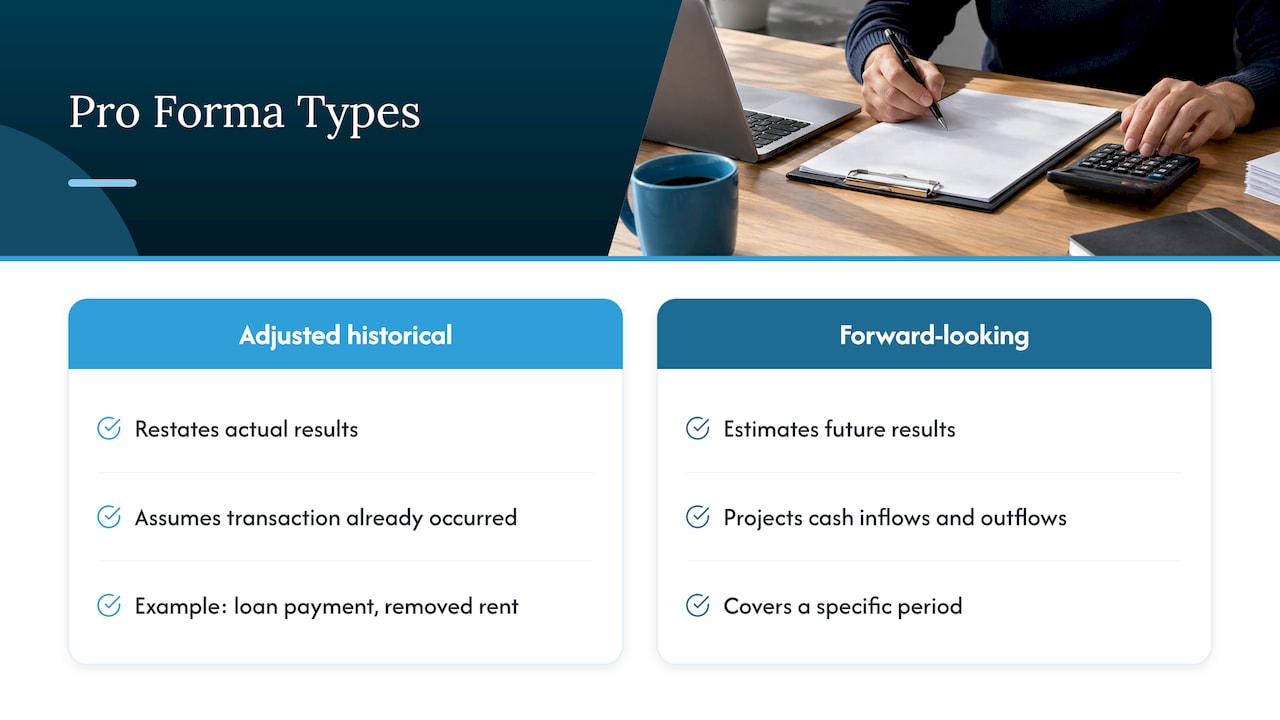
“Pro forma” is Latin for “for the sake of form.” In practice, it means numbers presented on a stated assumption rather than as plain historical results. It comes in two main flavors, and owners often mix them up.
Adjusted historical pro forma. You take actual results and restate them as if a transaction had already occurred. Public companies do this for acquisitions: SEC Article 11 pro formas present historical balance-sheet and income-statement information adjusted as if a transaction had occurred earlier. For a small business, the equivalent is showing last year’s results with your new loan payment and without the rent you will stop paying.
Forward-looking projection. Here you estimate future results. The FDIC’s small business curriculum describes a pro forma cash flow statement as a financial projection used to estimate future cash inflows and outflows for a specific period, in contrast to a cash flow statement that records what actually happened.
A pro forma is therefore only as good as its assumptions. That is why every serious version lists them.
Pro forma vs. TTM at a glance
| TTM | Pro forma | |
|---|---|---|
| Direction | Backward-looking | Forward-looking or hypothetical |
| Basis | Actual books, tax returns, interim statements | Historical numbers plus stated adjustments, or projections |
| Best used for | Proving what the business really earns | Showing the effect of the new property, equipment or debt |
| Main risk | Can lag a fast-changing business | Can be optimistic if assumptions are thin |
| What a lender wants | Statements that tie to tax returns | A written explanation of every assumption |
How SBA underwriting treats historical and projected numbers
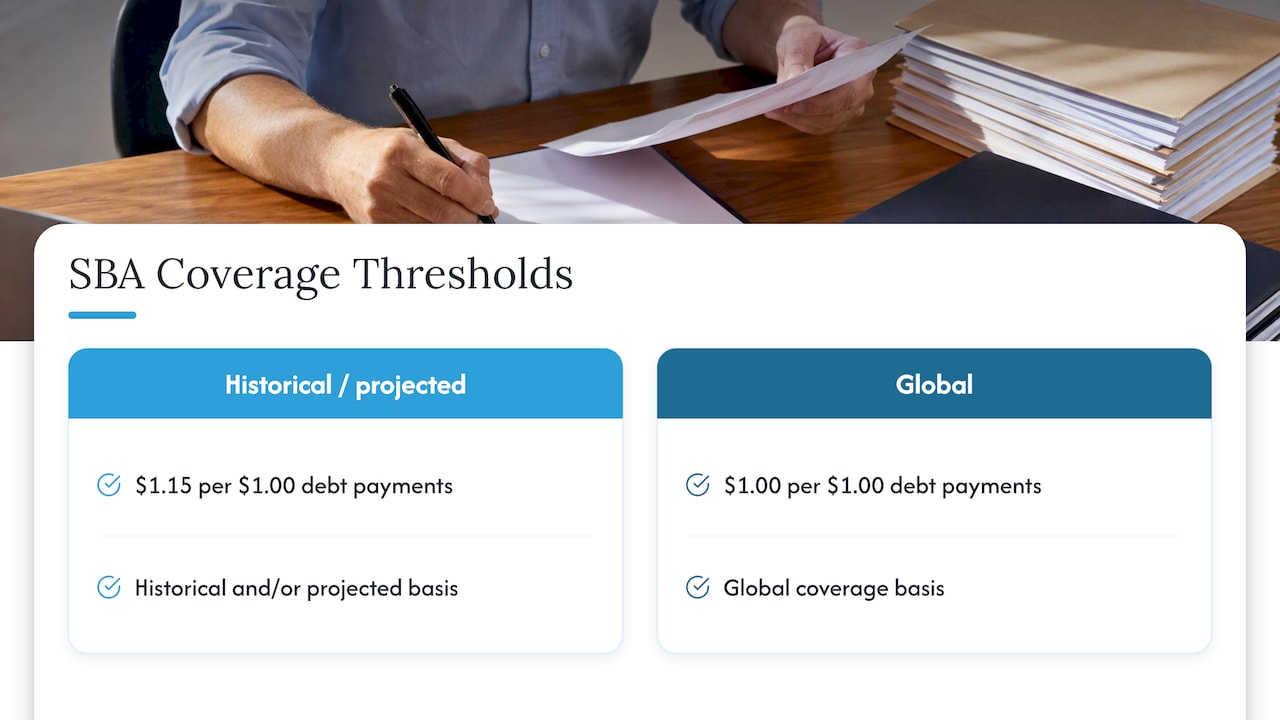
For SBA 504 borrowers, history comes first. The SBA’s lender rulebook, SOP 50 10 8.1, says analysis of an existing business rests on three years of historical financials plus an interim statement. It defines operating cash flow as EBITDA and expects a debt service coverage ratio of at least 1.15 on a historical and/or projected basis, and 1.0 on a global basis. Debt service coverage ratio (DSCR) is operating cash flow divided by your annual loan payments: at 1.15, you generate $1.15 for every $1.00 of debt payments.
The same rulebook explains where pro forma work enters. Where historical cash flow and interim statements do not show sufficient coverage, the lender must obtain two years of detailed projections with assumptions supporting revenue growth, expense reductions and comparison to industry trends. It also calls for a spread of the pro forma business balance sheet adjusted for the SBA loan, other debt, equity injection and use of proceeds.
The interim statement is where TTM thinking lives. The financial due diligence rules call for the three most recent year-end financials at the highest reporting level available (audited, reviewed, CPA compiled or tax returns), plus the latest interim statement and the same period of the prior year. That current-versus-prior-year pairing is exactly what you need to compute a TTM figure.
The practical takeaway: a lender builds the story from what you have done, then tests what you say you will do. Check the current SOP and your lender for the exact documents on your file, since the rulebook is updated periodically.
Building a pro forma that a lender can use
A good pro forma for a 504 project is short, specific and traceable. Work through it in this order.
- Start from TTM. Use your most recent twelve months as the baseline, not your best quarter. Make sure the revenue and expense lines tie to your tax returns and interim statement.
- Remove what will go away. If you are buying the building you now lease, take out the rent. If you are paying off an equipment lease, take out those payments.
- Add what the project creates. That means the new loan payments, property taxes, insurance, maintenance and any additional payroll. The 504 structure matters here: with a 10% down payment, your equity injection and the new debt both appear in the pro forma balance sheet.
- Add revenue only with a reason. New capacity, a signed contract or a documented waitlist is a reason. “We expect to grow” is not. The SBA rulebook asks lenders to justify cash-flow additions and subtractions, so make each one easy to justify.
- Separate one-time items. Moving costs, a nonrecurring legal bill or a one-off sale should be flagged. Public-company guidance on pro formas similarly calls for notes explaining each adjustment and items that will not recur within a year.
- Show the coverage ratio. Calculate DSCR on both TTM and the pro forma, side by side, so the effect of the project is visible in one line.
- Write the assumptions on one page. Each growth rate, cost and timing assumption gets a sentence and, where possible, a source such as a contract, a quote or a rent comparison.
A worked example
Say a machine shop leases its building for $144,000 a year and has TTM operating cash flow of $310,000 before rent. It plans to buy a building and finance it with a 504 loan.
| TTM (actual) | Pro forma (after purchase) | |
|---|---|---|
| Cash flow before occupancy costs | $310,000 | $310,000 |
| Rent | −$144,000 | $0 |
| Property taxes, insurance, upkeep | $0 | −$38,000 |
| Cash flow available for debt service | $166,000 | $272,000 |
| Annual loan payments | $0 | $190,000 |
| DSCR | n/a | 1.43 |
The figures are illustrative, not a quote. The shop has no real-estate debt today, so its TTM shows a strong baseline. The pro forma shows that after the purchase, the business still covers its payments with room to spare. Every number in the pro forma column traces either to the TTM column or to a stated assumption, which is what makes it credible.
Property and rent: the same logic for real estate income
If you are buying an owner-occupied building, TTM matters for your business. If part of the building is rented to others, TTM matters for the property too. Lenders in the multifamily world show how disciplined this is: Fannie Mae’s guide asks for prior three-year operating statements, or at minimum a trailing six-month statement annualized, and it builds gross potential rent from actual in-place rents plus market rents for vacant units. It also compares trailing three-month income with trailing six- and twelve-month figures to see the direction of travel, and it allows borrower budgets for acquisitions only.
SBA 504 owner-occupied projects follow different rules, but the habit carries over: show real collections first, market assumptions second. If you inherited a building or are weighing one that was previously rented, it helps to understand renting out an inherited property, since in-place rent history is the kind of record that supports a pro forma.
Where each one goes wrong
TTM pitfalls
- Mixing cash and accrual accounting between periods.
- Using a hot quarter in place of a full twelve months.
- Failing to reconcile to tax returns, which makes underwriters question everything else.
- Ignoring seasonality. A landscaping company’s TTM ending in August looks very different from one ending in February, so compare against the same month a year earlier.
Pro forma pitfalls
- Presenting a pro forma as if it were actual results. The SEC has warned that pro forma information has no defined meaning and results from selective editing of GAAP figures, and that it can mislead when it obscures standard results, for example by recasting a loss as a profit. Its remedy is plain: disclose in plain English how and by how much the figures depart from GAAP, and let readers compare against the standard statements.
- Stacking optimistic assumptions. Each one may be defensible, but together they can produce a number no one believes.
- Forgetting stand-alone costs. When a business separates from a parent or takes over operations, expenses that were once shared often rise; public-company rules call these autonomous entity adjustments. Buying an existing business with shared back-office costs is a common small-business version.
Which one do you lead with?
Lead with TTM whenever your recent performance is strong. It is hard to argue with. Bring pro forma in when the project changes your cost structure (replacing rent with a mortgage, for example), when you have a signed contract that has not yet shown up in revenue, or when you are refinancing and want to show the effect of lower or longer-term payments.
If your last fiscal year was weak but your recent months are strong, TTM and interim statements tell that story with real numbers. If you are early-stage, a supported projection carries more weight, but expect to explain it line by line.
Our perspective
Owners tend to treat the pro forma as a sales pitch and the TTM as a formality. We see it the other way around. The TTM is the foundation, and the pro forma is a bridge that shows how the foundation supports a bigger structure.
That is exactly why the 504 structure suits owner-occupied growth. With only 10% down and fixed rates for up to 25 years, the payment you put in a pro forma is a number that does not move. A projection built on a fixed payment is easier to defend than one tied to a rate that resets.
Our programs are built around the barriers owners actually face. Down payment assistance addresses the equity injection line on your pro forma balance sheet, our refinance program speaks to existing debt, and VetLoan Advantage offers specific benefits for veterans and their spouses. With more than 70 years of experience and over $2.3 billion invested in New England businesses, we know how to turn a business’s actual numbers into a financing plan that works.
PHENYX
Put your numbers to work
CDC New England provides SBA 504 loans for commercial real estate and equipment with a 10% down payment requirement and fixed rates for up to 25 years. The rates on our site as of September 16, 2026, were 6.58% for the Equipment 10-Year Fixed, 6.73% for the Real Estate 20-Year Fixed and 6.77% for the Real Estate 25-Year Fixed. Rates change over time, so check our current rates and programs when you build your pro forma.
If your project involves existing debt, see the SBA 504 Refinance Program. If you need help with the equity portion, look at our Down Payment Assistance Program. Veterans and their spouses can review the VetLoan Advantage Program. To see how your documents fit an application, read our guide to what goes in an SBA 504 application, and check 504 eligibility rules, including the 51% occupancy requirement, before you finalize your projections.
FAQ
What is the difference between pro forma and TTM?
TTM is the sum of your actual results over the most recent twelve months. Pro forma is a restatement or projection built on assumptions, such as your results as if you already owned the building. TTM is evidence, and pro forma is a plan built on that evidence.
How do I calculate TTM revenue?
Add your last four quarters, or your last twelve monthly figures. If you only have year-end and interim statements, take the last fiscal year, add the current year-to-date, and subtract the same year-to-date period from the prior year. Keep the accounting method consistent across every period.
Does an SBA 504 lender require a pro forma?
SBA rules start with historical financials and an interim statement. Projections are required when historical cash flow does not show enough debt service coverage, and a pro forma balance sheet adjusted for the loan and your equity injection is part of the analysis. Your lender will confirm which documents your file needs.
What is a cash pro forma?
It is another name for a cash flow projection. It estimates the cash coming in and going out over a future period, while a standard cash flow statement records what has already happened.
Can I use a pro forma when I am buying a building I will occupy?
Yes, and it is often the clearest way to show the change. Start from your TTM, remove current rent, add the new loan payment and property costs, and show the resulting coverage ratio next to your historical one.
Sources
- SEC: Cautionary Advice Regarding the Use of Pro Forma Financial Information in Earnings Releases
- SBA SOP 50 10 8.1, Underwriting (B.Ch4.C.2)
- SBA SOP 50 10 8.1, Financial Due Diligence (App15.C.1)
- FDIC Money Smart for Small Business, Module 10: Managing Cash Flow
- EY: Pro forma financial information guide
- Deloitte IAS Plus: Disclosures for Business Acquisitions and Dispositions
- Fannie Mae Multifamily Selling Guide
- Finance Strategists: Trailing Twelve Months (TTM)