

Asset-based lending (ABL) is a loan: you borrow against your receivables, inventory and equipment, and you keep your customer relationships and your collections. Factoring is a sale: you sell your invoices to a factor at a discount, and the factor usually collects from your customers. For a growing New England business with steady sales and real collateral, ABL is usually the stronger fit, because it works as a revolving credit line that grows with your assets. We lend in this space, and the sections below show how to decide.
TL;DR
- ABL is a loan secured by assets. Factoring is the sale of receivables, so the factor, not you, typically collects payment from your customers.
- ABL draws on a wider pool of collateral (receivables, inventory, equipment), so your borrowing capacity can grow as your balance sheet does.
- Factoring fees are usually charged per week or month, so slow-paying customers raise your total cost.
- ABL suits businesses with steady sales and a managed borrowing base. Pairing it with SBA 504 financing for real estate or equipment can free up working capital.
- Compare offers as an annual percentage rate (APR), not as a headline fee.
Table of Contents
- How the two products actually work
- Side-by-side comparison
- What each one costs
- When factoring fits, and when ABL fits better
- The borrowing base: the part that decides your ABL capacity
- Where cash-flow loans and SBA programs fit
- What to check before you agree to any receivables financing
- Our perspective
- Pair working capital with long-term financing
- FAQ
- Sources
How the two products actually work
Asset-based lending
In an asset-based loan, a lender sets up a revolving line of credit and lets you borrow against a percentage of your eligible assets. The assets are the collateral. According to the Journal of Accountancy’s overview of asset-based financing, asset-based lenders focus on the quality of the collateral rather than on credit ratings. That is why a company with thin equity or uneven earnings can still qualify.
The percentage you can borrow is called the advance rate. For a sense of how this looks in practice, the Export-Import Bank of the United States describes its export working capital guarantee as allowing borrowing against export-related receivables at advance rates up to 90% and against export-related inventory at up to 75%. Your own rates depend on the lender and on how clean and collectible your assets are. The total you can borrow at any moment is your borrowing base: eligible assets multiplied by their advance rates.
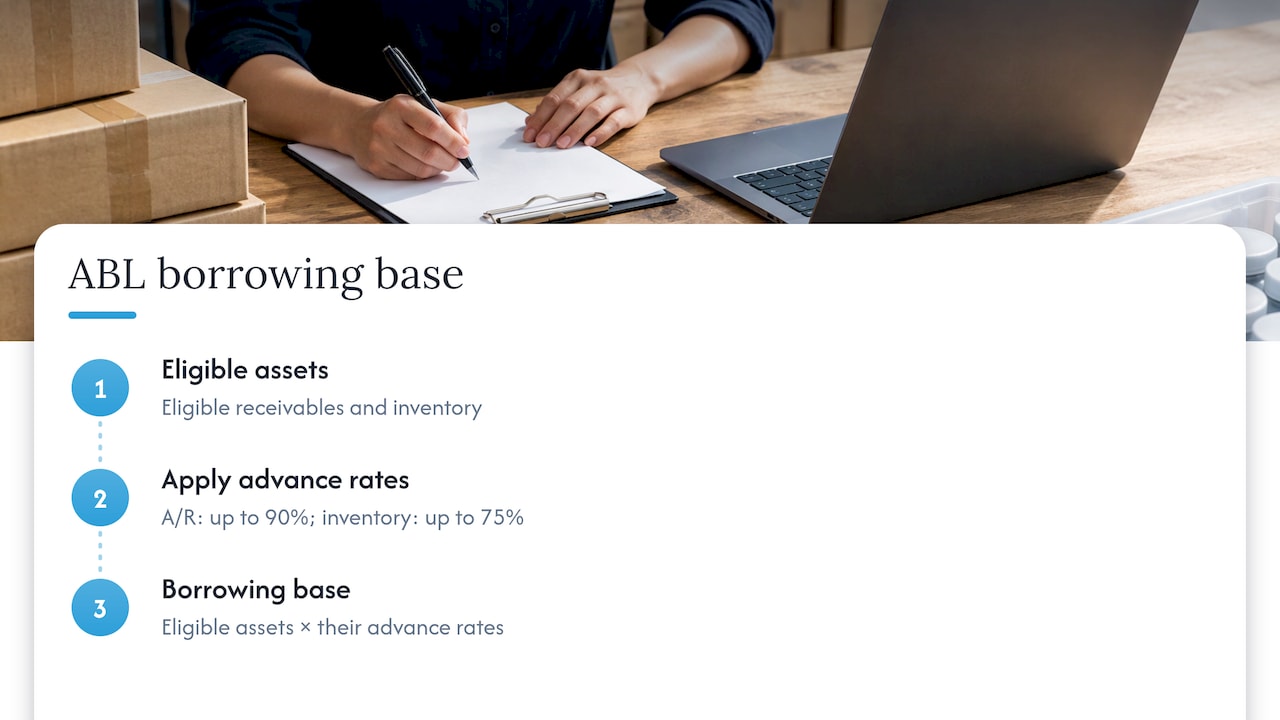
You borrow what you need, repay when customers pay you, and borrow again. You pay interest on the balance you use, and you continue to run your own billing and collections.
Factoring
Factoring is not a loan. Per the same Journal of Accountancy explanation, a factor buys your receivables at a discount and a transaction has three parts:
- The advance: a percentage of the invoice’s face value paid to you when you submit it.
- The reserve: the remainder, held until your customer pays.
- The fee: deducted from the reserve before the balance is released to you.
The factor typically manages your sales ledger and collects from your customers. The ICAEW’s guide to asset-based finance notes that a factor usually advances 80% to 90% of invoice value and that this service element can be valuable to smaller businesses without a full credit-control function.
The contract also decides who carries the risk of a customer not paying. In recourse factoring, you keep the bad-debt risk, and it is typically less costly. In non-recourse factoring, the factor absorbs that risk up to an agreed credit limit, and it typically costs more, according to the same ICAEW guide.
Side-by-side comparison
| Feature | Asset-based lending | Factoring |
|---|---|---|
| Legal form | Loan secured by assets | Sale of receivables at a discount |
| Collateral | Receivables, and often inventory and equipment | Invoices only |
| Who collects from customers | You | Usually the factor |
| How cost is quoted | Interest on the balance, plus facility fees | A fee as a percentage of invoice value, often per week or month |
| Capacity over time | Moves with your borrowing base | Moves with the invoices you submit |
| Customer awareness | Typically none, since you keep collecting | Customers are usually told to pay the factor |
| Best for | Steady sales, growing asset base, broader needs | Short-term cash from invoices with limited back-office capacity |
The wider collateral pool is the key difference. The ICAEW’s guideline on growth through asset-based finance states that an ABL facility is provided against a wider asset pool than factoring, including receivables plus stock, plant and equipment, and possibly property and intangibles. It also notes that ABL, once aimed at larger companies, is increasingly available to smaller businesses.
What each one costs
The two products price themselves differently, so the quotes are not directly comparable until you convert them.
Factoring fees are quoted as a percentage of invoice value. The ICAEW guide puts typical factoring fees at 0.5% to 5% of invoice value per month, charged weekly or monthly, so longer customer payment terms raise your total cost. A fee that looks small on a 30-day invoice looks different when a customer takes 75 days to pay.
ABL is priced as interest on the amount you actually borrow, usually with fees for setting up and monitoring the facility. Because you pay interest only on what you draw, a seasonal business can keep the line mostly unused in quiet months.
To compare fairly, turn every quote into an annual percentage rate. Take the total dollars you would pay, divide by the dollars you would actually receive, and scale it to a full year based on how many days the money is outstanding. A worked example:
- You submit a $100,000 invoice and receive an 85% advance, $85,000.
- The factor charges 3% of invoice value per 30 days. Your customer pays in 60 days, so fees total $6,000.
- The $6,000 cost, relative to the roughly $85,000 you were advanced, over 60 days, works out to about 43% annualized.
This is an illustration, not a quote. Your own number depends on your contract, your fees and how fast your customers pay. Our guide to converting fees to APR for invoice financing vs. factoring walks through the math with more cases.
Also compare these contract terms before you sign anything:
- Minimum volume or minimum monthly fees
- Contract length and early-termination charges
- Whether you must factor all your invoices or can choose
- Recourse or non-recourse terms, and the credit limit per customer
- Any added fees for processing, wire transfers or ledger maintenance
When factoring fits, and when ABL fits better
The right choice depends on your sales pattern, your customers and what you need the money to do.
Factoring tends to fit when:
- You need cash from a specific set of invoices quickly.
- You do not have a credit-control function and would value outsourcing collections.
- Your customers are creditworthy and pay reliably.
ABL tends to fit when:
- You have receivables and also inventory or equipment that can support borrowing.
- You want to keep your customer contact and collections in your own hands.
- You expect to scale, so you want a line whose capacity grows with your assets.
- You need working capital for inventory purchases, payroll and growth, not just bridging invoices.
Manufacturers and distributors often match the second list. Our article on pairing ABL with SBA MARC for manufacturers shows how that combination can reach up to $5 million.
The borrowing base: the part that decides your ABL capacity
With ABL, the details of your borrowing base matter more than the headline line size. A lender typically excludes some assets as ineligible, for example very old invoices or concentrated customers, and applies an advance rate to the rest. Keeping your aging reports current and your inventory records accurate keeps your available credit high.
Two practical habits help:
- Invoice promptly and follow up on collections, so more of your receivables stay eligible.
- Reconcile inventory and receivables reports before you submit them, so your reported borrowing base matches what the lender will verify.
We lay out the routine in six steps to protect your ABL borrowing base, and explain how advance rates and documents work in our guide to business loan collateral.
Where cash-flow loans and SBA programs fit
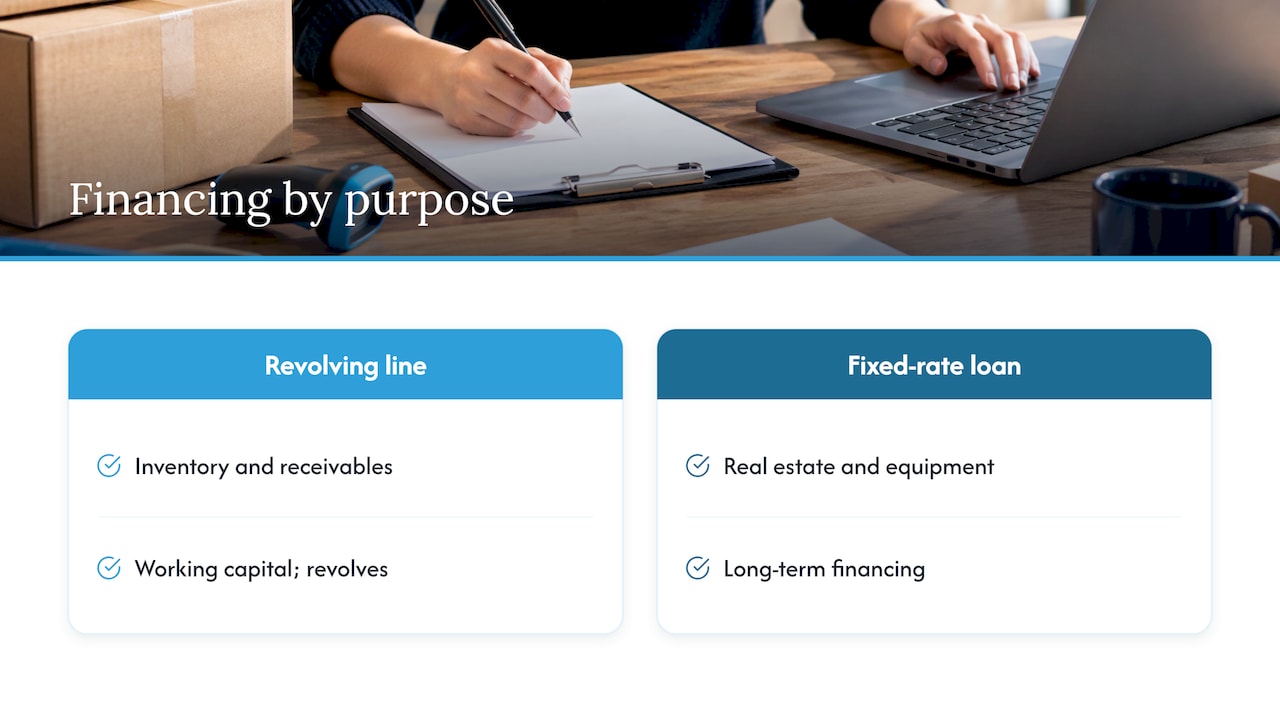
ASL and factoring both turn current assets into working capital. Cash-flow lending, by contrast, looks at your earnings history to size the loan. Neither is the right tool for buying a building or heavy equipment, because working-capital lines are meant to revolve, not to be repaid over decades.
For those purchases the SBA offers separate programs. The FDIC’s small business financing module describes the SBA 504 program as long-term, fixed-rate financing for major fixed assets, and the 7(a) program as covering working capital and equipment. It adds that SBA guarantees often lead to lower interest rates or more favorable terms.
The practical idea: let each product do its own job. Use a revolving line for inventory and receivables, and use a long-term fixed-rate loan for real estate and equipment. That keeps your working capital from being tied up in a down payment or a short equipment term. Our comparisons of SBA 504 vs. 7(a) and of when an equipment line of credit beats SBA 504 help you pick the right tool.
What to check before you agree to any receivables financing
Whichever way you go, run through these questions first:
- What is the all-in cost as an APR? Include every fee, not just the headline rate.
- How long are customers taking to pay? Slow payers raise factoring fees and may reduce ABL eligibility.
- Who will contact your customers? Decide whether you are comfortable with a third party collecting.
- What happens if a customer does not pay? Know whether the contract is recourse or non-recourse.
- What are the exit terms? Confirm minimums, notice periods and termination fees.
- What is your lender’s experience in your industry and region? Local knowledge of New England manufacturers, distributors and contractors matters when a field exam or a collateral review happens.
This is general information, not legal or tax advice. Before you sign a financing agreement, have your attorney and accountant review it.
Our perspective
We see asset-based lending as the more complete working-capital tool for a business that plans to grow. Factoring solves the problem of the invoice in front of you. A well-structured line solves the problem of the next twelve months: it draws on receivables, inventory and equipment, it expands as your business does, and it leaves you in direct contact with your customers.
Our approach is to look at the whole balance sheet. For many New England owners that means an asset-based line for day-to-day working capital, alongside SBA 504 financing for the building or equipment that anchors the business. Our 504 loans carry a 10% down payment requirement and fixed rates for up to 25 years, which keeps your cash available for payroll, inventory and opportunities instead of locking it into a purchase.
Our team has more than 70 years of experience and has invested over $2.3 billion in New England businesses. If you are weighing receivables financing, we would start by looking at your borrowing base and your growth plan together.
PHENYX
Pair working capital with long-term financing
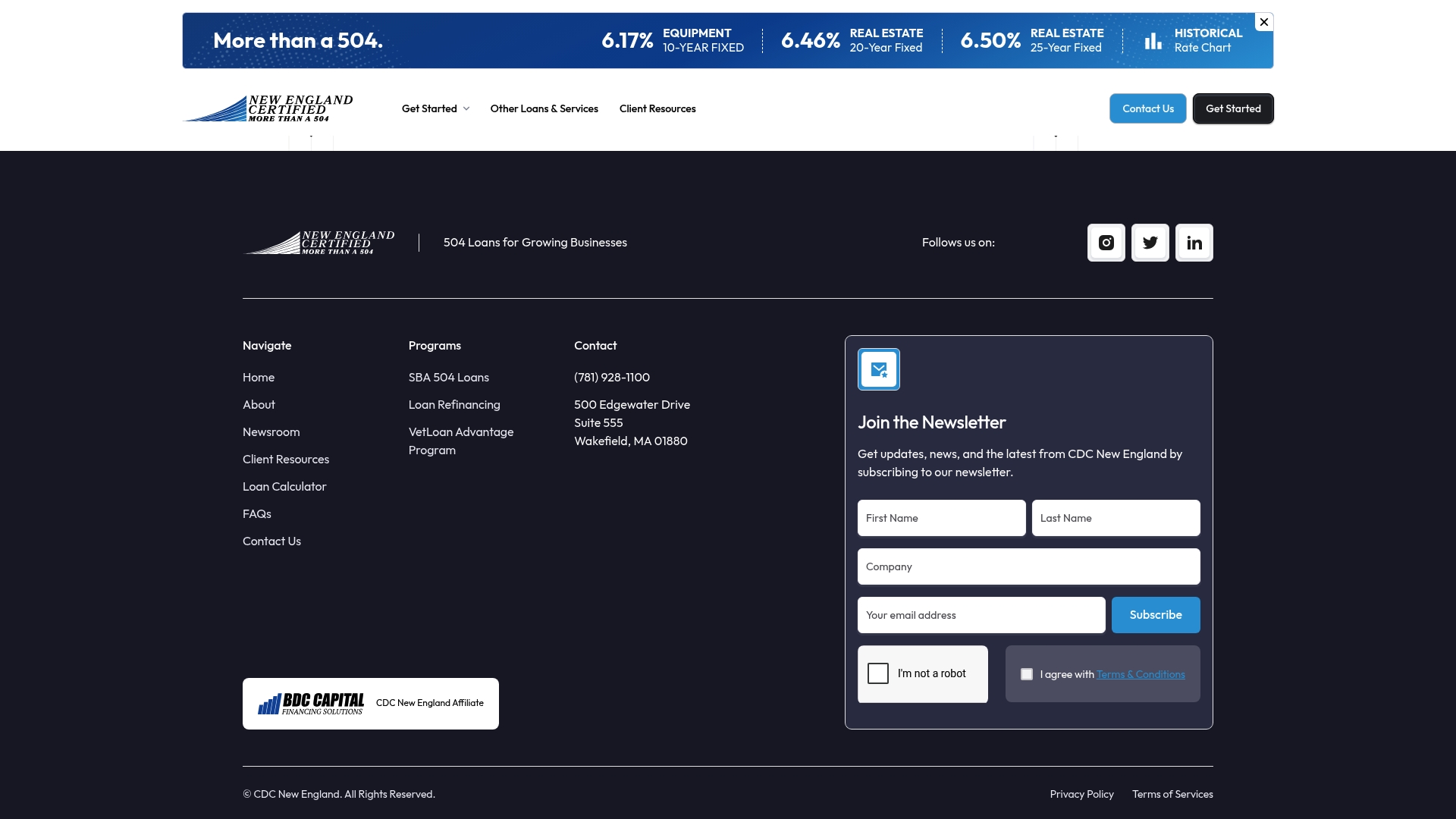
If your next move involves buying property, replacing equipment or refinancing existing debt, our SBA 504 loans are built for that. As published on our site in September 2026, rates were 6.58% for the Equipment 10-Year Fixed, 6.73% for the Real Estate 20-Year Fixed and 6.77% for the Real Estate 25-Year Fixed. These figures change with market conditions, so check our site for the current table. We also offer the SBA 504 Refinance Program, the VetLoan Advantage Program for veterans and their spouses, and the Down Payment Assistance Program for commercial property purchases.
See our SBA 504 loan options and talk to us about how a 504 loan and an asset-based line can work together for your business.
FAQ
Is factoring a loan?
No. Factoring is a sale of your receivables to a factor at a discount, while asset-based lending is a loan secured by assets. Because of that difference, the cost, the control over collections and the contract terms are structured differently.
Which is cheaper, asset-based lending or factoring?
It depends on your contract, but the two are priced differently, so convert both to an APR before comparing. Factoring fees are charged by the week or month as a share of invoice value, so slow-paying customers raise the total. ABL charges interest on the balance you use, which suits businesses with steady, collectible assets.
Do my customers know if I use asset-based lending?
Typically not. In an asset-based line you keep billing and collecting from your customers yourself, and the lender relies on your reporting and its own verification. In factoring, the factor usually manages the sales ledger and collects from customers.
Can a small business qualify for asset-based lending?
Yes. Asset-based lenders focus on collateral quality rather than credit ratings, and the ICAEW notes ABL is increasingly available to smaller businesses. The key is having enough eligible receivables, inventory or equipment to support a workable borrowing base.
Is ABL a substitute for an SBA 504 loan?
They do different jobs. ABL is a revolving line for working capital, while an SBA 504 loan provides long-term fixed-rate financing for real estate and major equipment. Many businesses use both so their working capital stays free for operations.
Sources
- Asset-Based Financing Basics, Journal of Accountancy
- Lenders, EXIM
- Asset-based finance, ICAEW
- Growth through asset-based finance, ICAEW
- Module 5 Small Business Financing, FDIC


