Choose an SBA 504 loan when you are buying, building or renovating owner-occupied real estate, or buying long-life equipment, and you want a fixed rate for 10, 20 or 25 years with as little as 10% down. Choose a 7(a) loan when you need one loan that can also cover working capital, inventory, a business acquisition or goodwill. Since July 2026 you can also use both on one project, up to $10 million combined.
The rest of this guide shows how the two programs differ in practice, with the numbers that matter to a Massachusetts, Connecticut, Rhode Island, New Hampshire or Vermont owner.
TL;DR
- 504 is specialized, fixed-rate financing for major fixed assets such as owner-occupied buildings, land and long-life machinery. 7(a) is the general-purpose program.
- 504 pairs a bank first loan with a nonprofit Certified Development Company (CDC) loan, and equity can be as low as 10%. 7(a) is a single lender loan with a negotiated rate that may be fixed or variable.
- 504 cannot fund working capital, inventory or goodwill. 7(a) can.
- Since July 4, 2026, one borrower can combine 7(a) and 504 for up to $10 million in total SBA-backed financing.
- For an owner-occupied building, 504 is usually the lower-cost, more predictable path.
Table of Contents
- The core difference: one loan or two
- What each loan can pay for
- Rates, terms and down payment compared
- Eligibility: who qualifies
- Refinancing existing debt
- Can you use both on one project?
- A decision checklist
- Our perspective
- Talk to a regional 504 lender
- FAQ
- Sources
The core difference: one loan or two
A 7(a) loan is the SBA’s primary business loan program. You apply through a local lender, and the SBA guarantees part of that lender’s loan. The SBA does not lend directly. The maximum loan amount is $5 million.
A 504 loan works differently. It is long-term, fixed-rate financing for major fixed assets that promote growth and job creation. It is originated through SBA-certified, SBA-regulated nonprofit CDCs working alongside a senior lender, and the maximum 504 loan amount is $5.5 million.
The SBA describes a typical 504 project this way:
- A private-sector senior loan covers up to 50% of project cost.
- A CDC loan, funded by a 100% SBA-guaranteed debenture, covers up to 40%.
- You contribute at least 10% equity.
That structure is the reason the 504 exists. The bank takes the first lien on a smaller share of the project, and the CDC portion carries a fixed rate for the full term. You deal with two lenders, but you get one coordinated closing and one monthly picture of your costs.
What each loan can pay for
Uses are the first filter, and for many owners they settle the question.
7(a) eligible uses include acquiring, refinancing or improving real estate; short- and long-term working capital; refinancing current business debt; purchasing and installing machinery and equipment; buying furniture, fixtures and supplies; and complete or partial changes of ownership.
504 eligible uses are narrower. Proceeds may finance the purchase, construction or renovation of buildings or land, long-term machinery and equipment with at least 10 years of remaining useful life, and qualifying debt refinancing. The SBA says 504 proceeds cannot be used for working capital or inventory, for nonqualified debt refinancing, or for speculation or investment in rental real estate.
In practice:
- A machine shop in Worcester buying its building and a new CNC machine: a 504 fits both pieces.
- A restaurant group in Providence buying a competitor, with goodwill and inventory in the price: the 7(a) fits, because the 504 cannot finance intangible value.
- A distributor in Manchester, New Hampshire that wants a warehouse plus cash to stock it: this is the case for combining programs, covered below.
If your project is mostly equipment, check the useful-life test. Our guide to the 10-year rule for 504 and equipment loans explains when equipment qualifies.
Rates, terms and down payment compared
This is where the 504 earns its reputation. The SBA’s lender comparison lists 7(a) maturities as generally 10 years or less, extending to 25 years when financing real estate or equipment with a useful life over 10 years. 504 loans range from $25,000 to $5.5 million, carry fixed interest, and generally have 25-year real estate or 10-year equipment maturities. For active 504 loans, 10-, 20- and 25-year maturities are available.
| Feature | SBA 504 | SBA 7(a) |
|---|---|---|
| Maximum SBA loan size | $5.5 million | $5 million |
| Structure | Bank first loan plus CDC loan | Single lender loan, SBA guaranteed |
| Interest rate | Fixed on the CDC portion | Negotiated; fixed or variable, capped by SBA maximums |
| Typical terms | 10, 20 or 25 years | Up to 10 years generally; up to 25 for real estate |
| Working capital, inventory | Not allowed | Allowed |
| Goodwill, business purchase | Not allowed | Allowed |
| Owner-occupied real estate | Core use | Allowed |
How rates are set
504 rates are pegged to an increment above the current market rate for 10-year U.S. Treasury issues, and fees, roughly 3% of the debt, can be financed with the loan. Because the rate is fixed for the term, a payment you model at closing is the payment you make in year 18.
For 7(a) loans, the SBA sets maximum rates over the base rate: plus 6.5% for loans of $50,000 or less, 6.0% for $50,001 to $250,000, 4.5% for $250,001 to $350,000, and 3.0% above $350,000. The actual rate is negotiated with the lender and may be fixed or variable. A variable 7(a) rate moves with the market, so your payment can rise even when your business is performing as planned.

Our currently published 504 rates are 6.58% for a 10-year fixed equipment loan, 6.73% for a 20-year fixed real estate loan and 6.77% for a 25-year fixed real estate loan. These move with the Treasury market, so confirm current figures on our rates page before you model a deal.
Down payment
A standard 504 asks for 10% equity. The SBA’s lender guidance describes at least 10% borrower equity in a typical structure, and a company-blog summary of the program notes that equity rises to 15% for startups or special-purpose properties, and 20% for both. Many conventional commercial loans ask for more, which is why owners keep cash for operations when they choose a 504. See our comparison of 10% down, 25 years versus conventional financing.
Fees and prepayment
7(a) loans carry an upfront guarantee fee, while 504 fees are built into the effective rate. Prepayment also differs. For 7(a) loans with maturities of at least 15 years, the SBA imposes a prepayment penalty when you voluntarily prepay at least 25% of the balance in the first three years: 5% in year one, 3% in year two and 1% in year three. If you may sell or refinance early, read that schedule before you sign anything.
For manufacturers there is a specific incentive. For fiscal year 2026, the SBA waived upfront fees on qualifying 7(a) loans up to $950,000 and all fees on 504 manufacturing loans. That waiver is limited to a fiscal year and to manufacturers, so ask whether a similar one applies when you apply.
Eligibility: who qualifies
Both programs require a for-profit business located in the United States. Beyond that, the tests differ.
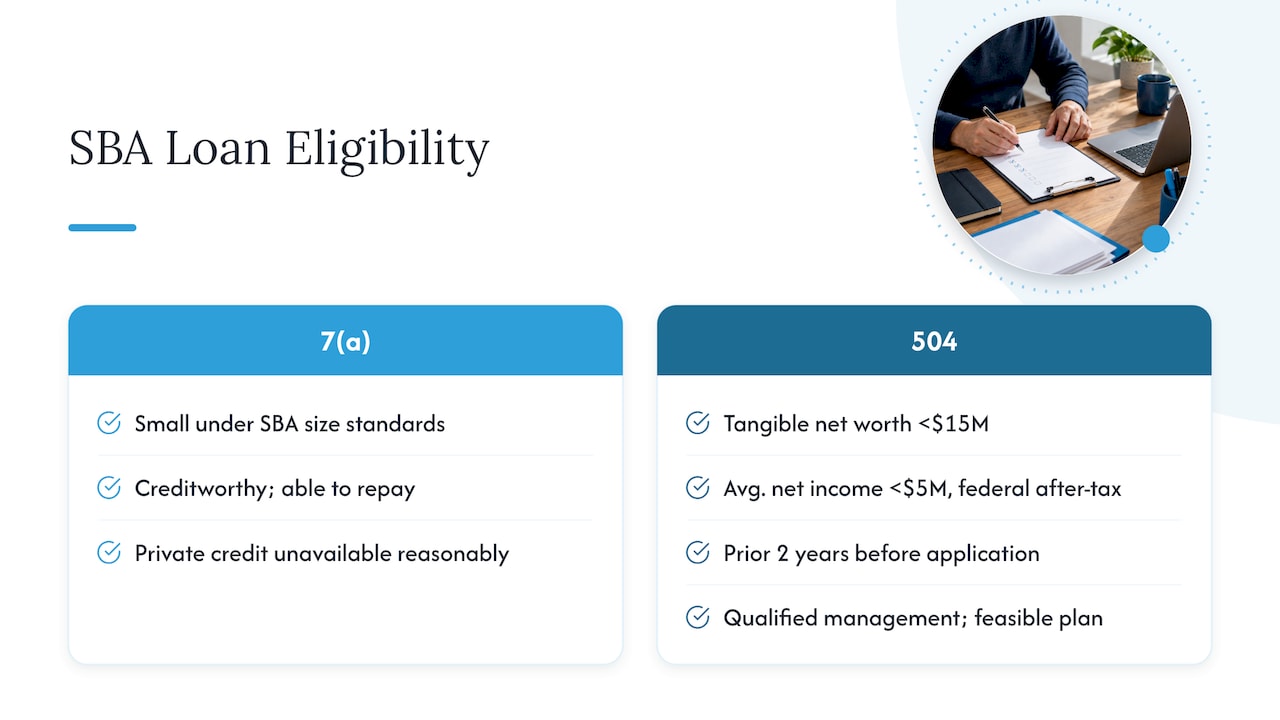
7(a): the business must be small under SBA size standards, creditworthy with a reasonable ability to repay, and unable to obtain the credit it wants from non-government sources on reasonable terms.
504: the SBA’s guidance sets a tangible net worth below $15 million and average net income below $5 million after federal income taxes for the two years before application. General requirements also include qualified management, a feasible business plan, good character and repayment ability.
The 504 also expects the project to be owner-occupied. For real estate, that means your business occupies most of the building; our guide to 51% occupancy and 504 eligibility walks through it, and the 504 requirements for New England borrowers cover documents and underwriting. Startups can qualify too, with higher equity, as described in our 504 for startups guide.
Refinancing existing debt
Both programs allow refinancing of qualifying existing commercial debt. The SBA says 7(a) offers broad flexibility for general business debt, while the 504 focuses on debt tied to eligible fixed assets. In 2024 the SBA also finalized a rule to streamline 504 refinancing, including debt tied to land, facilities and machinery.
If you carry a short-term or balloon loan on your building, a 504 refinance can turn it into a long fixed-rate loan. Details are on our SBA 504 refinance page.
Can you use both on one project?
Yes. Effective July 4, 2026, the SBA raised the cumulative limit so one borrower can hold up to $10 million in combined 7(a) and 504 financing, up from $5 million. That lets you pair real estate or equipment financing with operating capital.
A workable split looks like this:
- Use a 504 for the building and long-life equipment, locking a fixed rate on the largest, longest-lived part of the cost.
- Use a 7(a) for inventory, working capital or goodwill that the 504 cannot fund.
- Keep the two loans separate so each has the term that suits its asset.
For a broader view of how SBA programs sit against bank financing, this SBA versus conventional loan comparison looks at the same $10 million update. Our own write-up, Up to $10M SBA loans for New England small businesses, covers the 2026 rules from the 504 side.
A decision checklist
Work through these questions in order.
- Is most of the cost real estate or long-life equipment you will use yourself? If yes, start with the 504.
- Do you need working capital, inventory or to buy goodwill? Add a 7(a), or use it alone if those dominate.
- Do you want a payment that cannot change? The 504’s fixed CDC rate gives that. A 7(a) may be fixed or variable, so ask the lender.
- How much cash do you want to keep? Compare the 10% equity of a standard 504 against any alternative.
- Does your net worth and income fit the 504 limits? If you exceed them, the 7(a) is the likelier route.
- Will you sell or refinance within three years? Check the 7(a) prepayment schedule.
Our perspective
We see the same pattern across New England. Owners who plan to stay in a building for a decade or more tend to be happiest with a 504, because the payment is known on day one and the 10% equity keeps cash in the business. Owners buying a business, not a building, are usually better served by a 7(a), and we say so. When a project has both pieces, we like to structure the real estate through the 504 first and then size working capital around it.
We are a nonprofit-structured regional lender with more than 70 years of experience and over $2.3 billion invested in New England businesses, so we have watched how these loans behave through more than one rate cycle. A fixed rate for up to 25 years is the feature owners value most when rates rise. Premier Certified status also supports faster approvals on 504 projects. Our veteran and down payment programs exist because equity is the hurdle we hear about most.
— PHENYX
Talk to a regional 504 lender
If your project involves owner-occupied real estate or long-life equipment, we can model a 504 against your current options. Our published fixed rates run from 6.58% for 10-year equipment to 6.77% for 25-year real estate, and we offer a Down Payment Assistance Program for buyers who want to reduce the cash needed at closing. Veterans and their spouses can ask about the VetLoan Advantage Program, which lists a 1.0% processing fee.
Start at cdcnewengland.com and we will help you sort out which structure fits.
FAQ
Is a 504 loan cheaper than a 7(a)?
Often, for owner-occupied real estate, because the CDC portion carries a fixed rate pegged to Treasuries and fees are included in the effective rate. A 7(a) has an upfront guarantee fee and a negotiated rate that may be variable. Compare total cost on your own project, since the two loans fund different things.
Can a 504 loan fund working capital?
No. The SBA states that 504 proceeds cannot be used for working capital or inventory. If you need either, a 7(a) can cover it, and since July 4, 2026 you can combine the two programs for up to $10 million in total SBA-backed financing.
Can I use a 504 to buy a building I will lease out?
Not as an investor. The SBA says 504 proceeds cannot be used for speculation or investment in rental real estate. The project must be owner-occupied, so your business needs to occupy most of the space.
Who actually makes a 504 loan?
A Certified Development Company, a nonprofit certified and regulated by the SBA, works with a private senior lender. The SBA keeps a directory of CDCs by state if you want to see who serves your area.
Sources
- SBA: 504 loans
- SBA: 7(a) loans
- SBA lender resources: partnering with SBA loan programs
- SBA: increasing access to capital
- SBA: fee waiver for small manufacturers, fiscal year 2026
- SBA: cumulative 7(a) and 504 limit raised to $10 million
- SBA: 2024 rule to streamline 504 refinancing
- SBA: list of Certified Development Companies
- SBA 504 vs 7(a) loan: differences and which to pick