You qualify for an SBA 504 loan if you run a for-profit business in the United States, fall within the SBA’s size limits, plan to occupy the property you finance (or use the equipment in your operations), and can show the ability to repay. The loan is delivered through a Certified Development Company (CDC), so the practical test is whether a CDC can approve your project. This guide walks through each requirement a New England business owner will face, from size and occupancy to credit, down payment and paperwork.
TL;DR
- Your business must operate for profit in the U.S., be small under SBA rules, and show it can repay the debt from operating cash flow.
- The 504 program finances fixed assets you use: owner-occupied commercial real estate and long-life equipment, not working capital or inventory.
- The standard structure puts roughly 10% down from you, with a bank lender and a CDC covering the rest.
- Refinancing is possible when the debt meets the SBA’s definition of qualified debt.
- Start with a local CDC conversation before you assemble a full application.
Table of Contents
- What the SBA 504 program is designed to do
- Business eligibility: who can qualify
- What the loan can and cannot finance
- Down payment, collateral and structure
- Credit, cash flow and character
- Refinancing existing debt with a 504 loan
- Veterans and their spouses
- Perspective: what we see across New England
- Current rates and terms at CDC New England
- How to apply: a practical sequence
- Start your 504 project with CDC New England
- FAQ
- Sources
What the SBA 504 program is designed to do
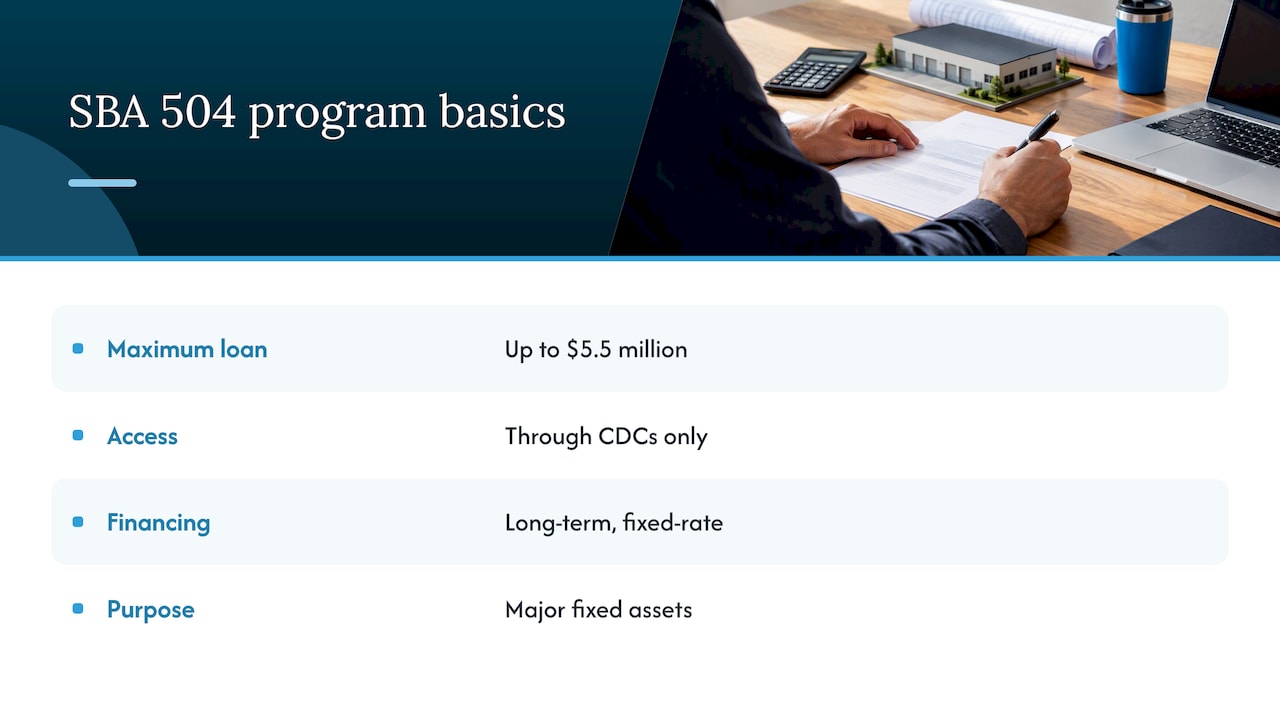
The 504 program provides long-term, fixed-rate financing of up to $5.5 million for major fixed assets, and it is available only through Certified Development Companies. CDCs are community-based nonprofit partners that understand the program’s regulations and help you work with lenders.
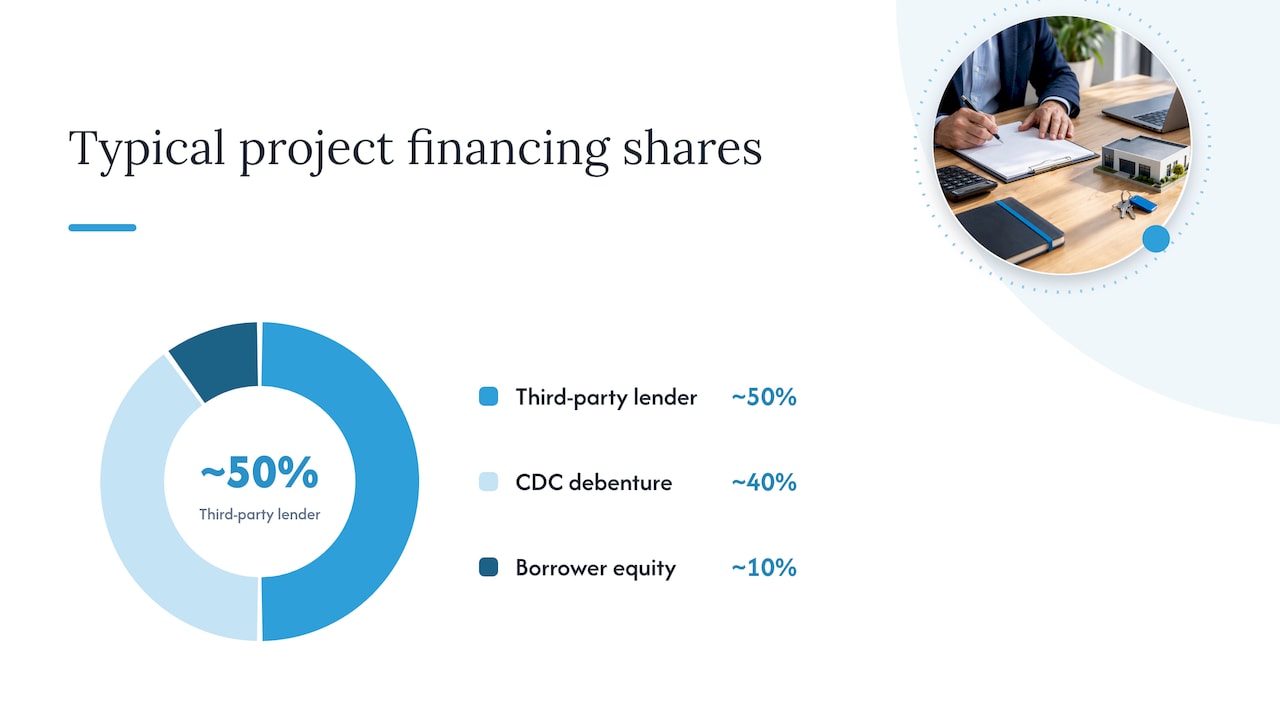
In practice, a 504 project has two loans. A bank or other third-party lender provides a first-lien loan, usually about half of the project. The CDC provides a second loan, funded through an SBA-backed debenture, for a large share of the remainder. You contribute the balance as equity. Lenders and CDCs increasingly use software to move these packages along, and AI automation in SBA lending is one example of how processing is changing, though the underwriting standards below still apply.
If you want the full mechanics of who funds what, see our breakdown of the 50/40/10 SBA 504 structure.
Business eligibility: who can qualify
The SBA’s baseline checks are straightforward. Your business should:
- Operate for profit in the United States.
- Be an operating business that is small under SBA size requirements.
- Not fall into an ineligible category.
- Have qualified management, a feasible plan, good character and the ability to repay.
Those standards come from the SBA’s 504 program page, which also directs applicants to a local CDC for eligibility and application requirements.
Size limits
The 504 program uses its own size test instead of industry-by-industry standards. Under the current test, your business generally needs a tangible net worth below $20 million and average net income after federal taxes below $6.5 million over the prior two years. Older fact sheets still circulate with lower thresholds, so confirm the current numbers with your CDC. For most owner-operated New England companies, such as manufacturers in Worcester, contractors in Manchester or professional practices in Providence, size is rarely the obstacle.
Owner occupancy
Occupancy is where many applicants stumble. The program is built for businesses that use the asset, not investors who buy property to lease out. For an existing building, your business typically needs to occupy at least 51% of the space. For new construction the requirement is higher, generally 60%. You may lease the remaining space to tenants, but your company must be the primary user. Our guide to 51% occupancy and SBA 504 eligibility explains how to calculate it and what happens if you plan to grow into the space.
Job creation and public policy goals
The 504 program also carries a public benefit test. CDCs must meet job creation or retention goals for each project, as set out in 13 CFR 120.860-861. Your CDC handles this analysis and will tell you early whether your project clears it, so you do not need to design it yourself. Projects that fall short can sometimes qualify under community development or public policy goals instead, which your CDC can assess.
Startups and newer businesses
Newer companies are not automatically excluded, though lenders look harder at projections, management experience and equity. If your business is under two years old, expect to document your plan in more depth. We cover the options in SBA 504 for startups.
What the loan can and cannot finance
An SBA 504 loan can fund purchasing, constructing or renovating existing buildings or land, buying long-term machinery or equipment with at least a 10-year remaining useful life, and refinancing or consolidating qualified debt under certain conditions.
It cannot cover everything. Under 13 CFR 120.884, ineligible costs include:
- Short-term equipment
- Furniture and furnishings, unless essential and a minor portion of the project
- Automobiles and trucks
- Ancillary business expenses such as management fees or advertising
Working capital and inventory are also outside the program. If you need both a building and operating cash, you may pair a 504 with a separate working capital product. Compare your equipment options in our article on the 10-year rule for 504 versus equipment loans.
| Project type | Typically eligible? | Notes |
|---|---|---|
| Buy an owner-occupied building | Yes | Meet the occupancy test |
| Ground-up construction | Yes | Higher occupancy threshold |
| Renovation or expansion | Yes | Must be tied to a fixed asset |
| Heavy machinery with 10+ year life | Yes | Short-life equipment does not qualify |
| Vehicles, furniture, advertising | No | Ineligible under 13 CFR 120.884 |
| Working capital, inventory | No | Use a separate product |
| Qualified existing debt | Yes, under conditions | See refinancing below |
Down payment, collateral and structure
The appeal of the 504 is the low equity requirement. The standard structure asks you for about 10% of the project cost, with the third-party lender typically providing about 50%. Those lenders are subject to participation and subordination rules in 13 CFR 120.920-926. The CDC’s debenture covers the remaining share.
Two cautions. First, the equity requirement can rise for startups or special-purpose properties, so confirm your number early. Second, the project itself is the primary collateral, with lenders often adding business assets or personal guarantees from owners. Ask your CDC what collateral package it expects.
If cash for the down payment is your sticking point, our Down Payment Assistance Program is designed for exactly that situation.
Credit, cash flow and character
The SBA sets general standards rather than a single credit score cutoff. In practice, the bank lender and the CDC each review your credit, and many guides cite scores in the high 600s as a working minimum. Treat that as a rule of thumb, not an SBA rule. What matters more is a clear story:
- Repayment ability: Two to three years of business tax returns and financial statements that show cash flow covering the new debt payments.
- Credit history: Personal credit for each owner of 20% or more, and business credit. Past problems are not an automatic denial, but be ready to explain them.
- Management experience: Your track record in the industry and the strength of your team.
- Character: Honest disclosure of past defaults, liens, bankruptcies or legal issues. Prior losses on federal debt are a serious problem.
Refinancing existing debt with a 504 loan
Yes, you can refinance with a 504 loan, within limits. The debt must meet the definition of qualified debt in 13 CFR 120.882, and the program cannot be used to refinance debt that does not qualify or to raise working capital. Typical candidates are short-term or balloon commercial mortgages and equipment loans that financed fixed assets your business already uses. Our SBA 504 Refinance Program walks borrowers through the qualification screen.
Veterans and their spouses
The SBA collects veteran status on applications, but disclosure is voluntary and, according to the federal regulations, it does not affect the loan decision. Any veteran benefit therefore comes from the CDC’s own program design. At CDC New England, veterans and their spouses can look at the VetLoan Advantage Program, which carries a 1.0% processing fee.
Perspective: what we see across New England
After more than 70 years working with regional businesses and over $2.3 billion invested, we see the same pattern. Owners often rule themselves out too early. They assume they need 20% or 25% down, or that their company is too small or too new. Others come in with the right project but the wrong structure, such as a building that is mostly leased to outside tenants.
The borrowers who get approved fastest have three things in order before they call: a clear occupancy plan, current financial statements, and a realistic view of their equity. We encourage owners to talk with us before signing a purchase contract, because the structure can often be adjusted while the deal is still flexible. As a Premier Certified CDC, we are set up for faster approvals, and our focus is the fixed-rate, long-term financing that preserves your working capital for running the business.
— PHENYX
Current rates and terms at CDC New England
Our published fixed rates on the 504 debenture portion, as listed on our site, are:
| Program | Rate |
|---|---|
| Equipment 10-Year Fixed | 6.58% |
| Real Estate 20-Year Fixed | 6.73% |
| Real Estate 25-Year Fixed | 6.77% |
Rates move with the market, so confirm today’s figures on our site. The final cost of your project also reflects the bank loan, which carries its own rate. To compare terms, read our guide to 10, 20 or 25 year SBA 504 terms.
How to apply: a practical sequence
- Check eligibility with a CDC. Describe your business, the property or equipment and your timeline. A short call can confirm occupancy, size and job creation questions.
- Line up a bank lender. The first-lien lender provides about half the financing. Your CDC can advise on lender fit.
- Gather documents. Plan on business and personal tax returns, financial statements, a debt schedule, a business plan or project summary, entity documents, a purchase contract or equipment quotes, and personal financial statements from owners.
- Complete the application. The core form is explained in our Form 1244 application guide.
- Underwriting and SBA approval. The CDC packages the loan, and the SBA reviews it.
- Close and fund. The debenture is sold after your project is complete or the asset is acquired. To avoid extra carrying costs in construction, read about interim interest on SBA 504 debentures.
It also helps to choose a local partner. Our guide on how to vet an in-state CDC lists what to ask.
Start your 504 project with CDC New England
We finance owner-occupied commercial real estate and equipment for businesses in Massachusetts, Rhode Island, Vermont, New Hampshire and Connecticut. We offer fixed rates for up to 25 years, down payments as low as 10%, help with the down payment itself, refinancing, and a dedicated veterans program.
If you are weighing a purchase or refinance, talk with CDC New England about your project and we will tell you plainly whether it fits the 504 program.
FAQ
What credit score do I need for an SBA 504 loan?
The SBA does not set one universal minimum score. The bank lender and CDC review your credit alongside cash flow, management experience and collateral. Many lenders look for scores in the high 600s or above, but a strong operating history can offset a weaker score.
Can I buy an investment property with an SBA 504 loan?
No. The program is for owner-occupied property. Your business generally needs to occupy at least 51% of an existing building, or a higher share of new construction, and you can lease only the remainder.
Can I use a 504 loan for working capital?
No. Working capital, inventory and unqualified debt are outside the program. If you need operating cash as well, ask about separate products such as an asset-based line of credit.
Do veterans get different SBA 504 requirements?
The core SBA eligibility rules are the same for everyone, and veteran status disclosure is voluntary. Veterans and their spouses may still benefit from CDC-level programs, such as our VetLoan Advantage Program.
Sources
- 504 loans, U.S. Small Business Administration
- 13 CFR Part 120 Subpart H, Development Company Loan Program
- 13 CFR 120.884, Ineligible costs for 504 loans
- nCino partners with Parlay to bring AI automation to SBA lending