

An SBA 504 loan can finance the purchase, ground-up construction, expansion or refinance of a self-storage facility, as long as you run it as an operating business. It combines long-term fixed-rate financing with a low down payment, which suits a property type that takes time to fill. We are CDC New England, a Certified Development Company, and this guide explains how the program applies to storage, what lenders look at, and how to prepare before you apply.
TL;DR
- A 504 loan can fund buying, building or renovating a storage facility, plus long-term equipment, but not working capital or inventory.
- You must operate the business and occupy enough of the property. Pure passive real estate investment does not qualify.
- Standard projects need a 10% borrower contribution. Limited- or single-purpose buildings can need 15%, so plan your equity for that.
- Our published fixed rates, read from our site in September 2026, run from 6.58% to 6.77%, depending on the term. Rates move, so confirm before you plan.
- Ground-up projects should expect a third-party feasibility study and an environmental review.
Table of Contents
- Why the 504 program fits self-storage
- What a 504 loan can pay for
- Eligibility: operating business, not passive investment
- How the financing is structured
- Rates, terms and costs
- What lenders want to see before a storage deal closes
- Refinancing an existing storage facility
- How to apply, step by step
- Our perspective
- Start with the numbers
- FAQ
- Sources
Why the 504 program fits self-storage
Self-storage is capital-intensive. You buy or build a large asset, then wait for units to lease up. A loan with a short term or a balloon payment puts pressure on you during exactly that period.
The SBA describes the 504 program as long-term, fixed-rate financing for major fixed assets that promote business growth and job creation. It is delivered through nonprofit Certified Development Companies (CDCs) working with a senior lender, and the maximum loan amount the SBA lists is $5.5 million. Because the payment is fixed for the life of the loan, your largest cost does not change while occupancy builds.
The low down payment matters too. Money you do not tie up in the building stays available for marketing, security systems, software and the first months of operation.
What a 504 loan can pay for
The SBA states that proceeds can finance the purchase, construction or renovation of existing buildings or land, and long-term machinery and equipment with a useful remaining life of at least 10 years. For a storage operator, that translates into:
- Buying an existing facility from an owner who is retiring or selling.
- Acquiring land and building a new facility.
- Adding buildings or units to a site you already own, which the regulation treats as an expansion. Under 13 CFR 120.882, eligible costs include land acquisition, essential professional fees and repayment of interim financing, including its points, fees and interest.
- A construction contingency reserve of up to 10% of construction cost.
- Long-life equipment tied to the project, such as fixed gate and access systems or climate-control equipment. Whether a given item qualifies depends on its useful life, so confirm each one with your CDC.
The same SBA page is clear about exclusions. A 504 loan cannot fund working capital, inventory, non-qualified debt, or speculation and investment in rental real estate. Marketing launches, operating reserves and initial payroll need another source.
Eligibility: operating business, not passive investment
This is where most storage owners need to pay attention. The SBA says eligible businesses must be operating, for-profit, located in the United States, small under SBA size standards and not engaged in passive or speculative activities.
The occupancy rule
The SBA’s operating manual for 504 loans, SOP 50 10 7.1, ties the occupancy requirement to 13 CFR 120.131: the borrower’s business must occupy at least 51% of an existing building and 60% of a newly constructed one. Section 120.880 of the regulation also says the borrower must use the project property, with one exception for an eligible passive company that leases it to an operating company. A storage owner who runs the facility, employs the manager and rents the units is operating a business. An investor who simply holds the building and collects rent from a separate tenant business has a different structure and needs a different path.
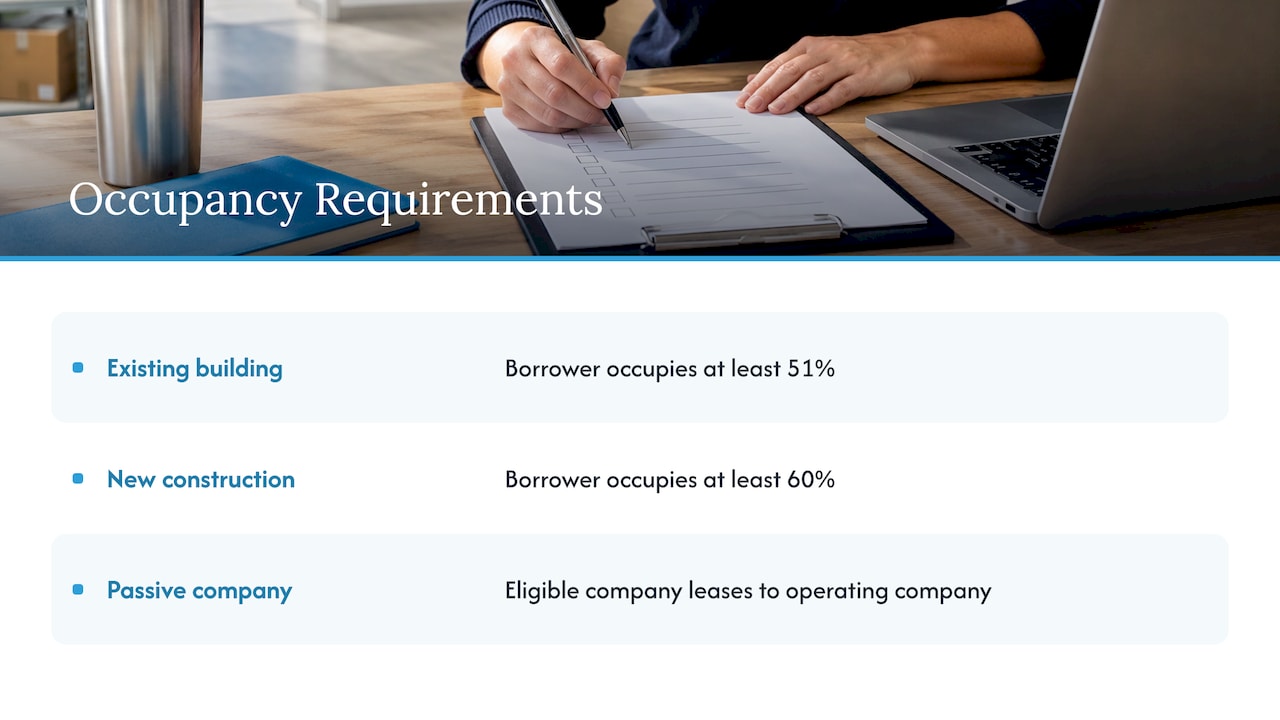
The SBA has since issued SOP 50 10 8, effective June 1, 2025, which replaced SOP 50 10 7.1. It covers 504 eligibility, passive company structures, occupancy and leasing, and program fees. Your CDC works from the current version, and you should ask which rules apply to your deal before you sign a purchase contract. Our guide to the 51% occupancy rule for New England borrowers walks through the same question in more detail.
Using a property-holding company
Many owners hold real estate in one entity and run the operations in another. The regulation allows that through an eligible passive company that leases the property to an operating company, with conditions set out in the SOP. If you are deciding how to set up those entities, choosing the right U.S. entity structure is worth reading before you talk to counsel, since the structure must be in place before the application.
Size and guarantees
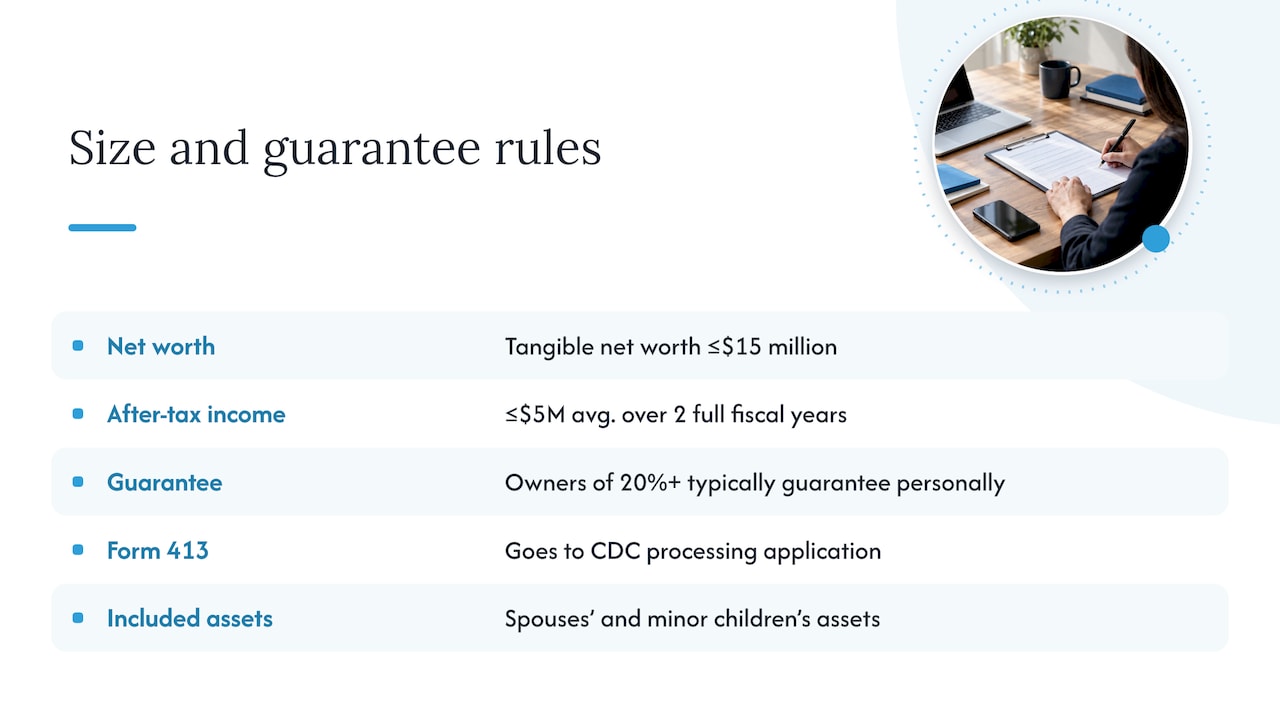
The business, together with its affiliates, must meet an SBA size standard under 13 CFR 121.301(b), as 13 CFR 120.880 provides. SOP 50 10 7.1 also describes an alternative standard: tangible net worth of no more than $15 million and average after-tax net income of no more than $5.0 million over the two full fiscal years before application. Most independent storage operators fall well inside these limits.
Owners of 20% or more are typically asked to guarantee the loan personally. Each of them, along with any guarantor, completes the SBA Form 413 personal financial statement, which for 504 loans goes to the CDC processing the application. Start gathering those statements early, because spouses’ and minor children’s assets are included.
How the financing is structured
A 504 project is funded from three sources, which is why the average borrower ends up with a lower payment than on a conventional loan with a short term:
- A senior lender provides a first-lien loan, usually about 50% of the project.
- The CDC provides the SBA-backed debenture, typically up to 40%, at a long-term fixed rate.
- You contribute the balance, which is 10% on a standard project.
Our explainer on the 50/40/10 structure covers who pays what and when.
The 15% question
The regulation raises the borrower contribution for limited- or single-purpose buildings. In the refinance rules at 13 CFR 120.882(g), the contribution is at least 15% for such a building, unless the SBA publishes a Federal Register notice allowing 10%. Lenders and CDCs look at how adaptable a building is to other uses. Because storage buildings have a specific design, some projects are treated as limited-purpose. For your own budget, plan on 15% equity until your CDC confirms the classification of your specific property in writing. If it comes in at 10%, you have a cushion.
A worked example
Suppose a $4,000,000 total project, such as acquiring an existing facility:
| Source | Share | Amount |
|---|---|---|
| Senior lender | 50% | $2,000,000 |
| CDC debenture | 40% | $1,600,000 |
| Borrower | 10% | $400,000 |
If the project is classified as limited-purpose, the borrower share rises to 15% ($600,000). The extra contribution reduces the share of the other lenders, and the CDC’s portion is generally the one that adjusts, so ask for both versions of the numbers on your term sheet. This example is illustrative, not a quote.
Rates, terms and costs
Our site publishes fixed rates by product. As we read them in September 2026:
| Product | Fixed rate |
|---|---|
| Equipment, 10-year fixed | 6.58% |
| Real estate, 20-year fixed | 6.73% |
| Real estate, 25-year fixed | 6.77% |
For a storage facility, the real estate terms are the relevant ones. These are the rates we published for that month. The debenture rate moves with market conditions and is reset on a regular schedule, so use our current rate listing as your reference and not this article. Your own quote will also show the senior lender’s rate, which is set separately.
Budget for closing costs beyond the rate: the third-party appraisal, environmental report, survey, legal fees and SBA program fees, which the SBA sets out in its operating manual. Eligible professional fees can be part of the financed project cost, so many of them do not have to come out of your cash.
What lenders want to see before a storage deal closes
The SBA sets the program rules, but the lenders and CDC underwrite the individual project. For storage, expect these questions:
- Your experience. Have you run a storage facility or a comparable service business? New operators often strengthen the file with a seasoned property manager.
- Market support. For ground-up construction, lenders commonly ask for an independent feasibility study that looks at the supply of storage space, absorption and rents in the trade area around the site.
- Environmental condition. An environmental site assessment is routine for land and commercial buildings.
- Cash flow. Projections must show that the facility can cover its debt service with a reasonable margin as it fills up, on realistic lease-up assumptions.
- Personal credit and liquidity. Lenders set their own credit standards, and owners with a clean record and cash reserves after closing have the easiest path.
If your facility will include other tenants, such as retail or office space, read our guide to multi-tenant 504 properties, since the occupancy rule is measured across the whole building.
Refinancing an existing storage facility
If you already own a facility financed with a short-term or higher-rate loan, the 504 program also covers refinancing. Under 13 CFR 120.882(g), a refinance without expansion requires that:
- You have operated for the full two years before applying.
- The debt being refinanced was incurred at least six months earlier, with at least 75% of the proceeds used for an eligible fixed asset.
- The refinance provides a substantial benefit, meaning a lower installment on the refinanced portion once penalties and fees are counted.
- The financing comes from a third-party loan at least equal to the 504 loan, a borrower contribution of at least 10% (15% for a limited- or single-purpose building) and a 504 loan of no more than 40%, with the 504 and third-party loans together not above 90% of the collateral’s fair market value.
For an expansion project, 13 CFR 120.882(e) allows refinancing of up to 100% of the expansion cost under the same 75% test. That is useful if you are adding buildings and want to fold older debt into the same package. Read how this works in our refinance with expansion guide, or see how to refinance commercial real estate with a 504 loan for the full process.
How to apply, step by step
- Confirm your structure. Decide which entity owns the property and which operates the business, and make sure the occupancy rule is met.
- Collect the basics. Entity documents, personal financial statements for each 20% owner, tax returns, a current debt schedule and the purchase contract or construction budget.
- Order the third-party reports early. For a build, the feasibility study and environmental assessment take the longest and drive the timeline.
- Talk to a CDC before you pick a senior lender. The SBA states that 504 loans are available exclusively through CDCs, which help shape the financing with the senior lender.
- Receive the term sheet. Compare the borrower contribution, the fixed rate and the fees for the standard and limited-purpose cases.
- Underwrite, approve and close. The CDC packages the application for SBA approval and the debenture is funded at closing.
Our Premier Certified status is designed to bring faster approvals, and we work with New England borrowers in Massachusetts, Rhode Island, Vermont, New Hampshire and Connecticut.
Our perspective
Storage owners often come to us having been quoted a five- or seven-year loan with a balloon. That structure assumes you will refinance at exactly the moment you want to be focused on filling units.
We built our approach around the opposite idea: a fixed rate for up to 25 years, a 10% down payment on standard projects, and a payment you can plan around from day one. Over 70 years we have invested more than $2.3 billion in New England businesses, and the businesses that do best are the ones that plan the equity, the structure and the lease-up together.
Our advice is to bring us the project before you commit to a contract. We can show you the numbers at 10% and at 15%, whether Down Payment Assistance fits, and how a refinance or expansion could be combined. If you served in the military, ask about our VetLoan Advantage Program too.
PHENYX
Start with the numbers
If you are planning to buy, build or refinance a storage facility in New England, we can model the project with you. Our 504 loans offer fixed rates for up to 25 years on real estate, and our Down Payment Assistance Program is there for owners who need help with the equity portion. Veterans and their spouses can look at the VetLoan Advantage Program, which lists a 1.0% processing fee. Owners with existing debt can review the SBA 504 Refinance Program.
See the rates and programs at cdcnewengland.com.
FAQ
Can I use an SBA 504 loan to build a self-storage facility from the ground up?
Yes. The SBA says 504 proceeds can fund the purchase of land and the construction of buildings. Expect lenders to require an independent feasibility study and an environmental review, and note that new construction carries a 60% occupancy requirement under the SBA’s rules.
Can I buy a storage facility only as an investment and rent the units through a manager?
The 504 program excludes passive and speculative activity. The borrower must operate the business, with a narrow exception for an eligible passive company that leases the property to an operating company. Speak with your CDC and an attorney about the structure before you apply.
How much is the down payment?
On a standard 504 project the borrower contribution is 10%. For limited- or single-purpose buildings, the regulation sets 15% in the refinance context, so storage owners should budget for 15% until the lender confirms the property’s classification.
What is the maximum 504 loan amount?
The SBA lists a maximum 504 loan amount of $5.5 million. That figure is the CDC’s portion of the project, and the senior lender’s loan comes on top of it, so the total project can be considerably larger.
Can I refinance my existing storage facility loan with a 504?
Yes, if you meet the conditions in 13 CFR 120.882: two years of operations, qualifying debt that is at least six months old and a substantial benefit to the borrower. Expansion projects have their own rules for including existing debt.
Sources
- SBA: 504 loans
- 13 CFR 120.882, Eligible project costs for 504 loans
- eCFR: 13 CFR Part 120, Subpart H
- SBA SOP 50 10 7.1
- SBA SOP 50 10 8
- SBA Form 413, Personal Financial Statement


