Leasing costs less cash on day one. Buying usually costs less per year of occupancy once you stay long enough, and it builds equity you keep. For a business that expects to occupy the same space for a decade or more, owning is often the stronger move, and an SBA 504 loan lowers the entry barrier to as little as 10% down. We lay out the numbers to compare, the tax treatment and a simple way to decide.
TL;DR
- Leasing needs less upfront capital and gives flexibility. Over a 10 to 20 year horizon, ownership may prove more economical if your space needs stay stable and the property appreciates.
- The SBA 504 program finances owner-occupied buildings and land with fixed-rate terms of 10, 20 or 25 years, and the borrower’s standard injection is 10% of the project.
- Compare after-tax cash outflow, not rent against mortgage payment alone.
- Your horizon, growth plans and capital needs decide the answer more than the market headline does.
Table of Contents
- The core trade-off: flexibility versus equity
- What leasing really costs
- What buying really costs
- Taxes: both options are deductible, in different ways
- A worked comparison
- How the SBA 504 loan makes buying reachable
- When leasing makes sense, and when buying does
- Financing a purchase in New England
- How to decide in five steps
- Where CDC New England fits
- Our view: pay yourself, not your landlord
- FAQ
- Sources
The core trade-off: flexibility versus equity
A lease rents you space for a set term. You pay a deposit and monthly rent, and you give the space back or renegotiate at the end. Your capital stays free for inventory, hiring and equipment. The cost is that you build no ownership, and the landlord sets the rent at renewal.
Buying means you carry a loan, taxes, insurance and maintenance, but your payment is fixed for the loan term if you choose a fixed rate. Every payment moves you toward a building you own, and you decide on renovations, signage and layout without asking permission.

Neither is right for every company. The question is which one fits your next 10 to 20 years.
What leasing really costs
The low entry price is real: typically first month’s rent plus a security deposit. But a fair comparison counts more than the rent line:
- Annual escalations. Most commercial leases build in scheduled rent increases. Add them across the full term.
- Operating charges. Many leases pass property taxes, insurance and common-area maintenance to the tenant. Read how your lease handles them.
- Build-out and moving. Tenant improvements, moving, downtime and new signage recur every time you relocate.
- Renewal risk. At the end of the term, your rent follows the market, and in a tight market that can be a steep step.
- Nothing at the end. Rent is a pure expense. You hold no asset when the lease ends.
Leasing wins when your needs are uncertain: a business that may double headcount in two years, test a new location or change its operations is better served by a shorter commitment.
What buying really costs
Ownership carries its own list, and a fair comparison counts all of it:
- Down payment and closing costs. This is the largest barrier, and the one most owners overestimate.
- Loan payment. Principal and interest on the financing.
- Property taxes, insurance and maintenance. Owners carry roofs, parking lots and systems directly.
- Opportunity cost. Cash in the building is cash not used elsewhere. Cresa’s comparison notes that the answer depends on local market conditions, interest rates, and how efficiently you can deploy capital elsewhere.
On the other side of the ledger: equity builds with each payment, a fixed-rate loan stabilizes your occupancy cost, and any appreciation belongs to you.
Taxes: both options are deductible, in different ways
Tax treatment is a real part of the comparison, so confirm it with your CPA before you commit.
The IRS says a taxpayer can deduct rent as an expense only if the property is used in their trade or business and they will not receive equity in or title to it. Owners, by contrast, deduct the interest on business borrowing, and the IRS notes limits and special rules may apply. Depreciation on the building is another deduction owners take.
Because rent, operating expenses, depreciation and interest are all deductible, SCORE explains that the analysis is usually made on an after-tax basis. For a purchase, the real cash outflow is operating expenses plus mortgage payments minus the tax shield those deductions provide. For a lease, it is rent and any pass-through charges minus the deduction.
A worked comparison
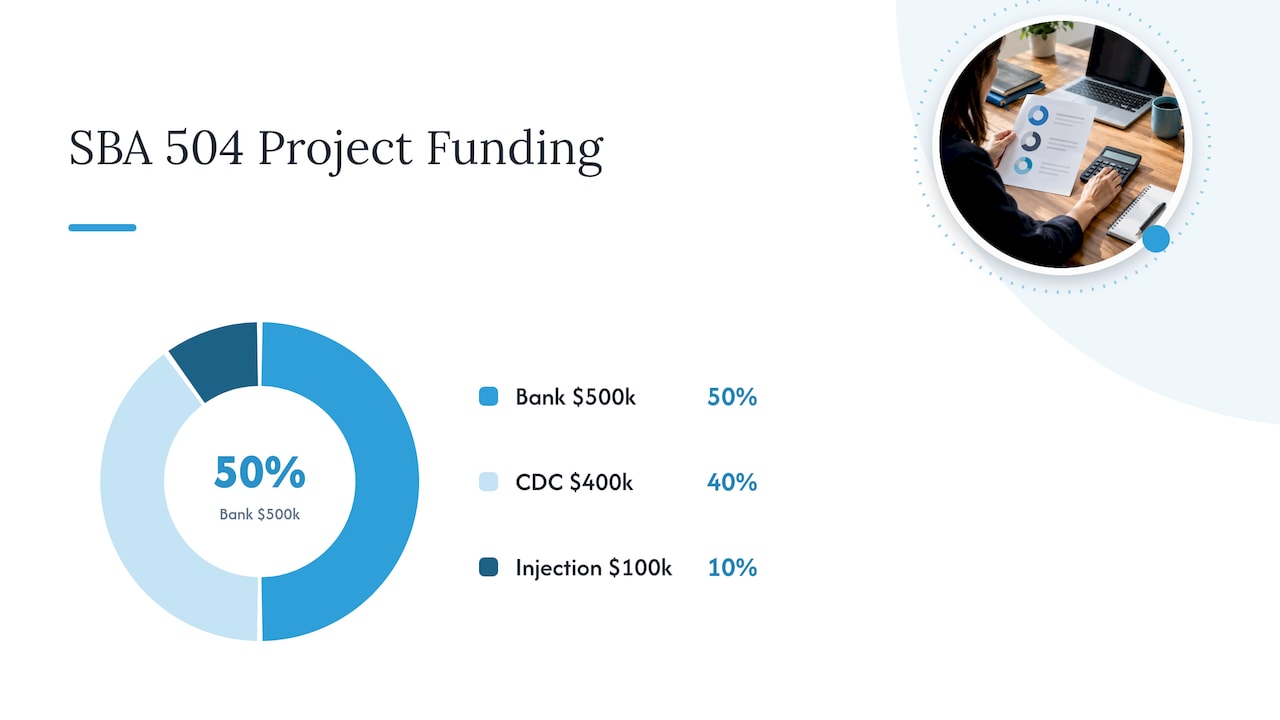
The figures below are round numbers for illustration, not a quote.
Say a company needs a $1,000,000 building. With an SBA 504 structure, a bank typically lends about half, a Certified Development Company lends up to 40%, and you inject at least 10%. That is roughly:
| Piece | Share | Illustrative amount |
|---|---|---|
| Bank first lien | About 50% | $500,000 |
| CDC debenture (second position) | Up to 40% | $400,000 |
| Your injection | At least 10% | $100,000 |
So the cash that buying requires is about $100,000 plus closing costs, not the 20% to 30% many owners assume. Now compare it with a lease on equivalent space. The lease asks for a deposit and the first month, perhaps a fraction of that. But over 20 years, you will pay escalating rent with no equity, while the owner’s payment on the CDC portion is fixed. Build the same table for your own numbers: annual occupancy cost for each path, after tax, over 10 and 20 years, plus the cash you would put to other use.
How the SBA 504 loan makes buying reachable
The SBA 504 program provides long-term, fixed-rate financing of up to $5.5 million for major fixed assets, including purchasing, constructing or renovating buildings or land. Terms of 10, 20 and 25 years are available. It is delivered only through Certified Development Companies, which are SBA’s community-based nonprofit partners.
The structure, per the SBA’s Standard Operating Procedure 50 10 8.1 (effective October 1, 2026):
- A third-party lender finances about 50% with a first lien.
- A CDC finances up to 40% through an SBA-guaranteed debenture in second position.
- You inject at least 10% of total project cost. New businesses (under two years) or special-purpose properties contribute 15%, and businesses that are both contribute 20%.
Eligible businesses must be operating, for-profit, located in the U.S., small under SBA size standards and not an ineligible type. One rule matters for this decision: businesses primarily engaged in owning real estate and leasing it out are not eligible. The program is built for companies that occupy and use what they buy.
Our published rates, read from our site in September 2026, were 6.77% on the Real Estate 25-Year Fixed, 6.73% on the Real Estate 20-Year Fixed and 6.58% on the Equipment 10-Year Fixed. Rates move with market conditions, so check the rates on our site for the current table. For how the three terms differ, see our guide to 10, 20 or 25 year SBA 504 terms, and for the injection, how much the down payment is.
If you already own your building and carry costly debt, the rule changed in your favor: a direct final rule that took effect November 15, 2024 removed the 50% cap on debt refinancing without expansion and raised the loan-to-value limit to 90% for such projects that include other business expenses. Our walkthrough covers how to refinance commercial real estate with an SBA 504 loan.
When leasing makes sense, and when buying does
| Your situation | Leaning |
|---|---|
| Plan to stay 10 years or more in one location | Buy |
| Stable headcount and space needs | Buy |
| Want control over layout, signage and upgrades | Buy |
| Want a predictable, fixed occupancy cost | Buy |
| Business under two years old with unclear space needs | Lease, then revisit |
| Expect to relocate or double in size within a few years | Lease |
| Every available dollar is needed for inventory or payroll | Lease, or buy with a smaller injection |
Local conditions count too. In a market where comparable buildings are scarce or rents are climbing, ownership locks in your cost. In a market with ample supply, leasing carries less renewal risk. If you are weighing a sale of a building you already own, our comparison of a sale-leaseback and an SBA 504 loan walks through that decision.
Financing a purchase in New England
The 504 structure works the same across our six-state region, but the property market does not. If you are buying in New Hampshire, our guide to commercial building loans for New Hampshire business owners covers the local picture, and for Massachusetts see the best commercial loans for small business owners in Massachusetts. If you are comparing a 504 with a conduit loan, read SBA 504 vs. CMBS.
How to decide in five steps
- Set your horizon. Write down how many years you expect to occupy this space. Under five years points toward leasing. Ten or more points toward buying.
- Price both paths on an after-tax basis. Include escalations and pass-through charges on the lease side, and loan payment, taxes, insurance and maintenance on the ownership side. Have your CPA apply the tax shield.
- Count the cash. Compare the deposit under a lease with the injection under a 504: 10% of project cost for an established business in a general-purpose building.
- Test the space. Ask whether the building can absorb growth, and whether a different layout would raise your productivity. Ownership lets you change it.
- Run the financing early. Eligibility, appraisal and structure take time, so talk to a CDC before you sign a lease renewal that locks you in.
Where CDC New England fits
We finance owner-occupied commercial real estate and equipment through SBA 504 loans, with only 10% down and fixed rates for up to 25 years. Our Down Payment Assistance Program is designed for companies that want to own but need help with the injection, and our VetLoan Advantage Program offers special terms for veterans and their spouses, with a published 1.0% processing fee. Our SBA 504 Refinance Program serves owners who want to restructure existing debt. As a regional Certified Development Company with over 70 years of experience and more than $2.3 billion invested in New England businesses, we can tell you early whether a purchase works for you.
Start with our 504 programs and published rates, or look at the Down Payment Assistance Program if the injection is your hurdle. Veterans can see the VetLoan Advantage Program.
Our view: pay yourself, not your landlord
Most owners come to us after years of paying rent and asking whether they could have owned all along. The answer is often yes, and the barrier was never what they thought it was.
The 10% injection is the number that changes the conversation. A bank loan on its own often asks for far more, but the 504 structure splits the financing so the borrower puts in a smaller share, and the CDC portion carries a fixed rate for up to 25 years. That fixed payment matters for planning: your occupancy cost stops moving with the market.
We would encourage any owner with a stable business and a horizon past ten years to price ownership seriously. Where the down payment is the sticking point, our assistance program is designed to help. Where existing debt is expensive, refinancing can give you a longer fixed term. We built our programs around making ownership reachable for New England businesses.
PHENYX
FAQ
Is it cheaper to lease or buy commercial property?
Leasing is cheaper at the start, because you pay a deposit and rent instead of a down payment. Over a 10 to 20 year horizon, ownership may prove more economical if your space needs stay stable and the property appreciates. Compare after-tax cash outflow for both paths over your real horizon.
How much do I need to put down to buy a commercial building?
With an SBA 504 loan, the borrower’s injection is at least 10% of total project cost. It rises to 15% for new businesses or special-purpose properties, and to 20% for both, according to the SBA’s SOP 50 10 8.1. Closing costs are additional.
Can I deduct rent and mortgage costs?
Yes, in different forms. The IRS says rent is deductible only when you have no equity or title in the property, while owners deduct business interest, subject to limits, plus depreciation. Your CPA can model both for your situation.
Can I use an SBA 504 loan to buy a building and lease part of it out?
The program is built for businesses that use the property. Under the SBA’s SOP, businesses primarily engaged in owning real estate and leasing it are not eligible. Talk with us about how much of the space you will occupy before you plan the purchase.
Sources
- 504 loans, U.S. Small Business Administration
- SBA SOP 50 10 8.1, Lender and Development Company Loan Programs
- Federal Register, SBA 504 debt refinancing direct final rule
- IRS, credits and deductions for businesses
- SCORE, Leasing versus Buying Business Location
- Commercial Lease vs Purchase