If you plan to buy and occupy your own building, an SBA 504 loan is usually the better fit than a CMBS loan. It is built for owner-operators: a 10% borrower contribution, long fixed terms and a structure designed around small-business growth. A CMBS (commercial mortgage-backed securities) loan is a conduit product that a lender pools and sells to investors, and it is priced and administered as an investment asset. It suits larger, stabilized properties, including investment real estate, where the 504 program does not apply.
How an SBA 504 loan is built
The 504 program provides long-term, fixed-rate financing for major fixed assets that promote business growth and job creation, with a maximum loan amount of $5.5 million for the SBA-backed portion. The loan is not a single note from a single lender. A typical project has three parts, as the Office of the Comptroller of the Currency describes:
The same OCC publication notes that partnering with a CDC can limit a bank’s credit exposure while helping it serve small-business borrowers. That is why the bank can lend on the first lien with more comfort, and why you pay a fixed rate on the CDC portion.
As a CDC, we work on the second-lien side of this structure. The rates we publish on our site for the CDC portion are 6.58% for a 10-year fixed equipment loan, 6.73% for a 20-year fixed real estate loan and 6.77% for a 25-year fixed real estate loan. Rates move with the market, so treat them as a reference point and confirm the current figure with us before you plan around it.
What a 504 loan can fund
The program can fund the purchase, construction or renovation of existing buildings or land, plus long-term machinery and equipment with a useful remaining life of at least 10 years. It is not a working-capital product. If you also need operating cash, see our guide to the 10-year rule for 504 and equipment loans, which explains where each product fits.
How a CMBS loan is built
A CMBS loan starts as a commercial mortgage from a conduit lender. Many loans are then pooled and sold as bonds to investors. That changes how the loan behaves after closing, even though you still make payments on a single note.
Two features stand out in federal descriptions of the market:
Investors also receive loan-level data, such as debt service coverage and delinquency reporting, so the loan is monitored as a security. In a pool, the master servicer is obligated to advance principal and interest to insulate bondholders from short-term cash flow shortfalls. That protects investors, not you. Your obligations to the borrower side of the note stay the same.
SBA 504 vs. CMBS side by side
FactorSBA 504CMBSTypical borrowerOwner-operated small businessOwner of larger, often income-producing propertyStructureBank first lien, CDC second lien, borrower equitySingle conduit loan, later pooled for investorsYour contributionFrom 10% of project costSet by the lender; not tied to a program minimumTerm25 years for real estate, 10 for equipmentSet by the lender; confirm term and amortizationRateFixed on the CDC portionQuoted by the conduit lender; confirm fixed or floatingUseOwner-occupied property, construction, long-life equipmentCommercial property financing generallyAfter closingServiced within the SBA and CDC frameworkMaster servicer, special servicer if distressedEligibilitySmall, for-profit U.S. business that occupies the propertyUnderwritten on property cash flow and collateral
The 504 program’s terms are published by the SBA: CDC/504 loans carry 25-year maturities for real estate and 10-year terms for equipment. Our own page on 10, 20 or 25 year SBA 504 terms explains how to choose among them.
Down payment and cash required
The cash you put in is often the deciding factor for a small business. On a 504 project, the borrower’s contribution is at least 10%, with the bank and CDC carrying the rest. That leaves more working capital in the business for inventory, hiring and the move itself.
If even 10% is a hurdle, we offer a Down Payment Assistance Program designed to help New England borrowers close that gap. A CMBS lender sets its own equity requirement based on the property’s value and income, so ask for it as a dollar figure early in the process. Do not assume that a lower-looking rate means less cash at closing.
Who qualifies
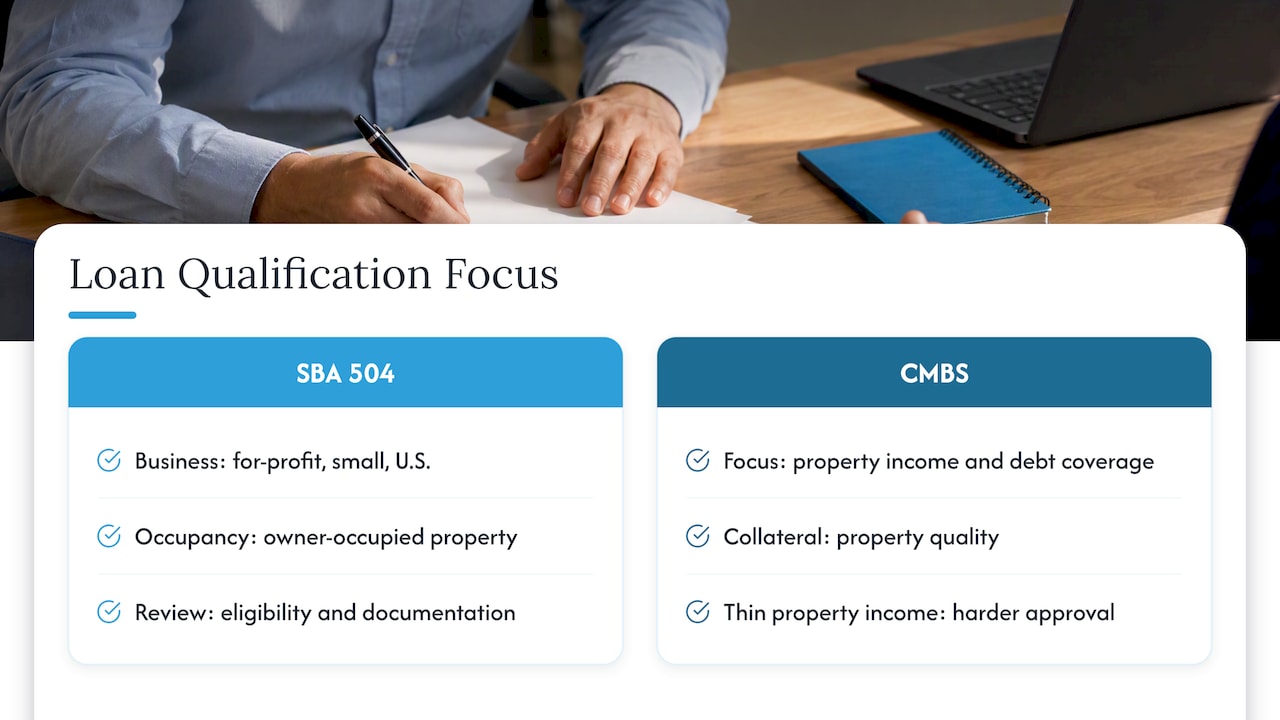
To be eligible for a 504 loan, a business must operate for profit, be small under SBA size requirements and be located in the U.S. In practice, that also means occupying the property. The program is designed for owner-occupied space, and we explain the occupancy threshold in our guide to 504 eligibility and the 51% occupancy rule. For a wider look at documents and credit, see who qualifies for a 504 loan in New England.
SBA lending carries its own compliance burden. The OCC notes that the SBA can decline to honor its guaranty if eligibility determinations or documentation are inadequate, and that strict underwriting exists because SBA borrowers often lack the credit or cash flow history conventional lenders want. For you, that means a thorough but predictable checklist. Our walkthrough of Form 1244 and the 504 application shows what to assemble.
A CMBS loan is underwritten mainly on the property: its income, its debt service coverage and the quality of the collateral. A business that occupies a building but has thin property-level income may find that a harder test to pass.
Refinancing existing debt
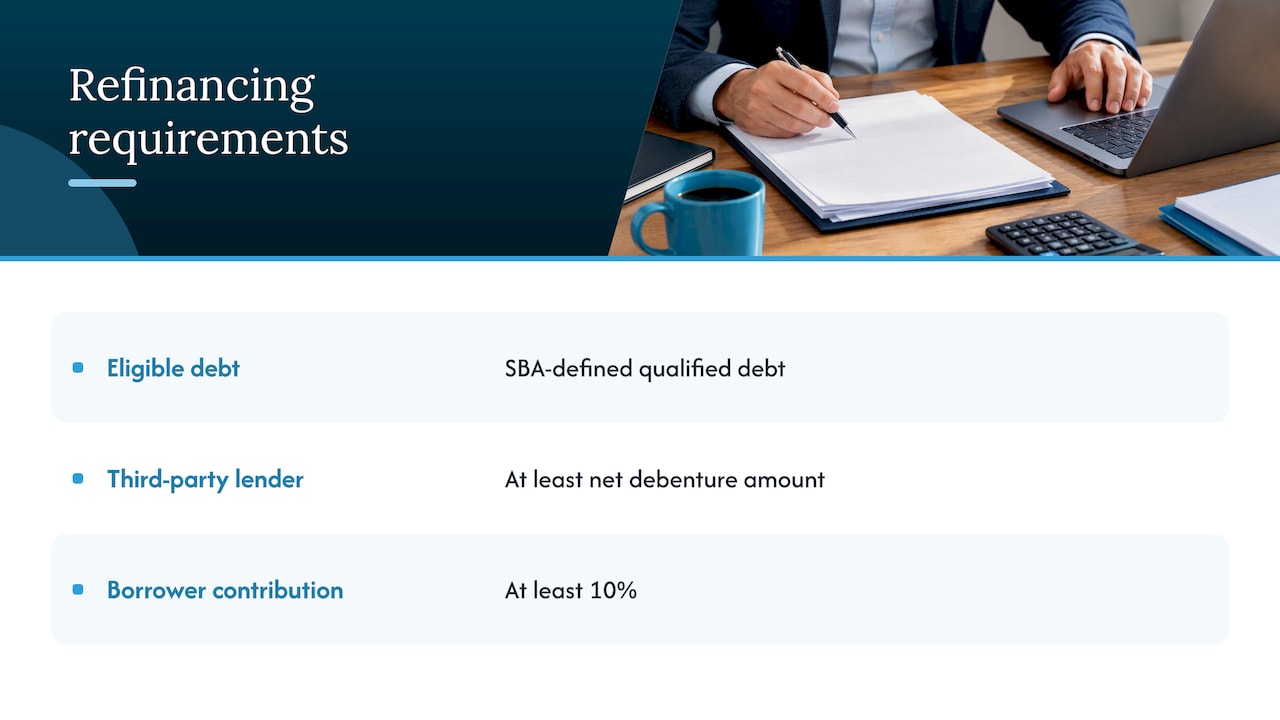
Both structures can be used to refinance in some form, but the 504 rules are specific. The program allows repayment or refinancing of debt defined as qualified debt under SBA regulations. On a 504 refinancing project, SBA’s submission form states that the third-party lender must provide an amount equal to or greater than the 504 net debenture, and you must contribute at least 10%.
If you hold a shorter-term commercial loan with a balloon payment, our SBA 504 Refinance Program is designed to move that debt into a long-term fixed structure. We also compare the options in 25-year fixed rate vs. a fast recast.
Exit costs and flexibility
This is where the products feel most different once you own the property. Ask each lender the same questions in writing:
CMBS loans typically carry formal prepayment mechanics that tie early payoff to bond-market terms, so request the full prepayment schedule and a worked payoff example before you commit. For a 504 loan, ask us for the prepayment terms that apply to your specific debenture. Do not rely on a general summary from any source, including this page.
What to verify before you choose
Use this checklist for either loan:
If you are a veteran or a veteran’s spouse, add one more question: does the program offer a fee benefit? Our VetLoan Advantage Program is built for that purpose, and the page lists a 1.0% processing fee.
Our perspective
We see the same pattern across New England. A business owner finds a building, compares a conduit quote with a bank quote, and focuses on the rate. The owners who do best step back and ask what the loan will do to their cash and flexibility over 20 years.
That is why we believe in the 504 structure for owner-occupied property. A 10% contribution keeps working capital in the company. A long fixed rate on the CDC portion makes the largest part of your debt service predictable. And because we work with banks, borrowers and the SBA every day, we can help you find the clean path through the paperwork instead of discovering it at the closing table.
We also built programs around the barriers we hear most: down payment assistance for those who are short on cash, a refinance program for owners facing a balloon, and VetLoan Advantage for veterans and their spouses. Our 70 years of experience and more than $2.3 billion invested in regional businesses are the reason we are comfortable saying it: if you will occupy the building, start with a 504 conversation.
PHENYX
Talk to us about your property
If you are weighing a building purchase, a construction project or a refinance, we can walk through the numbers with you and show how a 504 structure would look next to your other quotes. Start at CDC New England to see our current published fixed rates for equipment and real estate, then reach out with your project details.
For Massachusetts owners comparing several loan types, our overview of commercial loans and their alternatives is a good next read. If you are planning new construction in Connecticut, see our guide to small business construction loans.
FAQ
Can I use a CMBS loan for my own business building?
Yes, it is possible if the property meets the lender’s size and income criteria. CMBS is generally written for larger commercial properties underwritten on cash flow. If you will occupy the building and want a lower contribution and long fixed terms, compare it with a 504 quote before deciding.
Is the SBA 504 rate better than a CMBS rate?
The rates are not directly comparable without the full structure. The 504 rate applies to the CDC portion of the project, while the bank portion is priced separately. Compare the blended payment, fees and your cash at closing for both options, using the same property and loan amount.
Who services my loan after closing?
With a 504 loan, the bank and the CDC each service their own portions. With a CMBS loan, a master servicer handles the loan while it performs, and a special servicer takes over if it becomes seriously delinquent. Ask each lender to name the servicer and explain how modification requests are handled.
Can I refinance an existing loan with a 504?
Often, yes, if the debt meets SBA’s qualified-debt definition and the project meets the contribution and lender-share rules. Our refinance team can review your current note and tell you whether it qualifies and how a new structure would compare.