If you plan to build a new facility for your own business in Connecticut, you have three realistic ways to pay for it: a conventional bank construction loan, an SBA 7(a) loan, or an SBA 504 loan paired with a bank’s interim construction financing. For owner-occupants who want a low down payment and a fixed rate for the life of the loan, the 504 structure is usually the strongest fit. Which one is right depends on your project cost, your occupancy plans and how much cash you want to keep in the business.
This guide compares the options on the criteria that matter, walks through how a 504 construction project works from groundbreaking to permanent loan, and lists what to line up before you call a lender.
Cdcnewengland
cdcnewengland.com
Build Your Connecticut Business Facility
CDC New England provides SBA 504 financing for businesses acquiring commercial real estate, with a 10% down payment requirement and fixed rates for up to 25 years.
TL;DR
Table of Contents
The three main ways to finance a ground-up commercial building
Before comparing numbers, it helps to separate the loan types by what they were built to do.
Conventional bank construction loans
A bank construction loan is short-term, usually interest-only during the build, and typically carries a variable rate. When construction ends, you either refinance into a permanent mortgage or the loan converts to one. Banks hold this risk on their own balance sheets, so they tend to ask for substantial equity. Our own Connecticut guide puts the typical conventional down payment at 20% to 25%, versus 10% on a standard 504 project.
Bank loans make sense when your project is small, you have deep cash reserves, or the building does not meet SBA eligibility rules.
SBA 7(a) loans
The 7(a) program is the SBA’s general-purpose loan, and it can include construction costs, working capital and equipment in a single request. That flexibility is its main advantage. If your project mixes a building with inventory, hiring costs or a business acquisition, a 7(a) loan can cover the whole package. Rates on 7(a) loans are commonly variable, so your payment can move over a 25-year term.
SBA 504 loans
The 504 program was designed for exactly this kind of project: major fixed assets that help a business grow. According to the SBA, it offers long-term, fixed-rate financing of up to $5 million. The structure is shared: a private lender provides about 50% of the project, a Certified Development Company (CDC) provides about 40% through an SBA-guaranteed debenture, and you contribute 10%. You can see the mechanics in our breakdown of the 50/40/10 structure.

Side-by-side comparison
The table describes typical features by loan type. Terms vary by lender and project, so treat it as a framework for your conversations, not a quote.
FeatureBank construction loanSBA 7(a)SBA 504Typical down paymentOften 20% to 25%Varies by lender10% for most projectsRate during constructionUsually variableCommonly variableBank’s interim rate on its portionLong-term rateOften resets or adjustsCommonly variableFixed on the CDC portionBest forSmaller projects, deep cash reservesBuilding plus working capitalOwner-occupied buildings and major equipmentOccupancy rulesLender’s policySBA owner-use rulesOwner-occupancy required, higher bar for new constructionTwo lenders neededNoNoYes: bank and CDC
The real difference shows up in cash flow. Putting 10% down instead of 20% to 25% on a $3 million building leaves roughly $300,000 to $450,000 more in your business for equipment, payroll and the surprises every construction project produces. Our analysis of a construction loan versus a 504 walks through how that gap can add up.
How a 504 construction project works
The most common source of confusion is the interim phase. A construction project does not receive the 504 loan up front. Instead, the sequence looks like this:
The practical lesson: treat your bank and your CDC as partners who must talk to each other, and make sure your contractor understands the draw and documentation process from day one. Delays almost always trace back to missing paperwork or a lender who did not hear about a change in scope.
There is also a cost to watch. Because the debenture is funded only at completion, interest accrues on the interim side while you wait. Our article on avoiding interim interest on 504 debentures explains how to keep that period short.
Why the 504 fixed rate is possible
Banks fund loans largely with deposits, which makes very long fixed rates hard to offer on real estate. The 504 program works differently. The CDC’s share is funded by a debenture, a bond sold to investors, and the SBA’s lender overview describes CDCs as SBA-certified nonprofit corporations set up to contribute to the economic development of their communities. That structure is why you can lock in a fixed rate on the CDC portion for up to 25 years, which makes long-range budgeting for a new building far more predictable.
Current 504 rates we publish
Our published rates, as listed on cdcnewengland.com when we last checked, are:
For a ground-up building, the real estate terms are the ones that apply. Rates reset regularly and your all-in cost depends on how the bank’s portion is priced as well, so confirm the numbers with us before you plan around them.
Who qualifies for a 504 construction loan
Eligibility is where many Connecticut owners get tripped up, so check these points early.
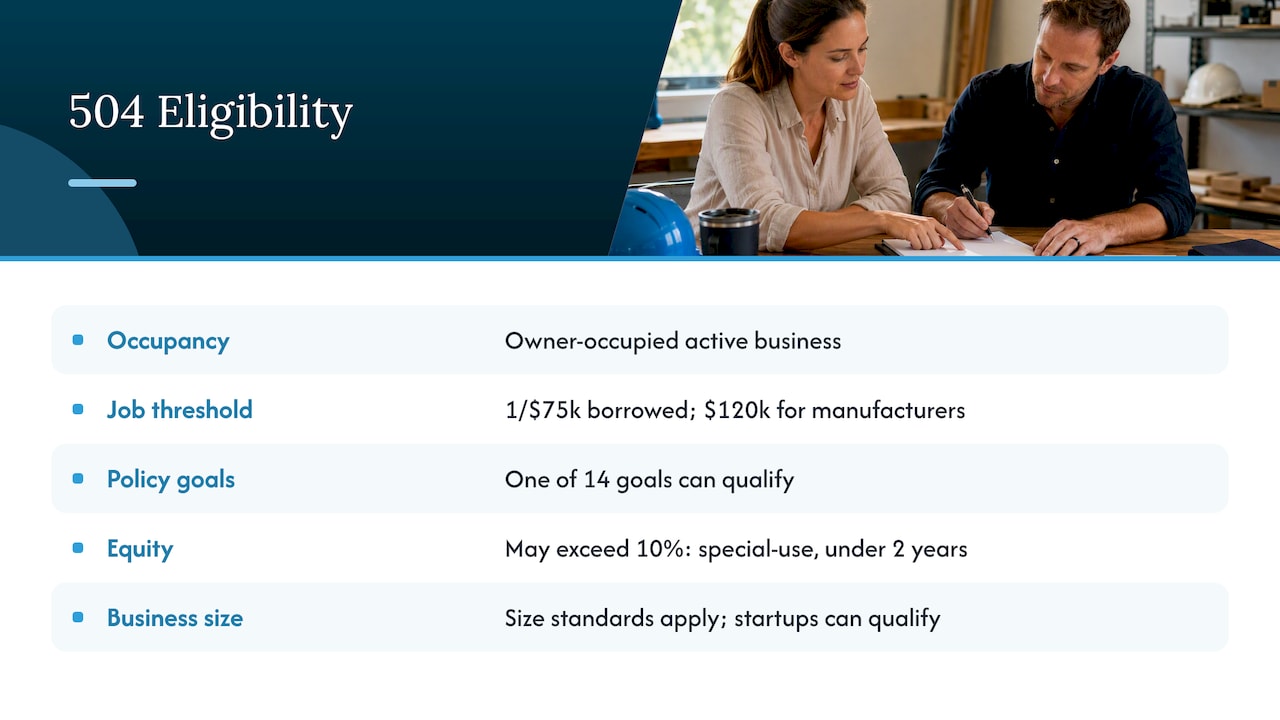
You must occupy the building. The program supports active businesses, not passive developers. If your plan includes renting out a large share of a new building to tenants, a 504 loan may not fit. New construction generally carries a stricter initial occupancy requirement than purchasing an existing building, and you will need a plan for growing into the space. Our guide to 504 eligibility explains the occupancy thresholds in more detail.
You must create or retain jobs, or meet a public policy goal. According to the OCC’s overview of the program, the general standard is one job created or retained for every $75,000 of SBA funds borrowed, or $120,000 for small manufacturers. Meeting one of the program’s 14 public policy goals can also satisfy the requirement.
Special-purpose buildings and young businesses may need more equity. Properties designed for a single use, such as car washes, hotels or wineries, and businesses with less than two years of operating history can push the down payment above 10%. If you fall into either category, ask for a written equity estimate before you commit to a site.
You must be a small business. Size standards apply, and startups can qualify too. We cover that in our guide to 504 loans for startups.
Combining 7(a) and 504 for larger projects
If your project is bigger than a single program allows, there is a recent change worth knowing. In May 2026, the SBA raised the combined 7(a) and 504 limit to $10 million, with up to $5 million through each program, effective July 4, 2026. A Connecticut manufacturer building a plant and buying equipment, for example, could use 504 for the real estate and machinery and a 7(a) loan for working capital. Our overview of up to $10M in SBA financing explains how we structure these requests.
Our perspective: build the building, protect the cash
We have worked with New England businesses for more than 70 years, and we have invested more than $2.3 billion in regional companies. The pattern we see on construction projects is consistent: the owners who struggle are rarely the ones with the wrong loan. They are the ones who ran out of liquidity at the wrong moment.
New construction almost always costs more than the first budget suggests. Soil conditions, permitting, utility connections and material prices all move. A 10% down payment gives you room to absorb those surprises while still funding the move-in, the equipment and the first months of operating in a larger space. A fixed rate for up to 25 years means the cost of the building will not change on you while your business grows into it.
Our advice is practical. Talk to a CDC before you finalize your site and your budget, not after. Choose a bank that has done 504 deals and understands the interim role. Keep documentation immaculate from the first draw. And be honest with yourself about occupancy, because it is the rule that most often decides whether a project qualifies.
As a Premier Certified CDC, we are set up to move qualified projects faster. We also offer down payment assistance for owners who need help with the equity side, and a program for veterans and their spouses.
When another option is the better answer
A 504 loan is not right for every Connecticut project, and it is better to know that early. Consider a different route when:
If you are unsure, the 504 versus conventional comparison lays the trade-offs out in detail.
What to prepare before you call a lender
A lender can give you a useful answer faster if you arrive with these items:
For a full overview of rates, requirements and the process in this state, see our Connecticut 504 guide.
Start your Connecticut project with a 504 conversation
If you are planning to build a facility in Connecticut, we can help you test the numbers early. Our real estate loans run 20 or 25 years at fixed rates, and our down payment assistance program is available for owners who want help with the equity portion. Veterans and their spouses can also look at the VetLoan Advantage Program. To begin, contact us at cdcnewengland.com with your site, budget and occupancy plan.
FAQ
Do you need 20% down for a construction loan?
Often, yes, for a conventional bank loan, though requirements vary by lender and project. An SBA 504 project typically requires 10% down, according to the SBA. Special-purpose buildings and businesses under two years old can require more.
Can I use an SBA 504 loan for ground-up construction?
Yes. A bank advances funds during construction, and the CDC’s 504 debenture funds once the building is complete and costs are documented. The building must be occupied by your business, and new construction has a higher initial occupancy requirement than an existing building.
How large can an SBA 504 loan be?
The SBA states that 504 financing goes up to $5 million per borrower for the SBA portion. Since July 4, 2026, borrowers who combine 7(a) and 504 can reach a combined $10 million, per the SBA announcement. The total project can be larger because the bank and your down payment make up the rest.
Can I rent out part of my new building?
Some leasing is generally allowed, but the business must occupy a required share at the start and grow into more of the space over time. Because the details depend on the building and the program rules in effect, ask your CDC to confirm your specific plan before you design the floor plan.