An SBA 504 application moves fastest when the full package is on the table at the start: SBA Form 1244, current personal and business financials, tax returns, a project budget and the purchase paperwork. This checklist walks through each item, how recent it must be, and where applications usually stall. We are CDC New England, and we work through this package with New England borrowers who are buying commercial real estate or long-term equipment.
TL;DR
- The core of every 504 package is SBA Form 1244, which lists 100% of your direct and indirect ownership, plus its required exhibits.
- Personal financial statements and credit reports must be recent (90 days is the standard window on Form 1244), while interim business financials must be dated within 120 days.
- Expect tax returns, a debt schedule, projections, a project cost breakdown, an appraisal and purchase agreements.
- Refinancing, veteran and down payment cases add a few documents on top of the core set.
- Gather in this order: ownership, personal, business, project. It keeps the file consistent from the first review.
Table of Contents
- How the 504 paperwork flows
- Checklist 1: Ownership and identity
- Checklist 2: Personal documents for each 20% owner and guarantor
- Checklist 3: Business financial documents
- Checklist 4: Project and purchase documents
- Checklist 5: Extra documents for special cases
- Timing: what has to be fresh
- How to organize the package
- Promo: your documents, one point of contact
- Our perspective
- FAQ
- Sources
How the 504 paperwork flows
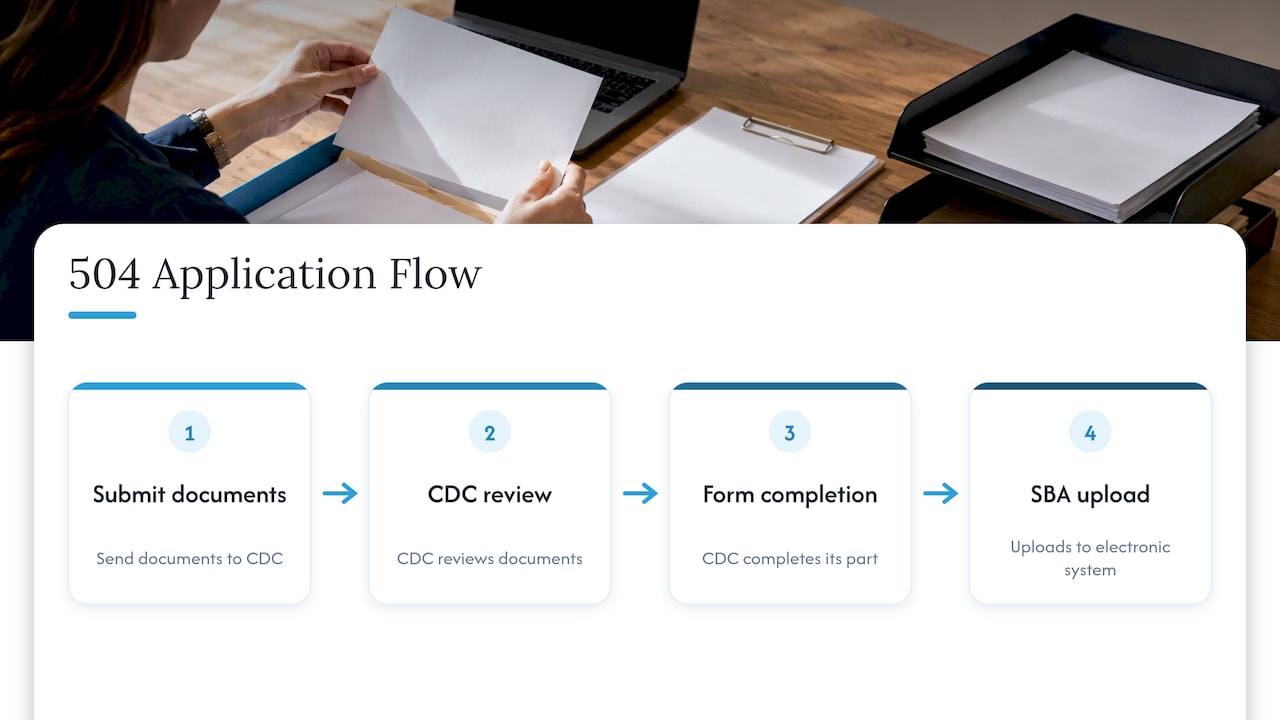
A 504 loan is available only through a Certified Development Company (CDC), a nonprofit lender certified by the SBA, as the SBA’s 504 loan page explains. You give your documents to the CDC. The CDC reviews them, completes its part of the form, and uploads the application to the SBA’s electronic system. Form 1244 has four sections: applicant and ownership, associates, legally required statements, and CDC and project information. You complete the first three with the CDC and the CDC completes the last.
The form is only the cover. The exhibits behind it are what take time to collect, so start with those. For a plain-English walk through the form itself, see our guide to what U.S. borrowers must include in an SBA 504 application.
Checklist 1: Ownership and identity
Start here, because every later document has to match it.
- Ownership table. Form 1244 requires you to list 100% of direct and indirect ownership, not just the big holders. Trace every entity back to the individuals who sit behind it.
- Owners and guarantors. The 20% threshold matters throughout. Each owner of 20% or more, and each proposed guarantor, supplies personal financial documents.
- Citizenship or immigration status. The form calls for USCIS or U.S. National status documentation.
- Entity documents. Articles of organization or incorporation, operating agreement or bylaws, and good standing evidence are the usual items. If a trust holds ownership, expect to provide the trust paperwork too.
A common stall: an ownership chart that adds up to 90% because a small holder was left off. Fix it before anything is submitted.
Checklist 2: Personal documents for each 20% owner and guarantor
The SBA’s Standard Operating Procedure 50 10 8.1, effective October 1, 2026, and Form 1244 call for the following from each 20%-plus owner and each proposed guarantor:
- SBA Form 413, the personal financial statement. It must be signed and dated within 90 days. The SOP notes that a spouse’s and minor children’s assets are included. The SBA revised Form 413 on June 13, 2025, and the SOP states that for 504 loans the personal financial data may be current within 120 days.
- One year of federal personal income tax returns. Form 1244’s Exhibit 3 asks for the most recent year.
- Credit reports dated within 90 days.
- IRS Form 4506-C or Form 8821. These authorize the CDC to pull tax transcripts. The SOP requires the transcripts to be reconciled with what you submitted before the debenture (the SBA-backed bond that funds the CDC portion of your loan) is funded, so your returns and your financial statements need to agree.
Worked example. Maria owns 60% of a machine shop and her brother owns 40%. Both are over the 20% line, so both need a Form 413, a personal return and a credit report, and both will likely guarantee. Her husband’s savings count on her statement because spousal assets are included. Knowing that up front avoids a surprise when the statement is first reviewed.
Checklist 3: Business financial documents
The same SOP and form set out how much history the CDC needs.
- Historical statements and tax returns. The SOP asks for the prior two years under the alternative size standard or three years under the industry size standard, or fewer years if the business has generated revenue for less time. The regulation at 13 CFR 120.191 likewise points to historical financial statements for the past three years, or tax returns where appropriate.
- Interim balance sheet and income statement. These must be dated within 120 days of submission to the SBA, with accounts receivable and accounts payable agings.
- Two-year projected income statement. Show the assumptions behind it. The projection should reflect the new payment and the project.
- Business debt schedule. List every obligation with lender, balance, rate, payment and maturity.
- Schedule of prior government financing. Past SBA or other federal loans belong here.
- Affiliate financials. If you own or control other companies, expect to provide their statements or returns for the last two to three years.
- Business plan, when applicable. The regulation lists it among the application contents where it fits the case. A newer business will usually need one.
Why repayment ability drives the file
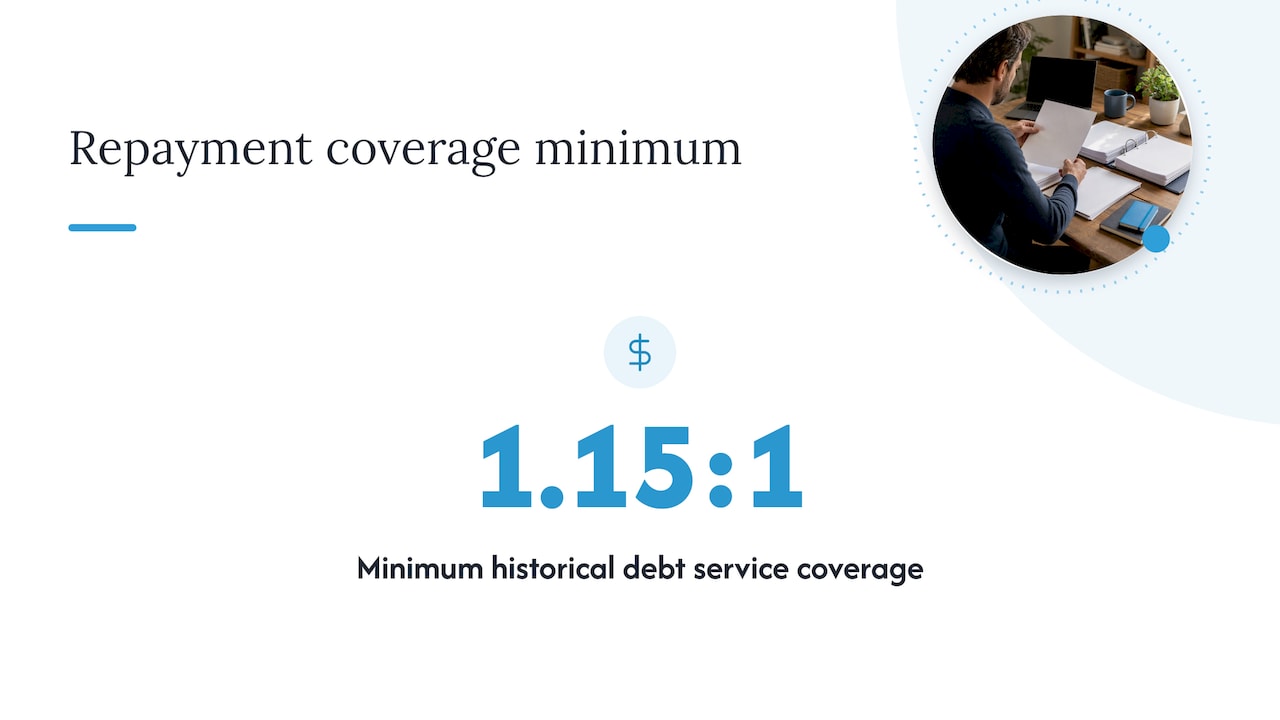
On a 504 loan, the SOP states that your cash flow is the primary source of repayment, not the expected sale of collateral. It sets a minimum historical debt service coverage of 1.15 to 1: your earnings before interest, taxes, depreciation and amortization (EBITDA) divided by your debt service after the transaction. Before you submit, divide your most recent EBITDA by what your annual payments would be with the new loan in place. If the result is near 1.15, make sure your projections and interim statements tell the whole story.
Checklist 4: Project and purchase documents
What the 504 can pay for shapes this list. The SBA says it covers buying or building real estate, renovating buildings or land, and long-term machinery and equipment with at least 10 years of remaining useful life. It cannot fund working capital, inventory or rental real estate speculation.
Form 1244 includes a project funding table where you itemize sources and uses of funds. Prepare it with these lines in mind:
- Land and building purchase
- New construction or remodeling
- Machinery and equipment
- Debt to be refinanced
- Eligible business expenses under refinancing
- Professional fees and other costs
The table also records the SBA portion, the third-party lender portion, your contribution and any other sources. Per the form, your contribution must be cash or project property, any borrowed contribution must carry a subordinate lien, and federal sources cannot supply more than 50% of eligible project costs.
Supporting paperwork usually includes:
- Purchase agreement or signed letter of intent for the property or equipment
- Equipment quotes or invoices with vendor details
- Construction budget and contractor estimates when you are building or renovating
- Independent real estate appraisal
- Environmental analysis, where it applies to the property
- Third-party lender letter of intent or term sheet for the first-lien portion of the financing
- Insurance evidence as the closing approaches
Occupancy matters here too. Check the 51% occupancy rule for owner-occupied property before you sign a purchase agreement, so the documents you collect describe a project that qualifies.
Checklist 5: Extra documents for special cases
Refinancing existing debt
Beyond the core file, a refinance needs the paperwork on the debt itself: notes, payoff or balance statements, payment history and the documents that show what the borrowed money paid for. The SBA limits refinancing to qualified debt under 13 CFR 120.882, so the CDC reviews the original use of proceeds. Our SBA 504 Refinance Program covers this route, and if your debt includes disaster loans, see how an EIDL refinance with an SBA 504 loan works.
Veteran and military spouse owners
Under 13 CFR 120.105, the SBA gives special consideration to businesses owned by a veteran or, if the veteran declines, by a dependent. A veteran is a person honorably discharged from active military service, so bring your discharge documentation (typically a DD-214) along with the standard file. More on this in our guide to SBA loans for veteran and military spouse business owners.
Down payment assistance
The core file does not change. What changes is the sources-and-uses table: you show how much cash you bring and how the assistance fits the structure. Form 1244 requires borrower contribution to meet its cash or project property rule, so show the numbers early.
Startups
If the business is new, the SOP allows fewer years of history. Replace the missing years with a stronger business plan and projections. Our page on SBA 504 for startups goes into structure.
Timing: what has to be fresh
| Document | Freshness standard | Source |
|---|---|---|
| Personal financial statement (Form 413) | Signed and dated within 90 days (SOP allows 120 days for 504 loans under the June 2025 revision) | Form 1244; SOP 50 10 8.1 |
| Credit reports | Within 90 days | SOP 50 10 8.1 |
| Interim business balance sheet and income statement | Within 120 days of submission to the SBA | SOP 50 10 8.1 |
| Interim statements at closing | Within 120 days of closing, plus a certification of no substantial adverse change | 13 CFR 120.892 |
| Personal tax returns | Most recent 1 year | Form 1244 |
| Business tax returns | 2 or 3 years, depending on size standard | SOP 50 10 8.1 |
Because the closing standard is separate from the application standard, a file that sat for months may need refreshed interim statements before the loan can close. Keep a calendar with the date each document goes stale.
How to organize the package
A clean file shortens review. Use this routine:
- Build a master index listing each document, its date, who signed it and where it stands.
- Name files consistently, for example “2025 Business Tax Return” or “Owner A Form 413”.
- Reconcile before you send. Your tax returns, financial statements and debt schedule should agree with each other. Differences surface when the CDC compares your transcripts later.
- Sign and date everything that requires it. Missing signatures on Form 413 are one of the easiest delays to avoid.
- Keep your records. The IRS says that for most returns you should keep supporting records for at least three years, and longer in some situations. A 504 file is a good reason to keep a tidy archive.
The form also notes that some project types, such as those needing a Standards of Conduct Committee approval or a statement of no objection from a department or military service, go to the SBA’s Loan Processing Center for review instead of being handled under delegated authority. If your project is unusual, tell your CDC early so the right documents are collected the first time.
Promo: your documents, one point of contact
With CDC New England, you work with a regional lender that has invested more than $2.3 billion in New England businesses over more than 70 years. Our 504 loans require only 10% down, and our posted fixed rates in September 2026 were 6.58% for the 10-year equipment loan, 6.73% for the 20-year real estate loan and 6.77% for the 25-year real estate loan. Rates change, so confirm on our site. We also offer a Down Payment Assistance Program and the VetLoan Advantage Program.
If you have your ownership chart and last year’s returns in hand, you are ready for a first conversation about which documents your project needs.
Our perspective
Most delays in a 504 file are not about the business. They come from small mismatches: an owner left off the ownership table, a personal statement that is out of date, a tax return that does not agree with the financials. We see the checklist as a way to catch those before they cost you weeks.
The 504 is built around your cash flow and the project you are financing. That is why the strongest files explain the project clearly: what you are buying, what it costs, how much you contribute and how the payments fit your earnings. With only 10% down and fixed rates for up to 25 years, the structure is designed to preserve your working capital, and a well-organized package lets that advantage show.
As a CDC with Premier Certified status, we are set up to move qualified files efficiently, and we tailor programs for refinancing, veterans and down payment needs. Bring us the file you have, and we will help you get it to complete.
PHENYX
FAQ
How many years of tax returns does an SBA 504 loan require?
Business returns cover two years under the alternative size standard or three under the industry standard, or fewer if the business is newer, per SOP 50 10 8.1. Each 20%-plus owner and guarantor provides one year of personal federal returns.
Do I need a business plan for an SBA 504 loan?
The regulation lists a business plan among application contents when applicable. Established businesses with strong history often rely on financials and projections, while newer businesses should expect to provide a fuller plan.
What is Form 4506-C and why is it on the list?
It is an IRS form that authorizes the CDC to obtain your tax transcripts directly from the IRS. The SOP says transcripts must be reconciled with your submitted returns before the debenture is funded.
Can the 504 loan pay for working capital or inventory?
No. The SBA states that 504 funds go to fixed assets such as real estate and long-term equipment, and to refinancing qualified debt. Working capital and inventory are not eligible uses.
Sources
- SBA Form 1244, Application for Section 504 Loans
- SBA SOP 50 10 8.1, Lender and Development Company Loan Programs
- 13 CFR Part 120, Business Loans (eCFR)
- SBA 504 loans
- IRS: How long should I keep records?