In most cases, an SBA 504 loan cannot pay off a COVID EIDL. The 504 program refinances only “qualified debt,” which is commercial debt that was mostly spent on land, buildings or long-term equipment. EIDL money is working capital, so it usually fails that test. A 504 refinance can still help if you also carry a conventional mortgage or equipment loan on your property. That debt may qualify, and it can be moved into a long-term fixed rate.
TL;DR
- EIDL funds cannot be used to refinance debt or buy fixed assets, so an EIDL generally does not meet the 504 qualified-debt definition.
- Qualified debt is a commercial loan at least 6 months old, with 75% or more of its proceeds used for eligible fixed assets, and the refinance must give you a substantial benefit.
- Your bank mortgage, equipment loan or an older 7(a) loan on owner-occupied property may qualify. Your EIDL may stay in place as it is.
- If the EIDL payment is the problem, SBA has its own relief options. Email CESC@sba.gov to discuss them.
Table of Contents
- Why an EIDL and a 504 loan do not line up
- What counts as qualified debt for a 504 refinance
- Can a 504 refinance include cash out or an expansion?
- Who can apply
- What a 504 refinance costs
- A simple way to test your own situation
- Perspective: why we start with the property, not the EIDL
- If your EIDL payment is the real problem
- Refinancing with our program
- FAQ
- Sources
Why an EIDL and a 504 loan do not line up
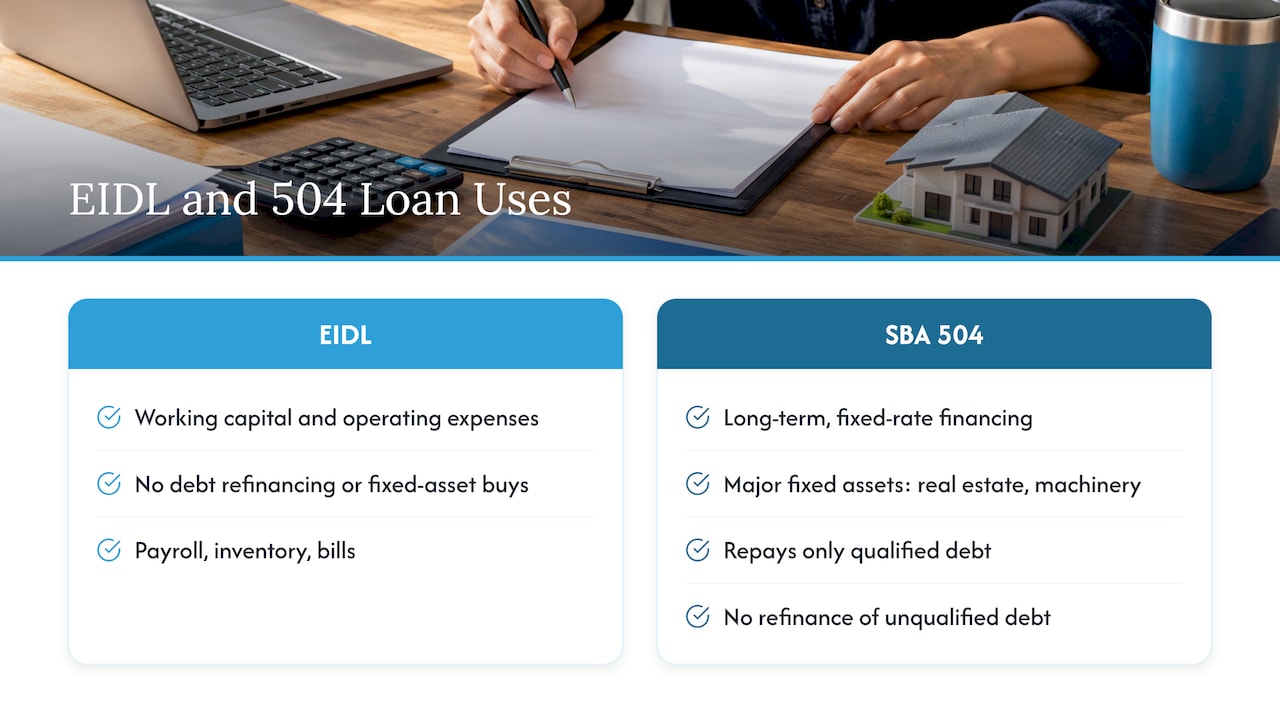
The two programs were built for different jobs. An EIDL covers working capital and normal operating expenses such as rent, utilities, health care benefits and fixed debt payments. SBA states that EIDL funds cannot be used to refinance debt or buy fixed assets.
A 504 loan is the reverse. It provides long-term, fixed-rate financing for major fixed assets, such as buying or building real estate or purchasing long-term machinery and equipment. SBA’s 504 page says the loan can repay debt defined as qualified debt, and it cannot be used to refinance debt that does not meet that definition.
That definition is where an EIDL runs into trouble. Because EIDL proceeds were not allowed to buy fixed assets, the money was not spent in the way the 504 rules require. If your EIDL funded payroll, inventory or bills, a 504 loan has no basis to take it out.
There is one practical point to keep in mind. The rules look at how the debt’s proceeds were used and what secures it. Read the loan documents for each debt you want to refinance. Then ask your CDC to review them before you plan around a payoff.
What counts as qualified debt for a 504 refinance
The rule is in 13 CFR § 120.882(g). To qualify, the debt must meet each of these conditions:
- It is a commercial loan incurred at least 6 months before you apply.
- At least 75% of the proceeds were used for an Eligible Fixed Asset.
- The debt was incurred for the small business’s benefit.
- It is collateralized by Eligible Fixed Assets.
- Your business has operated for the full 2 years before you apply.
- The refinance provides a substantial benefit to you.
The thresholds have changed. SBA’s 2023 final rule, effective November 13, 2023, shortened the look-back period from two years to six months. It also lowered the fixed-asset use threshold from 85% to 75%. Older articles and lender pages may still quote the earlier numbers.
What “substantial benefit” means
Substantial benefit means the new installment attributable to the refinanced debt is lower than what you pay now. The comparison accounts for prepayment penalties, financing fees and other financing costs. So run the math on the full cost of leaving your old loan, not only the interest rate.
Refinancing an existing SBA loan
Some SBA-backed loans can be refinanced too. Under 13 CFR § 120.882(g)(3):
- An existing 504 loan can be refinanced only if both the third-party loan and the 504 loan are being refinanced, or the third-party loan has been paid in full.
- An existing 7(a) loan can be refinanced if the CDC notifies the 7(a) lender in advance in writing.
- In both cases, the refinance must give you a substantial benefit.
If your first loan was a 7(a) used to buy a building, this is the route to look at. We cover the comparison in SBA 504 vs 7(a) loans for New England businesses.
Can a 504 refinance include cash out or an expansion?
Yes, in defined ways. The rules treat a refinance with and without expansion differently.
| Project type | What the rules allow |
|---|---|
| Refinance without expansion | Can include financing for Eligible Business Expenses if the cash funds provided exceed the amount paid to the qualified-debt lender. You must describe and itemize those expenses in your application. |
| Refinance with expansion | Existing debt up to 100% of the expansion project cost may be refinanced if 75% or more of its proceeds were used for eligible land, buildings or equipment. |
Both rows come from 13 CFR § 120.882. Working capital by itself is separate. SBA’s ineligible costs rule lists it as an ineligible 504 cost. Debt refinancing is also ineligible unless the specific refinancing provisions apply.
So a 504 will not be a general cash-out tool for paying off an EIDL or other operating debt. It can pay off qualified real estate or equipment debt and, within the rules above, add eligible expenses.
If you are planning to grow, a separate eligible project can sit alongside the refinance. A 504 can fund purchasing, constructing or renovating buildings or land, or buying long-term machinery. Our guide on refinancing commercial real estate with an SBA 504 loan walks through that structure.
Who can apply
SBA’s general standards apply to a refinance as they do to a purchase. Your business must be an operating, for-profit business located in the U.S. that is small under SBA size requirements. You also need qualified management expertise, a feasible business plan, good character and the ability to repay the loan.
SBA lists the maximum 504 loan amount at $5.5 million. For how that connects to larger projects, see how borrowers reach the combined SBA maximum.
The 504 program is built for owner-occupied property. We cover the occupancy rule in SBA 504 eligibility for New England borrowers, and the wider checklist in SBA 504 loan requirements in New England.
What a 504 refinance costs
Costs matter because they feed the substantial-benefit test. Under 13 CFR § 120.883, these administrative costs can be paid with the proceeds of the 504 loan and the debenture:
- The SBA guarantee fee
- The funding fee
- The CDC processing fee
- Your out-of-pocket closing costs, other than legal fees
- The CDC closing fee, up to a maximum of $10,000
- The underwriters’ fee
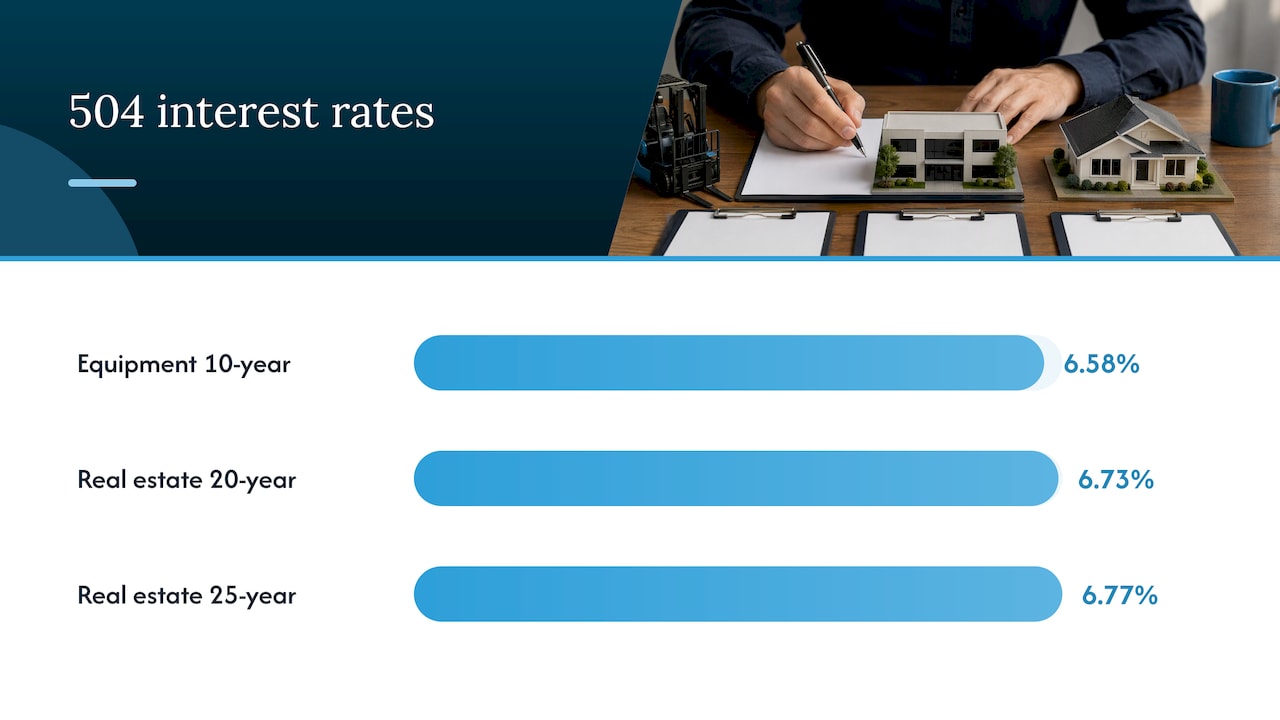
On our site, the published rates for 504 loans are 6.58% for Equipment 10-Year Fixed, 6.73% for Real Estate 20-Year Fixed and 6.77% for Real Estate 25-Year Fixed. These were read from our site in September 2026 and move with the market, so confirm the current figure on our home page before you model a payment.
The VetLoan Advantage Program lists a 1.0% processing fee. Details are on the VetLoan Advantage page.
A simple way to test your own situation
Work through these steps with your CDC or accountant before you apply:
- List every business debt. Note the lender, date, balance, rate, prepayment terms and collateral.
- Sort by use of proceeds. Mark which loans financed real estate or equipment and which financed operations.
- Check age and share. Confirm the loan is at least 6 months old and that 75% or more went to eligible fixed assets.
- Price the exit. Add prepayment penalties and fees to the new loan’s costs.
- Compare installments. The new payment on the refinanced portion must be lower.
- Itemize any extra cash use. If you want eligible business expenses included, write them out for the application.
A worked example shows the logic. Say a business owns its building with a bank mortgage from several years ago, and it also has an EIDL used for payroll during 2020. The mortgage is a candidate for a 504 refinance. The EIDL is not, because its proceeds were operating funds. The owner can ask whether a lower mortgage payment frees cash flow to handle the EIDL.
Perspective: why we start with the property, not the EIDL
We hear this question often, and our answer is consistent. The EIDL is not the debt to focus on when you look at a 504. The property or equipment loan is.
A 504 refinance works well for owner-occupied businesses that took out a short-term or adjustable-rate loan and now face a balloon or a higher payment. Our programs are designed around a fixed rate for up to 25 years and a 10% down payment on new purchases. Locking in a long, fixed schedule on qualified debt can make your monthly obligations easier to predict and plan around.
We also look at the whole picture with you. Our Premier Certified status is designed to speed up approvals, and our team knows the New England market. If you are a veteran or a veteran’s spouse, we have a program built for you. If you need help with the equity side of a purchase, we offer a down payment assistance program.
Bring us your loan documents and your EIDL terms. We will tell you what qualifies, what does not, and how a refinance on the right debt could change your cash flow.
PHENYX
If your EIDL payment is the real problem
A 504 will not take out the EIDL, but relief may be available through SBA. For help with an existing COVID EIDL, email CESC@sba.gov.
Congressional Research Service reporting, updated May 28, 2026, says eligible COVID EIDL borrowers may reduce payments by 50% for six months. Interest continues to accrue during that time, and full payments resume afterward. Eligibility and terms can change, so confirm them with SBA directly.
A tax advisor or your attorney can help if the EIDL is secured by assets you also plan to pledge on a new loan.
Refinancing with our program
If you own your building or equipment and carry qualified debt, our SBA 504 Refinance Program is the place to start. We review your existing loans, confirm what qualifies under SBA rules and help you see whether the new installment would be lower. Visit our SBA 504 Refinance Program page to begin.
If you also want to buy a new property, our down payment assistance program is designed to help with the equity side. For a fixed-rate versus recast comparison, read 25 year fixed rate vs fast recast.
FAQ
Can I use an SBA 504 loan to pay off my COVID EIDL?
Generally no. EIDL funds could not be used to buy fixed assets, and a 504 can only refinance qualified debt tied to eligible fixed assets. Ask your CDC to review your documents if you believe part of your EIDL was used differently.
Can I refinance a bank loan on my building and get cash out?
A refinance without expansion can include eligible business expenses if the cash funds exceed the amount paid to the qualified-debt lender. You have to itemize those expenses in the application. Working capital by itself is an ineligible 504 cost.
How old does my existing loan have to be?
Qualified debt must have been incurred at least 6 months before you apply. SBA’s 2023 rule shortened this from two years. Your business must also have operated for the full 2 years before application.
Can I refinance an existing 7(a) loan into a 504?
Yes, in some cases. The CDC must notify the 7(a) lender in advance in writing, and the refinance must give you a substantial benefit. For an existing 504 loan, the rules require both the third-party loan and the 504 loan to be refinanced, or the third-party loan to be paid in full.
Sources
- SBA disaster assistance: low-interest relief loans
- SBA 504 loans
- 13 CFR Part 120 Subpart H, loan-making policies (eCFR)
- 13 CFR 120.884, ineligible costs for 504 loans (eCFR)
- 13 CFR 120.883, eligible administrative costs (Cornell LII)
- Federal Register, Volume 88, Issue 196, SBA final rule (October 12, 2023)
- SBA COVID-19 EIDL financial relief: policy options (Congressional Research Service)