Leasing and buying are both legitimate ways to house a business, but they are not priced the same way. A lease asks for a small amount of cash up front and hands you a payment that rises over time. Ownership asks for a down payment, but it turns your monthly occupancy cost into a payment you can fix for years and into equity you keep. With an SBA 504 loan, that down payment can be as low as 10%, and at CDC New England we offer fixed rates for terms of up to 25 years. That combination is why many owner-occupants in New England find buying closer than they expected.
This guide shows you how to run the comparison on your own numbers, what each path really costs, and when the ownership math starts to work.
TL;DR
- Compare leasing and buying on after-tax cost over the same period, not on the first monthly payment.
- A standard SBA 504 structure asks for a 10% borrower contribution, so the cash barrier to buying is lower than the conventional 20% to 25% many owners assume.
- We publish fixed rates for 20-year and 25-year real estate loans and a 10-year equipment loan, which lets you model ownership with a payment that does not reset.
- Leasing buys flexibility. Owning buys stability and equity. Your growth plans for the space decide which matters more.
- Veterans, businesses short on down payment cash and owners with existing debt have dedicated programs worth pricing before you decide.
Table of Contents
- What you are really comparing
- What leasing costs
- What buying costs
- How to run the comparison
- Why the down payment is the real hurdle, and how 504 lowers it
- What the SBA requires of an owner-occupant
- When buying makes sense, and when a lease still fits
- Special situations: down payment help, veterans and existing debt
- Where we stand
- Start with your numbers
- FAQ
- Sources
What you are really comparing
A lease is a service contract: you pay for the right to use space, and the landlord carries the risk of owning it. Ownership is an investment: you carry the risk of the roof, the taxes and the market, and you capture the upside.
SCORE’s guidance on this decision points out that real estate is rarely a company’s principal business, and that leasing lets a firm adjust its space as market requirements change, while ownership makes adapting harder because buying, building or selling takes time. That is a real consideration, and it is the reason the decision is operational as well as financial.
So start with two questions before any spreadsheet:
- How sure are you that you will need roughly this much space, in this location, for the next 10 to 25 years?
- Is the building central to how you earn, such as a production floor, a clinic, a restaurant build-out or a warehouse you have customized?
If you answer yes to both, ownership deserves a serious look. If your space needs may change a lot in three years, a lease can fit that phase. Many owners know they will need to adapt over time, and for those readers it helps to understand how a lease is stored and tracked, because the renewal and expansion terms you negotiated are what you will be living with.
What leasing costs
The appeal of leasing is easy to see. According to SCORE’s brief, the advantages include no down payment beyond one or two months of prepaid rent, lower individual payments, deductible lease payments and no property-value risk, since that stays with the lessor.
The same brief notes the long-run side of the ledger: leasing tends to cost more over a long horizon, the implicit interest rate in a lease can be higher than a bank loan, and leased property cannot serve as collateral. Add the pattern you probably already know from your own lease: yearly escalations, common-area charges and a renewal where the landlord sets the terms.
When you model a lease, include:
- Base rent for every year of the term, with the scheduled increases.
- Operating expenses you pay on top of rent (taxes, insurance, maintenance, often called triple-net charges).
- The cost of improvements you make to space you do not own.
- Moving costs and downtime if you do not renew.
What buying costs
Ownership costs more cash on day one and less pressure on the monthly line over time. Budget for:
- The down payment. In a standard SBA 504 structure this is 10% of the project.
- Closing costs. The IRS counts settlement costs such as legal and recording fees, survey charges, abstract fees and owner’s title insurance as part of the property’s basis, the number you depreciate.
- Operating costs. Property taxes, insurance, utilities, repairs and eventually capital replacements such as a roof or HVAC.
- Improvements. Renovation or build-out, which a 504 project can include.
On the tax side, nonresidential real property is depreciated over 39 years under the General Depreciation System, and land is not depreciable. Interest on the loan is generally deductible as a business expense too. Your accountant should confirm how both apply to your return, since depreciation rules can be updated after the 2015 publication cited here.
How to run the comparison
SCORE’s method is the most practical frame for a small business: compare after-tax costs over the same period, usually the length of the lease you are considering.
For buying, add operating expenses and loan payments, subtract the tax shield from depreciation and interest, then subtract the estimated after-tax cash you would receive if you sold the property at the end of the period.
For leasing, add lease payments (including each yearly increase) and operating expenses, then subtract the tax shield from deducting the lease payments.
The result depends heavily on one assumption: how much the property’s value grows each year. Run it three ways, with flat values, modest growth and growth below inflation. If ownership wins in all three, you have a strong case. If it only wins in the optimistic one, the lease may be the safer base case.
A simple worked example
Say a $1,000,000 owner-occupied building. Under the standard 504 split, your 10% contribution is $100,000, a bank covers 50% ($500,000) and the SBA 504 debenture covers 40% ($400,000). Those percentages come from the SBA’s rules in 13 CFR 120.900 and 120.910.
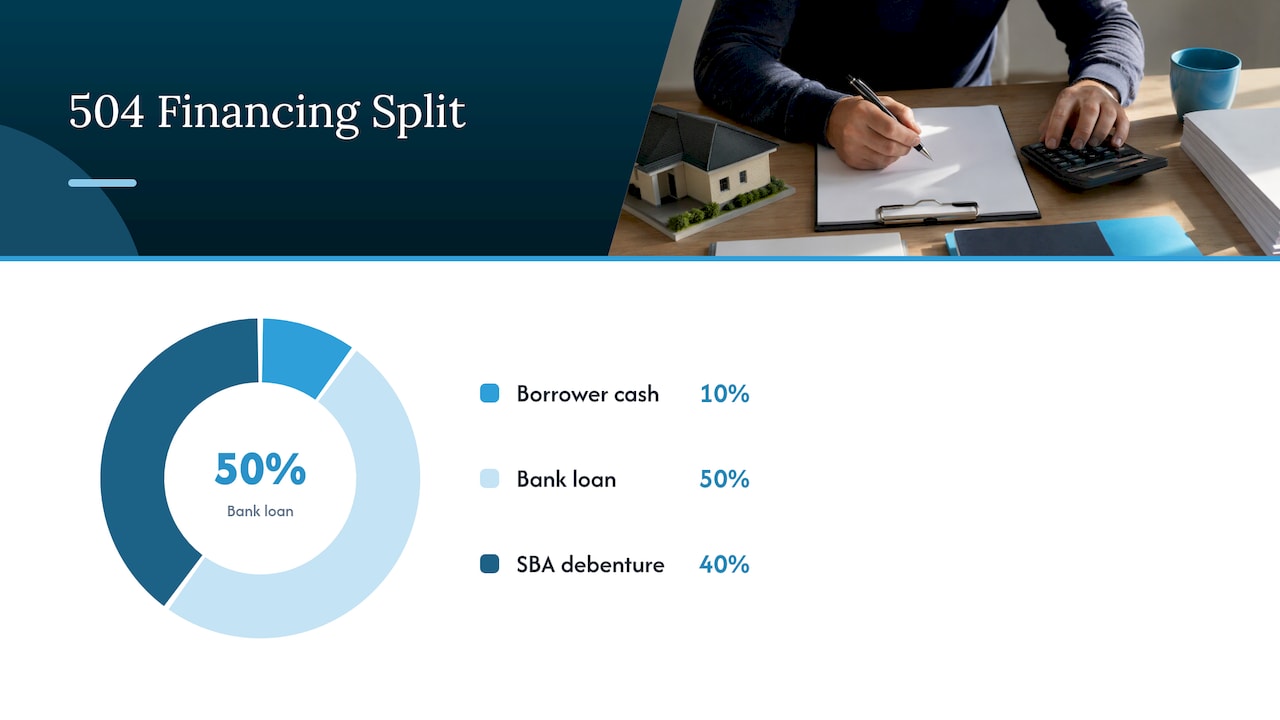
Compare that $100,000 of cash against the lease alternative. In the lease, your cash outlay is a deposit and perhaps a tenant build-out, but your payments are on a schedule that rises. In the purchase, your cash outlay is larger, but part of every payment builds equity, and the fixed-rate portion does not reset. Whether ownership wins depends on your rent today, the price per square foot you would pay, and how long you will stay. That is the calculation to bring to a lender before you make a decision.
Why the down payment is the real hurdle, and how 504 lowers it
Most owners who lease are not leasing because they prefer it. They are leasing because they assume buying takes 20% to 25% down plus a rate that floats. The SBA 504 structure is built differently. The 10% contribution is the baseline, with two adjustments in the SBA’s rules: the borrower contributes at least 15% if the business has operated two years or less or the building is limited- or single-purpose, and 20% if both apply. Our 504 structure guide walks through who pays what and when, and our guide for startups using 504 covers the newer-business case.
The other half of the appeal is the payment itself. On our site as of September 2026, we published these fixed rates:
| Program | Term | Published rate |
|---|---|---|
| Equipment | 10-year fixed | 6.58% |
| Real estate | 20-year fixed | 6.73% |
| Real estate | 25-year fixed | 6.77% |
Rates change with the market and with each debenture sale, so treat these as the figures published for that date, and confirm the current figure with us before you build a final model. Our explainer on 10, 20 and 25 year terms shows how the term you pick shifts the monthly payment.
When you compare to your lease, place the 504 payment next to your current rent, including the escalations on your lease. A fixed payment over 20 or 25 years is the cleanest contrast to rent that steps up every year.

What the SBA requires of an owner-occupant
A 504 loan is for businesses that use the property, not investors. That means a few rules matter before you commit:
- Existing buildings. Under 13 CFR 120.131(b), you must permanently occupy at least 51% of the rentable space and may lease up to 49% to other tenants. That can offset your costs if you buy more building than you need today.
- New construction. Under 120.131(a), you may lease up to 20% if you occupy at least 60%, plan to occupy more within three years, and all of it within ten.
- Purpose. SBA proceeds cannot fund property bought primarily for sale, lease or investment, with narrow exceptions.
- Eligible uses. Eligible uses include land, existing buildings, new construction, renovation and fixed assets, and 504 equipment must have a useful life of at least 10 years.
Our guide to 504 occupancy requirements explains how to count space for your building. SBA also publishes program updates for lenders, including SOP 50 10 8.1 changes effective October 1, 2026, so the details of processing can shift. Our team stays current on those changes so you do not have to track them.
When buying makes sense, and when a lease still fits
There is no formula that fits every company, but these signals lean toward buying:
- You have operated long enough to show steady revenue and expect to occupy the space for a decade or more.
- Your rent is rising faster than your revenue.
- You have spent, or will spend, significant money customizing the space.
- You can keep the equivalent of the down payment and closing costs without draining working capital. The 504 structure helps here, because the lower contribution leaves more cash in the business.
- You have extra space you can lease to other tenants within the occupancy limits.
These signals lean toward staying in a lease for now:
- Your headcount or footprint could change sharply within a few years.
- You are still validating a location or concept.
- The cash you would put down would starve inventory, payroll or equipment.
Owners often split the decision: lease the space while the business stabilizes, buy once the numbers are proven. Planning that second step early, including how your records and revenue will look to a lender, shortens the path when you are ready.
Special situations: down payment help, veterans and existing debt
Short on down payment cash. Our Down Payment Assistance Program is built for companies acquiring commercial property that need help covering the borrower’s share.
Veterans and spouses. Under 13 CFR 120.105, SBA gives special consideration to businesses owned by an honorably discharged veteran or, if the veteran declines, a dependent: the application is processed promptly and close questions are resolved in the applicant’s favor. Our VetLoan Advantage Program carries a 1.0% processing fee.
You already own. If you are paying a higher or floating rate on a building you own, refinancing can move you into long-term fixed financing. The SBA says the 504 program can refinance qualifying debt, up to 90% of the current appraised value, when the business has operated at least two years, the debt is at least two years old, and payments have been current for the last 12 months (SBA lender resources). The SBA 504 Refinance Program page and our guide to refinancing commercial real estate with a 504 loan cover how it works, and our comparison of 504 vs. CMBS helps if you are weighing another long-term structure.
Where we stand
Owners come to us asking whether they should lease or buy, and the honest first answer is to price it. Most of the businesses we meet have not seen a purchase on a 10% down payment with a fixed rate stretching up to 25 years, so they compare ownership to a lease using a down payment that does not apply to them.
With more than 70 years of experience and more than $2.3 billion invested in New England businesses, our view is that an owner-occupied building is one of the strongest ways a small business can turn a monthly occupancy cost into something it owns. Our Premier Certified status is designed to bring faster approvals, and our programs for down payment assistance, veterans and refinancing exist so that the cash barrier is not the reason a sound purchase stays on the shelf.
Bring your current lease and we will help you compare it with an ownership structure on the same timeline.
PHENYX
Start with your numbers
If your lease is coming up for renewal, or your rent keeps stepping up, compare it against a purchase before you sign again. CDC New England provides SBA 504 loans for commercial real estate and equipment, with only 10% down and fixed rates for up to 25 years, to business owners across Massachusetts, Rhode Island, Vermont, New Hampshire and Connecticut.
See our published 504 rates and programs and tell us about the property you have in mind.
FAQ
Is it better financially to buy or lease commercial property?
It depends on how long you will stay and how much the property’s value grows. Compare after-tax costs for both over the same period, as described above, and test several growth assumptions. When you plan to occupy a space for a decade or more, a fixed-rate purchase with a low down payment often compares well against rent that keeps rising.
How much down payment do I need to buy commercial property with an SBA 504 loan?
The standard structure asks for 10% from the borrower, with 50% from a bank and 40% from the SBA debenture. The SBA’s rules raise the borrower contribution to 15% for a business operating two years or less or a special-purpose building, and 20% when both apply. Our Down Payment Assistance Program is available for companies that need help with that share.
Can I lease part of the building I buy?
Yes, within limits. For an existing building financed with 504, you must permanently occupy at least 51% and may lease up to 49% to other tenants. New construction has stricter percentages, so confirm your plan before you design the space.
Are lease payments tax deductible?
Lease payments are generally deductible as a business expense, which is why the lease comparison subtracts a tax shield. Ownership has its own shield through interest and depreciation. Ask your accountant to run both with your actual tax position.
Sources
- Leasing versus Buying Business Location (SCORE)
- Publication 946 (IRS)
- 13 CFR Part 120, June 5, 2024 (eCFR)
- 13 CFR Part 120 Subpart A (eCFR)
- SBA lender resources
- Store a lease (how-to video)