

To qualify for an SBA 504 loan, your business must occupy at least 51% of an existing building, or at least 60% of a new construction project, and operate there permanently. You can lease the rest to other tenants within set limits. The rules are firm but workable, and most owner-operators who plan the space early meet them without trouble. At CDC New England, we structure SBA 504 loans for New England businesses, with 10% down and fixed rates for up to 25 years, so occupancy is something we work through with you before you sign a purchase agreement.
TL;DR
- Existing building: your business must permanently occupy and use at least 51% of the rentable space. You may lease up to 49% to other tenants.
- New construction: you must occupy at least 60% at the start, may lease up to 20% permanently, and must plan to fill the remaining space with your own operations over time.
- Timing: the 51% and 60% thresholds have not changed in the latest SBA lender rulebook (SOP 50 10 8.1, effective October 1, 2026).
- Structure matters: if a separate real estate company holds the property, it must lease 100% of it to your operating company, which then meets the occupancy test.
- Plan early: the right percentage, floor plan and lease terms are easiest to settle before closing.
Table of Contents
- What “owner-occupied” means for a 504 loan
- The occupancy percentages
- What the rules mean for a landlord-tenant setup
- Holding the property in a separate company
- What changed recently, and what did not
- Timing: when you must be in the space
- A step-by-step way to test your own property
- Why occupancy rules work in your favor
- How CDC New England can help
- FAQ
- Sources
What “owner-occupied” means for a 504 loan
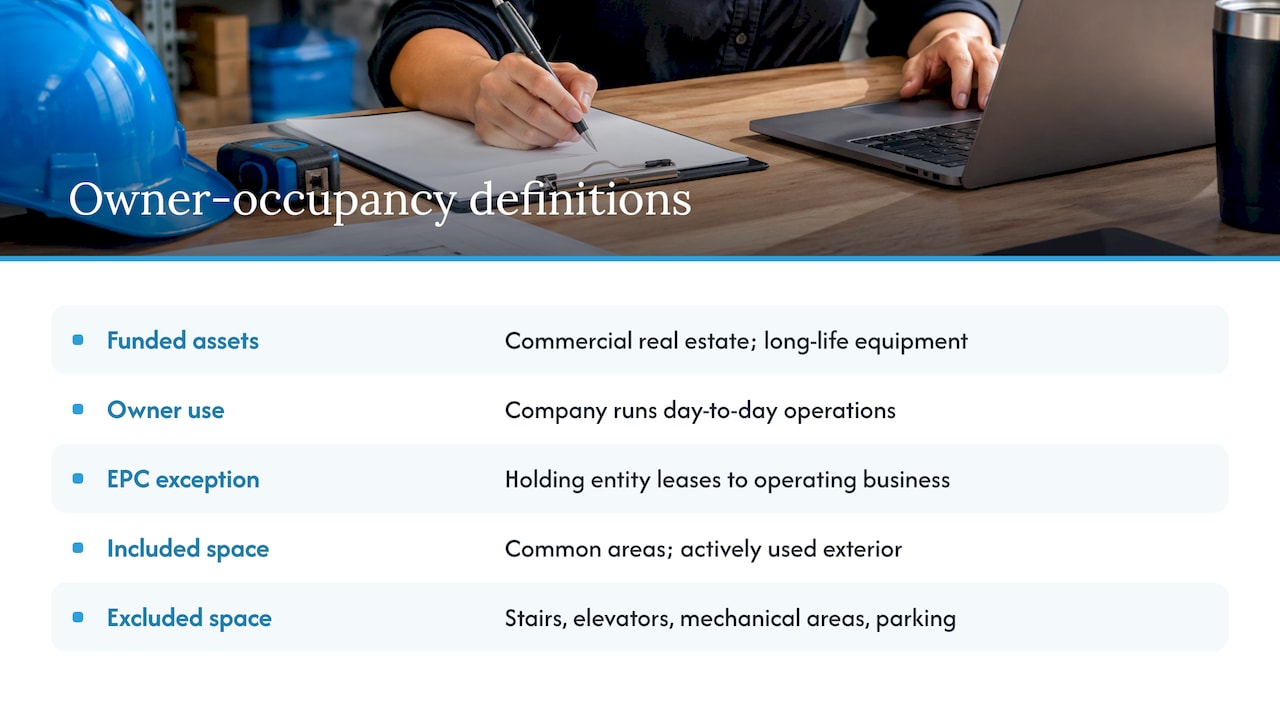
The SBA 504 program finances fixed assets for businesses that will use them: commercial real estate and long-life equipment. It is not an investor loan. Under 13 CFR § 120.880, the borrower must use the project property and, together with its affiliates, meet an SBA size standard. The one structural exception is an Eligible Passive Company, a real estate holding entity that leases to an operating business. We cover that setup below.
In practice, owner-occupied means your company runs its day-to-day operations in the building. A manufacturer producing in the plant, a dental group seeing patients in the suite, a contractor running a shop and office: all qualify. A buyer who wants to collect rent from tenants and run no business there does not.
The SBA measures occupancy against “Rentable Property.” Under the SBA’s SOP 50 10 7.1, that is the total square footage of the buildings or facilities used for business operations, excluding stairways, elevators and mechanical areas and including common areas. It may also include exterior space that is actively used in your operations, though not parking areas. Knowing this definition helps you count your own space correctly.
The occupancy percentages
Two tests apply, depending on whether the building already stands.
| Project type | Your minimum occupancy | What you may lease to others |
|---|---|---|
| Existing building (purchase, renovation or reconstruction) | 51% of Rentable Property | Up to 49% on a permanent basis |
| New construction | 60% of Rentable Property at the start | Up to 20% permanently, plus planned growth into the rest |
Existing buildings: 51%
For acquiring, renovating or reconstructing an existing building, 13 CFR § 120.131(b) lets the borrower permanently lease up to 49% of the Rentable Property, provided it permanently occupies and uses at least 51%.
A simple example: you buy a 20,000 square foot building. Your business needs 12,000 square feet for operations. That is 60%, so you clear the 51% test, and you may lease the other 8,000 square feet to a tenant for the long term. If you needed only 9,000 square feet (45%), you would fall short and would need a smaller building, a larger footprint for your own use, or a different financing structure.
New construction: 60%, with a growth plan
New construction carries a higher bar because the space does not exist yet and the SBA wants the project to be built around a real operating business. Under 13 CFR § 120.870, the borrower may lease long term up to 20% of the Rentable Property if it immediately occupies at least 60%. It must also plan to occupy some of the remaining space within three years, and all of the remaining space not leased long term within ten years.
The OCC’s SBA 504 Q&A summarizes the practical result: 60% occupancy at closing, with up to 20% leased temporarily and up to 20% permanently, so roughly 80% occupancy is expected at the three-year mark.
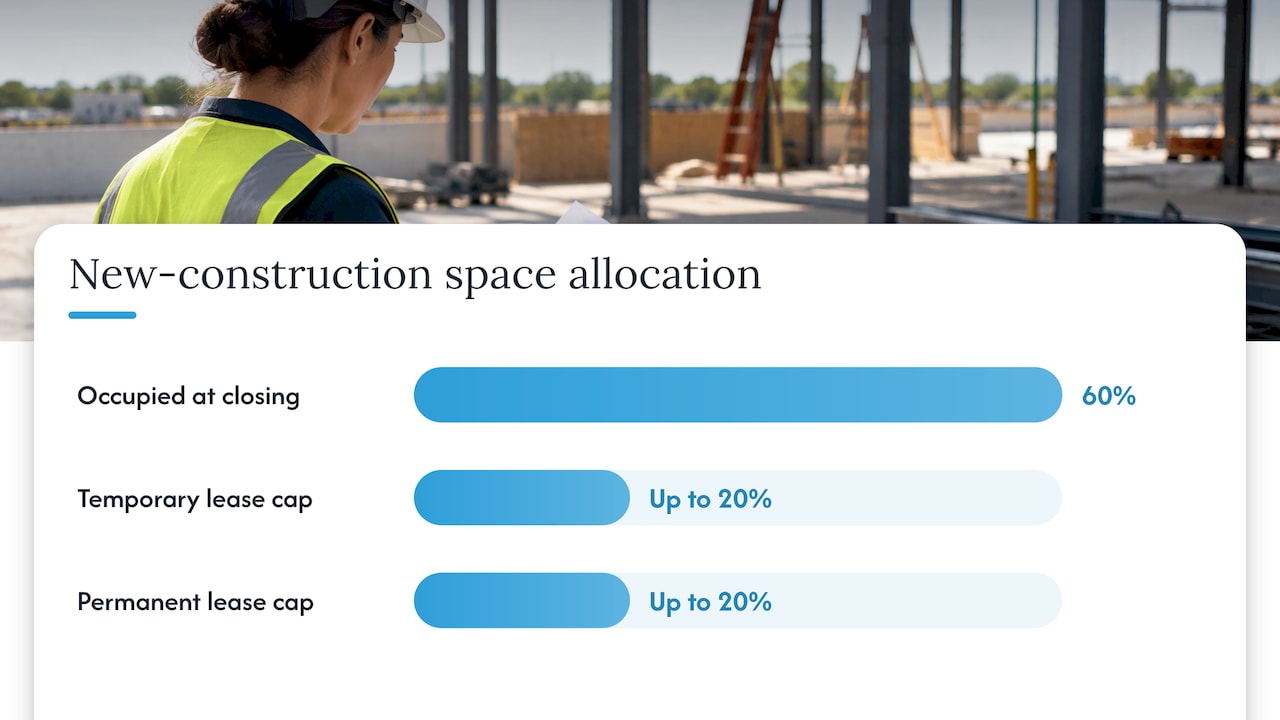
A worked example: you build a 30,000 square foot facility. You occupy 18,000 square feet on day one (60%). Up to 6,000 square feet (20%) can be leased permanently to another business. The remaining 6,000 square feet can be leased on a shorter-term basis while you grow into it, with your plan to use part of it within three years and the rest within ten.
What the rules mean for a landlord-tenant setup
Many New England owner-occupants want rental income from the portion they do not use. That is allowed within the limits above, and a few details shape how you structure it.
- Tenant improvements. Under 13 CFR § 120.871, the cost of interior finishing for space leased to another business is not an eligible project cost. Third-party loan proceeds used to renovate the leased space do not count toward the 504 first mortgage requirement or your contribution. Budget for build-out of rented space separately.
- Lease length. The percentages apply to permanent leasing. In new construction, shorter-term leasing of the growth space is part of the plan, but you must show how your own operations will absorb it.
- Tenant mix. A stable tenant in your leasable share can help carry the property’s cost. If you are weighing how to market and structure leases for your spare space, looking at office and retail leasing listings shows how commercial space is typically presented to prospective tenants.
For a deeper look at buildings with several tenants, see our guide to SBA 504 multi-tenant property loans.
Holding the property in a separate company
Many owners keep real estate in one entity and operations in another, for liability or estate planning reasons. The 504 program accommodates this through the Eligible Passive Company (EPC) structure. Per SOP 50 10 7.1, the EPC must lease 100% of the Rentable Property to an eligible operating company. That operating company must itself occupy 51% of an existing building or 60% of a new construction project, and may sublease within the same limits.
The SOP 50 10 8.1 update effective October 1, 2026 restates this: the operating companies lease 100% of the property from the EPC and may sublease a portion under the occupancy rules in Chapter 3, Paragraph C. In short, the occupancy test follows the operating business, not the entity on the deed.
What changed recently, and what did not
The SBA reissues its lender rulebook periodically. SOP 50 10 8 took effect June 1, 2025, and the technical update SOP 50 10 8.1 took effect October 1, 2026. Across those versions the 51% and 60% occupancy thresholds stayed the same, according to the current SOP text.
Ownership rules are a separate matter. The same source notes an SBA procedural notice effective March 1, 2026 that requires 100% of direct and indirect owners to be U.S. citizens or nationals with a principal residence in the United States. Check that your ownership group meets it before you plan a purchase.
Timing: when you must be in the space
Occupancy is measured when the loan closes, but the SBA recognizes that moves do not always happen in a single day. Under SOP 50 10 7.1, circumstances may justify up to one year after closing to meet the occupancy requirement, and in no case may a small business have more than one year. A development company must not submit a 504 closing package if the borrower will not be occupying and operating in the required amount of property after closing and funding, unless the SBA approved an extension in advance in writing.
The lesson is to build your move-in schedule into the deal. If you are relocating from a leased space, lease expirations, build-out time and moving dates all need to line up. Our article on SBA 504 relocation rules walks through that planning.
A step-by-step way to test your own property
- Measure the rentable square footage. Use the SBA’s definition: include common areas and actively used exterior space, exclude stairways, elevators, mechanical areas and parking.
- List your operating needs. Count the space for production, storage, offices, customer areas and shared areas that serve your business.
- Divide. Your usable space divided by total rentable space is your occupancy percentage. For an existing building you need at least 51%. For new construction you need at least 60%.
- Check your headroom. If you land just above the line, a small change in the floor plan or a tenant’s space could tip it. Leave a margin.
- Plan the leasable space. Decide whether any tenant will be permanent and what improvements they need, remembering that tenant build-out is not a 504-eligible cost.
- Confirm the entity structure. If a separate real estate company will own the property, confirm the operating company holds a lease for 100% of it.
- Set your move-in date. Align lease expirations and the closing date so occupancy is in place within the allowed window.
If you want a second set of eyes on that math, we review the numbers with you as part of the loan structuring. Our overview of SBA 504 eligibility and the 51% rule and the broader SBA 504 loan requirements for New England cover the other qualifying tests, including business size and use of proceeds.
Why occupancy rules work in your favor
The occupancy requirement is the reason the 504 program can offer terms that investor loans do not. Because you will run your business in the building, the property supports your own operations and growth rather than speculation. That is also why the program’s structure can lower your barrier to entry: our 504 loans require only 10% down, with fixed rates for up to 25 years. Our published rates on the CDC New England site, as read on September 16, 2026, were 6.58% for the Equipment 10-Year Fixed, 6.73% for the Real Estate 20-Year Fixed and 6.77% for the Real Estate 25-Year Fixed. Rates move with market conditions, so confirm the current figures with us when you plan your project.
If your business is planning a different kind of move, such as selling a property you own and leasing it back, our comparison of sale-leaseback and SBA 504 shows how occupancy and ownership interact in that case.
Our view: plan the space before you plan the price
In our experience as an SBA 504 lender in New England, the businesses that move through underwriting most smoothly are those that treat occupancy as a design question rather than a hurdle. A building that fits your operations at 55% or 65% leaves room to grow and a tenant that can help carry costs.
We have been financing regional businesses for more than 70 years and have invested more than $2.3 billion in New England companies. That history is why we encourage owners to talk with us before they sign a purchase contract. The percentage, the entity structure and the timing are all easier to set up at the start.
Our Premier Certified status is designed to support faster approvals, and our programs, including down payment assistance and the VetLoan Advantage Program, exist to lower the barriers that stop good businesses from owning their buildings.
PHENYX
How CDC New England can help
We provide SBA 504 loans for commercial real estate and equipment, with 10% down and fixed rates for up to 25 years. We also offer an SBA 504 refinance program for existing debt, a down payment assistance program for commercial property acquisition, and the VetLoan Advantage Program for veterans and their spouses, which carries a 1.0% processing fee.
If you have a building in mind, send us the address, the square footage and a rough picture of how you would use it. We will help you see where you stand against the occupancy tests and what structure fits. Start at cdcnewengland.com.
FAQ
Can I lease part of my SBA 504 building to another business?
Yes. In an existing building you may permanently lease up to 49% as long as you occupy at least 51%. In new construction you may lease up to 20% permanently when you occupy at least 60%. Tenant interior finishing costs are not eligible project costs.
Does the 51% rule apply if my real estate sits in a separate company?
Yes, through the operating company. The holding company must lease 100% of the property to the operating business, and that operating business must meet the 51% (existing) or 60% (new construction) test. The structure does not change the percentage.
How long do I have to move into the property after closing?
The SBA’s lender rulebook allows up to one year after closing in justified circumstances, and never more than a year for a small business. Plan your move so you are operating in the required space as close to closing as possible.
Did the occupancy percentages change in 2026?
No. The 51% and 60% thresholds are unchanged in SOP 50 10 8.1, effective October 1, 2026. The SBA did add an ownership citizenship and residency requirement through a procedural notice effective March 1, 2026.
Sources
- eCFR: 13 CFR Part 120 Subpart H, loan-making policies (§ 120.880)
- eCFR: 13 CFR Part 120 Subpart H, leasing policies (§§ 120.870, 120.871)
- 13 CFR § 120.131, leasing part of new construction or existing building
- OCC: Responses to online questions from the SBA 504 teleseminar
- SBA SOP 50 10 7.1, Lender and Development Company Loan Programs
- SBA SOP 50 10 8.1, effective October 1, 2026
- Office and retail leasing listings


