Yes, you can use an SBA 504 loan to move your business into a new building. The federal rule does not ban relocation. It bars projects where the move causes a net workforce reduction of one-third or more, or a substantial increase in unemployment, and even then your Certified Development Company (CDC) can make a case for an exception. This guide explains what counts as a relocation, what you must disclose, which costs the loan can cover and how to prepare, so you can plan a move with confidence.
TL;DR
- A 504 loan can finance a move into a new owner-occupied building, equipment or land, as long as the project passes the federal displacement test.
- The test: relocating operations is ineligible if it causes a net reduction of one-third or more in the relocating business’s workforce or a substantial increase in unemployment anywhere in the country.
- An exception is possible when the CDC documents key economic reasons and shows the benefits outweigh the harm to the community you leave.
- Your CDC completes the relocation questions on the application with you, so raise the move at the first conversation.
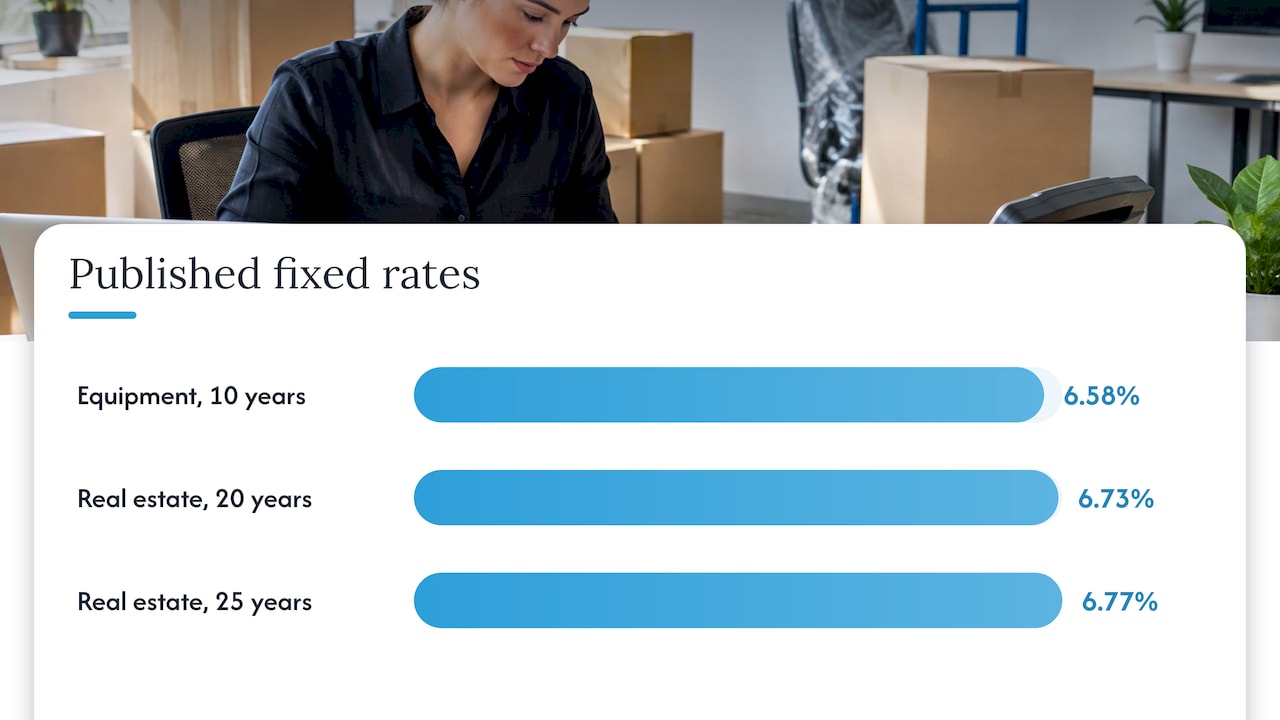
- Our published fixed rates are 6.58% (equipment, 10 years), 6.73% (real estate, 20 years) and 6.77% (real estate, 25 years), and they change over time.
Table of Contents
- What counts as a relocation under the 504 program
- The federal rule: when a move makes a project ineligible
- What you disclose on the 504 application
- Owner-occupancy: the rule your new location must meet
- What a 504 loan can and cannot pay for in a move
- How the financing is structured
- If you already have a 504 loan and want to move
- Our perspective: plan the move around the jobs
- Plan your move with CDC New England
- Steps to prepare before you apply
- FAQ
- Sources
What counts as a relocation under the 504 program
A relocation is any project where you move existing operations from one place to another and use 504 proceeds to do it. The most common cases look like this:
- A tenant outgrows leased space and buys a larger building across town.
- A manufacturer moves production from an older facility to a new one in a neighboring state.
- A company consolidates two leased locations into one owned building.
- A business moves closer to its customers, suppliers or workforce.
Moving across the street and moving across state lines are both relocations. What matters to the rule is the effect on jobs, not the distance. A move that keeps your team intact, or adds jobs at the new site, usually presents no difficulty. A move that shrinks headcount sharply is where the file needs extra work.
The 504 program itself is built for this kind of growth. SBA describes it as long-term, fixed rate financing for major fixed assets that promote business growth and job creation, originated by CDCs working alongside a senior lender. Buying and occupying a new building fits that purpose directly.
The federal rule: when a move makes a project ineligible
The governing language sits in 13 CFR §120.881. Under paragraph (a), relocating any operations is ineligible if it causes either of these outcomes:
- A net reduction of one-third or more in the relocating business’s workforce.
- A substantial increase in unemployment in any area of the country.
SBA’s Standard Operating Procedure for lenders restates the same restriction for the 504 program and applies it to moving the applicant out of a community.
A worked example
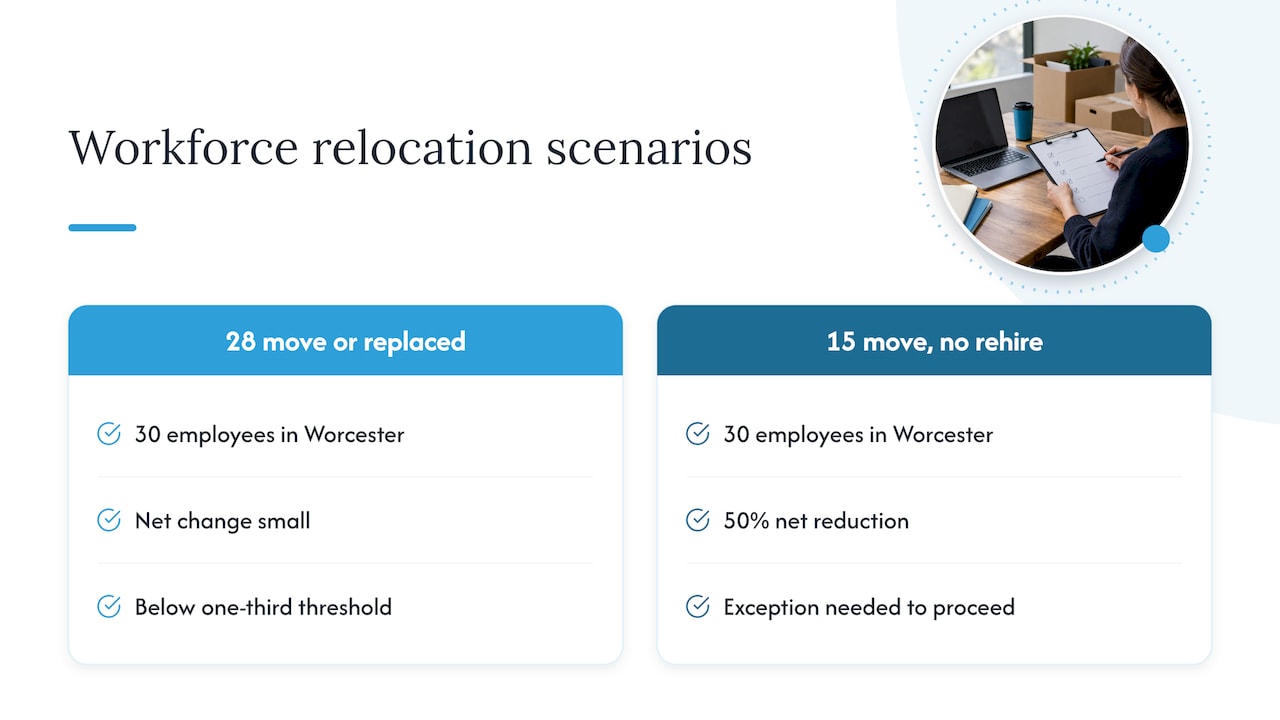
Suppose you employ 30 people in Worcester and plan to buy a building in Providence. If 28 of those employees will make the move or be replaced at the new site, the net change is small and the one-third threshold is nowhere close. If only 15 will relocate and you do not expect to rehire, the net reduction is half your workforce, and the project would need an exception to proceed.
The threshold is about net workforce, so new hires at the destination count. A business that moves and grows is in a very different position from one that moves and downsizes.
The exception
The regulation allows the CDC to justify a relocation anyway. The justification must show the move is crucial for key economic reasons and that its benefits to you and the receiving community outweigh the harm to the community you are leaving. This is a CDC decision documented in the loan file, which is one reason regional experience matters. If you think your move might trip the threshold, tell us early so we can assess whether the exception is realistic and what documentation it would need.
Experienced lenders also point out, in one public discussion among deal professionals, that where your customers and employees are located shapes how the issue is handled. A business whose customers sit near the current site has a harder story to tell than one moving toward its market.
What you disclose on the 504 application
The relocation question is built into the paperwork. Section Four of SBA Form 1244, completed by the CDC, asks whether you are using project funds to relocate. You then certify that you understand the regulations prohibit a relocation that causes a net reduction of one-third or more in your workforce or a substantial increase in unemployment anywhere in the country.
There is one more certification worth knowing. If proceeds relocate an existing business, including an affiliate, subsidiary or other entity under direct, indirect or common control, you certify that the relocation will not significantly increase unemployment in the original location.
In practice, prepare these items before the application conversation:
- Current headcount at each location, by site.
- Expected headcount at the new site over the first one to two years.
- Which employees you expect to retain through the move and why others might not relocate.
- A short explanation of the business reason for moving (capacity, customer access, lease costs, ownership stability).
- Whether any affiliates or related entities are also moving operations.
Answer honestly and completely. Disclosure is simply a part of the process, and a well-documented move is far easier to approve than one that surfaces questions late.
Owner-occupancy: the rule your new location must meet
A 504 loan finances property you will use, not property you hold as an investment. Under 13 CFR §120.880, the borrower must use the project property, with one exception: an eligible passive company may lease it to an operating company, and the borrower plus its affiliates must satisfy an SBA size standard.
For most owner-operators this means a single clean structure. You can form a real estate holding entity that owns the building and leases it to your operating business, provided the structure is set up as the program requires. We cover the occupancy percentages and how they apply to New England borrowers in our guide to SBA 504 occupancy requirements. Since a relocation usually means a new building, confirm early that the space you are considering gives your business enough room to meet the requirement, including any space you plan to lease to others.
Broader qualifications, such as for-profit status, U.S. location and SBA size limits, are summarized on SBA’s 504 page, and our overview of 504 loan requirements in New England walks through them for regional borrowers.
What a 504 loan can and cannot pay for in a move
SBA’s regulation on eligible project costs says costs directly attributable to the project may be paid with 504 proceeds, including qualifying expenditures incurred before you applied. The program page lists purchase, construction or renovation of buildings or land and long-term machinery or equipment with at least 10 years of remaining useful life as permitted uses.
For a move, that generally translates into the following.
| Cost | Typically financeable? |
|---|---|
| Purchase price of the new building or land | Yes, as a fixed asset |
| Renovation or build-out of the new space | Yes, as part of the construction or improvement work |
| Long-term equipment with at least 10 years of useful life | Yes |
| Eligible professional fees and interim financing tied to the project | Yes, when directly attributable |
| Construction contingency | Up to 10% of construction cost, per §120.882 |
| Costs not directly attributable and necessary to the project | No |
Any cost that is not directly tied to the project is excluded, so day-to-day items such as inventory, payroll during the move or marketing for your grand opening belong in a separate working capital plan. Your CDC will tell you which line items fit when we build the project budget.
If the new site needs new machinery, it helps to understand how fixed-asset lending differs from other structures. A short explainer on loan versus asset finance shows the general trade-offs of financing equipment through a term loan rather than leasing it. Under the 504 program, equipment is financed at our published 10-year fixed rate, listed at 6.58% when we last read it.
Do you also carry debt on the building you are leaving? Refinancing is a separate product. Our SBA 504 refinance program and our guide on refinancing commercial real estate with a 504 loan cover that path, so ask us how the two projects can be sequenced.
How the financing is structured
A 504 project has two loans. A senior lender, usually a bank, provides a first-lien loan on the property. The CDC provides the second loan, funded by a debenture that SBA guarantees. SBA’s maximum 504 loan amount is $5.5 million, a ceiling that applies to the SBA-backed portion. Our own program is built around a 10% down payment and fixed rates for up to 25 years.
Our published rates, as read from our site, are:
| Product | Term | Published fixed rate |
|---|---|---|
| Equipment | 10 years | 6.58% |
| Real estate | 20 years | 6.73% |
| Real estate | 25 years | 6.77% |
Rates move with the market, so use these as a reference and confirm the current figure on our site. To compare terms for your situation, see our breakdown of 10, 20 and 25 year SBA 504 terms.
For a relocation, the fixed-rate structure matters. Moving is a year with many variable costs, and a payment that will not change gives you a steady number to build your new budget around. Property appraisals are also part of the process, and our appraisal requirements checklist explains what to expect.
If you already have a 504 loan and want to move
Moving after you close is a different situation from moving as part of a new project. The property secures your loan, so a sale or change in how you use it is not something to arrange on your own. Before you list the building, sign a lease at a new site or tell your landlord anything, contact your CDC and your senior lender. We can walk through what your loan documents say, how a sale would work and whether a new 504 project for the next building is a sensible path.
A good order of operations for an existing borrower looks like this:
- Pull your loan documents and note the property use and occupancy terms you agreed to.
- Call your CDC before any public step, such as listing the property.
- Map your headcount and customer locations for the move, as a new project will face the same displacement test.
- Talk to your senior lender about the existing first lien.
- Decide whether to buy before you sell or sell before you buy, with your advisors.
Our perspective: plan the move around the jobs
We see relocation as a growth decision, and the 504 program is built to support it. Most of the businesses we work with move because they have outgrown leased space, and owning the next building lets them stop paying rent into someone else’s equity. The displacement rule rarely stands in their way, because their teams are moving with them or growing at the new site.
Our advice is to treat the workforce plan as part of the financing plan from day one. Write down who is moving, who is being hired and why the new location serves your customers. A clear plan makes the application smoother and gives us what we need if an exception ever has to be documented.
With only 10% down, fixed rates for up to 25 years and regional knowledge across New England, we can help you buy the next building without draining the working capital you need for the move itself. If you are a veteran or a spouse, our VetLoan Advantage Program adds incentives, and our Down Payment Assistance Program can help when the equity is the hurdle.
PHENYX
Plan your move with CDC New England
We finance owner-occupied commercial real estate and equipment across Massachusetts, Rhode Island, Vermont, New Hampshire and Connecticut, with more than 70 years of experience and more than $2.3 billion invested in regional businesses. If you are weighing a move, start with a conversation about your headcount and timeline, and we will tell you what the project looks like.
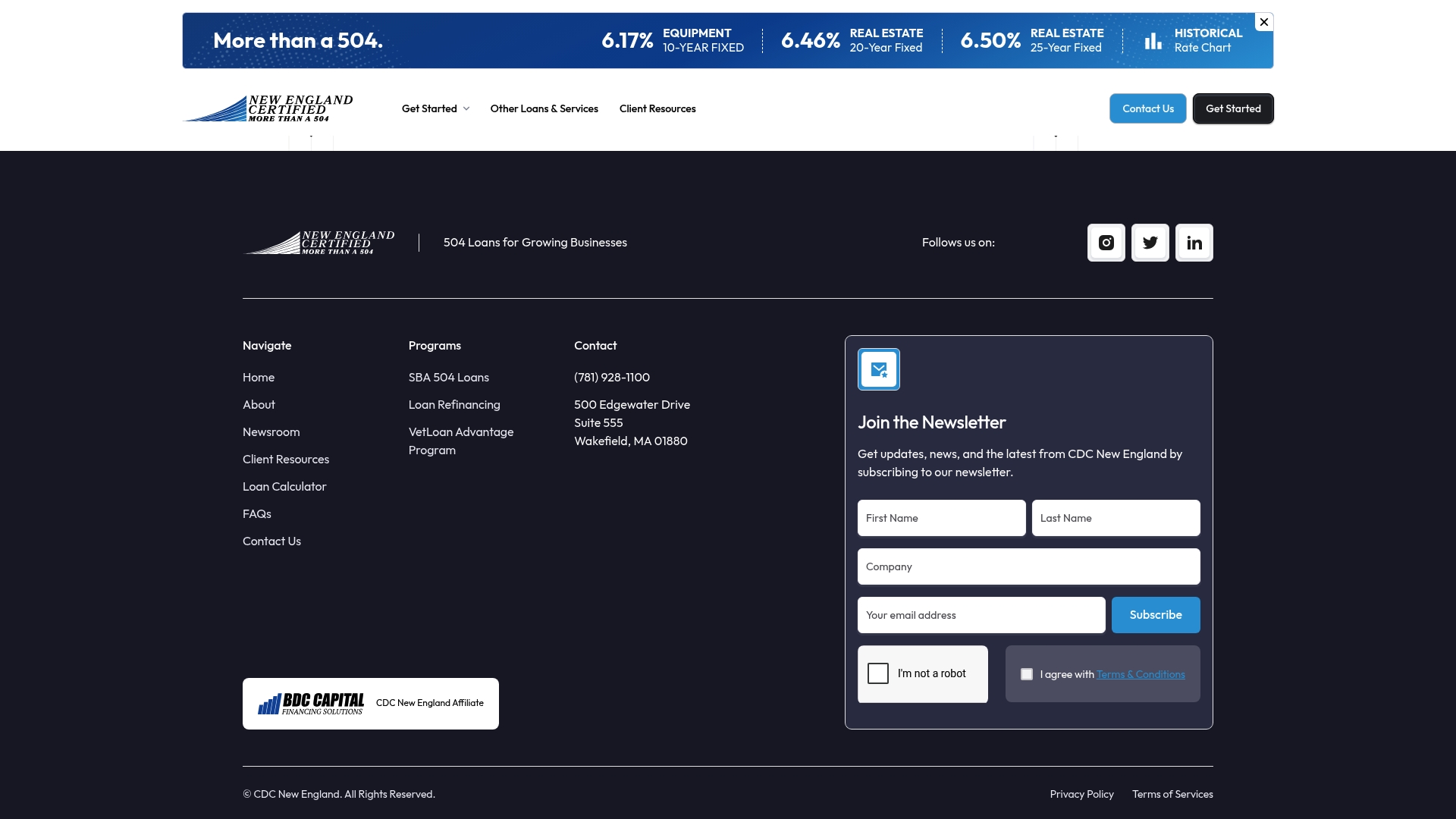
See current rates and start on our home page. If down payment is the obstacle, review our Down Payment Assistance Program. Veterans and spouses can look at the VetLoan Advantage Program, which lists a 1.0% processing fee.
Steps to prepare before you apply
- Document your workforce. List current employees by location and your hiring plan for the new site.
- Define the business reason. Capacity, customer access and ownership are all legitimate, specific reasons.
- Confirm occupancy. Make sure your business will use the required share of the new building.
- Build a budget of eligible costs. Separate the property, build-out and equipment from working capital needs.
- Talk to a CDC before signing anything. Costs and timing are easier to structure before a purchase contract is final.
- Gather financials. Tax returns, a debt schedule and a current balance sheet will be requested.
Startups and younger companies have their own considerations, covered in our guide to 504 financing for startups. If you are comparing programs, our comparison of SBA 504 and 7(a) loans can help you choose.
FAQ
Can I use an SBA 504 loan to relocate my business?
Yes. A 504 project can finance a move into a new building as long as the relocation does not cause a net workforce reduction of one-third or more or a substantial increase in unemployment. If it would, the CDC can justify an exception based on key economic reasons.
Does the one-third rule apply to all moves?
It applies to any project where 504 proceeds fund the relocation of operations. The test looks at the net change in your workforce, so jobs you add at the new site count. Moves where your team comes along are typically straightforward.
What is the SBA 504 loan limit for a relocation project?
SBA states the maximum 504 loan amount is $5.5 million. Your project can be larger, because the bank’s first loan and your down payment fund the rest. Your CDC will size the structure for your property.
Can I move if I already have a 504 loan?
Talk to your CDC and senior lender before taking any step, since the property secures your loan. Often the path is a new 504 project for the next building, coordinated with the handling of the first one.
Sources
- eCFR, 13 CFR Part 120 Subpart H, Loan-Making Policies for 504 Loans
- SBA, 504 loans
- SBA Form 1244, Application for Section 504 Loans
- SBA SOP 50 10 7.1, effective November 15, 2023
- 13 CFR §120.882, Eligible project costs for 504 loans
- Searchfunder, SBA lending question on buying and relocating a business
- Loan vs asset finance