You can refinance commercial real estate with an SBA 504 loan if you own the property, occupy it for your business, and your existing debt meets the SBA’s definition of qualified debt. The loan replaces a shorter or higher-cost mortgage with long-term, fixed-rate financing. This guide explains who qualifies, how the numbers work, the difference between refinancing with and without expansion, and the steps to close.
What an SBA 504 refinance does
The 504 program exists to give small businesses long-term financing to purchase or improve land, buildings and major equipment, in support of job creation and local economic development, as the SBA described when it proposed its refinancing changes. Most borrowers use it to buy a building. Refinancing applies the same structure to a property or equipment you already own.
The SBA states that a 504 loan can repay or refinance debt defined as qualified debt under its regulations. In practice, that means you swap an existing commercial loan, often a balloon mortgage, a short-term bank loan or a loan with a rate that is about to reset, for a package with a fixed rate over a long amortization.
The rate is fixed on the CDC portion, so your payment on that portion does not change for the life of the loan. That is the main reason owners with maturing debt look at 504 first. Our own commercial mortgage refinance comparison explains why 504 is usually the first option to price.
Who qualifies
The loan is designed for operating businesses that occupy their property. Several requirements come up in nearly every file:
If you borrowed against a building and used a large share of the proceeds for inventory, payroll or a personal purchase, you may miss the 75% test. Gather the closing documents from the original loan early so this can be checked.
Refinancing with expansion vs. without expansion
There are two paths, and the difference matters for how much debt you can include.
Refinance with expansionRefinance without expansionWhat it meansYou are also buying, building or improving somethingYou are only replacing existing debtDebt that can be refinancedExisting debt up to 100% of the expansion project’s costQualified debt, within the collateral limitKey limitExisting debt cannot exceed the cost of the expansion project504 loan plus third-party loan cannot exceed 90% of fair market value of the collateralPayment history12 months of timely payments on the original debtQualified debt rules apply
The SBA’s rulemaking set out both categories: with expansion, existing debt up to 100% of the project’s cost may be refinanced, and without expansion, refinancing is available for projects without business expansion under specific requirements. NerdWallet notes that refinancing with expansion calls for a history of timely payments over the previous 12 months on the original debt.
Expansion can be modest. Adding a building wing, renovating, or buying new equipment can qualify as the expansion element, provided the project meets the program rules. If you are planning any of these anyway, it is worth asking your CDC whether folding the debt into the project gives you more room.
What the 2024 rule changed
The SBA published a direct final rule on 504 debt refinancing that took effect on November 15, 2024. It amended the regulations for refinancing with and without expansion and streamlined the application process. Two changes stand out for borrowers:
The SBA says these changes aim to lower costs for small businesses by streamlining access to debt refinancing. Older articles that still mention a required payment reduction describe the rules before this change. If a lender or blog tells you that you must cut your payment by a set percentage, ask which version of the rules they are citing.
Refinancing an existing SBA loan with a new one is now possible in some cases, but NerdWallet points out that you still need a reason to replace it, since the original loan may already have competitive terms. Run the numbers before you assume newer is better.
How the financing is structured
A typical 504 project has two lenders. The SBA describes the standard structure as a private-sector senior loan covering at least 50% of the project cost and a CDC loan covering up to 40%. In a purchase, the borrower contributes the remaining 10%. Our post on the 50/40/10 structure shows who funds which portion and when.
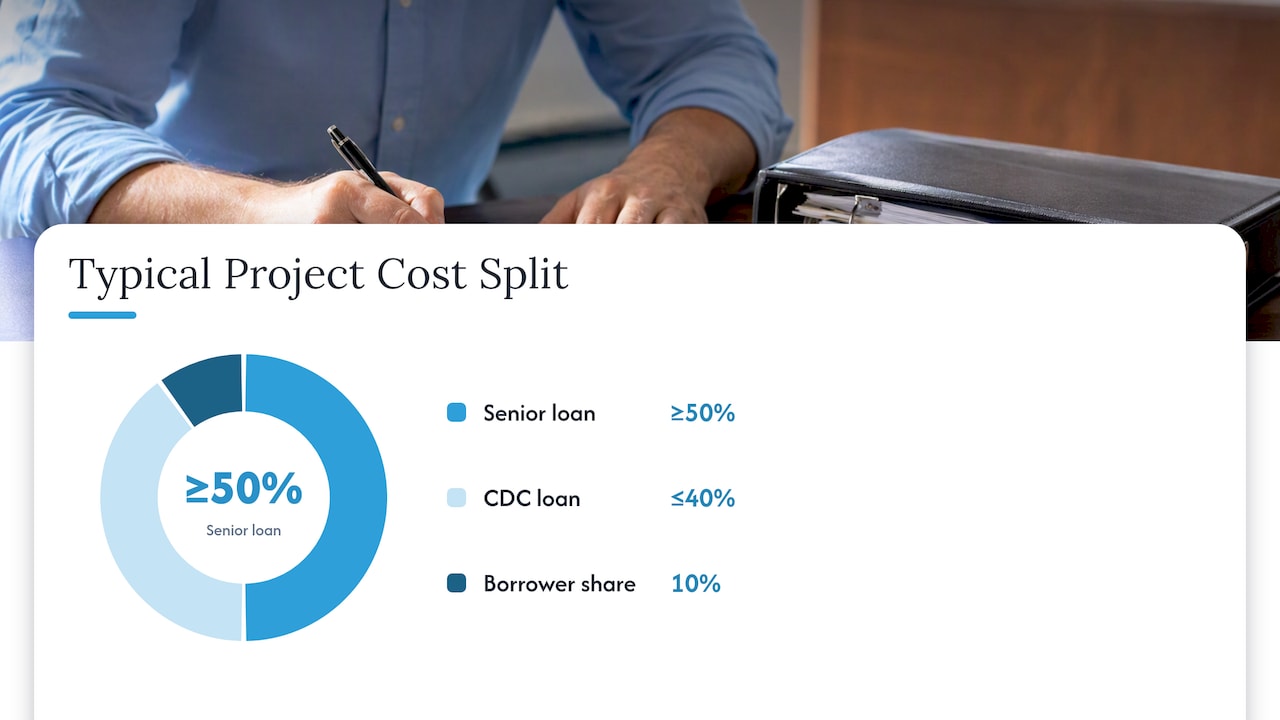
In a refinance without expansion, equity is measured against the property’s value rather than a purchase price. The combined 504 and third-party loans may not exceed 90% of the fair market value of the collateral fixed assets. Put simply, you need roughly 10% equity in the real estate.
Here is a worked example with round numbers for illustration only. Suppose your building appraises at $2,000,000 and your qualified debt is $1,400,000.
When the numbers leave a gap in the capital stack, some borrowers explore subordinate capital. A good overview of mezzanine financing basics shows how that layer sits behind senior debt. For most refinances, though, the 504 structure alone is enough.
The SBA lists the maximum loan amount for a 504 loan at $5.5 million. That limit applies to the SBA-backed portion, not the bank loan alongside it.
Rates and terms
The SBA says the program provides fixed-rate financing with 10-, 20- and 25-year terms. Real estate usually takes the 20- or 25-year option, and equipment the 10-year term. Our guide to 10, 20 or 25 year terms helps you match the term to the asset.
As published on our site at the time of writing, our rates are:
ProductRateEquipment 10-Year Fixed6.58%Real Estate 20-Year Fixed6.73%Real Estate 25-Year Fixed6.77%
Rates move with the market, so use these as a reference point and confirm the current figures on our home page before you build a model.
A fixed rate over 25 years can lower your annual debt service compared with a loan that amortizes over 10 or 15 years, because the principal is spread over more payments. It also protects you if rates rise. It does not always lower your total interest cost, since you pay for more years. That is why we compare total cost and cash flow, not just the monthly payment. For a deeper look, read our comparison of 10% down, 25 years, SBA 504 vs. conventional and our piece on fixed rate vs. fast recast.
Step-by-step: how to refinance
Timelines vary with the quality of the file and the appraisal. We do not promise a fixed number of days, but a complete package submitted at the start is the best way to speed things up.
When refinancing with a 504 makes sense
This loan is a strong fit when:
It is a weaker fit when your debt is under six months old, you lease most of the building to others, or your existing SBA loan already carries a low fixed rate that a new loan would not beat. Be honest about that last point: a refinance should solve a problem, not simply change the paperwork.
Our perspective
We see the same pattern with borrowers across New England. A business buys a building with a five- or ten-year bank loan, grows into the space, and then faces a maturity date at the wrong moment. The 2024 rule change made refinancing more accessible because owners no longer have to prove a set payment reduction, but the fundamentals still decide the outcome: owner occupancy, a clean payment history and a property worth at least what the lenders will advance against it.
Our advice is to start the conversation 6 to 12 months before a maturity date, not 6 weeks. That gives you time to gather records, resolve any appraisal surprise and compare structures. We take a hands-on approach: we review your existing note and payment history, tell you which path fits, and say so plainly if a 504 is not the right tool. We have supported regional businesses for more than 70 years and have invested more than $2.3 billion in New England companies, and that experience shows up mostly in the details that keep a file moving.
Refinance with CDC New England
Our SBA 504 Refinance Program is built for owner-occupied commercial property and equipment debt. We review whether you qualify, outline the structure with your bank, and help you through the application. Veterans and spouses can ask about our VetLoan Advantage Program, and if a purchase or expansion also needs equity, our Down Payment Assistance Program may help.
To see where you stand, send us your current loan terms and property details through the refinance page.
FAQ
Can I refinance an SBA 504 loan I already have?
Possibly. The SBA’s 2024 rule covers refinancing government-guaranteed debt, and it removed the 10% substantial-benefit test. You still need a clear reason to replace the loan, because the original may already carry strong terms. Ask your CDC to compare the two payment schedules side by side.
How much equity do I need to refinance without expansion?
The 504 loan and the third-party loan together cannot exceed 90% of the fair market value of the collateral. That means you need about 10% equity in the property. An appraisal sets the final number.
How old does my current loan have to be?
Qualified debt must be a commercial loan incurred at least six months before you apply. At least 75% of it must have been used for eligible fixed assets. If the loan is newer, wait until it reaches six months.
Do I have to show lower payments to qualify?
No. Since the SBA’s rule took effect on November 15, 2024, borrowers no longer need to show a minimum reduction in their payment. A lender may still look at whether the new structure improves your cash flow, since that is good underwriting.