A fully amortizing loan is paid off by its last scheduled payment. A balloon loan leaves a large balance due at the end, so you owe a lump sum on top of your regular payments. For a business buying property or equipment, that difference decides whether you finish the term owning the asset free and clear or facing a refinance on someone else’s timeline. Our SBA 504 loans are built on the first model: fixed rates, no balloon, and a payment you can plan around for the full term.
TL;DR
- An amortizing loan repays principal and interest in every payment, so the balance reaches zero at maturity.
- A balloon loan has lower payments along the way but a large final payment, which you must pay in cash or refinance.
- Refinance risk is the main danger of a balloon: you may not be able to replace the debt on reasonable terms when it comes due.
- SBA rules do not allow balloon payments on the covered SBA guaranteed-loan amortization methods, and SBA 504 financing runs on long, fixed-rate terms.
- Our published fixed rates: 6.58% for 10-year equipment, 6.73% for 20-year real estate and 6.77% for 25-year real estate.
Table of Contents
- How an amortizing loan works
- How a balloon loan works
- Side by side
- Where balloon loans go wrong
- What to check before you choose
- Why SBA 504 fits the amortizing model
- Our perspective
- Financing built to amortize
- FAQ
- Sources
How an amortizing loan works
Amortization means that regular payments gradually reduce what you owe. The CFPB’s key terms page explains that amortization is the process of paying down the amount owed over time, and that a loan which does not fully amortize can still carry a balance after the scheduled payments end.
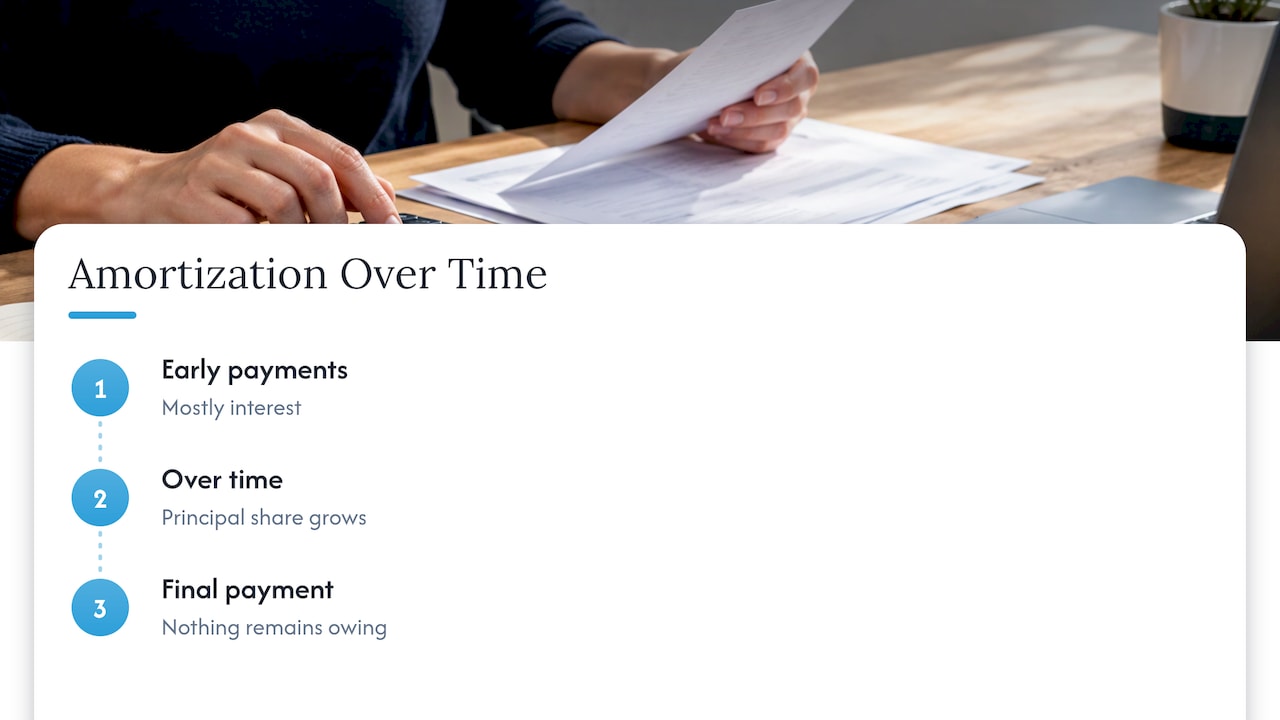
In a fully amortizing loan, each payment covers the interest that has built up plus a slice of principal. Colorado State University Extension describes how the principal share grows over time as the interest share shrinks. Early payments are mostly interest. Late payments are mostly principal. The final payment leaves nothing owing.
For you, that means three things: the payment is predictable, the balance falls every month, and the end date is also the date the debt is gone.
How a balloon loan works
A balloon loan sets payments as if the loan were repaid over a long schedule, then comes due much sooner. The same Colorado State guide says a balloon schedule lowers the periodic payment by leaving some principal unpaid in the installments and due as a lump sum at the end.
The CFPB, in its guidance on balloon payments, describes the balloon as a large one-time payment at the end of the term. For mortgages, it says balloon terms generally run 5 to 10 years, against 15 to 30 years for traditional loans, and that the final payment is generally more than twice the average monthly payment. Commercial loans follow the same logic even though the terms differ.
A worked example
The CFPB’s payment calculation example uses a $100,000 loan at 4% over 30 years, which has a $477 monthly principal-and-interest payment. If that same payment schedule sits inside a five-year balloon, $90,448 is still owed at year five. After five years of payments, you would have retired less than 10% of the principal.

A farm-lending example from Iowa State University Extension shows the same pattern: a loan amortized over 40 years but due after the tenth payment ends with a $10,058 balloon, made up of $9,400 of remaining principal and $658 of interest for year 10.
Side by side
| Fully amortizing | Balloon | |
|---|---|---|
| Monthly payment | Higher, covers full repayment | Lower, based on a longer schedule |
| Balance at maturity | Zero | Large lump sum due |
| Term | Matches the repayment schedule | Often shorter than the schedule |
| Main risk | Payment size must fit your budget | Cash or refinancing needed at maturity |
| Planning | Same payment for the whole term when the rate is fixed | Depends on conditions at the end of the term |
Where balloon loans go wrong
The low payment is real, and so is the deadline. The CFPB notes that you may be able to refinance to pay off the balance, but that is not assured: refinancing may be unavailable if property values fall or your finances weaken. If a balloon secured by property cannot be paid, the options narrow to refinancing, selling or foreclosure.
The Office of the Comptroller of the Currency defines refinance risk in its October 2024 bulletin as the risk that a borrower cannot replace existing debt at a future date on reasonable terms under prevailing market conditions. It lists rising interest rates, high leverage, constrained liquidity, weak financial performance and near-term maturities among the factors that heighten that risk. It also says fully amortizing loans to sound borrowers generally carry lower refinance risk than loans that are not fully amortizing.
That last point matters for a growing business. The moment a balloon comes due is rarely one you choose. It may land in a tight credit market, after a slow year, or right when you want your cash for expansion.
What to check before you choose
- Ask what is owed on the last day. Request the full schedule and look for the final figure, not just the monthly payment.
- Compare term to amortization. A 10-year term on a 25-year schedule is a balloon. A 25-year term on a 25-year schedule is not.
- Plan the payoff. Decide whether you would pay the balloon from cash, a sale or a refinance, and what happens if rates are higher or the property is worth less.
- Test the payment. Check that the higher amortizing payment still fits your cash flow with room to spare.
- Look at the rate type. A fixed rate keeps the payment steady for the term, which makes the first four checks easier.
Why SBA 504 fits the amortizing model
A 504 project is long-term fixed-asset financing. Under SBA’s business loan regulations, a Certified Development Company provides the final portion through an SBA-guaranteed debenture sold to investors. The same rules cap covered business-loan maturities at 25 years, and they do not allow balloon payments for the covered SBA guaranteed-loan amortization methods.
The result for an owner-occupant is a loan designed to be paid down on a schedule, not refinanced on a deadline. The rates we publish are fixed: 6.58% on our 10-year equipment loan, 6.73% on our 20-year real estate loan and 6.77% on our 25-year real estate loan, as listed on our site in September 2026. Rates move with the market, so check our site for the current figures when you are ready to compare.
If you hold an existing loan that is coming due, our SBA 504 refinance program is built for that situation, and our guide to owner-occupied commercial refinance options and steps walks through how it works. If you are weighing SBA 504 against other structures, see SBA 504 vs. CMBS.
Our perspective
We have been financing New England businesses for more than 70 years and have invested more than $2.3 billion in regional companies. The pattern we care about most is simple: owners do best when the loan matches the life of the asset.
A building or a piece of equipment earns its keep over many years. A fixed-rate loan with a long amortization lets the asset pay for itself while your payment stays the same. There is no maturity date that forces a decision about refinancing in a market you did not choose.
That is why we put so much into the 504 structure: 10% down, fixed rates for up to 25 years, and programs such as down payment assistance and VetLoan Advantage for veterans and their spouses. Our Premier Certified status is meant to speed approvals. The goal is a payment you can plan around and a balance that ends at zero.
PHENYX
Financing built to amortize
We offer SBA 504 loans for commercial real estate and equipment with only 10% down and fixed rates for up to 25 years. If the down payment is the hurdle, look at our Down Payment Assistance Program. Veterans and their spouses can look at the VetLoan Advantage Program, which lists a 1.0% processing fee. To see the rates and talk with our team, start at cdcnewengland.com.
FAQ
What is considered a balloon loan?
A balloon loan is one whose regular payments do not fully repay it, so a large lump sum is due at the end of the term. The CFPB describes it as a large one-time payment at maturity, with lower payments beforehand.
What happens if I can’t pay a balloon payment?
You may be able to refinance, but that is not assured. If property values fall or your finances weaken, refinancing can be unavailable. When the loan is secured by property, the CFPB warns the outcome can be a forced sale or foreclosure.
Does an amortizing loan always have higher payments?
Usually, yes, for the same rate and amount, because each payment must retire the whole balance by the end. In return you owe nothing at maturity, and the OCC notes that fully amortizing loans to sound borrowers generally carry lower refinance risk.
Are balloon payments allowed on SBA loans?
SBA’s regulations in 13 CFR Part 120 do not allow balloon payments for the covered SBA guaranteed-loan amortization methods. The same part sets a 25-year maximum term for the covered business-loan maturities.
Sources
- CFPB: What is a balloon payment? When is one allowed?
- CFPB: Mortgage answers, key terms
- CFPB: How do mortgage lenders calculate monthly payments?
- Colorado State University Extension: Long Term Loan Repayment Methods
- Iowa State University Extension: Types of Term Loan Payment Schedules
- OCC: Commercial Lending: Refinance Risk
- eCFR: 13 CFR Part 120, Business Loans