If your business occupies the building it owns, you can refinance the mortgage through a conventional bank loan, an SBA 7(a) loan or an SBA 504 loan. For owners who qualify, the 504 program is usually the first one to price, because it pairs a long-term fixed rate with a modest equity requirement. This guide explains what counts as owner-occupied, how each route works, what lenders check, how much cash you can take out and what the process looks like from first call to closing.
TL;DR
- Owner-occupied means your operating business uses at least 51% of the property. Lenders underwrite the loan on your business cash flow, with the building as collateral.
- SBA 504 refinancing offers fixed terms of 10, 20 or 25 years. Current SBA rules allow a refinance without expansion when the existing debt is qualified and the combined loans stay within the loan-to-value limit.
- A 7(a) loan can also refinance real estate debt, with maturities up to 25 years, but it carries its own rules on what debt it may pay off.
- Balloon maturities are the main reason owners refinance early. Start the conversation well before your current loan comes due.
Table of Contents
- What owner-occupied means in a refinance
- When refinancing makes sense
- Your main options
- Rates and terms you can expect
- Can you take cash out?
- Documents and steps
- Our perspective
- Start a refinance review with us
- FAQ
- Sources
What owner-occupied means in a refinance
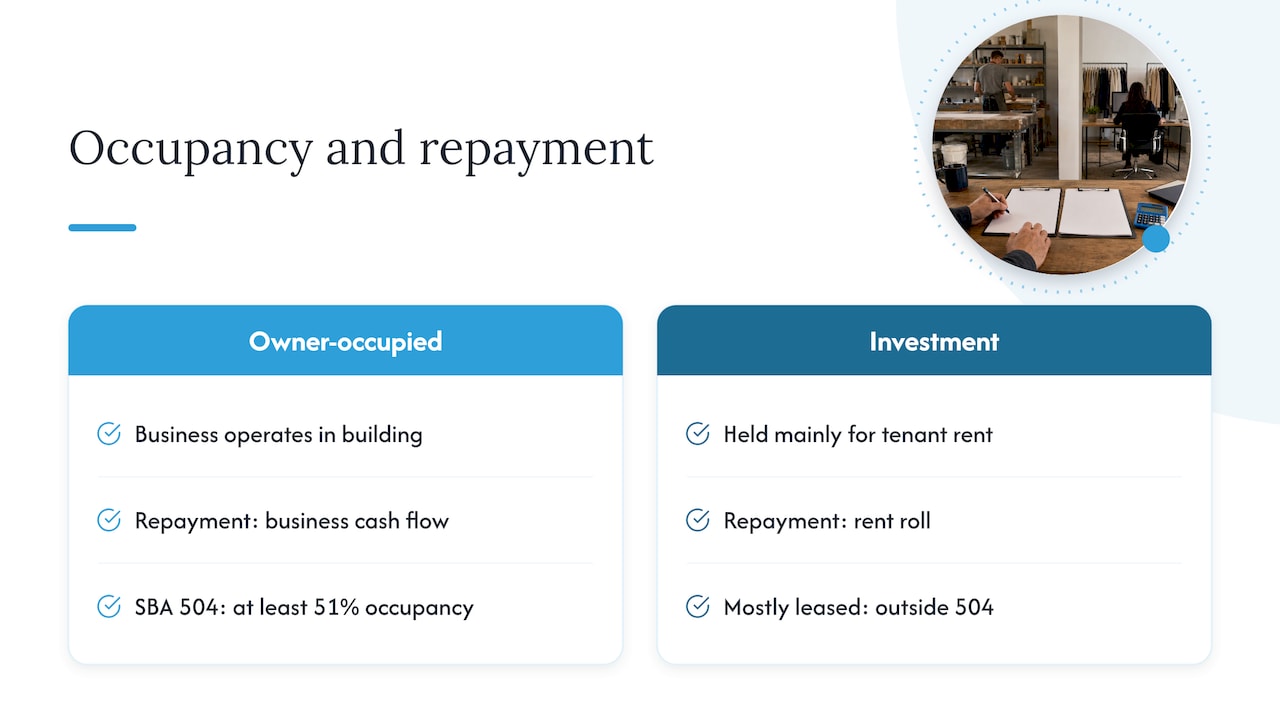
An owner-occupied commercial property is a building your own business uses to operate: a machine shop, a medical office, a restaurant, a warehouse or a distribution facility. An investment property is held mainly to collect rent from other tenants. The difference matters because it changes how the lender thinks about repayment. On an owner-occupied loan, the lender looks at the cash flow of the business inside the building. On an investment loan, it looks at the rent roll.
For SBA 504 financing, the test is concrete: the business must occupy at least 51% of an existing building. You can read how we apply that rule in our guide to SBA 504 eligibility for New England borrowers. The remaining space can be leased to other tenants, which can help carry the building, but a building leased mostly to outsiders no longer fits the program.
Holding the building in a separate entity
Many owners hold real estate in a separate LLC and lease it to the operating company. That structure is common and workable. Under SBA rules for an Eligible Passive Company, the operating company must be a guarantor or co-borrower, and the lease must be in writing with a term at least equal to the loan. If your lease is informal or shorter than the loan you want, fix that before you apply. It is one of the most common reasons files stall.
When refinancing makes sense
Owners refinance a building they occupy for a handful of reasons:
- A balloon payment is coming due. Many bank loans amortize over 20 or 25 years but mature in 5 to 10. The bank loan ends with one large payment. The Office of the Comptroller of the Currency notes that borrowers can struggle to refinance a balloon at maturity if property conditions or values decline. Refinancing into a fully amortizing fixed-rate loan removes that exposure.
- Your rate is adjustable. A fixed rate for the full term makes your occupancy costs predictable for budgeting.
- You want to consolidate. A first mortgage, a second note and an equipment line can sometimes roll into one payment. Our article on locking a 25 year fixed rate on business debt consolidation covers how that works.
- You want working capital. Some refinance structures allow a limited amount of cash out for business purposes (more on that below).
Refinancing also has costs. You will pay appraisal, legal, title and lender fees, and a prepayment penalty on the old loan can erase the savings. Run the numbers on total cost over the time you expect to hold the building, not only the new rate.
Your main options
SBA 504 refinance
The SBA 504 program offers long-term, fixed-rate financing of up to $5.5 million for major fixed assets, with terms of 10, 20 and 25 years. A 504 project is split into two pieces: a first mortgage from a bank or other third-party lender, and a second piece funded through a certified development company (CDC) such as ours. That second piece is the long-term fixed-rate part.
The SBA’s refinance rules matter most for owner-occupants. In a 2024 direct final rule, the SBA removed the 50% cap on debt refinancing without expansion, raised the loan-to-value limit to 90% on refinance projects that include other business expenses, and aligned the “substantially all” standard at 75% for refinancing with and without expansion. In plain terms, a qualifying owner-occupant can often refinance an existing building loan without adding square footage or buying new equipment.
The details lenders typically examine include:
- The business has been operating for a period set by SBA rules, commonly two years.
- The debt being refinanced is qualified: it was used for fixed assets, and it has seasoned for the required period.
- At least 75% of the old loan went toward the fixed assets involved.
- The combined bank and 504 loans stay within the SBA’s loan-to-value limit.
Exact eligibility depends on your file, so treat this list as the questions to prepare for, not a guarantee. Our SBA 504 Refinance Program page explains how we review qualified debt, and a short call can tell you quickly whether your loan fits.
SBA 7(a) refinance
The SBA 7(a) program offers financing of up to $5 million that can be used to refinance existing business debt and real estate, with maturities up to 25 years for real estate. It is more flexible on uses than the 504, which can suit a business that wants to combine real estate debt with other needs. The trade-offs are that 7(a) loans often carry variable pricing, and the regulations restrict paying off a creditor when it would shift the loss from an existing debt to the SBA. If your current lender is in a weak position on your loan, expect scrutiny.
Conventional bank refinance
A conventional commercial mortgage is the third option. Terms vary by lender, and many include shorter maturities with a balloon, adjustable rates after an initial period, and higher equity requirements than a 504 structure. For a business with strong cash flow and significant equity, a conventional loan may still be competitive, especially if speed matters most. Ask any lender for the maturity, the rate adjustment schedule, the prepayment terms and the full list of fees, and compare them against a 504 quote on equal terms.
How the options compare
| Feature | SBA 504 | SBA 7(a) | Conventional bank loan |
|---|---|---|---|
| Maximum loan size | Up to $5.5 million for major fixed assets | Up to $5 million | Set by lender |
| Longest real estate term | 25 years | 25 years | Varies, often a shorter maturity with balloon |
| Rate structure | Long-term fixed on the CDC portion | Often variable | Fixed or adjustable |
| Owner-occupancy | At least 51% for existing buildings | Owner-occupancy expected | Often 51% or more for owner-occupied pricing |
| Typical fit | Owner-occupied real estate and equipment | Mixed uses, working capital | Strong equity, speed |
Rates and terms you can expect
Because the 504 second mortgage is funded through SBA-backed debentures, the fixed rate is set for the life of the loan. The rates published on our site when this article was written were:
| Program | Fixed rate |
|---|---|
| Equipment 10-Year Fixed | 6.58% |
| Real Estate 20-Year Fixed | 6.73% |
| Real Estate 25-Year Fixed | 6.77% |
Those figures apply to the CDC portion of a 504 project and change as the market moves, so check the current rates on our site before you plan. Remember that your total cost blends the bank’s first mortgage rate with the CDC’s fixed rate. We explain how to choose a term in our guide to 10, 20 or 25 year SBA 504 terms, and how a longer fixed term compares with a faster payoff in 25 year fixed rate vs fast recast.
Equity works differently in a refinance than in a purchase. Instead of a down payment, the lender measures your existing equity against the appraised value of the building. The more equity you hold, the easier the structure. If equity is thin, a program such as down payment assistance is aimed at purchases, not refinances, so ask which route fits your situation.
Can you take cash out?
Yes, in limited form. A refinance can include cash out for business purposes when the program allows it. Under the 504 rule change above, projects that include other business expenses can go up to 90% loan-to-value, and the former cap on those expenses was removed. Typical uses include working capital, inventory, equipment and renovations of the building. Cash out is generally not for personal use, for buying unrelated investment real estate, or for paying owners.
Two cautions apply. First, cash out raises your loan balance and your payment, so test your debt service coverage with the larger payment, not the old one. Second, the more you take, the less equity cushion you leave if values fall. Decide what the money will earn for the business before you borrow it.
Documents and steps
Most lenders ask for similar paperwork. Gather these before you call:
- Three years of business tax returns and year-to-date financial statements.
- A current debt schedule listing every loan, balance, rate, maturity and payment.
- Personal financial statements and tax returns for every owner of 20% or more.
- The existing note, mortgage and closing statement for the loan you want to refinance, which show what the debt paid for and when it started.
- The lease between the real estate entity and the operating company, if you hold the property separately.
- A rent roll, if you lease any space to outside tenants.
Then the process runs in a few stages:
- Screening call. We confirm occupancy, business age and whether your debt is qualified.
- Pairing with a first-mortgage lender. For a 504 structure, a bank or other lender provides the first position loan.
- Application and underwriting. The CDC and lender review financials, an appraisal and environmental information on the property.
- SBA authorization. The loan package goes for SBA approval. Premier Certified status can speed this step, and we hold it.
- Closing and funding. Title work closes, old debt is paid off and your new fixed-rate payments begin.
If you are in a specific state, our pages on commercial building loans in New Hampshire and SBA 504 loans in Connecticut cover local details.
Our perspective
We have worked on commercial real estate financing in New England for more than 70 years and have invested more than $2.3 billion in regional businesses. What we see most often is owners who assume the loan they have is the loan they are stuck with. A business that bought its building on a five-year bank term often has more choice than it realizes, and the fixed 25-year option can turn a looming balloon into a predictable payment.
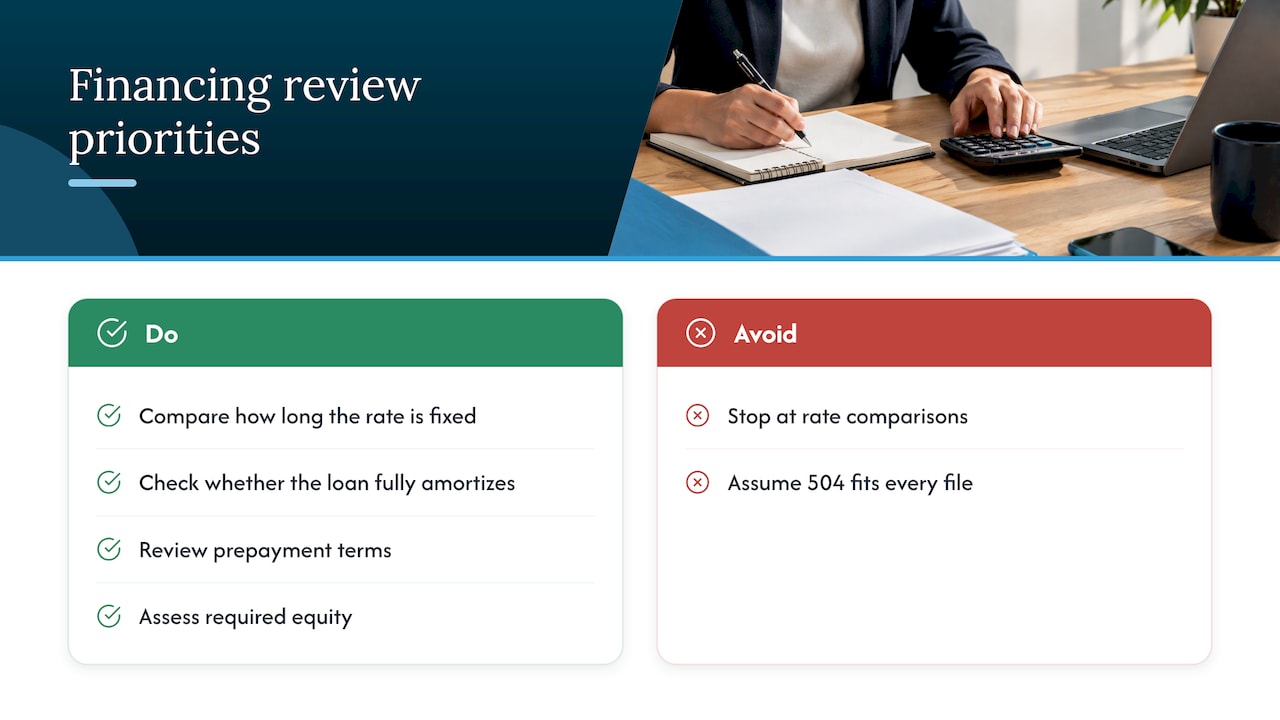
We also see owners compare rates and stop there. Look at structure first: how long the rate is fixed, whether the loan fully amortizes, what prepayment terms apply and how much equity you need. A slightly higher fixed rate that removes refinancing risk can be worth more than a lower rate that resets in five years.
We do not suggest the 504 is right for every file. If your building is mostly leased to others, or your business is too new, another structure may be better, and we will tell you so. Veterans and their spouses should also ask about our VetLoan Advantage Program, which has a 1.0% processing fee.
— PHENYX
Start a refinance review with us
If you own the building your business occupies and want to know whether your current loan qualifies for an SBA 504 refinance, we can review your debt schedule and tell you what is workable. Visit our SBA 504 Refinance Program page to get started, and for a wider comparison of routes, read our overview of commercial mortgage refinance options.
FAQ
What is considered owner-occupied commercial real estate?
It is a commercial building in which the owner’s operating business occupies a substantial share of the space. For SBA 504 financing, that share is at least 51% of an existing building. Lenders then underwrite the loan on the business’s cash flow rather than on rental income.
Can I refinance a commercial mortgage with an SBA 504 loan?
Often yes, if your business occupies the property, has been operating long enough and the debt qualifies under SBA rules. Since the SBA’s 2024 rule change, refinancing without expansion is no longer capped at 50%, and combined loans can reach up to 90% of value when other business expenses are included. A lender must review your specific debt to confirm.
Can an LLC refinance a commercial property?
Yes. A property-holding LLC can borrow, but under SBA rules the operating company must act as guarantor or co-borrower, and a written lease with a term at least equal to the loan must be in place. Owners of 20% or more usually guarantee personally as well.
What is the downside of refinancing early?
Costs can outweigh savings. Prepayment penalties, appraisal, legal and title fees add up, and cash out increases your balance and payment. Compare total cost over the time you plan to keep the building, not only the new rate.
Sources
- SBA 504 loans, U.S. Small Business Administration
- SBA lenders and 7(a) program, U.S. Small Business Administration
- 504 Debt Refinancing, Federal Register
- 13 CFR 120.111, Eligible Passive Companies, eCFR
- 13 CFR Part 120 Subpart B, eCFR
- Commercial Real Estate Lending, Comptroller’s Handbook, OCC