

If you want to buy or build a commercial building in New Hampshire, you have four main routes: a conventional bank mortgage, an SBA 7(a) loan, a construction or development loan, and an SBA 504 loan. For owner-occupied property, the 504 usually asks the least cash up front and offers the longest fixed rate. The right choice still depends on your timeline, your project and how much working capital you want to keep. This guide compares the options so you can walk into a lender meeting knowing what to ask.
TL;DR
- Conventional commercial mortgages are the simplest to understand, but they typically ask for a larger down payment than the SBA 504 program does.
- SBA 504 financing combines a bank first mortgage with a CDC loan. It needs 10% down in the standard case and offers fixed rates for up to 25 years on real estate.
- SBA 7(a) is more flexible on use of proceeds, such as working capital or buying a business, but it is not built around fixed long-term real estate pricing.
- Construction loans fund the build itself and are often paired with permanent financing afterward.
- Our published 504 rates, as of September 2026, are 6.73% for 20-year real estate and 6.77% for 25-year real estate.
Table of Contents
- The four types of commercial building loans
- How the SBA 504 loan works
- Comparing the options on what matters
- Refinancing a building you already own
- Veterans and spouses
- Our perspective: why we start with the 504
- Talk to us about your building
- FAQ
- Sources
The four types of commercial building loans
Most New Hampshire lenders, from community banks to credit unions to regional banks, fall into one of these categories. Here is how they compare for a business that will occupy the building.
| Loan type | Best for | Typical structure | Main trade-off |
|---|---|---|---|
| Conventional commercial mortgage | Established borrowers with strong equity | One lender, often with a shorter fixed period or an adjustable rate after it | Larger down payment, and rate resets or balloon payments are common |
| SBA 7(a) | Mixed uses: building plus working capital, or a business acquisition | SBA-guaranteed loan through a participating lender | Broader use of funds, with different pricing and terms than 504 |
| Construction or development loan | Ground-up builds and major renovations | Draws against progress, then converts or is refinanced | Interest-only phase and extra oversight during the build |
| SBA 504 | Owner-occupied buildings, land and long-life equipment | Bank first mortgage plus a CDC second loan | Two lenders and an occupancy requirement |
No single row wins for every project. What matters is how the loan fits the way your business uses the building.
Conventional commercial mortgages
A conventional loan is the baseline. You deal with one bank, the underwriting is familiar, and closing can be quick if your financials are clean. The cost is usually in the equity: our own comparison of SBA 504 and conventional loans explains why a larger down payment ties up cash that many owners would rather put into inventory, hiring or equipment. Ask any bank how long the rate is fixed, because a rate that is fixed for five or seven years on a 25-year amortization leaves you exposed at renewal.
SBA 7(a) loans
The 7(a) program is SBA’s primary business loan program. It guarantees a portion of a loan made by a participating lender. It is a good fit if you need one loan to cover a building purchase plus working capital or other business costs. If the project is mostly the building itself and you plan to occupy it, a 504 is often the more focused tool.
Construction and development loans
If you are building from the ground up, you will need financing that pays out as work is completed. Many owners then move into permanent financing once the building is finished. The 504 program can serve as that long-term piece for eligible owner-occupied projects, so it is worth discussing the permanent plan before you commit to the construction lender.
How the SBA 504 loan works

The 504 is built on three parties. According to the SBA, the structure involves the borrower, a private-sector lender that typically provides about 50%, and a Certified Development Company (CDC) that provides up to 40% through an SBA-guaranteed debenture. The borrower’s equity is 10% in the standard case, and it can rise for startups or special-purpose property (see SBA’s overview).
On a $2,000,000 building, for example, that looks like this:
- Bank first mortgage, up to 50%: $1,000,000
- CDC debenture, up to 40%: $800,000
- Your down payment, 10%: $200,000
The CDC portion carries a fixed rate for its full term. SBA describes the program as long-term, fixed-rate financing for major fixed assets that promote business growth and job creation. Terms of 10, 20 or 25 years apply depending on the asset, and real estate typically gets the longer ones. Our guide to 10, 20 or 25 year SBA 504 terms walks through which term fits which asset.
What the fixed rates look like now
These are the rates published on our site when we last checked, on September 16, 2026. They can change, so confirm before you plan around them.
| Product | Published rate |
|---|---|
| Equipment 10-Year Fixed | 6.58% |
| Real Estate 20-Year Fixed | 6.73% |
| Real Estate 25-Year Fixed | 6.77% |
These figures apply to the CDC portion of the financing. The bank’s first mortgage is priced by the bank, so your blended cost depends on both pieces.
Who qualifies
SBA loan eligibility generally requires that you be a for-profit business operating in the U.S., meet SBA’s size standards, and show a reasonable ability to repay. The 504 adds an occupancy rule for real estate: the owner-occupied requirement means your business must occupy a majority of the building, which is covered in our 504 eligibility guide. If you plan to lease out most of the space as an investment, the 504 is not the right fit.
Before applying, make sure the name on your EIN registration matches your legal entity name exactly. IRS guidance on the EIN is the place to start, and a mismatch is an easy way to slow down a file.
Comparing the options on what matters
Down payment and cash left over
Cash is the clearest difference. A building purchase that needs a large equity check can drain the working capital you need after you move in. With the 504’s standard 10% structure, more of your cash stays in the business. If you are short even of that, our Down Payment Assistance Program is designed to help with the equity piece for commercial property acquisition.
Rate stability
A fixed rate for 20 or 25 years means your principal and interest on the CDC loan do not move. Conventional loans often fix the rate for a shorter window. If you expect to hold the building for a decade or more, ask each lender to show you the payment in year eight, not just year one.
Speed and complexity
Two lenders mean two sets of documents, and you should plan for coordination between them. A conventional loan has one underwriter and can be simpler. The offset is experience. A CDC with Premier Certified status can speed up approvals, and having one team that works with your bank every day helps keep the file moving.
Use of proceeds
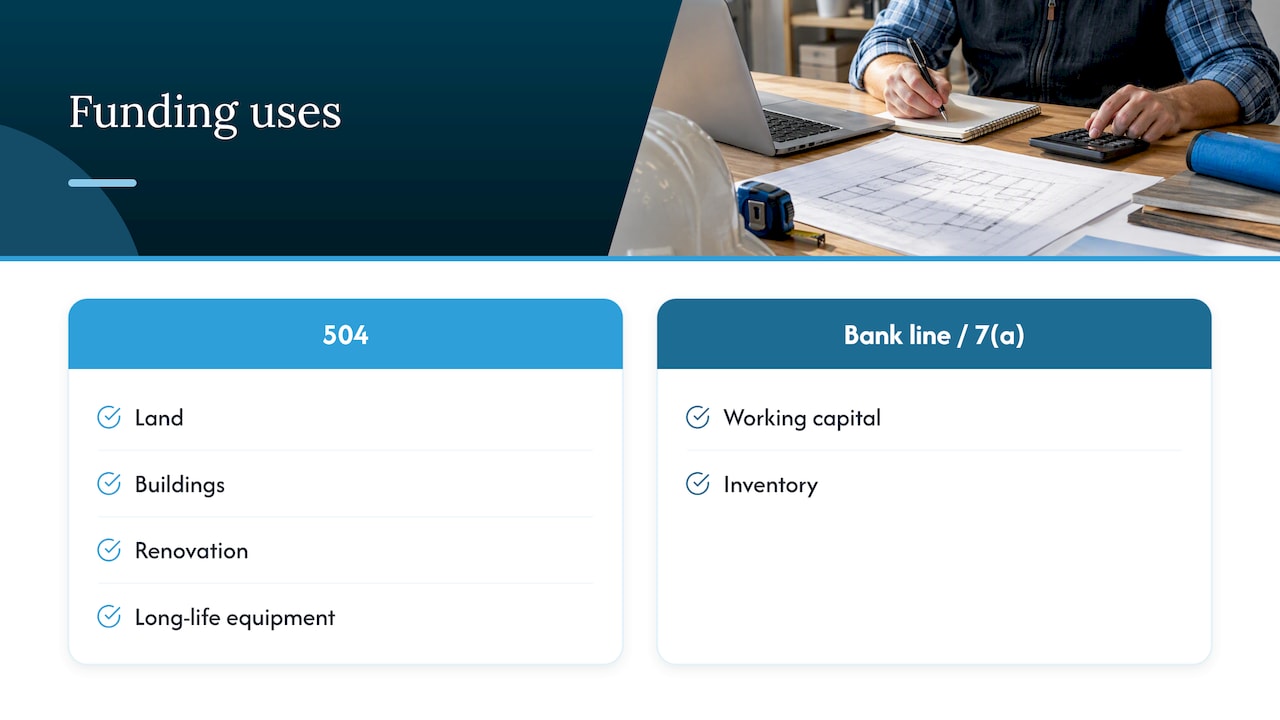
A 504 funds fixed assets: land, buildings, renovation and long-life equipment. If you also need working capital or inventory, pair it with a bank line or consider a 7(a). Our guide to SBA loans for small business owners explains how the programs fit together, and our page on startups and the 7(a)+504 combination covers newer businesses.
Refinancing a building you already own
If you already own your building and carry a loan with a rate reset or balloon coming, refinancing is worth a look. The SBA says rule changes that took effect in late 2024 streamlined 504 debt refinancing, including for debt that was not previously SBA-guaranteed. Our SBA 504 Refinance Program is built around that opportunity, and we compare the choices in our posts on 25-year fixed versus a fast recast and commercial mortgage refinance options.
Veterans and spouses
If you are a veteran or the spouse of one, ask about incentives before you pick a lender. SBA maintains resources for veteran entrepreneurs, including funding programs and counseling. Our VetLoan Advantage Program is aimed at veterans and their spouses buying commercial property or equipment, and the program carries a 1.0% processing fee.
Our perspective: why we start with the 504
We work only in New England, so we see the same pattern across New Hampshire, Massachusetts and the rest of the region. A business finds the right building, then discovers that a conventional loan needs far more cash than expected. The owner either shrinks the project or drains the reserves needed to operate after the move.
The 504 exists to prevent that. With a 10% standard down payment, long fixed rates and an SBA-guaranteed second loan, it spreads the cost of a building over the life of the asset instead of loading it up front. That is why we recommend owners of owner-occupied property look at it first, then compare the result with a bank-only offer.
We have more than 70 years of experience and have invested more than $2.3 billion in regional businesses. That history is why we are comfortable saying that the best structure is the one you have compared in writing, line by line, before you sign.
— PHENYX
Talk to us about your building
If you are planning a purchase, a build or a refinance in New Hampshire, we can walk you through how a 504 would be structured for your project and what it would mean for your cash and your monthly payment. Start at CDC New England and tell us about the property, the price and your timeline.
FAQ
Can SBA loans be used for commercial real estate?
Yes. The 504 program was designed for it, financing land, buildings and other major fixed assets, according to SBA. The 7(a) can also be used for real estate in some cases. The building generally needs to be owner-occupied.
How much down payment do I need for a commercial building in New Hampshire?
It depends on the loan. A 504 typically asks for 10% from the borrower, and this can rise for startups or special-purpose property. Conventional loans usually ask for more, so compare the cash needed at closing across all offers.
Can I use my EIN to get a business loan?
Your EIN identifies your business to lenders, who use it to verify the entity and pull credit information, but it is not a loan on its own. You will still need financial statements and project details. Make sure the name on your EIN matches your legal entity name.
Is the 504 only for startups or small projects?
No. SBA says its guaranteed loans are often used by established businesses to refinance debt, buy machinery or renovate facilities. The program has size and eligibility limits, so ask us whether your project qualifies.
Sources
- SBA: 504 loans
- SBA: 7(a) loans
- SBA: overview of loan programs
- SBA: 2024 rule on lower costs for small businesses
- SBA: veteran small business resources
- SBA
- IRS: EIN guidance


