You likely qualify for an SBA 504 loan if your business is for-profit, operates in the United States, meets SBA small business size standards or the alternate net worth test, and will occupy at least 51% of the real estate you’re financing. If you’re short on any of those points, particularly owner-occupancy or the credit-elsewhere test, talk to a Certified Development Company before assuming you’re out of the running.
TL;DR:
- Most small businesses qualify if they operate in the U.S., meet SBA size standards, are owner-occupied with at least 51%, and have strong credit.
- Eligible uses include land, buildings, renovations, and heavy equipment, but working capital and rental properties are ineligible.
- Down payments are typically 10% for established businesses on standard properties, rising to 15-20% for startups and special-purpose assets.
- The application process is managed by a Certified Development Company, which reviews financials, orders appraisals, and packages documents for SBA approval.
- Working with a regional CDC with SBA experience can streamline approval, avoid common pitfalls, and increase chances of funding success.
Table of Contents
- What Does the SBA 504 Loan Actually Finance?
- Do You Meet the Core SBA 504 Eligibility Requirements?
- Eligible Uses, Ineligible Uses, and the Owner-Occupancy Rule
- Size Tests: Net Worth, Income, and Down Payment Rules
- Documentation, Credit Review, and Personal Guarantees
- How Do You Apply for an SBA 504 Loan?
- How Does a Local CDC Improve Your Odds?
- What’s Overrated and What Matters Most in 504 Eligibility
- Ready to Confirm Your Eligibility With Cdcnewengland?
- Verify the Rules Yourself
- Sources
What Does the SBA 504 Loan Actually Finance?
The 504 program exists to give small businesses long-term, fixed-rate financing for major fixed assets, the kind of purchases that build equity instead of draining cash flow. It’s not designed for day-to-day operating expenses.
The structure is what makes it work. A private lender typically covers 50% of the project, a Certified Development Company (CDC) backed by an SBA-guaranteed debenture covers up to 40%, and you contribute as little as 10% down. Terms run up to 25 years for real estate and 10 to 20 years for equipment.
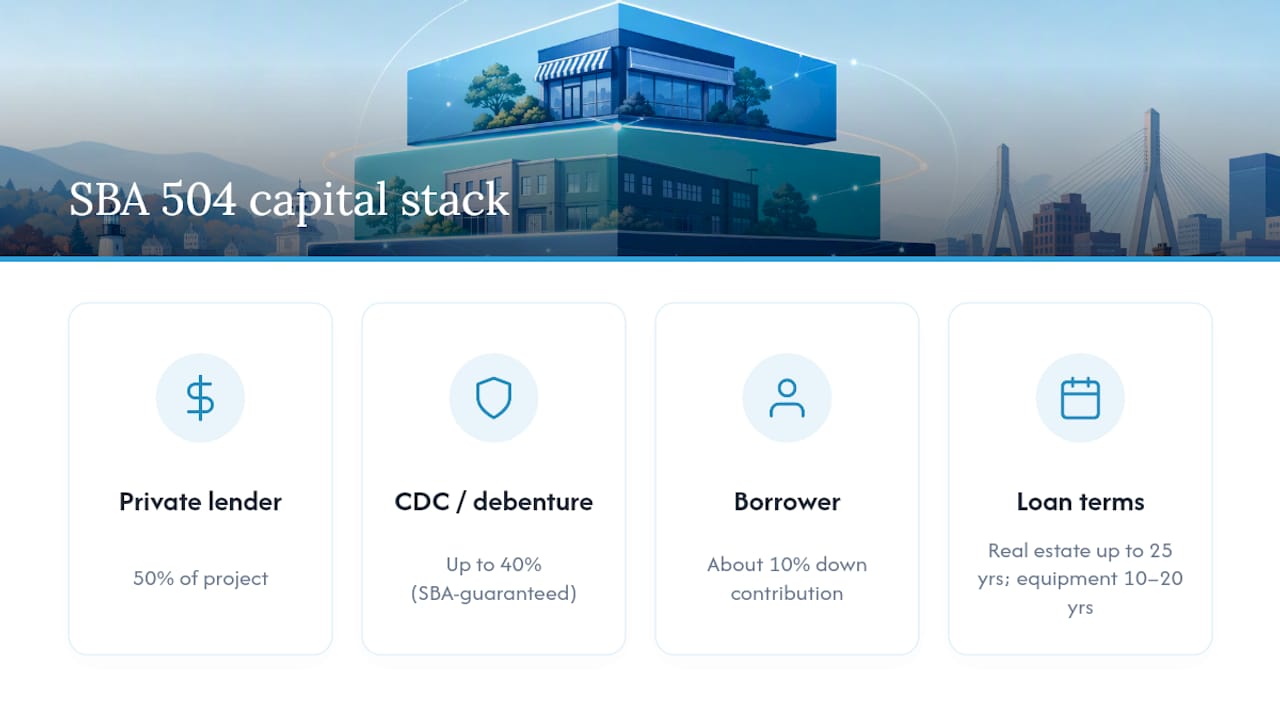
Eligible uses center on purchasing land and buildings, ground-up construction, renovating existing facilities, and buying heavy machinery or long-life equipment. This structure explains why the eligibility rules are so focused on occupancy and asset type: the 504 loan program rewards businesses that plan to use, not flip, what they finance.
Do You Meet the Core SBA 504 Eligibility Requirements?
Before you get into paperwork, run through the baseline SBA 504 eligibility requirements the Small Business Administration applies to every applicant. Miss one of these and no amount of good paperwork fixes it.
- For-profit and operating. Nonprofits, passive real estate holding entities, and speculative ventures don’t qualify. Your business needs to be actively generating revenue.
- U.S.-based. You must operate in the United States or its territories, which for Cdcnewengland’s borrowers means Massachusetts, Rhode Island, Vermont, New Hampshire, or Connecticut.
- Small by SBA standards. You either fall under SBA’s industry-specific size standards or qualify through the alternate net worth and income test which some businesses use to qualify.
- Ownership and citizenship. Principals need to be U.S. citizens or lawful permanent residents, and everyone with a 20% or greater ownership stake carries personal responsibility for the loan.
- Credit-elsewhere test. SBA financing exists to fill a gap. You need to show that comparable conventional financing, on comparable terms, isn’t reasonably available to you.
- Good character and repayment ability. Clean tax standing, no outstanding federal debt in default, and cash flow that supports the new debt service.
Pro Tip: Don’t self-reject over the credit-elsewhere test. Most CDCs interpret it broadly, meaning if a bank would only offer you a 5-year balloon note on a 20-year asset, that alone can satisfy the requirement.
Eligible Uses, Ineligible Uses, and the Owner-Occupancy Rule
The 504 program draws a hard line between capital investment and operating expense. Land, buildings, ground-up construction, major renovations, and heavy equipment with a long useful life all qualify, along with certain soft costs like architectural and engineering fees tied directly to the project.
Working capital, inventory, and refinancing that doesn’t meet specific debt-refinance rules are off the table entirely. So are properties bought primarily as rental or investment plays. That distinction trips up more applicants than any other single rule in the program: treating the 504 loan like a flexible commercial line of credit is the fastest way to get an application rejected.
Owner-occupancy is where most real estate deals live or die. The SBA’s occupancy standards set clear thresholds:
| Property Type | Minimum Occupancy Requirement |
|---|---|
| Existing building | 51% occupied by your business |
| New construction | 60% occupied initially |
| Multi-tenant property | Same 51%/60% thresholds apply to your occupied space |
Special-purpose properties like hotels, gas stations, or car washes face additional scrutiny and sometimes higher equity requirements, since these assets are harder to repurpose if your business doesn’t succeed.
Size Tests: Net Worth, Income, and Down Payment Rules
Most applicants don’t need to memorize SBA’s industry-by-industry size charts. The alternate test is simpler and covers the majority of 504 borrowers: your business qualifies as small if tangible net worth stays under $20 million and average net income after taxes stays under $6.5 million over the prior two years, according to Nav’s breakdown of 504 loan requirements.
If your industry has a specific SBA size standard, often measured by employee count or revenue, meeting that standard suffices. Either path works.
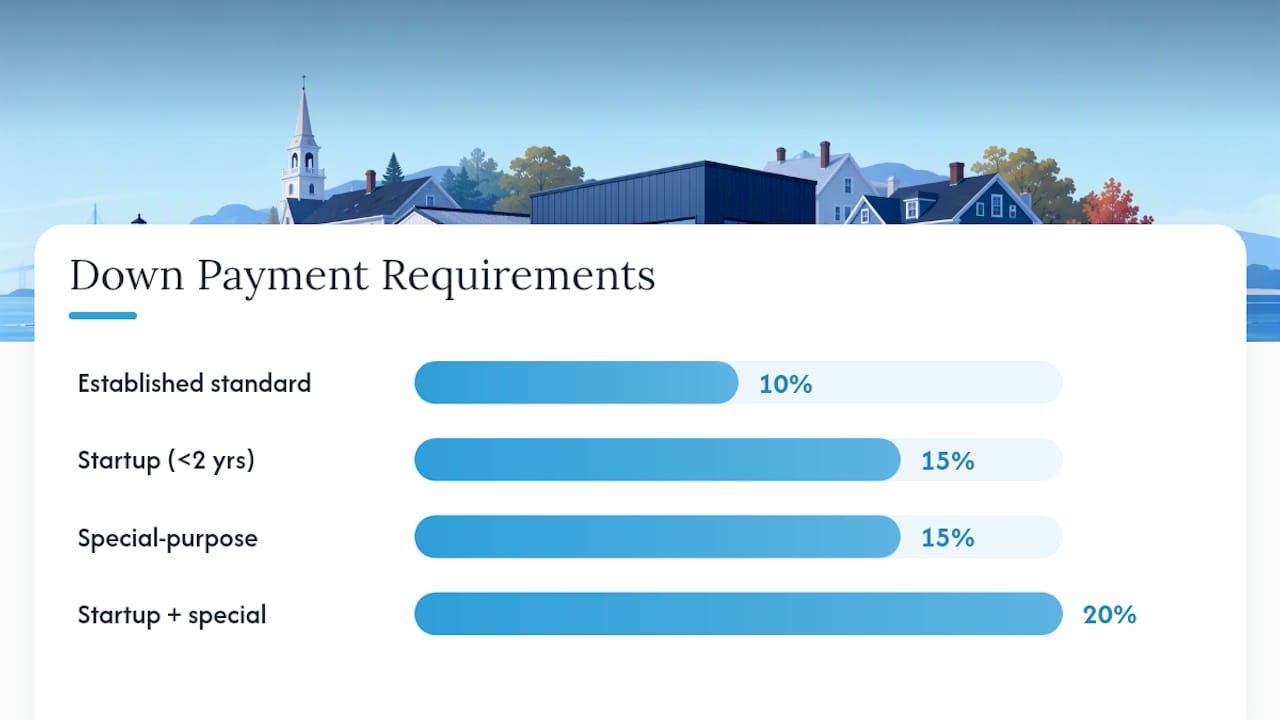
Down payment requirements shift based on your business history and property type:
- Established businesses, standard property: 10% down.
- Startups (under two years old): typically 15% down.
- Special-purpose property: typically 15% down.
- Startup plus special-purpose property: 20% down, the two conditions stack.
If you’re unsure which size test applies, a CDC will run both calculations during pre-qualification. There’s no penalty for checking.
Documentation, Credit Review, and Personal Guarantees
CDCs move faster when you arrive with a complete file. Expect this baseline request list, drawn from what the SBA’s policy guidance on 504 eligibility requires from applicants:
- Business tax returns for the past three years, plus year-to-date financial statements.
- Personal tax returns for every owner holding 20% or more of the company.
- Accounts receivable and accounts payable aging schedules.
- SBA Form 413, the personal financial statement, disclosing all beneficial owners.
- A signed purchase agreement or construction contract tied to the project.
- An independent appraisal of the property or equipment being financed.
Credit review looks at both business and personal history. There’s no single magic score, but most CDCs want to see personal credit in the high 600s or better, along with a business that shows consistent or improving cash flow.
Pro Tip: Pull your own credit report before your CDC does. Fixing a reporting error takes weeks; discovering it mid-underwriting can cost you your closing date.
How Do You Apply for an SBA 504 Loan?
You don’t apply to the SBA directly. A Certified Development Company originates the loan, packages your file, and submits it for SBA approval, which is why choosing an experienced CDC matters as much as meeting the eligibility rules themselves.
- Pre-qualification call. A CDC reviews your basic numbers and flags any red flags before you invest time in paperwork.
- Document assembly. You gather tax returns, financials, and the SBA Form 413 while the CDC orders the appraisal.
- Underwriting and packaging. The CDC structures the debenture, coordinates with your private lender, and submits the full package to the SBA.
- SBA approval and closing. Approval typically lands within 30 to 60 days of a complete submission; closing follows once title work and final appraisals clear.
Delays almost always trace back to incomplete financials or an appraisal that comes in below the purchase price. Start the process by finding a certified development company near you and running your numbers through a loan calculator before your first call.
How Does a Local CDC Improve Your Odds?
Working with a CDC that knows your regional market changes how smoothly your file moves through underwriting. An experienced CDC catches occupancy or documentation gaps before the SBA ever sees them, which cuts the back-and-forth that stalls slower applications.
- Regional track record. A local CDC has operated across Massachusetts, Rhode Island, Vermont, New Hampshire, and Connecticut for many years.
- Capital deployed. The organization has invested over $2.3 billion into regional businesses through 504 lending, a scale that reflects consistent SBA relationships.
- Practical pre-check tools. Running your numbers through the 504 loan calculator before you apply shows you roughly where your down payment and monthly payment will land.
That kind of familiarity with SBA policy notices and local property markets tends to shorten the gap between “interested” and “approved.”
What’s Overrated and What Matters Most in 504 Eligibility
Most guides treat SBA 504 eligibility like a credit-score contest. It isn’t. Credit matters, but the businesses that get rejected almost always trip on structure, not score: they buy a property they’ll only half-occupy, they try to fold working capital into a real estate deal, or they misjudge the credit-elsewhere test and assume they need a bank rejection letter in hand before applying (you don’t).
The conventional advice, “get your credit in order and apply,” skips the part that actually decides most outcomes: whether the deal itself fits the program.
If you take one thing from this article, prioritize the occupancy math before you fall in love with a property. The paperwork is tedious but forgiving. The structural rules aren’t.
— PHENYX
Ready to Confirm Your Eligibility With Cdcnewengland?
Beyond standard 504 origination, the team offers down payment assistance for buyers stretched thin on upfront cash and dedicated benefits for veteran-owned businesses through the VetLoan Advantage program.
With extensive regional experience and substantial investment in New England businesses, some local CDCs have seen nearly every version of the eligibility questions covered here. Rather than guess whether your project clears the occupancy and net worth thresholds, run your numbers through the SBA 504 loan calculator or visit the SBA 504 loans page to start a pre-check with a CDC that knows your local market.
Verify the Rules Yourself
Cross-check anything here against primary sources: the SBA’s 504 loan overview, the CDC finder tool, and 13 C.F.R. §120.110 covering primary applicant eligibility. Then estimate your numbers with Cdcnewengland’s loan calculator.
Sources
- 504 loans - Small Business Administration
- 13 C.F.R. §120.110 — Primary applicant eligibility (ECFR)
- SBA 504 Loan Requirements, Rates & Terms Guide - Nav
Recommended
- Do You Qualify for 90% Commercial Real Estate Financing?
- What Can You Finance with an SBA 504 Loan? A Complete Guide for New England Businesses
- SBA 504 Loan Appraisal Requirements: What New England Business Owners Need to Know
- SBA 504 Loan Program Explained: How Small Businesses Can Buy Commercial Real Estate With Just 10% Down