Owner-occupied properties are ones where you or your business use most of the space as your primary home or operating location, while investment properties are held mainly to generate rental income. That single distinction drives three practical consequences for your financing: lower rates and smaller down payments for owner-occupied deals, stricter occupancy verification under thresholds like the SBA’s 51% rule, and underwriting that weighs business cash flow instead of just rent rolls.
TL;DR:
- SBA 504 borrowers must occupy 51% of existing buildings or 60% of new construction, rising to 80% within ten years; otherwise, lenders can reclassify financing.
- Residential borrowers using owner occupied terms may need to move in within 60 days of closing and live there for at least 12 months.
- Businesses occupying commercial property face underwriting based on their finances and global debt service coverage; investment loans center on rent rolls and net operating income.
- Residential rental owners can depreciate the property over 27.5 years, deducting about 3.64% of depreciable basis annually, alongside eligible operating costs.
- Before buying an investment property, stress test vacancy and compare its cap rate with the loan rate; a lower cap rate usually signals negative leverage.
Table of Contents
- Owner-Occupied vs Investment: A Quick Comparison
- What Counts as Owner-Occupied vs Investment Property
- How Financing Terms Differ Between the Two Tracks
- How Lenders Verify Occupancy and What They Require
- Tax and Depreciation Rules You Need to Plan Around
- How to Decide Which Financing Track Fits You
- Why Cash Flow Discipline Beats Chasing Appreciation
- SBA 504 Financing for Owner-Occupied Commercial Buyers
- FAQ
- Sources
Owner-Occupied vs Investment: A Quick Comparison
Before you dig into the details, here’s how the two tracks typically stack up on the factors that matter most to your bottom line.
- Rate differential: Investment loans typically price higher than owner-occupied loans because lenders treat rental income as less predictable than business or personal income.
- Down payment: Owner-occupied commercial deals financed through SBA 504 may require less equity than conventional investment property loans.
- Underwriting focus: Owner-occupied lending leans on your business financials and Global Debt Service Coverage, while investment lending centers on the property’s own cash flow, often measured through Debt Service Coverage Ratio and rent rolls.
- Best use case: Owner-occupied financing tends to win on terms when your business genuinely needs the space; investment financing fits when the goal is pure rental income rather than operational use.
What Counts as Owner-Occupied vs Investment Property
An owner-occupied property is one where you live in or your business operates from most of the space, while an investment property is held primarily to produce rental income from tenants who are not you. The classification determines which loan products, rates, and compliance rules apply to your deal.
On the residential side, house hacking is a common example: you buy a duplex or triplex, live in one unit, and rent out the others. Lenders generally require you to move in within 60 days of closing and occupy the property for at least 12 months to keep owner-occupied terms. Adding an accessory dwelling unit (ADU) to a single-family home and renting it out can work the same way, as long as you remain the primary resident.
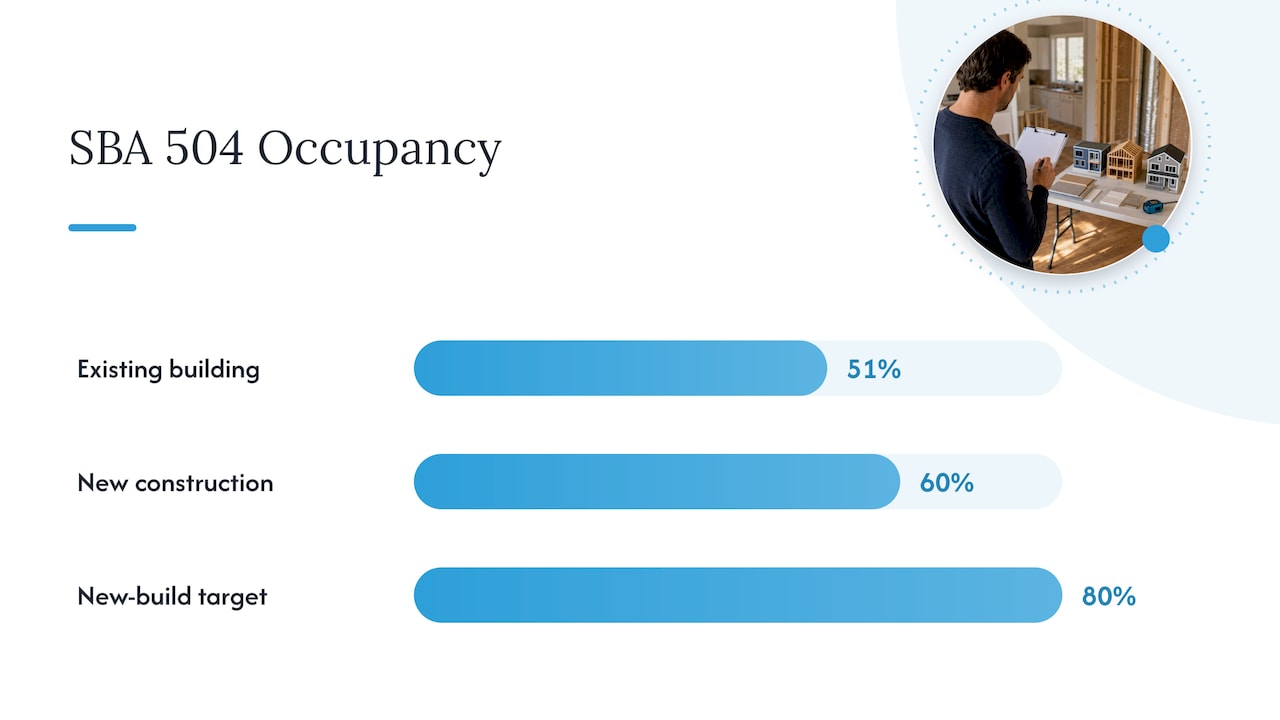
On the commercial side, the dividing line is sharper. For an SBA 504 loan, your operating business must occupy at least 51% of the net rentable area for an existing building, or commit to occupying 60% of new construction with a plan to reach 80% within ten years. Fall short of that threshold and the lender typically reclassifies the deal as investment financing, changing your rate, down payment, and documentation requirements.
- Residential owner-occupied: you live in at least one unit of a multi-unit property.
- Commercial owner-occupied: your business uses 51% or more of the building’s net rentable area.
- Investment: the property generates income from tenants unrelated to your primary residence or business operations.
How Financing Terms Differ Between the Two Tracks
The cost of capital changes meaningfully once a property crosses from owner-occupied to investment. Lenders price investment loans higher because rental income carries more uncertainty than a borrower’s own business or personal cash flow, and vacancy or tenant turnover adds risk that doesn’t exist when the owner occupies the space.
Down payments diverge early in the process. Residential investment properties may require larger down payments than owner-occupied residential loans, depending on the lender and program. On the commercial side, SBA 504 financing may offer owner-occupied borrowers a lower-equity path than conventional commercial financing for investment buyers.
Underwriting focus shifts with occupancy status. For owner-occupied commercial loans, lenders look closely at your business’s financial statements and calculate Global Debt Service Coverage, which combines business cash flow with any personal income pledged to the loan. For investment properties, the property itself carries the underwriting weight: lenders calculate Debt Service Coverage Ratio (DSCR) from rent rolls and net operating income, largely setting aside the borrower’s personal financials.

Statistic: NADCO/SBA guidance confirms that falling below the 51% occupancy threshold on an SBA 504 deal normally triggers reclassification as investment financing, which resets your down payment and underwriting requirements entirely.
Loan terms and amortization also differ. SBA 504 owner-occupied loans can offer fixed terms on real estate and equipment, giving you long-term rate certainty that most conventional investment products don’t match.
How Lenders Verify Occupancy and What They Require
Lenders don’t take your word for occupancy status. They verify it through documentation and ongoing compliance checks, because misclassified loans carry real risk for both parties.
- Threshold measurement: Lenders and appraisers measure net rentable area or effective gross income to confirm whether your business meets the 51% owner-occupied standard for SBA 504 loans.
- Move-in timing: For residential deals, lenders may require you to occupy the property after closing and continue living there. Check your loan terms for the applicable requirements.
- Documentation request: Expect lenders to ask for leases, rent rolls, profit-and-loss statements, business bank statements, and an appraisal that breaks out owner-occupied versus leased square footage.
- Ongoing compliance: SBA loans may require you to maintain occupancy throughout the loan. Check the applicable program requirements and loan terms.
Pro Tip: Keep a simple square-footage log of your business’s occupied space from day one, so you have documentation ready if a lender or the SBA requests proof of compliance later.
Tax and Depreciation Rules You Need to Plan Around
Tax treatment is where owner-occupied and investment properties diverge most sharply, and it affects your real return more than most buyers expect.
If you occupy the property as your primary residence, you generally cannot deduct depreciation or operating expenses the way an investor would, though mortgage interest and property tax deductions may still apply to your personal return. If you hold the property for rental income, IRS Publication 527 allows you to deduct operating expenses including property management fees, maintenance, and insurance against your rental income.
- Residential rental property depreciates under MACRS over a 27.5-year recovery period, per IRS Publication 527.
- That works out to roughly 3.64% of your depreciable basis deducted annually.
- Deductible operating costs for rental property include management, maintenance, insurance, and depreciation, all outlined in the same IRS guidance.
- Owner-occupied commercial space used in your business follows different depreciation schedules tied to the property’s business use, not the residential rental rules above.
Statistic: IRS Publication 527 sets the residential rental depreciation rate at approximately 3.64% of the depreciable basis per year, a figure that materially affects your after-tax cash flow projections.
These rules get complicated fast once you mix personal and rental use in the same property, or operate a business from part of your home. A tax professional familiar with your specific situation can help you apply these rules correctly to your return.
How to Decide Which Financing Track Fits You
Before you approach a lender, run through a short checklist to figure out which track actually matches your situation.
- Do you or your business genuinely need to occupy the space, or is the goal pure rental income?
- Can you meet the 51% commercial occupancy threshold, or the 60-day move-in and 12-month residency rules for residential deals?
- How much cash do you have for a down payment, and does an owner-occupied program like SBA 504 get you there faster?
- Are you prepared to manage tenants and maintenance, or would you rather underwrite for passive income?
Once you’ve answered those, calculate the numbers that separate a good deal from a risky one:
- DSCR: Divide net operating income by annual debt service; investment lenders may set a minimum DSCR. Check the lender’s requirements.
- Cash-on-cash return: Divide annual pre-tax cash flow by your total cash invested to see your real yield.
- Vacancy stress test: Stress-test your numbers for higher vacancy to confirm you can still cover debt service.
- Cap rate vs. mortgage rate: Compare the property’s cap rate to your financing rate; a cap rate below your rate usually signals negative leverage.
Owner-occupied financing generally wins when your business needs the space and you want lower rates and smaller down payments. Investment financing makes more sense when the property’s income, not your occupancy, is the entire point.
Why Cash Flow Discipline Beats Chasing Appreciation
Too many buyers underwrite deals assuming appreciation will bail out a weak purchase. Market experts consistently point out that rental income and price growth aren’t guaranteed, which means your numbers need to work on cash flow alone.
Active ownership, including house hacking or self-managing a rental, can boost returns but demands real time. Outsourced property management commonly costs a share of monthly rent, according to Navy Federal’s investing guidance, which is the trade-off between control and convenience. Talk to a lender early and stress-test your scenarios before you commit.
— PHENYX
SBA 504 Financing for Owner-Occupied Commercial Buyers
When your business is ready to occupy and own commercial space rather than lease it, SBA 504 financing gives you a structure built specifically for that scenario. We offer Real Estate 20-Year Fixed and Real Estate 25-Year Fixed loan programs for businesses purchasing owner-occupied commercial real estate, with fixed rates and long terms that protect you from future rate swings.
For businesses carrying existing commercial debt, our SBA 504 Refinance Program can help you restructure financing after you’ve established occupancy or changed strategy. We also offer a Down Payment Assistance Program for qualifying borrowers who need help covering the upfront equity SBA 504 projects require, and a VetLoan Advantage Program with a processing fee for veteran and spouse-owned businesses.
- Owner-occupied real estate loans with fixed rates and long terms.
- Down payment assistance for qualifying borrowers who need to preserve working capital.
- Dedicated veteran support through VetLoan Advantage.
- Regional lending experience across New England.
Check your occupancy percentage and business cash flow against the numbers in this guide, then reach out to discuss your eligibility for an SBA 504 loan that fits your business.
FAQ
What is the difference between owner-occupied and investment property?
Owner-occupied property is where you or your business occupies most of the space, while investment property is held mainly to generate rental income from unrelated tenants. The distinction changes your financing rate, down payment requirement, and how lenders evaluate your application.
What percentage of homes in America are owned by investors?
National ownership and investor-share statistics shift year to year and vary by housing market, so a single figure doesn’t hold steady across regions. For current data on investor ownership trends, the U.S. Census Bureau’s housing vacancy survey is a reliable starting point.
What are common rules of thumb for rental property?
Definitions of rental property rules of thumb vary across sources, and no single rental-property rule of thumb has a consistent, universally cited definition. Investors typically rely on metrics like DSCR and cash-on-cash return instead, which have clear, standardized calculations.
Is it better to have a second home or investment property for taxes?
A second home used personally follows mortgage interest and property tax deduction rules similar to a primary residence, while a true investment property allows you to deduct operating expenses and depreciation against rental income under IRS Publication 527. Which structure benefits you more depends on how much you personally use the property versus rent it out, so a tax professional should review your specific situation.
How do lenders verify owner-occupancy for a commercial property?
Lenders and appraisers measure the net rentable area your business occupies against the 51% SBA 504 threshold, using documentation like leases, floor plans, and business financials. Falling below that threshold during the loan term can trigger reclassification to investment financing with different rates and terms.