

Affiliation rules likely affect your SBA loan eligibility if any single owner controls more than 50% of your business, or if two owners each hold 20% or more within the same three-digit NAICS subsector. If either test hits, the SBA counts that other company’s receipts and employees toward your size calculation. The checklist below walks through exactly how to run both tests before you apply.
TL;DR:
- If any owner controls more than 50% of your business or two owners each hold 20% or more in the same industry subsector, affiliation is likely to apply.
- Ownership through trusts or other entities counts proportionally, and recent rule changes now focus on ownership percentages and NAICS codes rather than subjective control assessments.
- Early, detailed mapping of ownership and NAICS classification helps prevent delays, especially for businesses with foreign ownership or familial stakes.
- Collecting comprehensive documents such as tax returns, ownership charts, and employee counts before applying can streamline SBA loan processing.
- Rechecking affiliation status before applying can avoid stalls, especially since affiliation affects eligibility for 7(a) and 504 loans and determines eligibility for benefits like fixed-rate real estate financing.
Table of Contents
- What Are SBA Affiliation Rules and Why Do They Matter?
- The Ownership Thresholds That Trigger Affiliation
- How to Calculate Your Affiliation Status Step by Step
- The 2023 and 2026 Rule Changes You Need to Know
- Documents Lenders Will Ask You to Prepare
- Common Affiliation Scenarios That Catch Borrowers Off Guard
- How Affiliation Shapes an SBA 504 Loan Application
- What Actually Slows Down Affiliation Reviews
- Confirm Your Affiliation Status Before You Apply
- Where to Verify These Rules Yourself
- Sources
- FAQ
What Are SBA Affiliation Rules and Why Do They Matter?
Affiliation is the SBA’s way of asking one question: does someone else’s ownership or control mean their business should count as part of yours? When the answer is yes, the SBA adds that other company’s receipts and employees to your own for size purposes, under the standards laid out in its compliance guide for size standards.
That combined total decides whether you still qualify as “small” for your industry. Miss the threshold and you lose eligibility for 7(a) loans, 504 loans, and the guaranty limits that make both programs attractive. A restaurant owner who also holds a 30% stake in a commissary kitchen, for example, might discover the commissary’s revenue pushes her combined receipts past the cap for her industry, even though her own restaurant looks small on paper. Affiliation is the mechanism that catches cases like that before a lender ever funds the loan.
The Ownership Thresholds That Trigger Affiliation
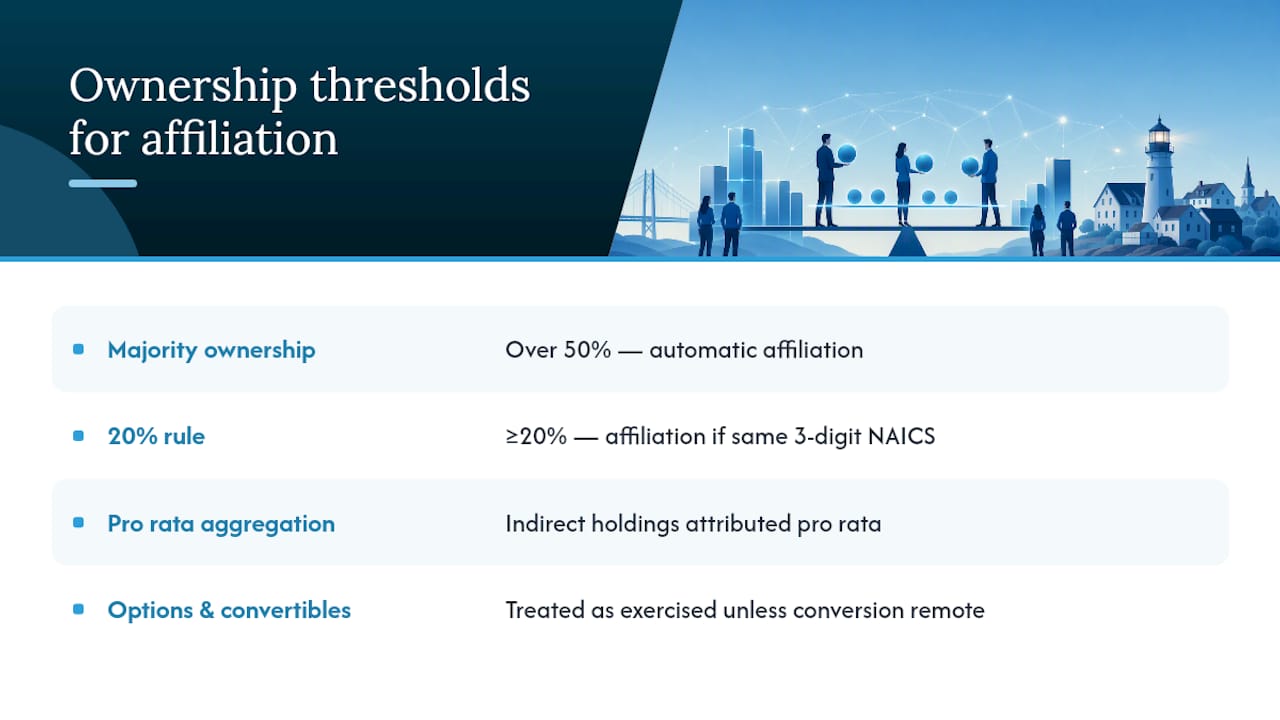
Ownership, not job title or day-to-day involvement, drives most affiliation findings under 13 CFR § 121.301. The rule set breaks down into a few concrete tests.
Majority ownership. Anyone who owns more than 50% of a business is treated as controlling it outright. If that person or entity also owns a piece of your company, the two businesses become affiliates automatically, regardless of what any operating agreement says about voting power.
The 20% rule. When no single owner holds a majority, any owner with 20% or more can still create affiliation, but only if their other business operates in the same three-digit NAICS subsector as yours. A 20% stake in an unrelated industry generally does not trigger this test on its own.
Pro rata aggregation. Ownership held through a trust, holding company, or other entity gets attributed back to the individual based on their percentage interest in that entity.
Stock options and convertible securities. These are given present effect, meaning the SBA treats them as already exercised, unless the condition triggering conversion is so remote it is practically impossible.
How to Calculate Your Affiliation Status Step by Step
Run through this checklist before you submit anything to a lender. Lenders and the SBA will eventually ask for this analysis anyway, and doing it early avoids a stalled application later.
- List every entity connected to your ownership group. Include businesses owned by you, your spouse, and your minor children, along with any trusts or holding companies in the chain.
- Calculate direct and pro rata ownership percentages for each entity, then combine spousal and minor-child interests into a single figure per family unit.
- Identify each entity’s three-digit NAICS subsector and compare it against your own. This single step decides whether a 20% stake matters at all.
- Sum receipts and employees across every entity where affiliation applies, using the trailing period your size standard requires.
- Document stock options, warrants, and convertible agreements, and note which ones get present effect under the remote-condition exception.
A few practical notes make this easier to get right:
- Keep the family-aggregation step separate from the entity-mapping step. Combining them early causes most of the errors lenders catch.
- Treat NAICS classification as a factual question, not a marketing one. Pick the code that matches what the business actually does.
- Save your calculation worksheet. Underwriters will ask to see how you arrived at your combined receipts and employee counts, not just the final number.
The 2023 and 2026 Rule Changes You Need to Know
The SBA rewrote its affiliation framework in a final rule implemented through a procedural notice effective May 11, 2023. The change removed several subjective tests, including franchise-directory review and some identity-of-interest and common-management standards that used to require narrative explanations from applicants.
The practical effect: affiliation determinations now lean almost entirely on ownership percentages and NAICS matching rather than qualitative judgments about who “really” controls a business. That shift, as the Federal Register’s rulemaking notice explains, was intentional, aimed at giving lenders a more predictable, math-driven test.
More recently, the SBA issued a procedural notice revising applicant ownership, citizenship, and residency requirements for both 7(a) and 504 loans, effective March 1, 2026. If your ownership group includes foreign nationals or recent immigrants, review these updated rules before you assume your eligibility is unchanged.
Documents Lenders Will Ask You to Prepare
Every lender underwriting an SBA loan needs to verify your affiliation calculation independently. Gathering these documents before you apply shortens the underwriting timeline considerably.
- Financial statements and tax returns for your business and every affiliated entity you identified
- Ownership charts showing percentage interests, including trusts and holding companies
- Operating agreements, stock ledgers, and any option or convertible-security agreements
- Payroll records and employee counts for each affiliate
- Documentation supporting your NAICS classification, such as revenue breakdowns by activity
Pro Tip: Build a single “affiliation packet” before your first conversation with a lender. Pair each entity on your ownership chart with its tax returns, NAICS code, and employee count in one file. Underwriters move faster when they can verify your math instead of requesting it piece by piece.
Common Affiliation Scenarios That Catch Borrowers Off Guard
Family ownership surprises more applicants than any other rule. The SBA requires you to combine ownership interests held by spouses and minor children as though one person held all of it, even when the spouse has no active role in the business.
Joint ventures carry their own wrinkle: two companies bidding together on a specific contract are generally not treated as affiliates, but that exception has time limits, and repeated joint ventures on similar work within a short window can convert partners into affiliates under 13 CFR § 121.103.
Divestitures rarely erase affiliation immediately. If you sold your stake but retained an option to reacquire it, that option can still get present effect. Borrowers who believe an affiliation finding is wrong should gather ownership documents, transfer agreements, and NAICS evidence early, since rebutting a finding after underwriting has started takes considerably longer.
How Affiliation Shapes an SBA 504 Loan Application
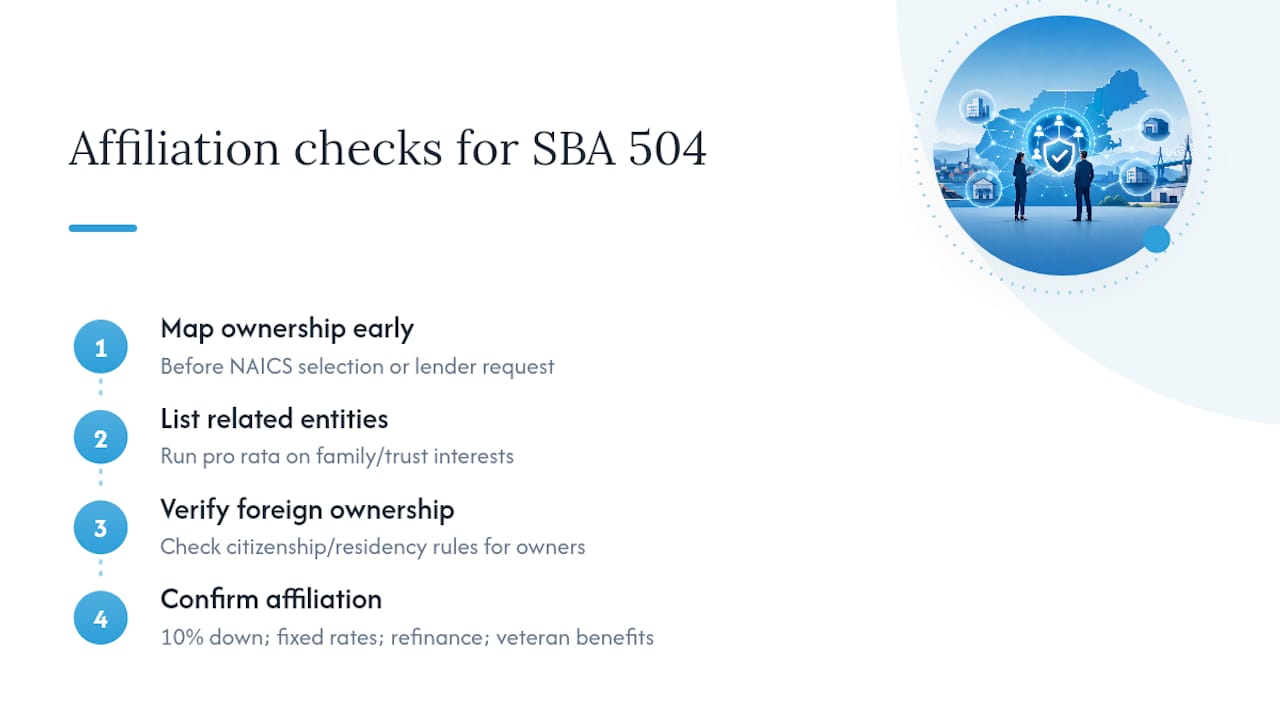
Affiliation calculations hit 504 applicants the same way they hit 7(a) borrowers: combined receipts and employees from affiliated entities determine whether you still meet your industry’s size standard before a Certified Development Company can move your file forward. Get the math wrong, and a deal that looked straightforward stalls in underwriting.
Applicants who move fastest are the ones who map ownership early, before selecting a NAICS code and before a lender asks. That means listing every related entity, running the pro rata math on family and trust interests, and documenting the NAICS subsector match rather than guessing at it. Foreign ownership adds another layer worth checking against the latest citizenship and residency requirements before you assume eligibility.
Once affiliation is confirmed clean, or documented and cleared, the SBA 504 program opens up real options: a 10% down payment on owner-occupied commercial real estate, fixed rates locked for up to 25 years, refinance paths for existing debt, and dedicated benefits for veteran-owned businesses.
What Actually Slows Down Affiliation Reviews
Most delays trace back to one of two mistakes: an undisclosed affiliate the borrower did not think to mention, or a NAICS code chosen without checking what the affiliated entity actually does. Neither is a legal problem so much as a homework problem.
The fastest fix is early mapping and honest disclosure to your lender before underwriting starts, not after a request for additional information arrives. A borderline call resolved on paper beats a borderline call resolved through a stalled file.
— PHENYX
Confirm Your Affiliation Status Before You Apply
If you suspect affiliation might apply to your business, sorting it out before you submit paperwork saves weeks of back-and-forth with underwriters. Ownership mapping and NAICS classification can help catch the kind of affiliation issues that stall generic loan applications elsewhere in New England.
Once your eligibility looks solid, the numbers get more interesting: a 10% down payment on commercial real estate, fixed rates for up to 25 years on the Real Estate 25-Year Fixed program, and a dedicated VetLoan Advantage Program for veteran-owned businesses carrying a 1.0% processing fee. Borrowers restructuring existing debt can also explore the SBA 504 Refinance Program, and those short on upfront cash can look into down payment assistance options. Run your numbers on the SBA 504 loan calculator, then contact Cdcnewengland for a straightforward review of your ownership structure and next steps.
Where to Verify These Rules Yourself
Check the primary sources directly: the SBA’s compliance guide for size standards, the regulation text at 13 CFR § 121.301, and the 2026 ownership and citizenship notice for the latest applicant requirements. For real-estate-specific diligence questions that often surface alongside 504 financing, OwnInAZ’s guidance for buyers and borrowers covers practical documentation steps worth reviewing.
This article is general information, not a substitute for advice from a qualified financial advisor. Consult a qualified financial professional about your own circumstances before acting on anything here.
Sources
- Compliance guide for size standards | U.S. Small Business Administration
- 13 CFR § 121.301 - What size standards and affiliation principles are applicable to financial assistance programs? | e-CFR
FAQ
What triggers SBA affiliation between two businesses?
Control through management agreements or contractual arrangements can also trigger affiliation under 13 CFR § 121.301.
Do my spouse’s business interests count toward my SBA affiliation?
Yes. The SBA requires you to combine ownership interests held by spouses and minor children as though one person held the total stake, according to SBA’s compliance guide. This applies even if your spouse has no active management role in the other business.
How did the 2023 rule change affect SBA affiliation determinations?
The 2023 final rule, implemented through a procedural notice, removed several subjective control-based tests and narrowed the analysis mostly to ownership percentages and NAICS matching. This made affiliation determinations more predictable for both lenders and applicants.
Does the 2026 SBA notice change citizenship requirements for loan applicants?
Yes. A procedural notice effective March 1, 2026 revised applicant ownership, citizenship, and residency requirements for both 7(a) and 504 loans. Applicants with foreign ownership should review these updated requirements before assuming their eligibility is unaffected.
Can Cdcnewengland help me determine if my business has affiliates?
Cdcnewengland works directly with applicants to map ownership structures and confirm NAICS classification before submitting a 504 loan application. Contact the team for a review if you suspect affiliation might affect your eligibility.
Recommended
- SBA 504 Loan Appraisal Requirements: What New England Business Owners Need to Know
- New SBA Citizenship Requirements: What Bankers and Borrowers Need to Know
- What Can You Finance with an SBA 504 Loan? A Complete Guide for New England Businesses
- SBA 504 Loan Program Explained: How Small Businesses Can Buy Commercial Real Estate With Just 10% Down


