

A bridge loan and an SBA 504 loan are not really rivals. A bridge loan is short-term money meant to carry you until longer-term financing is available, while the 504 is that longer-term financing: fixed-rate, up to 25 years for real estate, and built for owner-occupied property and major equipment. Most owners who ask “bridge loan vs. 504” are really asking whether they can move fast now and still land in a permanent, affordable loan later. In many cases they can, because the 504 program lets you repay interim financing as part of the project.
This guide explains how the two compare, when a bridge makes sense, and how the takeout works, so you can plan the whole sequence before you sign anything.
TL;DR
- A bridge loan is short-term financing meant to carry a purchase or renovation until permanent financing is in place. An SBA 504 is the long-term, fixed-rate loan that often becomes that permanent financing.
- A 504 funds land, buildings and long-life machinery. Terms run up to 10 years for equipment and 20 or 25 years for real estate.
- The 504 program specifically allows repayment of interim financing, including its points, fees and interest, as an eligible project cost.
- If your timeline allows it, going straight to a 504 avoids paying for two loans. If a deal will not wait, plan the exit into a 504 before you close the bridge.
- Our published fixed rates in September 2026 ranged from 6.58% to 6.77% depending on the program.
Table of Contents
- What a bridge loan does
- What an SBA 504 loan does
- Bridge loan vs. 504: side-by-side
- Rates and cost: what to compare
- Down payment and timing
- When a bridge loan makes sense before a 504
- How a 504 takes out a bridge loan
- Building the exit plan
- Veteran-owned businesses
- Our perspective
- Start with the permanent loan
- FAQ
- Sources
What a bridge loan does
A bridge loan exists to cover a gap in time. According to Forbes Advisor’s overview of commercial real estate loans, bridge loans are short-term financing meant to carry a borrower until longer-term financing is available or a property stabilizes, and they can provide quick capital to buy, renovate or reposition a property before a refinance.
That description tells you what to expect from the product:
- The loan is temporary by design. Every bridge loan comes with an exit, usually a refinance into permanent debt or a sale.
- Speed is the selling point. Owners use bridges when a seller wants a quick close, when a property needs work before it qualifies for permanent financing, or when the permanent loan is still in process.
- The exit plan matters more than the headline rate. If the permanent loan does not arrive on time, the bridge comes due anyway.
For brokers and investors who finance properties that need to be stabilized, bridge-to-perm financing and the six-month takeout is a useful lens on how the exit gets planned from the start.
What an SBA 504 loan does
The 504 is a permanent financing tool. The Congressional Research Service describes the program as long-term, fixed-rate financing for major fixed assets, intended to help small businesses that might not otherwise obtain financing on reasonable terms.
The SBA’s 504 page sets out the basics:
- Eligible uses: purchase or construction of land, existing buildings, and machinery or equipment with a useful life of at least 10 years.
- Maximum loan amount: $5.5 million for the 504 portion.
- Terms: up to 10 years for equipment and 20 or 25 years for real estate.
- Rate basis: pegged to an increment above the current market rate for 10-year U.S. Treasury issues, then fixed.
- Who qualifies: for-profit businesses located and doing business in the U.S. that are small under SBA standards.
The SBA also states that 504 eligibility standards require tangible net worth below $15 million and average net income below $5 million after federal income taxes for the two years before application.
The structure is what makes the monthly payment manageable. A bank typically provides a first mortgage, a certified development company like ours provides the second portion backed by an SBA-guaranteed debenture, and you contribute the down payment, which is often as low as 10%. You can read more about how those pieces fit together in our guide to 10, 20 or 25 year SBA 504 terms.
Bridge loan vs. 504: side-by-side
| Factor | Bridge loan | SBA 504 loan |
|---|---|---|
| Purpose | Short-term gap financing until permanent financing or stabilization | Long-term financing for owner-occupied real estate and long-life equipment |
| Term | Short, built around an exit event | Up to 10 years (equipment), 20 or 25 years (real estate) |
| Rate structure | Set by the individual bridge lender | Fixed for the life of the 504 portion, priced off 10-year Treasuries |
| Collateral | The property or asset being financed | The real estate or equipment being financed |
| Best for | Deals where timing cannot wait, or a property that is not yet ready for permanent debt | Owners who plan to occupy the property and want a predictable payment |
| What happens at the end | Must be refinanced or repaid | Amortizes to zero, no balloon on the 504 portion |
| Where it fits in a deal | The first step when speed is critical | Often the final, permanent step |
The two columns answer different questions. The bridge answers “how do I close now?” The 504 answers “how do I carry this property for 20 or 25 years without a payment shock?”
Rates and cost: what to compare
A bridge lender’s rate and fees depend on the lender, the property and the deal, so get a full term sheet before you compare. The numbers to line up are the same for every loan:
- Rate type. A fixed rate for the full term is easy to budget. Any rate that can adjust deserves a worst-case calculation.
- Points and fees. Origination, legal, appraisal and closing costs add up, and on a short loan they are spread over fewer months.
- Total cost of carry. Add the interest and fees on the bridge to the costs of the permanent loan, because you will likely pay closing costs twice.
- Payment on the permanent loan. This is what your business lives with for years.
For reference, here are the fixed rates we published in September 2026 for 504 programs. Rates move with the Treasury market, so confirm the current figure on our rates page before you plan around them.
| 504 program | Published fixed rate (September 2026) |
|---|---|
| Equipment, 10-year fixed | 6.58% |
| Real estate, 20-year fixed | 6.73% |
| Real estate, 25-year fixed | 6.77% |
Because the 504 portion is fixed for the full term, your payment on that piece does not move when the market does. That predictability is the main reason owners who plan to stay in a building choose it for the long haul.
Down payment and timing
A 504 project is commonly structured with a 10% down payment from the borrower, with the bank and the 504 debenture covering the rest. That is a lower equity requirement than many conventional commercial loans ask for. If the 10% is the obstacle, our Down Payment Assistance Program is designed to help New England borrowers close that gap.

Timing is where bridge loans earn their keep. A 504 involves a participating bank, a certified development company and SBA processing, so it generally takes longer than a loan from a single lender. Our Premier Certified status is designed to speed up approvals, but you should still plan the 504 timeline realistically and talk to us early. If you are comparing the 504 against other permanent options, our guides to SBA 504 vs. 7(a) loans and SBA 504 vs. CMBS cover those trade-offs.
When a bridge loan makes sense before a 504
There are real situations where interim financing is the practical move:
- A seller who needs a fast close. If another buyer has cash and a short timeline, interim money can hold the deal while the 504 is processed.
- A building that needs work first. Some properties need renovation or lease-up before permanent lenders will take them on.
- A purchase that arrives before the paperwork. Your financials, appraisal, environmental review or entity documents may not be ready in time for a 504 closing.
- Equipment or construction that begins before the permanent loan is in place. Interim financing can cover the build period, with the 504 taking it out afterward.
In each case, the question to settle before signing is how the bridge ends. Ask yourself:
- Does the property or project qualify for 504 financing (owner-occupied, eligible use)?
- Will the business meet the size standards when you apply?
- Is there enough time between the bridge maturity and the expected 504 closing, with a cushion for delays?
- What are the extension terms and costs if the takeout runs late?
If you cannot answer those four questions, you are not ready to take the bridge yet.
How a 504 takes out a bridge loan
This is the part that connects the two products, and the rules are specific.
The SBA’s 504 program allows proceeds to repay or refinance debt classified as “qualified debt” under 13 CFR 120.882(g), or to consolidate debt under 13 CFR 120.882(e). The regulation also states that the program permits repayment of interim financing, including associated points, fees and interest, as an eligible project cost.
What that means for you in practice:
- Your bridge fees and interest can be rolled into the project cost when the interim loan financed the eligible project, rather than coming out of your pocket at closing.
- Expansion projects have room. Under 13 CFR 120.882, refinancing existing debt as part of an expansion is permitted when the debt does not exceed 100 percent of the expansion cost, the assets are eligible for 504 financing and the debt is collateralized by fixed assets.
- Refinancing without expansion has seasoning rules. The same regulation requires that the qualified debt was incurred at least six months before the application date and that 75 percent or more of the original proceeds went to eligible fixed assets.
The six-month and 75 percent tests matter if you already closed a bridge and are now looking for the exit. A bridge that financed a property purchase generally looks different from one that funded working capital. If you already have a loan in place, our walkthrough on refinancing commercial real estate with an SBA 504 loan and our SBA 504 Refinance Program page show how that conversion works.
Building the exit plan
A workable plan fits on one page. Before you close any interim loan, write down:
- The target permanent loan. Name it (504, conventional, other) and confirm with that lender that your project fits.
- The documents it needs. Tax returns, financial statements, appraisal, environmental report, project budget and entity documents.
- The timeline. Work backward from the bridge maturity, allowing buffer for third-party reports and SBA processing.
- The fallback. If the takeout is delayed, what are the extension fees, and can you cover the payments?
- The all-in cost. Bridge interest and fees, plus permanent-loan closing costs, set against the monthly savings from a fixed 20 or 25 year amortization.
A conversation with a 504 specialist before you sign the bridge costs nothing and often changes the structure. We can confirm that the property and your business qualify, and flag problems such as ineligible uses, before they become closing-day surprises.
Veteran-owned businesses
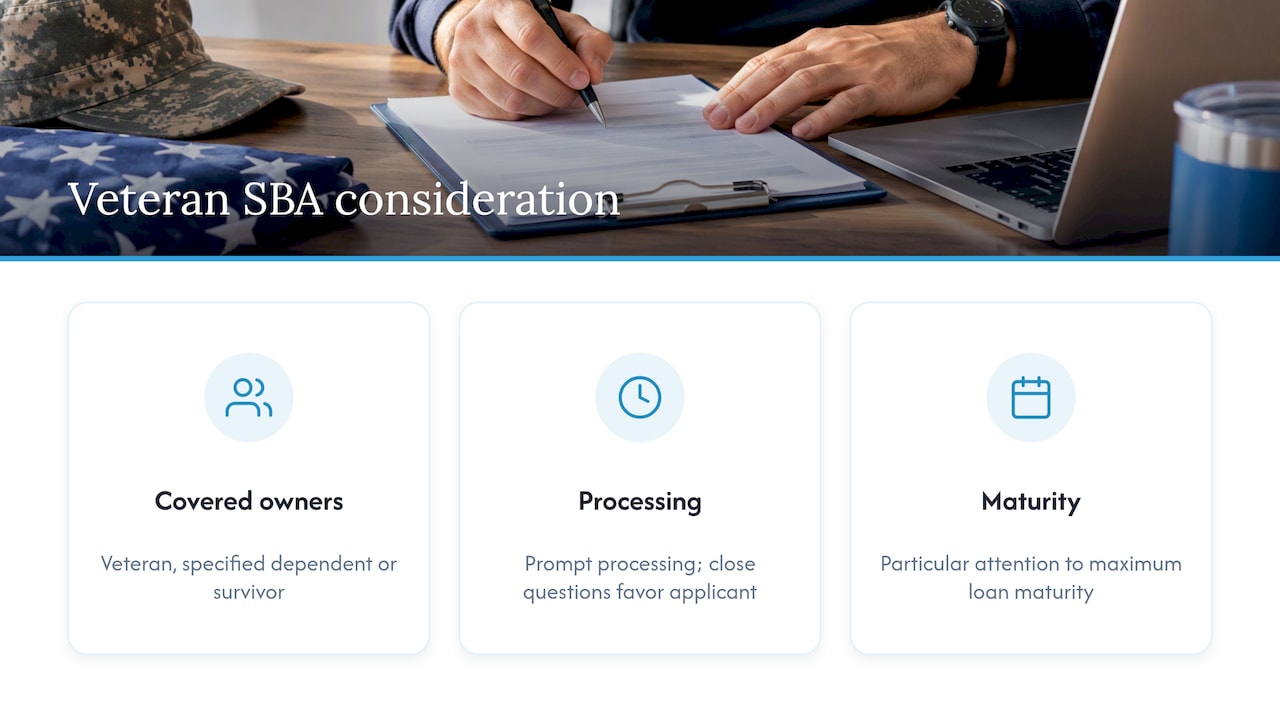
If you or your spouse served, there is additional help. Federal regulation 13 CFR 120.105 directs SBA to give special consideration to a small business owned by a veteran or, in specified circumstances, a veteran’s dependent or survivor: prompt processing, close questions resolved in the applicant’s favor, and particular attention to maximum loan maturity. Our VetLoan Advantage Program is built for veteran and spouse-owned businesses in New England.
Our perspective
When owners come to us after signing a bridge loan, the stress is almost always about the same thing: the clock. The interim loan is short, the closing date on the permanent loan slips, and suddenly extension fees are on the table.
That is why we start the conversation with the end of the deal. A 504 gives you a fixed rate for up to 25 years on real estate, a down payment as low as 10%, and the ability to repay interim financing as part of the project. Our Premier Certified status is designed to make approvals faster, and we work with businesses across Massachusetts, Rhode Island, Vermont, New Hampshire and Connecticut, so we know the local banks and the local deals.
Our advice is simple. If your timeline allows, go straight to the 504 and keep one set of closing costs. If it does not, bring us in before you sign the bridge, so the exit is already built into the plan. Having supported more than $2.3 billion in investment in regional businesses over more than 70 years, we have seen both paths work, and the second one works best when the 504 is planned first.
PHENYX
Start with the permanent loan
Whether you need to move quickly or can take the direct route, the permanent loan should drive the plan. Our 504 programs offer fixed rates for up to 25 years on real estate and 10 years on equipment, a 10% down payment structure, and dedicated support for veterans, refinancing and down payments.
Tell us about your property or equipment project and we will tell you whether it fits a 504, what the structure could look like, and how to line up the timeline. Start at cdcnewengland.com or, if you are weighing a refinance of existing debt, go straight to the SBA 504 Refinance Program.
FAQ
Can an SBA 504 loan pay off a bridge loan?
Often, yes. The 504 program treats repayment of interim financing, including its points, fees and interest, as an eligible project cost. The project must still meet 504 rules, such as an eligible fixed-asset use and a qualifying business. Talk to us before you close the bridge so we can confirm the structure.
Is a bridge loan cheaper than a 504?
A bridge loan costs less only if you measure by speed and not by price. The 504 portion carries a fixed rate priced off 10-year Treasuries and amortizes over up to 25 years on real estate. A bridge is short-term by design, so you also pay closing costs again when you move into permanent financing. Compare total cost over your expected holding period, not just the rate.
How much can I borrow with a 504 loan?
The maximum 504 loan amount is $5.5 million, according to the SBA. That is the SBA-backed portion, and a participating bank’s first mortgage typically sits alongside it, so total project size can be larger. Eligible uses are land, buildings and machinery with at least a 10-year useful life.
Can I use a 504 loan for working capital?
No. The 504 is designed for fixed assets: land, existing buildings, construction and long-life machinery or equipment. If you need working capital alongside a property purchase, ask us about supplemental products such as asset-based lines of credit.
Sources
- Commercial Real Estate Loans: What You Should Know, Forbes Advisor
- Small Business Administration 504/CDC Loan Guaranty Program, Congressional Research Service
- 504 loans, U.S. Small Business Administration
- Increasing access to capital, U.S. Small Business Administration
- 13 CFR Part 120 Subpart H, eCFR
- 13 CFR § 120.882, Eligible project costs for 504 loans
- 13 CFR § 120.105, Special consideration for veterans
- Bridge-to-perm financing, CRE Brokers Connect


