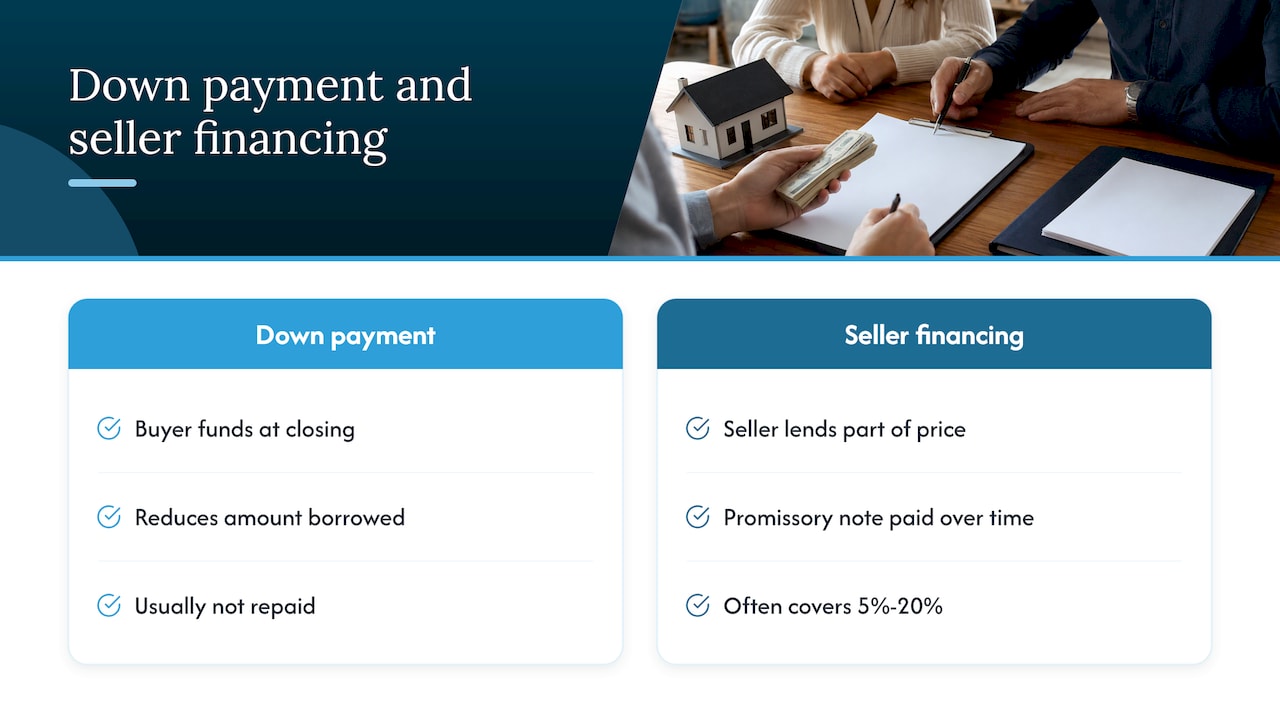
A down payment is the cash or equity you put into a purchase yourself. Seller financing is a loan from the seller, who accepts payments over time for part of the price. For commercial real estate and business acquisitions, the two are rarely rivals. The strongest structure usually starts with a low-down-payment SBA 504 loan, which asks for as little as 10% down, and then, where the rules allow, uses a seller note in a supporting role. We built our programs around that first step.
Cdcnewengland
Plan Your Commercial Property Financing
Explore CDC New England’s SBA 504 financing and programs that may help New England buyers address down payment needs.
TL;DR
Table of Contents
What each one actually is
A down payment is money you contribute at closing. Lenders call it equity or an equity injection, because it shows you have your own capital at risk. It reduces what you borrow and, in most loan programs, it is not repaid to anyone.
Seller financing (also called owner financing) means the seller acts as a lender for part of the price. You sign a promissory note, usually secured by the property or the business assets, and pay the seller over time. NerdWallet’s guide to financing a business purchase notes that seller financing commonly covers only 5% to 20% of the purchase price and that buyers often pair it with other funding, including to cover the down payment on an acquisition loan.
That last point is the heart of the comparison. A seller note is not a substitute for a lender. It is a piece of the capital stack, and sometimes a piece of your down payment.
Why the comparison matters in commercial deals
On a residential purchase, the question is often “bank or seller?” On a commercial purchase it is closer to “how much cash, how much senior debt, and what is left over?” Three features make the answer different:
That is why the best first question is not “which one?” but “what does my primary loan require, and what can a seller note legitimately add?”
How the SBA 504 program treats your down payment
The 504 program finances long-term fixed assets such as owner-occupied buildings, land and heavy equipment. A Certified Development Company (CDC) provides the final portion of the financing through a debenture that SBA guarantees 100%, alongside a first-position loan from a bank. Proceeds can be used to acquire land, buy existing buildings, renovate, build, or install fixed assets, and for 504 loans the asset generally needs a useful life of at least 10 years and a fixed location.
On the borrower side, SBA’s Standard Operating Procedure 50 10 8 (effective June 1, 2025) sets the contribution levels:
SituationMinimum borrower contributionEstablished business, standard property10%New business15%Limited or special-purpose property15%New business and special-purpose property20%
That 10% floor is what makes the program attractive next to a conventional commercial loan. Our 504 loans start at 10% down, and our guide to the 504 down payment walks through when the higher tiers apply. The usual split, explained in our 50/40/10 structure article, is a bank loan for about half, the CDC debenture for about 40%, and your contribution for the rest.
Where seller financing fits inside a 504 deal
The SBA rules speak to this directly. In the SOP text, any financing provided by the seller of the project property must be subordinate to the 504 loan and may not be prepaid without SBA consent. The same section allows part of the borrower’s contribution to be borrowed if that debt is subordinate to the third-party loan and the 504 debenture.
In plain terms: the seller agrees to be paid after the senior lenders, and the SBA wants a say before that note is paid off early. A seller who understands this up front is far easier to negotiate with.
What changed on October 1, 2026
SBA’s newer SOP 50 10 8.1 took effect October 1, 2026. According to a comparison of the 8.1 and 8 changes, it names four types of change of ownership, with Initial Acquisition as the default. For an Initial Acquisition, the 10% equity injection cannot be reduced or eliminated, and standby seller debt, other standby debt and minority equity under 20% together may provide no more than half of the required equity injection. (Standby means the seller agrees not to be paid on the note, or only on limited terms, until the senior debt is in good standing.)
This matters if you are buying a business along with its premises, because it caps how much of your equity a seller note can supply. If your deal is a straightforward purchase of a building for your own operations, talk to us early about how the rules apply to your transaction.
A worked example
Say you are buying a $2,000,000 building and business for your own operations in New Hampshire, and the 10% minimum applies.
The lesson is not that a seller note is bad. It is that the contribution you can fund with a seller’s note is limited, so you should plan your own cash alongside it. Every figure here is an illustration. Your actual structure depends on the property, your business history and the lender’s review.
Comparing the two for your deal
Use these questions to decide how much to pay upfront and how much to leave with the seller:
If you want a wider view of how business owners structure acquisition capital from several sources, structuring acquisition financing is one more angle to read.
Rates and terms to plan around
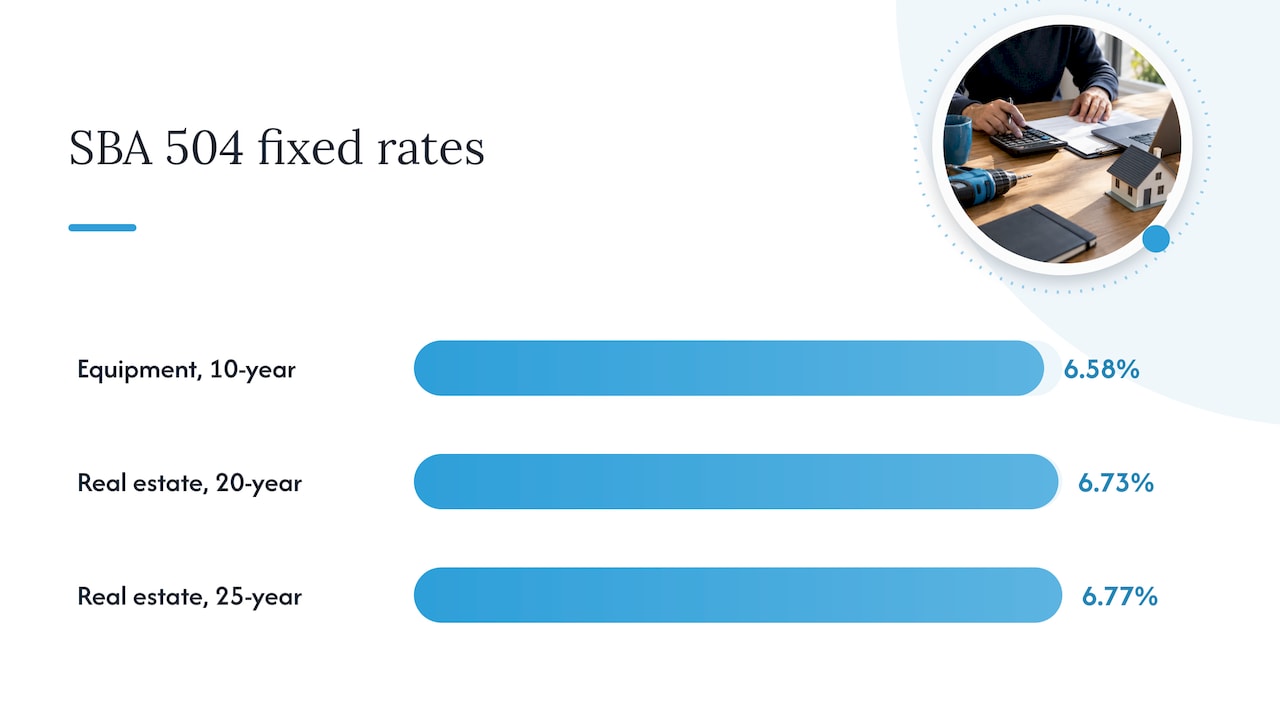
The rates published on our site, read in September 2026, were 6.58% for the Equipment 10-Year Fixed, 6.73% for the Real Estate 20-Year Fixed and 6.77% for the Real Estate 25-Year Fixed. Those are published figures for that month. Rates move, so use our site for the live figures before you build a model.
Compare that with a negotiated seller note: it may carry a favorable rate, but it is usually shorter and often has a balloon. A fixed 20- or 25-year schedule keeps your monthly payment predictable, which is what preserves working capital for hiring, inventory and growth.
Closing the down payment gap
If the difficulty is cash, not the seller, there are routes built for it. Our Down Payment Assistance Program is designed for commercial property buyers who need help meeting the equity requirement. Veterans and their spouses can look at the VetLoan Advantage Program, which carries a 1.0% processing fee. Federal rules also direct SBA to give special consideration to veteran-owned businesses, including prompt processing and attention to maximum loan maturity.
If your goal is to replace existing debt rather than buy, our SBA 504 Refinance Program is the place to start, and our article on refinancing commercial real estate with a 504 loan covers the steps.
Our perspective
We have been financing New England businesses for more than 70 years and have invested over $2.3 billion in the region. In that time the pattern is clear to us: owners who start with the long-term, fixed-rate loan and build the rest of the structure around it make steadier decisions.
A seller note can be a useful part of a deal, but the foundation is the loan that lets you keep your cash. With only 10% down and fixed rates for up to 25 years, a 504 loan is designed to leave you working capital after closing, not just a building.
That is also why we offer down payment assistance and a dedicated program for veterans and their spouses. Our Premier Certified status is intended to speed approvals, and we work with buyers across Massachusetts, Rhode Island, Vermont, New Hampshire and Connecticut. Bring us the property, the price and any seller proposal, and we will help you see how the pieces fit before you sign.
PHENYX
Start with the loan, then negotiate the rest
If you are comparing a down payment with a seller note, begin with the financing that sets your equity requirement. We offer SBA 504 loans for commercial real estate and equipment with 10% down and fixed terms up to 25 years, and a seller note can be discussed within SBA’s limits once your structure is clear.
See our current fixed rates and programs at cdcnewengland.com, or look at the Down Payment Assistance Program if equity is your main hurdle.
FAQ
Can seller financing replace my down payment?
Sometimes it can supply part of it, but not all. Under SBA’s 504 rules, a seller note used toward equity must be subordinate to the 504 loan, and for business acquisitions under the October 2026 SOP, standby seller debt and similar sources together may provide no more than half of the required equity injection. Plan to bring your own capital for the rest.
Are closing costs the same as a down payment?
No. The down payment is your equity contribution toward the price. Closing costs are fees for items such as appraisal, legal and title work. You need cash for both, so budget them separately.
Is a seller note easier to get than a bank loan?
It can be easier to qualify for, and rates may be negotiated, according to NerdWallet. The trade-offs are that not every seller will offer one and the price may rise. Most buyers use it alongside another loan.
Does the seller get paid before or after the 504 lenders?
After. Seller financing in a 504 deal must be subordinate to the 504 loan, and it cannot be prepaid without SBA consent. Ask your seller to agree to this at the term sheet stage.
What is the minimum down payment on an SBA 504 loan?
The SBA’s minimum is 10% for all borrowers, rising to 15% for new businesses or special-purpose property and 20% when both apply. Our 504 loans start at 10% down.