An asset-based loan (ABL) is sized by what you own: receivables, inventory and, in some cases, equipment. A cash flow loan is sized by what you earn. If your balance sheet is strong but your income is uneven, seasonal or growing faster than your profits, an asset-based line of credit usually gives you more room to borrow. If your earnings are steady and you hold few hard assets, a cash flow loan is the more natural fit. At CDC New England, we finance New England businesses with asset-based lines of credit alongside SBA 504 loans, so the right structure can be matched to the right need, and this guide shows you how to tell which one that is.
TL;DR
- ABL lends against collateral. Your borrowing capacity is a percentage (the advance rate) of eligible receivables and inventory, and it moves as those assets move.
- Cash flow loans lend against earnings. The lender studies your income statement and projected cash flow, then sets the amount and term on your ability to repay.
- ABL tends to suit asset-rich, income-lumpy or fast-growing companies. Cash flow loans tend to suit steady, profitable companies with few hard assets.
- Buying property or equipment is a different job. An SBA 504 loan, with 10% down and fixed rates, is built for that, and an ABL line can then cover working capital.
Table of Contents
- What an asset-based loan is and how it works
- What a cash flow loan is and how lenders judge it
- ABL vs. cash flow loan: side-by-side
- Advance rates: what you can actually borrow
- Covenants and flexibility
- What lenders ask for
- Which one fits your business
- When neither is the right tool: buying property or equipment
- Put the right structure to work
- FAQ
- Sources
What an asset-based loan is and how it works
The Office of the Comptroller of the Currency (OCC), the federal regulator of national banks, describes asset-based lending as a specialized product that provides fully collateralized credit facilities, most commonly a revolving line of credit. Advances are limited to a percentage of eligible collateral, known as the borrowing base. Repayment comes as that collateral turns back into cash over your normal business cycle.
In practice, a revolving ABL works like this:
- You pledge eligible assets, usually accounts receivable and inventory.
- The lender applies an advance rate to each category to calculate your borrowing base.
- You draw, repay and redraw up to the lesser of the borrowing base or the commitment.
- Customer payments are typically routed to the lender through a lockbox, a controlled account that applies incoming cash to your balance.
The OCC notes that maturities are typically short-term, though tenors have stretched to as long as five years, and that preapproved seasonal over-advances can be built in. Its example is a lawn-and-garden manufacturer that borrows more in winter to stock up for spring sales. New England has plenty of businesses with the same rhythm: landscapers, marine suppliers, ski and outdoor retailers, and manufacturers who build ahead of a big order. Our guide to a seasonal line of credit for New England firms walks through that pattern.
Because the line grows when your sales and inventory grow, capacity follows the business. That is the central feature of ABL: the facility can expand in step with the assets it is secured by, instead of staying at a fixed number set from last year’s results.
What a cash flow loan is and how lenders judge it
A cash flow loan is underwritten mainly on your ability to repay from operating earnings. The lender begins with your profit and loss statement, historical performance and projections, then decides how much the business can support and over what term. Collateral may still be taken, but it is not what sets the amount.
A useful public example is the SBA’s flagship 7(a) program. The OCC’s bulletin on SBA lending describes underwriting that considers the business industry, operating history, available collateral and a reasonable loan term based on actual or projected business cash flow. Most term loans work this way: the repayment schedule is fixed, and your earnings must cover each payment.
A term loan and a cash flow loan are closely related. “Term loan” describes the shape (a lump sum repaid on a schedule), while “cash flow loan” describes the underwriting (earnings drive the decision). When you compare against ABL, the underwriting is the distinction that matters, because it decides how much you can borrow and what the lender expects of you along the way.
ABL vs. cash flow loan: side-by-side
| Feature | Asset-based loan (ABL) | Cash flow loan |
|---|---|---|
| What sets the amount | Advance rate on eligible receivables and inventory (the borrowing base) | Historical and projected earnings and debt service |
| Typical structure | Revolving line of credit | Term loan with scheduled payments |
| How capacity changes | Rises and falls with your collateral | Fixed at closing |
| Repayment source | Collateral converting to cash, often via a lockbox | Operating cash flow |
| Reporting | Regular borrowing base reports on receivables and inventory | Financial statements, covenant compliance |
| Best for | Asset-rich, seasonal, lumpy or fast-growing companies | Steady, profitable companies with predictable income |
Two rows deserve more explanation.
Underwriting: collateral first or earnings first
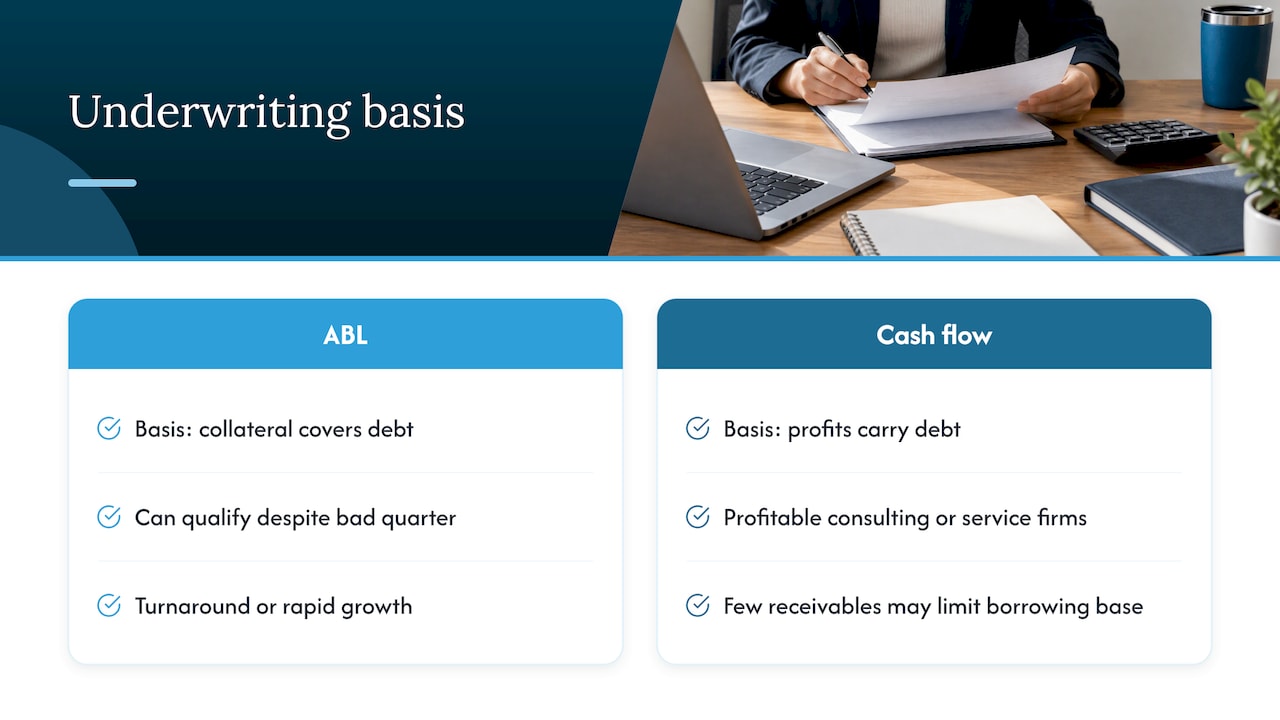
A cash flow lender asks whether your profits can carry the debt. An asset-based lender asks whether the collateral can cover the debt even if profits wobble. That is why a company with a bad quarter, a turnaround underway or rapid growth can still qualify for ABL when a cash flow lender would hesitate. The reverse is also true: a profitable consulting or service firm with few receivables of its own may find little borrowing base to work with and be better served by a cash flow structure.
Reporting: borrowing base certificates
ABL comes with a routine. You will report your receivables and inventory regularly, usually through a borrowing base certificate, and the lender confirms which assets are eligible. This rhythm is manageable when a controller owns it. Our five-step borrowing base reporting workflow and monthly borrowing base formula example lay out the mechanics so there are no surprises.
Advance rates: what you can actually borrow
The advance rate is the percentage of an asset’s value that counts toward your borrowing base. Strong, current receivables typically earn a higher rate than inventory, because invoices convert to cash faster and more predictably than goods that still have to be sold. Equipment and real estate, where pledged, are usually valued by appraisal.
Here is a simple worked example with round numbers for illustration only, not a quote:
- Eligible receivables: $400,000 at an 85% advance rate = $340,000
- Eligible inventory: $200,000 at a 50% advance rate = $100,000
- Borrowing base: $440,000
If your commitment is $500,000, you can draw up to $440,000, the lesser of the two. If a large customer’s invoices age past the lender’s eligibility window, that portion drops out of the base and your availability shrinks. Our article on business loan collateral, including advance rates and documents shows how lenders think about each asset type, and the guide to six steps to protect your ABL borrowing base explains how to keep eligible collateral clean.
Covenants and flexibility
Cash flow loans commonly carry financial covenants, which are performance tests such as a minimum debt service coverage ratio. If earnings dip below the threshold, you can be in default even though you are making payments. ABL puts its discipline in collateral monitoring instead, so a temporary earnings dip matters less than the quality of your receivables and inventory. For a business with variable income, that distinction can be the difference between sleeping well and renegotiating every quarter.
What lenders ask for
For an ABL:
- Accounts receivable aging reports
- Inventory listings and, where relevant, valuations
- Accounts payable aging
- Customer concentration details
- Financial statements and tax returns
- Willingness to report regularly and use a lockbox arrangement
For a cash flow loan:
- Two to three years of financial statements and tax returns
- Interim statements and a current-year projection
- Debt schedule
- Evidence of management experience and a clear use of proceeds
Costs differ in structure as well. When comparing offers, put the interest rate, any processing or origination fee, ongoing collateral monitoring or unused-line fees, prepayment terms and covenant requirements side by side, and compare the total cost for your expected usage, not the headline rate alone.
Which one fits your business
Ask yourself five questions:
- Where is your strength? If it is receivables and inventory, ABL puts them to work. If it is consistent profit, a cash flow loan rewards that.
- How lumpy is your year? Seasonal swings favor a revolving line that expands when you build inventory.
- Are you growing quickly? ABL capacity rises with sales, so funding keeps pace with growth.
- What is the money for? Working capital, payroll and inventory fit a revolving ABL. A building or machinery is a long-term asset and calls for long-term financing.
- How much reporting can your team handle? ABL asks for regular collateral reports. If you have a controller or bookkeeper, that is routine.
If you are also weighing invoice-based options, our comparison of asset-based lending vs. factoring goes through that decision. Manufacturers can read how to pair ABL with the SBA MARC program, and our overview of asset-based lending for business owners covers the questions to take to any lender.
When neither is the right tool: buying property or equipment

Many owners compare ABL and cash flow loans when the real goal is owning a building or a machine. For that, neither is the best match. Working-capital lines are designed to revolve, and the assets they finance are short-lived. A long-term, fixed-rate structure matches a long-term asset.
That is what an SBA 504 loan is for. It funds owner-occupied commercial real estate and major equipment with a down payment of 10% and fixed rates for up to 25 years. Our comparison of SBA 504 and 7(a) loans explains how the two SBA programs differ for New England companies. A common combination is a 504 loan for the building or equipment, plus an asset-based line of credit to run day-to-day operations, so the long-term asset and the working capital each sit in the structure designed for them. For a short-term cash gap, our piece on when a line of credit beats a term loan is a useful companion.
Our perspective
We see the ABL vs. cash flow question as a question of matching the loan to the thing you are financing. Your receivables and inventory turn over within months, so a revolving line that grows and shrinks with them is the right structure. Your building and heavy equipment last for decades, so they belong in long-term, fixed-rate financing. Mixing the two is where owners get squeezed, either by payments sized for one purpose and used for another, or by a line stretched to carry something it was never designed to carry.
That is why we offer both sides of the picture: SBA 504 loans for commercial real estate and equipment, refinancing of existing debt, and asset-based lines of credit and mezzanine financing for New England businesses. With more than 70 years of experience and over $2.3 billion invested in regional businesses, we know how these pieces fit together for companies across the region, and we would rather help you design the whole structure than sell you one product.
PHENYX
Put the right structure to work
If you are planning to buy a building or equipment, our SBA 504 loans carry a 10% down payment requirement and fixed rates for up to 25 years. As published on our site in September 2026, the rates were 6.58% for the Equipment 10-Year Fixed, 6.73% for the Real Estate 20-Year Fixed and 6.77% for the Real Estate 25-Year Fixed. Rates move over time, so check the current rates on our site before you plan. We also offer a Down Payment Assistance Program and a refinance program for existing debt, and veterans and their spouses can look at the VetLoan Advantage Program, which lists a 1.0% processing fee.
Tell us what you are financing and how your year flows, and we will help you map it to a loan structure.
FAQ
What is the main difference between an ABL and a cash flow loan?
An ABL is sized by the value of your eligible collateral, mainly receivables and inventory, while a cash flow loan is sized by your earnings and ability to repay. ABL capacity moves with your assets, and a cash flow loan is typically fixed at closing.
Is an ABL a term loan?
Usually not. According to the OCC’s Comptroller’s Handbook, the most common ABL structure is a revolving line of credit where you draw, repay and redraw within a borrowing base. A term loan is a lump sum repaid on a set schedule.
Can a business with weak profits get an ABL?
Because ABL looks first to collateral, a company with uneven or recovering earnings can still have borrowing capacity if it holds quality receivables and inventory. The lender will still review financial statements and the condition of your collateral.
Should I use ABL to buy a building or equipment?
Long-term assets are better matched with long-term financing. An SBA 504 loan offers a 10% down payment and fixed rates for up to 25 years, and an asset-based line can sit alongside it to fund working capital.