

Invoice financing is a loan against your unpaid invoices; you keep the receivable, collect payment yourself, and repay with interest. Invoice factoring is a sale of those same invoices to a third party, who takes over collections. Choose financing if you want to protect customer relationships and control; choose factoring if you need speed or your business credit can’t qualify on its own. Factoring usually costs more once you annualize the fees.
TL;DR:
- Invoice financing typically offers an advance rate of up to 80% to 95%, with effective APRs usually between 11% and 12%, depending on usage.
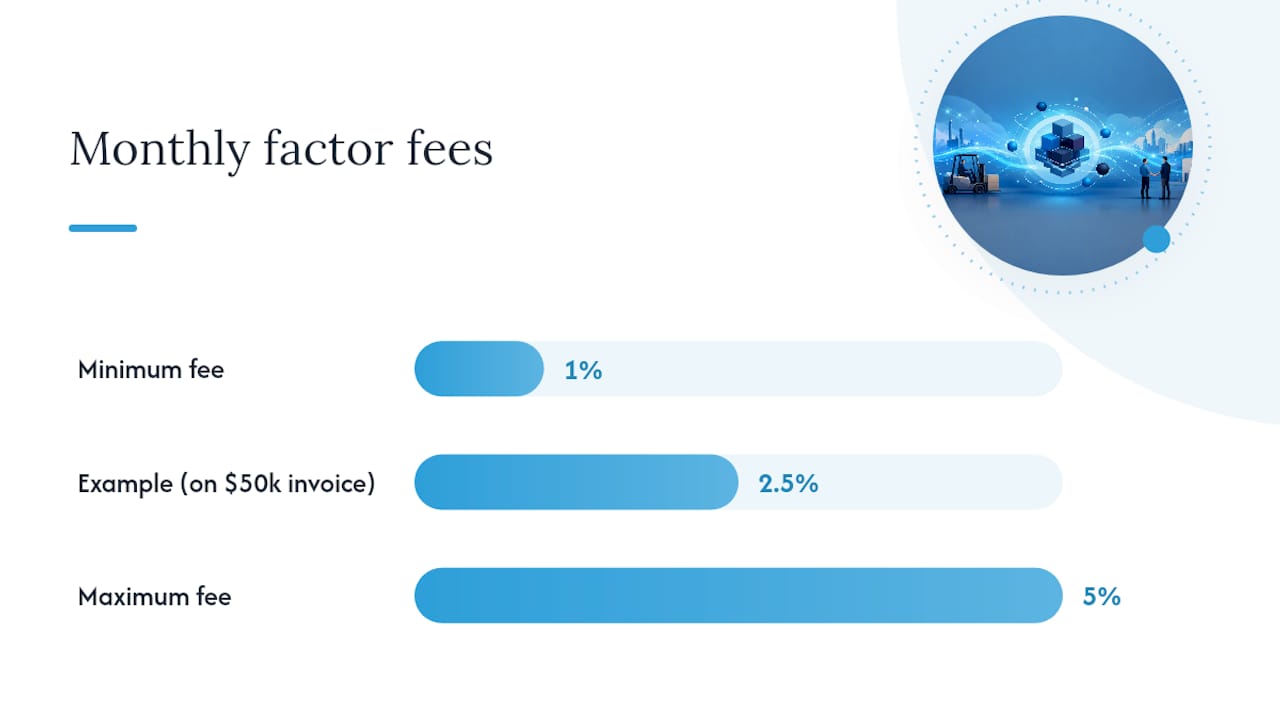
- Factoring advances 80% to 95% of invoice value at a monthly fee of 1% to 5%, with effective APRs often ranging from 15% to 60%, especially for slow-paying invoices.
- Financing records as a liability on your balance sheet and relies on your business credit, while factoring is a sale that usually removes receivables from your books.
- Faster approval and less customer notification make factoring appealing for newer or fast-invoice turnover businesses, but it often costs more long-term than financing for established companies.
- Always compare total annualized costs, including additional fees like setup, aging, and early termination charges, before choosing between invoice financing and factoring.
Table of Contents
- Invoice Financing vs Factoring: The Key Differences at a Glance
- What Is Invoice Financing, and How Does It Work?
- What Is Invoice Factoring and How Does It Work?
- How Do You Compare the Real Cost of Financing vs Factoring?
- Which Option Fits Your Business Situation Best?
- How Do You Choose a Provider? Questions to Ask and Red Flags to Watch
- How Do UCC-1 Liens and Accounting Treatment Affect Your Options?
- What Other Options Exist Beyond Financing and Factoring?
- How CDC New England Thinks About Receivables Financing and Long-Term Growth
- Ready to Move Beyond Short-Term Fixes? Talk to CDC New England
- Sources
Invoice Financing vs Factoring: The Key Differences at a Glance
The two options solve the same problem, cash trapped in unpaid invoices, through fundamentally different mechanics. Here’s how they stack up on the factors that matter most to your decision:
- Advance rate: Invoice financing often advances a percentage tied to your credit line terms; factoring commonly advances 80% to 95% of invoice value.
- Ownership and collections: With financing, you keep the receivable and collect it yourself. With factoring, you sell the invoice and the factor collects, often contacting your customer directly.
- Balance-sheet treatment: Financing books as a loan or liability. Factoring is typically a sale of an asset, which can change how your receivables and debt ratios look.
- Qualification focus: Financing leans on your business’s credit and financials. Factoring leans on your customer’s creditworthiness, since the factor is betting on your buyer paying.
- Cost structure: Financing is usually quoted as an APR plus fees. Factoring is quoted as a factor fee per 30 days, which needs conversion to compare apples to apples.
What Is Invoice Financing, and How Does It Work?
Invoice financing, sometimes called accounts receivable financing or AR-backed lending, is a loan or revolving credit line secured by your unpaid invoices. You submit invoices as collateral, draw an advance, and repay the balance with interest as customers pay you. Your company retains ownership of the receivable and keeps collecting from customers directly, which is the core distinction from factoring.
Expect to encounter costs beyond the headline interest rate including interest charges, possible origination fees, and ongoing monitoring or unused-line fees, depending on your usage.
Pro Tip: *Ask lenders to quote every fee as an annualized number before signing.
That’s $500 in interest for the period plus $200 flat, or $700 total, against $50,000 for 45 days. Annualized, that lands close to 11% to 12% APR, in line with bank-adjacent facilities rather than fintech pricing, which can run considerably higher.
What Is Invoice Factoring and How Does It Work?
Invoice factoring means selling your unpaid invoices to a factoring company at a discount, in exchange for cash today. The factor advances most of the invoice value upfront, holds back a reserve, and releases that reserve (minus fees) once your customer pays in full.
Two contract structures matter here:
- Recourse factoring: You remain liable if your customer never pays, meaning you buy the invoice back or replace it.
- Non-recourse factoring: The factor absorbs certain nonpayment risk, though most non-recourse deals only cover buyer insolvency, not disputes over quality or service.
Because the factor is collecting the debt, they typically notify your customer and collect payment directly, which some clients notice and some don’t love. Providers commonly advance 80% to 95% of invoice value and fund within 24 to 48 hours, charging a factor fee typically between 1% and 5% per 30 days.
Run the numbers on a 2.5% monthly factor fee on a $50,000 invoice: that’s $1,250 for 30 days.
How Do You Compare the Real Cost of Financing vs Factoring?
Converting a factor fee or interest rate into an apples-to-apples annualized figure is the single most useful skill in this decision. A factoring company quoting “2% per 30 days” sounds cheap until you multiply that by twelve. Effective APR on factoring commonly lands between 15% and 60%, depending on how fast your customers pay and how the fee schedule steps up as invoices age.
Watch for these add-on costs, which rarely appear in the headline pricing:
- Setup or application fees: Often $0 to $500 depending on the provider.
- Monthly minimum volume fees: Charged if you don’t factor enough invoices in a given month.
- Aging fees: Additional charges that kick in when an invoice goes past 30, 60, or 90 days unpaid.
- Early termination penalties: Common in factoring contracts with a minimum term.
Paid in 30 days, the fee is $1,000. Paid in 60 days, many contracts charge the fee twice, pushing the cost to $2,000. That’s why slow-paying customers make factoring dramatically more expensive than the initial quote suggests.
Bank lines of credit and SBA-style financing tend to beat both options on pure cost, since they’re priced on your overall business credit rather than transaction-by-transaction risk. AR financing APRs vary widely by lender type: bank-adjacent facilities can sit in the single digits to low teens, while fintech lenders often charge far more for the same convenience.
Which Option Fits Your Business Situation Best?
Neither option is universally better. The right choice depends on your credit profile, how fast you need cash, and how much you value keeping collections in-house.
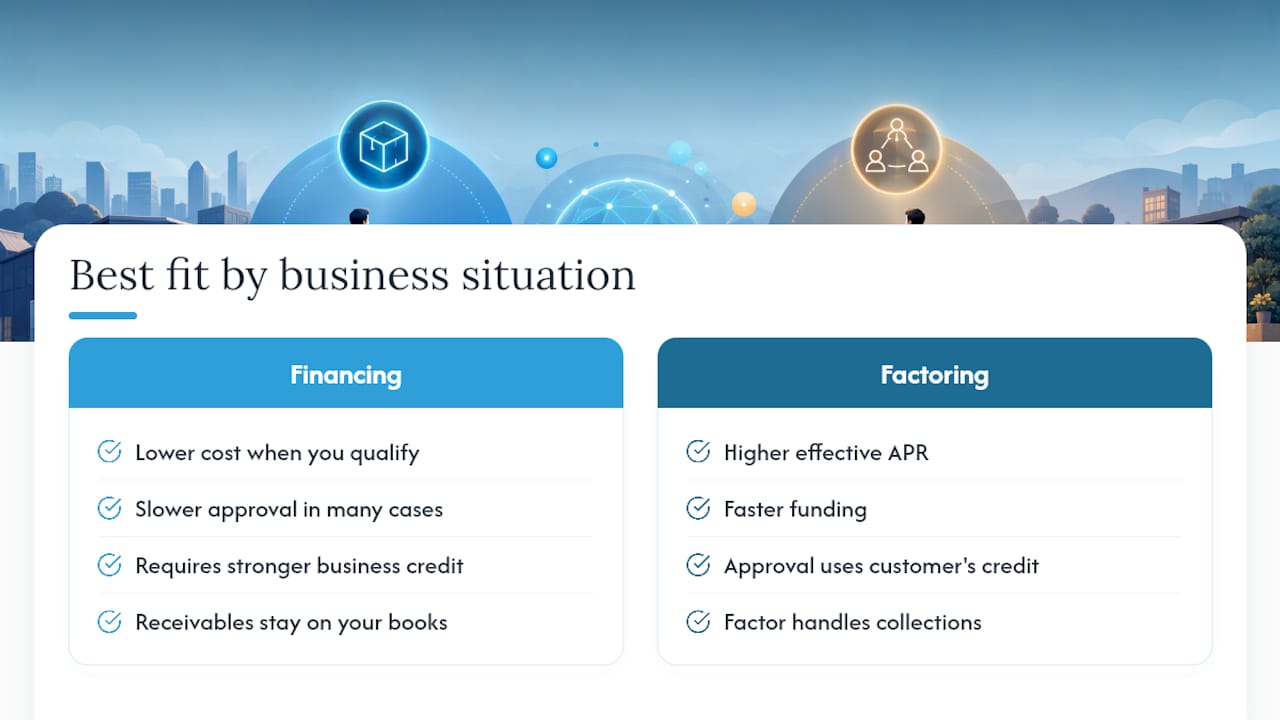
Invoice financing pros: Lower cost when you qualify, no customer notification, receivables stay on your books under your control.
Invoice financing cons: Requires stronger business credit and financial reporting, slower approval than factoring in many cases.
Factoring pros: Faster funding, approval leans on your customer’s credit rather than yours, works well for newer businesses without a credit history.
Factoring cons: Higher effective APR, customer notification can affect relationships, contract minimums can trap you into ongoing fees.
Some patterns show up repeatedly across industries. Startups with thin credit files often start with factoring simply because they can’t qualify for anything else. Trucking and staffing companies, both heavy on fast invoice turnover and thin margins, lean on factoring to bridge payroll between jobs. Government contractors, who often deal with reliable but slow-paying agencies, frequently prefer financing once they’ve built enough history to qualify, since the customer relationship (the government) doesn’t shift with a factor’s involvement. Professional services firms handling large, infrequent invoices sometimes use spot factoring for a single big client without committing to a full contract.
Pro Tip: If speed matters more than cost right now, factor the invoice. If you have six months of runway, spend that time qualifying for a financing line instead, it will almost always be cheaper.
How Do You Choose a Provider? Questions to Ask and Red Flags to Watch
Before you call a lender or factoring company, gather your last six to twelve months of invoices, your accounts receivable aging report, and your business financial statements. Providers move fast once you’re qualified, but they need this paperwork upfront.
Bring these questions to every call:
- What’s the advance rate, and is it fixed or does it vary by customer?
- How is the factor fee or interest rate structured, and does it increase if an invoice ages past 30, 60, or 90 days?
- When exactly does the reserve get released after my customer pays?
- Is this recourse or non-recourse, and what specifically does non-recourse cover?
- Is there a minimum monthly volume requirement, and what’s the penalty if I fall short?
- What are the termination fees if I want to exit the contract?
Watch for red flags during these conversations. A provider that’s vague about total fees, or that only discloses the aging fee schedule after you’ve signed, is worth walking away from. Blanket UCC-1 filings without clear release terms are another warning sign, since they can quietly restrict your ability to borrow elsewhere later. Inflexible minimum-volume clauses that penalize you for a slow month are common in factoring contracts, so get the exact dollar penalty in writing before you sign anything.
How Do UCC-1 Liens and Accounting Treatment Affect Your Options?
The accounting distinction between these two products isn’t just paperwork, it changes what your balance sheet says about your business. Invoice financing records as a liability, since you’ve taken on debt secured by receivables. Factoring, when structured as a true sale, typically removes the receivable from your books entirely in exchange for cash, though recourse factoring can create a contingent liability if your customer doesn’t pay.
- Blanket UCC-1 liens are standard practice in both financing and factoring arrangements.
- These liens attach to your receivables (and sometimes broader assets) as collateral for the lender or factor.
- A blanket UCC-1 filing can restrict or complicate your ability to secure additional financing until it’s released.
- Recourse factoring creates a contingent liability that your accountant needs to track, since you’re still on the hook if a customer doesn’t pay.
A blanket UCC-1 lien from a receivables deal can quietly follow your business for years. If you’re planning to apply for an SBA loan or a bank line down the road, resolving or disclosing that lien early saves you from a stalled application later.
Talk to your accountant before signing either type of contract, particularly if you’re planning to raise capital or apply for a term loan within the next year or two.
What Other Options Exist Beyond Financing and Factoring?
Receivables funding isn’t the only lever for improving cash flow. A traditional bank line of credit, when you qualify, usually beats both options on cost. Renegotiating payment terms with vendors, or offering customers a small discount for paying early, can reduce how much external funding you need at all.
- Traditional bank line of credit: cheaper than factoring, but requires stronger credit and more paperwork.
- Vendor term renegotiation: stretches your payables without borrowing a dollar.
- Early-payment discount programs: encourage customers to pay faster in exchange for a small price break.
- Accounts payable automation: reduces the cash drag from your own payment processes, freeing up capital without new debt.
If you’re using short-term receivables funding as a bridge, plan your exit toward fixed-rate financing once your revenue and reporting stabilize. Start now: pull your aging report, calculate your real annualized cost under each scenario above, and call two providers this week to compare live quotes.
How CDC New England Thinks About Receivables Financing and Long-Term Growth
Receivables financing and factoring solve a real, immediate problem: the gap between doing the work and getting paid for it. But we’ve watched enough businesses grow over more than 70 years and $2.3 billion invested across New England to know that short-term fixes work best when they’re a bridge, not a permanent strategy.
Once your cash flow stabilizes, the businesses that grow fastest typically shift toward fixed-rate financing for the assets that actually build equity, real estate and equipment, rather than continuing to pay factoring fees indefinitely. That’s the point where an SBA 504 loan often makes more sense than another round of invoice-based funding. If you’re solving today’s cash crunch and already thinking about tomorrow’s expansion, we’re glad to talk through where your business fits.
— PHENYX
Ready to Move Beyond Short-Term Fixes? Talk to CDC New England
Invoice financing and factoring buy you time. An SBA 504 loan buys you equity, fixed payments, and a rate that doesn’t move when the market gets nervous.
We also offer down payment assistance for eligible borrowers and dedicated benefits for veteran-owned businesses working toward their next property or equipment purchase. Before you commit to another cycle of short-term receivables funding, run your numbers through the SBA 504 loan calculator to see what fixed-rate financing could look like for your next real estate or equipment purchase. Reach out to CDC New England to start a capital planning conversation about where your business goes next.


