

Asset-based lending is a business loan sized by a borrowing base, meaning your available credit rises and falls with the value of pledged collateral like receivables, inventory, or equipment. It works best for asset-rich or cash-flow-variable companies that need flexible working capital without the tighter covenants of a traditional term loan. If your balance sheet carries strong receivables or inventory but your cash flow swings seasonally, this financing structure deserves a serious look.
TL;DR:
- Asset-based lending relies on a borrowing base calculated from eligible collateral, which fluctuates as receivables and inventory change.
- Eligible collateral typically includes receivables, finished inventory, equipment, and sometimes real estate, with advance rates usually ranging from 50% to 85%.
- The process involves detailed upfront diligence, regular reporting, and operational controls, making it more administratively demanding than traditional loans.
- Lenders prefer collateral with quick liquidation potential and impose exclusions on aged receivables, bespoke inventory, and in-process work.
- Asset-based lending suits seasonal, growth, or restructuring needs, but requires careful management of collateral value and lender relationships.
Table of Contents
- How Asset-Based Lending Works: Borrowing Base, Facility Types, and Underwriting
- Eligible Collateral and Advance-Rate Guidance
- Benefits and Use Cases for Asset-Based Lending
- Risks, Disadvantages, and Common Myths
- The Asset-Based Lending Process: From Application to Ongoing Monitoring
- How to Choose an Asset-Based Lender
- Where Cdcnewengland Fits Into Your Financing Plan
- What Actually Matters When You Weigh ABL
- Sources
How Asset-Based Lending Works: Borrowing Base, Facility Types, and Underwriting
Every asset-based lending facility runs on a borrowing base, a running calculation of how much you can borrow against eligible collateral at any given moment. As your receivables get collected or your inventory sells through, the base shrinks. As you generate new invoices or restock, it grows again. This is the defining difference from a fixed-amount term loan: your credit line breathes with your operations.
Lenders typically structure these facilities in a few ways:
- A revolving line of credit tied to receivables and inventory, redrawn as the borrowing base updates
- A term loan component layered on top for less liquid assets like equipment
- A “first-in, last-out” (FILO) tranche, which sits behind the revolver but ahead of equity, often used to stretch availability without diluting ownership
The OCC’s Comptroller’s Handbook on asset-based lending makes clear that underwriting here centers on liquidation value rather than pure cash-flow ratios. That’s why field exams and appraisals happen on a recurring cadence, often quarterly for stable borrowers and monthly for higher-risk accounts. J.P. Morgan’s guidance confirms these facilities are commonly structured as revolvers with continuous monitoring built in.
Eligible Collateral and Advance-Rate Guidance
Not every asset on your balance sheet qualifies, and the ones that do rarely count at full value. Lenders typically accept:
- Trade receivables, usually the strongest collateral category
- Finished goods inventory, valued conservatively
- Equipment and machinery, appraised at liquidation value
- Select commercial real estate
- Occasionally, intellectual property, though this is rare and heavily scrutinized
Advance rates, the percentage of an asset’s value a lender will actually lend against, vary widely by category. Receivables under 90 days often draw 80% to 85% advance rates. Finished inventory might draw 50% or less, and raw materials or work-in-process typically draw far less than that, if they qualify at all. This gap exists because collateral value depends on how quickly and reliably it can be converted to cash, and inventory sitting in a warehouse is riskier to liquidate than an invoice from a creditworthy customer.
Common exclusions include receivables aged past 90 days, bespoke or custom-built inventory with no resale market, and work still in production. Plan on needing meaningfully more collateral value than the loan amount you actually want.
Pro Tip: Run your own borrowing-base math before you talk to a lender. Pull your aged receivables report, strip out anything past 90 days, and apply a conservative 80% advance rate. That number, not your total balance sheet, is your realistic starting point.
Benefits and Use Cases for Asset-Based Lending
Certain business situations line up naturally with this financing structure:
- Seasonal or working-capital-intensive operations. Retailers, distributors, and manufacturers with predictable inventory cycles can scale borrowing up ahead of peak season and pay down after.
- Rapid growth phases. When revenue is outpacing cash on hand, a borrowing base that expands with new receivables keeps pace with expansion in a way a fixed loan amount can’t.
- Ownership transitions or recapitalizations. Companies buying out a partner or restructuring debt often use asset-based lending as bridge financing while arranging longer-term capital.
The core advantage across all three cases is the same: your credit line scales with your balance sheet, not with a static approval from a year ago. Bank explainers on asset-based lending also note these facilities frequently carry lighter financial covenants than cash-flow loans, since the lender is leaning on collateral value rather than projected EBITDA. That makes it a workable bridge to conventional financing once your financials stabilize.
Risks, Disadvantages, and Common Myths
The trade-off for that flexibility is administrative weight. You’re signing up for recurring reporting, periodic field exams, and often operational controls like a lockbox arrangement where customer payments route directly to the lender before hitting your account. Miss a covenant or let collateral quality slip, and the lender can tighten advance rates or, in a default scenario, exercise its lien against pledged assets.
A few myths deserve correcting:
- “ABL is only for distressed companies.” The OCC’s own framing treats it as a legitimate tool for healthy companies needing working capital, not just turnaround situations.
- “It’s always more expensive than a term loan.” Pricing depends on collateral quality and facility size; asset-rich borrowers sometimes get better effective rates than they would through unsecured options.
- “Reporting requirements never ease up.” Lenders increasingly use technology to reduce reporting friction for borrowers with clean, automated systems.
Strong internal controls and documented collateral tracking go a long way toward mitigating both the administrative burden and the lien risk.
The Asset-Based Lending Process: From Application to Ongoing Monitoring
Getting funded involves more diligence upfront than a standard term loan, but the timeline is often shorter than borrowers expect if paperwork is ready.
- Initial diligence and collateral review. The lender examines your receivables aging, inventory composition, and any existing liens. Expect this phase to take two to four weeks.
- Appraisals and borrowing-base setup. Equipment and real estate typically require third-party appraisals; receivables and inventory get evaluated against your own reporting.
- Closing and initial funding. Once the borrowing base is set, funding can happen within days of final documentation.
- Ongoing reporting. Expect to submit borrowing-base certificates weekly or monthly, along with aged receivables and inventory reports on a set schedule.
- Cash-dominion triggers. Most facilities include specific covenants (a minimum availability threshold, for example) that, if breached, shift cash control toward the lender until conditions are cured.
Clean, consistent reporting from day one is the single biggest lever you have over how smoothly this entire process runs.
How to Choose an Asset-Based Lender
Not all asset-based lenders operate the same way, and the differences show up fastest in the fine print. Evaluate:
- Industry experience with your specific collateral type (receivables-heavy service firms and inventory-heavy distributors need different expertise)
- Flexibility on advance rates for atypical collateral
- Reporting technology, since manual borrowing-base certificates eat staff time every single cycle
- Turnaround speed on both initial funding and ongoing draw requests
Ask lenders directly: What are your advance rates by asset category? Which receivables get excluded and why? How often do you require reporting, weekly or monthly? What specifically triggers cash dominion? What’s your process when a borrower disputes an eligibility exclusion?
Pro Tip: If a lender can’t clearly explain their advance-rate methodology in the first conversation, that’s worth noting. Vague answers on eligibility rules tend to surface as disputes later, usually at the worst possible time.
Red flags include opaque or shifting advance-rate policies, springing dominion clauses that trigger too easily, and no documented process for resolving eligibility disagreements. A lender with dedicated industry knowledge and modern reporting tools tends to make the entire relationship less painful.
Where Cdcnewengland Fits Into Your Financing Plan
If your asset-based lending research has you also thinking about buying the building or equipment your business runs on, that’s a different financing conversation, and it’s one Cdcnewengland has spent over 70 years having with New England business owners. The company offers SBA 504 loans, which pair a down payment with fixed rates locked for extended terms on commercial real estate and equipment purchases.
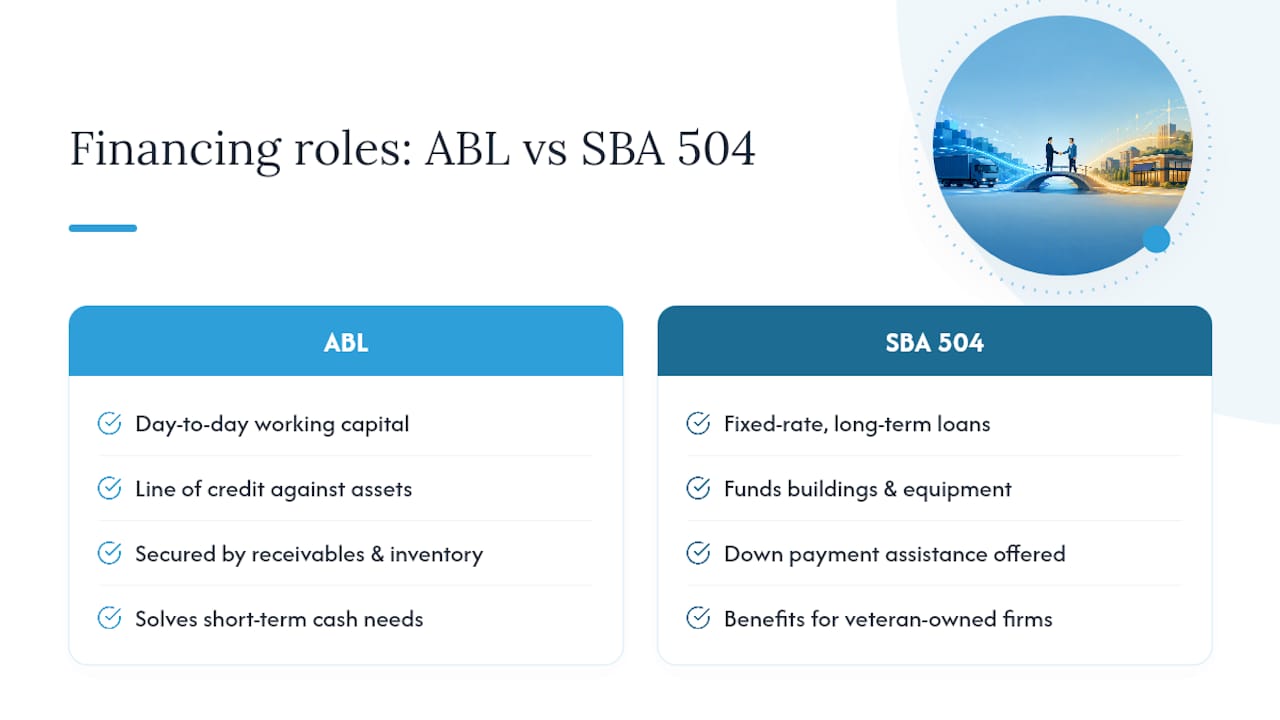
An asset-based line of credit and an SBA 504 loan solve different problems. ABL funds your day-to-day working capital against receivables and inventory. Cdcnewengland’s SBA 504 loans fund the fixed assets, the building, the manufacturing line, that generate the collateral your ABL facility relies on in the first place. The lender also offers down payment assistance and specific benefits for veteran-owned businesses.
Run the numbers on your own scenario using the SBA 504 loan calculator, or reach out to Cdcnewengland directly for an assessment of how a fixed-rate real estate or equipment loan could complement the working capital financing you’re already evaluating.
What Actually Matters When You Weigh ABL
Asset-based lending rewards businesses that treat their receivables and inventory as living data, not year-end line items. The flexibility is real, but so is the operational cost, and the two scale together. Before applying anywhere, run your own borrowing-base estimate, build a simple reporting template now, and get a candid read from a financing advisor on whether your collateral quality actually supports the advance rates you’re hoping for.
— PHENYX
Sources
The OCC’s Comptroller’s Handbook on asset-based lending remains the most authoritative regulatory reference on borrowing-base mechanics and lender controls. J.P. Morgan’s overview and Bank of America’s explainer both break down structuring and fit from a lender’s perspective. For the fundamentals of how advance rates and haircuts work, Investopedia’s collateralization primer is a solid plain-language starting point.
- Asset-based lending, Comptroller’s Handbook
- Asset-Based Loans: How They Work for Businesses — J.P. Morgan
- Collateralization — Investopedia
- What is Asset-Based Lending (ABL) & How Does it Work — Bank of America
Recommended
- New SBA Citizenship Requirements: What Bankers and Borrowers Need to Know
- SBA 504 Loans New England | 10% Down, 25-Year Fixed Rates
- SBA 504 vs. 7A Loans: Which is Right for Your Commercial Real Estate Purchase?
- SBA 504 Loan Program Explained: How Small Businesses Can Buy Commercial Real Estate With Just 10% Down


