ABL covenants are the conditions that keep an asset-based line of credit available to you. They center on your collateral, not your earnings: a borrowing base certificate, field exams, concentration limits, and a minimum availability cushion that can trigger a fixed charge coverage ratio (FCCR) test. Once you know which of these your agreement contains and how close you run to each trigger, a covenant package becomes a routine to manage, not a risk to fear. For New England companies weighing a receivables- and inventory-backed line, we offer asset-based lines of credit and can walk you through the structure before you sign.
TL;DR
- ABL covenants are collateral-driven: they govern how much you can borrow against receivables and inventory, and what you must report to keep drawing.
- Most ABL lines focus on excess availability. If availability falls below a set threshold, a springing FCCR test, cash dominion, or field exams can activate.
- Covenant-light does not mean control-light. Reporting is frequent, and small definitional changes can move your availability quickly.
- A plain-language compliance checklist and early lender conversations keep a thinning cushion from becoming a default.
- Review covenant definitions, reserves, and cure rights at the term sheet stage, when they are still negotiable.
Table of Contents
- What a covenant is, and what makes ABL covenants different
- The covenants you will most often see
- How a springing covenant works
- Covenant-light, not control-light
- ABL covenants versus cash-flow loan covenants
- What happens if you breach a covenant
- A compliance routine that works
- Where SBA financing fits alongside an ABL
- Our perspective
- Finance the long-term side with us
- FAQ
- Sources
What a covenant is, and what makes ABL covenants different
A covenant is a promise written into the credit agreement. Affirmative covenants say what you must do, such as deliver financial statements. Negative covenants say what you may not do without the lender’s consent, such as take on new debt or sell major assets. Financial covenants require you to hold certain ratios or performance levels as an ongoing condition of credit.
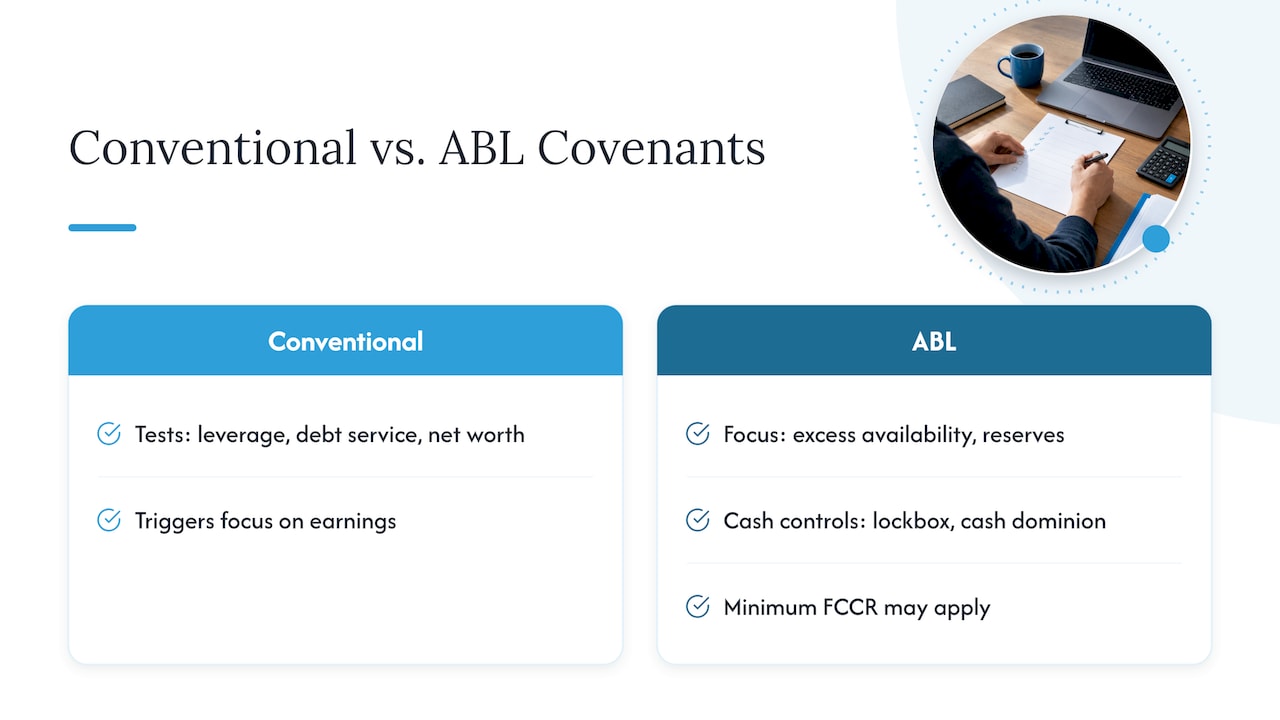
The Office of the Comptroller of the Currency (OCC) describes covenants as early indicators of potential problems that give the bank default triggers if performance slips. In a conventional term loan, those triggers are mostly earnings-based: leverage, debt service coverage, and net worth tests.
Asset-based lending shifts the center of gravity. According to the OCC, ABL covenants commonly focus on excess availability and may take the form of a reserve against the borrowing base, along with cash controls such as cash dominion through a lockbox arrangement. Financial covenants, when present, typically take the form of a minimum fixed charge coverage ratio, and limits on capital expenditures are also common.
That design suits companies whose strength lies in their balance sheet: distributors, manufacturers, wholesalers, and staffing firms with solid receivables and inventory but uneven earnings. Your borrowing capacity follows your collateral, so growth in sales and inventory can lift your availability.
The covenants you will most often see
Borrowing base certificate and reporting
The borrowing base is the ceiling on what you can borrow at a given moment: an advance rate applied to eligible receivables and inventory, less reserves. You certify it on a schedule, often weekly or monthly, depending on the facility. If outstanding loans exceed the base, you repay the excess. The reporting is a core covenant, and accuracy matters as much as timeliness.
If you want to see the arithmetic, our borrowing base formula walkthrough with a monthly example shows how eligible collateral, advance rates, and ineligibles combine. For the monthly routine, see our five-step borrowing base reporting workflow.
Field exams, appraisals, and concentration limits
Expect the lender to have the right to examine your books and collateral. Concentration limits cap how much of any single customer’s receivables count toward the base, so one large account cannot carry your availability. Eligibility rules also exclude aged or disputed receivables.
Minimum availability and springing financial covenants
This is the covenant that attracts the most attention, and it deserves its own section below.
Negative covenants
The OCC’s guidance on receivable and inventory financing notes that other covenants restrict asset sales, new debt or equity, and the use of proceeds from those activities. Maximum limits can also apply to capital expenditures, dividends, and insider compensation. These restrictions shape how you plan an expansion, a distribution to owners, or an acquisition. If you are structuring a purchase of another company, it helps to look at the range of financing options with seller financing alongside your lender’s consent requirements.
How a springing covenant works
A springing covenant lies dormant while you hold comfortable availability. It activates only when availability drops below a threshold.
Excess availability is generally the lesser of your borrowing base and the line commitment, minus drawn loans, minus letters of credit, minus reserves. The threshold is typically written as a fixed dollar amount, a percentage of the line, or the greater of the two. A common middle-market pattern is the greater of a fixed dollar amount and roughly 10 to 12.5 percent of the line, as one practitioner write-up of springing FCCR triggers describes.
Here is a worked illustration with made-up numbers. Suppose you have a $4 million line with a trigger at the greater of $400,000 or 10 percent of the line. Your borrowing base is $3.6 million, you have drawn $3.1 million, and you carry $100,000 in reserves. Excess availability is $3.6 million minus $3.1 million minus $0.1 million, or $400,000. You are exactly at the trigger. One more draw, or one more reserve, and the covenant springs.
Once triggered, what typically happens:
- The FCCR is tested, commonly as of the most recent fiscal quarter end.
- The lender may begin daily cash dominion, sweeping collections to pay down the line.
- Field exam rights may become available on demand.
The OCC also describes a hard block: a minimum amount of availability that must be maintained at all times. The distinction matters. A springing trigger changes what you must prove, while a hard block limits what you can draw.
The practical lesson: the test runs against availability, not against your drawn balance. A seasonal inventory build, a large customer’s slow payment, or a new reserve can reduce availability even when sales are healthy. That is why forecasting availability weekly is more useful than watching the balance.
Covenant-light, not control-light
ABL borrowers often hear that these facilities carry fewer financial covenants than cash-flow loans. Wells Fargo’s comparison of asset-based and cash flow loans makes the same point: cash flow loans require covenants on metrics like EBITDA, liquidity, and leverage, while asset-based loans involve fewer financial covenants, generally tied to a specific event or trigger, with periodic reporting of asset levels and values.
A Legal 500 article by finance lawyer Tom Dell’Avvocato adds the other half of the picture. ABL structures typically feature fewer traditional financial covenants but real operational visibility, asset monitoring, and dynamic controls that can activate far faster than a conventional covenant breach. The same article notes that modest adjustments to eligibility criteria, valuation assumptions, or concentration limits can affect availability immediately.
For a borrower, this means the negotiation that matters happens in the definitions. Read these closely before you sign:
- How “eligible receivable” and “eligible inventory” are defined, and how aging cutoffs work.
- How the lender may set or change reserves, and whether it must give notice.
- The advance rates and how inventory is valued.
- The size and test date of any springing trigger.
- Whether cash dominion is ongoing or only springing.
- Cure rights and grace periods.
Our guide to six checks borrowers and lawyers need on a term sheet versus a commitment letter is a good companion when you reach this stage, since the term sheet is where these points are still open.
ABL covenants versus cash-flow loan covenants
| Feature | Asset-based line | Cash-flow term loan |
|---|---|---|
| What drives availability | Eligible receivables and inventory | Fixed commitment based on projected earnings |
| Typical financial covenants | Springing FCCR or minimum availability | Leverage, interest coverage, EBITDA-based tests |
| Reporting | Borrowing base certificates, often weekly or monthly | Periodic financial statements and compliance certificates |
| Main control | Collateral monitoring, reserves, cash dominion | Ratio tests and default triggers |
| What grows capacity | Growth in eligible collateral | A renegotiated commitment |
The table reflects the general pattern described by the OCC and the Legal 500 article above. Individual agreements vary, so your own credit agreement is the final word.
What happens if you breach a covenant
In ABL agreements, any event of default, from a late notice to a missed financial covenant, can give rise to the lender’s contractual rights. The American Bar Association’s article on ABL credit facilities for borrowers observes that defaults give lenders leverage to renegotiate pricing and terms, and that waivers and amendments are distracting, time consuming, and often costly. It also points out that ABL agreements can include events of default borrowers may not see elsewhere, such as events tied to an important customer contract, cancelled orders, or uncollected receivables, and that counsel should try to negotiate the highest thresholds.
If an event of default continues, the lender’s remedies can be substantial. A representative ABL security agreement filed with the SEC lets the agent exercise a secured party’s rights under the Uniform Commercial Code, withdraw cash held in collection accounts, and, if that cash is insufficient, dispose of collateral. Your own agreement spells out your specific rights and cure periods, and your attorney should review it before you sign.
The OCC also cautions lenders that waiving borrower noncompliance weakens their own controls. That is a reason to treat covenant dates as firm and to avoid planning around a waiver.

A compliance routine that works
The ABA article advises that after closing, counsel should prepare a compliance checklist in layman’s terms covering regular and occurrence-based reporting and the operating negative covenants. Build yours around five habits:
- Calendar every deliverable. List borrowing base certificates, financial statements, tax returns, insurance certificates, and collateral reports with owners and due dates.
- Track availability weekly. Calculate excess availability the way the agreement defines it, including reserves and letters of credit, and compare it with the springing trigger.
- Set internal alerts above the trigger. Choose a cushion, such as a buffer above the threshold, so you see a squeeze before the lender does.
- Report occurrence-based events promptly. Loss of a major customer, a large order cancellation, a lawsuit, or a change in ownership may all require notice.
- Talk early. If you expect a tight quarter, bring your lender a forecast and a plan before the certificate is due.
Many of the problems that cut availability start with the base itself. Our six steps to protect your ABL borrowing base cover the collections and inventory habits that keep eligible collateral high.
Where SBA financing fits alongside an ABL
An asset-based line funds working capital, while long-term assets are often better financed separately. Many New England owners pair a revolving line with fixed-rate financing for property or equipment, so that working capital is not tied up in buildings and machines. Our SBA 504 program is built for that purpose: owner-occupied commercial real estate and equipment with a 10% down payment requirement. For manufacturers, we also cover how to pair an ABL with SBA MARC for access to up to $5 million.
Separating the two matters for covenants. Fixed assets financed on a long-term fixed rate leave your line’s availability for inventory and receivables, which is where your springing trigger is measured.
Our perspective
Most covenant trouble we see described in lending guidance starts the same way: a company treats the covenant package as paperwork until availability gets thin. We think the better approach is to treat the borrowing base as a management number, like cash or backlog, and to learn its definitions before the first draw.
That is why we offer asset-based lines of credit alongside our SBA 504 loans and mezzanine financing for New England businesses. A growing company rarely needs just one product. Long-term assets belong on long-term, fixed-rate financing, and working capital belongs on a line that grows with your receivables and inventory.
Our advice to any owner reading a term sheet: ask how reserves are set, where the springing trigger sits, and what the cure rights are, and get the answers in writing. Covenants you understand are covenants you can plan around.
PHENYX
Finance the long-term side with us
If you are planning a building purchase, an equipment acquisition, or a refinance, our SBA 504 loans keep your down payment at 10% and your rate fixed. Our published rates are 6.58% for the Equipment 10-Year Fixed, 6.73% for the Real Estate 20-Year Fixed, and 6.77% for the Real Estate 25-Year Fixed, as read from our site in September 2026. We also offer a SBA 504 refinance program, a down payment assistance program, and the VetLoan Advantage program for veterans and their spouses. See current terms on our financing page, and read our overview of asset based lending for business owners to compare structures.
FAQ
What is a covenant in banking terms?
A covenant is a contractual promise in a loan agreement. Affirmative covenants say what you must do, such as deliver financial statements, and negative covenants limit what you can do, such as incur new debt or sell assets. Together they define the ongoing conditions for keeping the credit available.
What are the most common ABL covenants?
The OCC lists excess availability requirements, reserves against the borrowing base, cash dominion through a lockbox, a minimum fixed charge coverage ratio when a financial covenant is present, and limits on capital expenditures. Borrowing base certificates, field exam rights, and concentration limits round out a typical package.
What is a springing covenant?
It is a financial test, usually an FCCR, that applies only when excess availability falls below a set threshold. While availability stays above the trigger, the test is dormant. Below it, the lender may also begin cash dominion or request field exams.
How do ABL covenants differ from term loan covenants?
ABL covenants are tied to collateral and availability, while term loan covenants are tied to earnings metrics such as leverage and interest coverage. ABL reporting is also usually more frequent, since the borrowing base is recalculated on a regular schedule.
Sources
- OCC Comptroller’s Handbook: Asset-Based Lending
- OCC Comptroller’s Handbook: Accounts Receivable and Inventory Financing
- Legal 500: Asset-Based Lending, At Times Covenant-Lite, But Not Control-Lite
- American Bar Association: Asset-Based Lending Credit Facilities, The Borrower’s Perspective
- SEC filing: Amended and Restated ABL Security Agreement
- Wells Fargo: Asset-based versus cash flow loans
- Springing FCCR covenants in ABL