

Borrowing base reporting is the recurring process of certifying which assets, usually accounts receivable and inventory, still qualify as collateral under an asset-based loan, and how much cash that collateral supports. Lenders require it because it acts as an early warning system, flagging trouble long before a default. For you as the borrower, the number on that report, not your credit line’s stated maximum, decides how much you can actually draw this month.
TL;DR:
- Borrowing base calculations are based on eligible collateral, with advance rates typically ranging from 80% to 90% for receivables and 40% to 65% for inventory.
- Regular monthly reporting within 15 to 30 days of month-end ensures accurate reflection of current collateral values, with quicker updates for volatile businesses.
- A borrower signs a certificate attesting the figures, and material falsehoods can trigger defaults regardless of collateral performance.
- Sudden drops in collateral value or breaches of concentration caps could cause shortfalls, prompting immediate remedial actions or loan restrictions.
- Fixed-rate SBA 504 loans offer more predictable financing options by eliminating collateral revaluation surprises common with revolving lines.
Table of Contents
- Understanding Borrowing Base Reporting and Its Role in Asset-Based Lending
- How to Calculate a Borrowing Base: Formula and Worked Example
- Borrowing Base Certificate: What to Include and Who Signs It
- Advance Rates, Reserves, and Concentration Limits Explained
- Reporting Cadence and a Month-End Timing Example
- Managing a Borrowing Base Surplus or Deficiency
- Reconciliation Checklist and Common Reporting Pitfalls
- Building a Borrower-Ready Reporting Checklist
- What Credit Officers Actually Watch in Your Reports
- Financing Options Built Around Your Collateral Position
- Where to Read More on Borrowing Base Standards
- Sources
- FAQ
Understanding Borrowing Base Reporting and Its Role in Asset-Based Lending
Your loan agreement may promise a substantial line, but the borrowing base is what determines what you can actually draw against it. The two figures rarely match. Asset-based lending ties availability directly to the value of pledged collateral at a given moment, which means your effective credit limit rises and falls with your balance sheet, not with what was negotiated at closing.
Collateral typically included in the calculation breaks down into a few categories:
- Trade accounts receivable, usually the largest and most liquid component
- Raw materials and finished goods inventory, valued conservatively against resale risk
- Cash and marketable securities held in blocked or controlled accounts
- Occasionally, equipment or real estate, added when working capital alone won’t support the requested facility size
The Comptroller’s Handbook on asset-based lending frames this structure as a deliberate tradeoff: lenders extend credit to borrowers who might not qualify on cash flow alone, provided the collateral is monitored closely enough to catch deterioration early. That tradeoff is why the reporting requirement exists at all.
How to Calculate a Borrowing Base: Formula and Worked Example
The borrowing base calculation follows a consistent sequence, even though the specific inputs vary by industry and lender.
- Start with the gross value of eligible collateral pools, typically accounts receivable and inventory.
- Strip out ineligibles, receivables aged past 90 days, balances owed by affiliates, disputed invoices, or inventory already pledged elsewhere.
- Apply the negotiated advance rate to what remains in each pool.
- Subtract any reserves the lender has imposed for dilution, seasonality, or known collection risk.
- Sum the results to arrive at total borrowing base availability.
Statistic Callout: Advance rates typically fall in the 80% to 90% range for eligible accounts receivable and 40% to 65% for inventory, depending on how quickly each pool converts to cash.
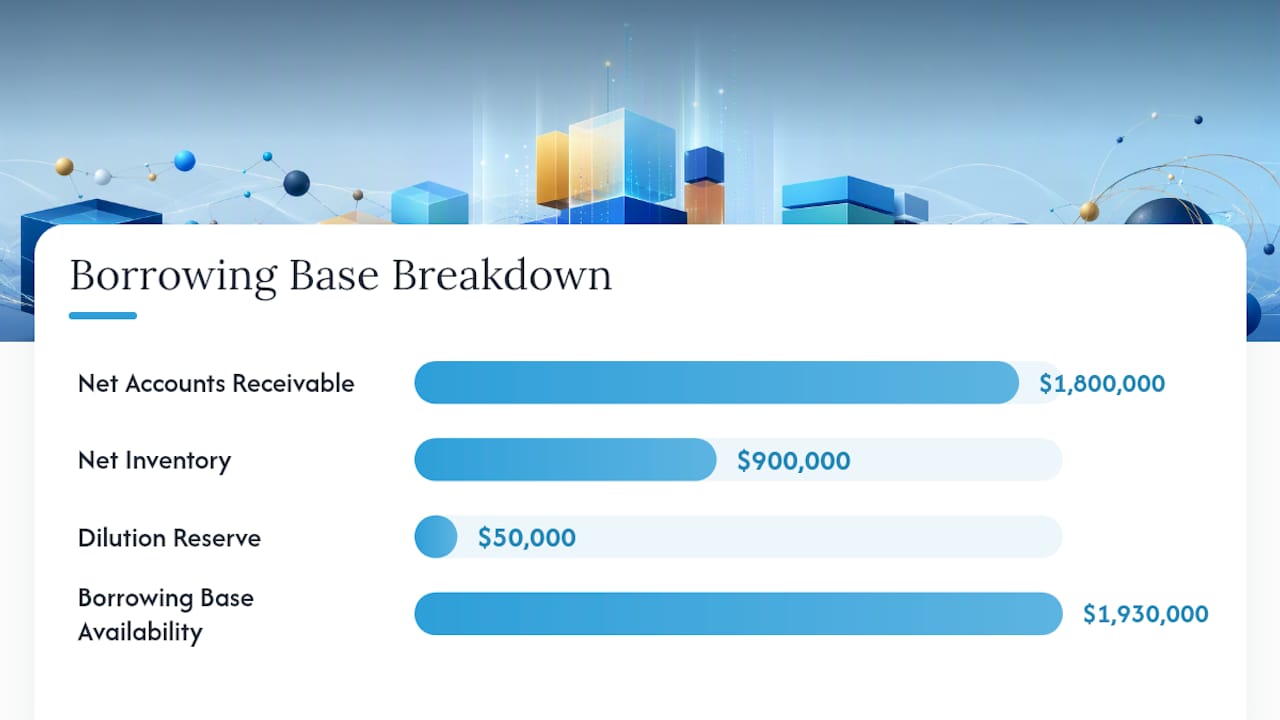
Here’s how the math plays out for a mid-size distributor. Say gross accounts receivable total $2 million, with $200,000 aged past 90 days and excluded. Inventory sits at $1 million gross, with $100,000 already pledged to a separate lender and removed. Add both figures, subtract a $50,000 dilution reserve, and the borrowing base lands at $1,930,000, regardless of what the facility’s stated ceiling says.
Borrowing Base Certificate: What to Include and Who Signs It
The certificate is the document that turns your calculation into a formal, contractual claim on availability. Lenders expect a consistent package each cycle, not a summary number typed into an email.
Most certificates bundle these components together:
- An account receivable aging schedule broken into standard buckets (current, 30, 60, 90-plus days)
- An inventory schedule showing raw materials, work in process, and finished goods separately
- A concentration table identifying any single customer exceeding the lender’s cap
- The calculation worksheet itself, showing gross values, ineligibles, advance rates, and reserves line by line
Lenders often request supporting backup alongside the certificate: sample invoices, lockbox statements confirming collections, and periodic appraisals for inventory or equipment pledged as collateral. This is where the SEC-filed loan exhibits become useful reading, since they show exactly how “Eligible Accounts” and advance rate definitions get written into binding contract language.
Certification isn’t a formality. A designated officer, typically the CFO or controller, signs attesting the figures are accurate. That signature carries legal weight; a materially false certificate can trigger default provisions independent of whether the underlying collateral shortfall was intentional.
Advance Rates, Reserves, and Concentration Limits Explained
Advance rates aren’t arbitrary. Lenders set them based on how quickly and reliably a collateral pool converts to cash. A distributor with blue-chip customers and 30-day payment terms earns a higher AR advance rate than a contractor billing on long-cycle projects with retainage clauses.
Reserves and caps work alongside advance rates as a second layer of protection:
- Dilution reserves account for expected credit memos, returns, and discounts that shrink collectible AR over time
- Seasonal reserves anticipate predictable swings, retailers before the holiday buildup, agriculture around harvest
- Customer concentration limits cap how much of the borrowing base any single account can represent, often 10% to 20%
- Geographic or contract-type exclusions remove foreign receivables or government contracts subject to assignment restrictions
Pro Tip: Ask your lender for the exact concentration formula in writing before your first reporting cycle. Borrowers frequently discover a top customer already exceeds the cap only after a draw request gets rejected.
Reporting Cadence and a Month-End Timing Example
Most facilities require certificates submitted monthly, though the exact window varies by lender and risk profile.
- Standard monthly reporting typically requires submission within 15 to 30 days of month-end close.
- Higher-risk borrowers, or those in volatile inventory positions, may face weekly reporting instead.
- Some facilities layer in a daily cash collection report even when the full certificate is monthly.
Statistic Callout: Because certificates reflect a prior-period snapshot, fast-growing or fast-shrinking businesses can face a real liquidity gap between what the report shows and what’s actually happening on the ground.
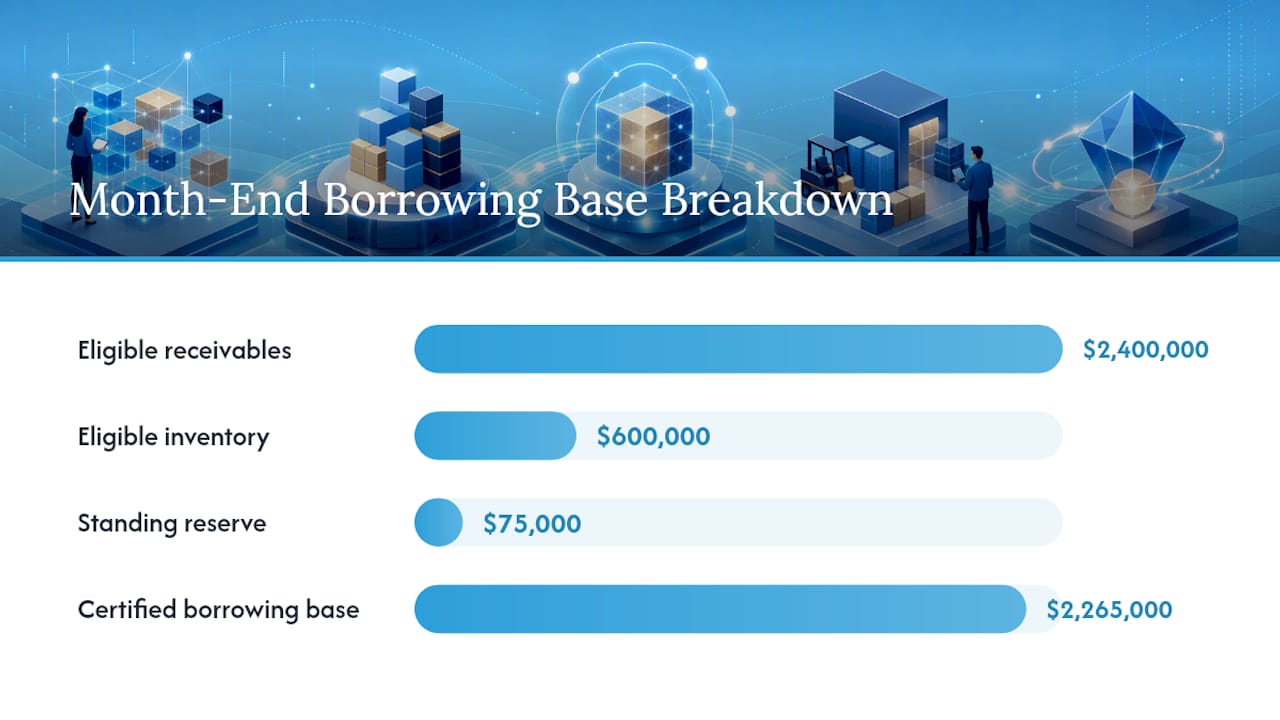
Picture a business closing March 31 with $2.4 million in eligible receivables and $600,000 in eligible inventory after ineligibles. Subtract a $75,000 standing reserve and the certified borrowing base for April draws sits at $2.265 million. If a major customer defaults on April 5, that change won’t surface in the numbers until the April certificate is filed in May.
Managing a Borrowing Base Surplus or Deficiency
A surplus, availability exceeding what you’ve drawn, gives you breathing room for opportunistic inventory buys or unexpected payroll timing. It’s not free money, but it is flexibility worth using deliberately rather than letting it sit idle.
A deficiency is a different conversation entirely:
- Most agreements grant a short cure period, often 5 to 10 business days, to correct the shortfall
- Cures typically involve an immediate paydown, pledging additional eligible collateral, or both
- Persistent deficiencies can trigger cash dominion, where the lender takes control of incoming receipts
- Borrowers who flag a likely shortfall before the certificate is due, rather than after, usually negotiate softer terms than those who let the lender discover it first
Reconciliation Checklist and Common Reporting Pitfalls
Reconciling your internal accounting to the borrowing base tape before submission catches most errors before they become lender inquiries.
- Confirm your AR aging cutoff date matches the lender’s required reporting date exactly
- Flag any receivable reclassified as ineligible since the prior period, and document why
- Verify no inventory item appears pledged to more than one lender simultaneously
- Keep invoice and lockbox backup ready before the certificate is due, not after a request comes in
Pro Tip: Build a two-day internal reconciliation buffer before your certificate deadline. Mismatched cutoffs and reclassified ineligibles are the most common causes of lender inquiries and delayed advances, and they’re almost always caught by comparing your GL to the tape a few days early.
Building a Borrower-Ready Reporting Checklist
Prepare your AR aging, inventory schedule, and concentration table on the same day each month, then reconcile before submission. Keep sample invoices and lockbox statements on file year round for field exams. A tool like CDC New England’s SBA 504 loan calculator helps size financing decisions once your true collateral capacity is clear.
What Credit Officers Actually Watch in Your Reports
Credit officers rarely react to a single weak month. What draws attention is the trend: receivables aging longer each cycle, one customer creeping past the concentration cap, collections slowing while sales hold steady. A borrower who explains a dip proactively earns more patience than one whose numbers simply arrive quiet and unexplained.
— PHENYX
Financing Options Built Around Your Collateral Position
If your borrowing base reporting keeps surfacing gaps between what your facility promises and what it actually funds, that’s usually a signal worth acting on, not just documenting. CDC New England structures financing differently: SBA 504 loans require only a 10% down payment and lock in fixed rates for up to 25 years, so your real estate or equipment purchase isn’t held hostage to a monthly collateral recalculation the way a revolving asset-based line can be.
That fixed structure matters most for businesses tired of watching availability shrink every time receivables age or a customer concentration cap gets tripped. Explore SBA 504 financing for commercial real estate and equipment, or run your numbers through the 504 loan calculator to see what a fixed, predictable facility looks like against your current plans. For businesses weighing which structure fits, our breakdown of SBA 504 versus 7(a) loans is a useful next read before you call.
Where to Read More on Borrowing Base Standards
- Comptroller’s Handbook: Asset-Based Lending, the primary regulatory guidance on advance rates and monitoring
- Journal of Accountancy’s borrowing base primer, for the accounting perspective on certification
- Wall Street Prep’s borrowing base guide, for calculation mechanics and typical advance-rate ranges
- SEC-filed borrowing base definitions and certificate exhibits, showing how contract language governs the formula
This article is general information, not a substitute for advice from a qualified financial advisor. Consult a qualified financial professional about your own circumstances before acting on anything here.
Sources
- Borrowing base and asset-based lending primer — Journal of Accountancy
- Comptroller’s Handbook: Asset-Based Lending — OCC
- Borrowing base primer — Wall Street Prep
- Example borrowing base definitions and certificate forms — SEC filing (Exhibit)
FAQ
What is an example of a borrowing base?
A distributor with eligible receivables and inventory advanced at typical rates in the common ranges would have a borrowing base calculated as shown in the worked calculation above.
What is the purpose of a borrowing base certificate?
It gives the lender a borrower-certified snapshot of current collateral so availability under the credit line reflects real, verified asset values rather than the facility’s stated maximum.
What are the 5 C’s of borrowing?
Definitions vary across lenders, but the concept commonly used in underwriting refers to character, capacity, capital, collateral, and conditions, criteria examined during initial credit approval rather than the ongoing borrowing base calculation itself.
What is the difference between a borrowing base and an advance rate?
The borrowing base is the total dollar amount available for draws, while the advance rate is the percentage applied to each eligible collateral pool, typically 80% to 90% for receivables and 40% to 65% for inventory, to arrive at that total.


