You can change how a building is used under an SBA 504 loan, and you can expand it, as long as your business keeps occupying enough of the space and the project stays an owner-occupied one rather than a rental investment. The way to stay safe is to settle the new use before the loan is structured, not after the keys are in your hand. That is the point where a regional Certified Development Company (CDC), the nonprofit lender that originates 504 loans, can shape the project around your plans. At CDC New England, we work with New England owners on exactly these questions.
TL;DR
- A 504 loan is built for owner-occupied property. The SBA says it cannot be used for speculation or investment in rental real estate, so a change of use that turns the building into a rental asset conflicts with the program.
- For an existing building, you must permanently occupy and use at least 51% of the rentable space. Up to 49% can be leased to tenants.
- Expansion, conversion and renovation are eligible uses. Plan them into the original loan request where you can.
- If a project changes after approval, the CDC handles the request to SBA. Talk to your CDC before you act, not after.
Table of Contents
- What “change of use” means for a 504 property
- The occupancy rule that governs most changes
- Use changes that conflict with the program
- What happens when the project changes after approval
- Expansion projects: what a 504 loan can finance
- How a 504 expansion is structured
- Steps for planning a change of use or expansion
- Rules that have changed recently
- Financing your expansion with CDC New England
- FAQ
- Sources
What “change of use” means for a 504 property
The SBA does not publish one rule titled “change of use.” The phrase covers several situations, and each one touches a different requirement:
- You move into a building and convert part of it, for example turning warehouse space into offices or a showroom.
- You lease more space to tenants than you first planned.
- Your business grows, shrinks or moves, and the share of the building you occupy shifts.
- You add square footage or equipment, which makes it an expansion project.
In every case, the test comes back to one question: does your business still use the property in the way the program expects? Under 13 CFR 120.880, the federal rule for 504 loan-making, a 504 borrower must use the project property. The one exception is an Eligible Passive Company, a real estate holding entity that leases the property to an operating business.
That framing helps because it turns a vague worry into a checkable one. If your new use keeps your company in the building as the main occupant, you are generally working inside the program. If it makes you a landlord first and an operator second, you are not.
The occupancy rule that governs most changes
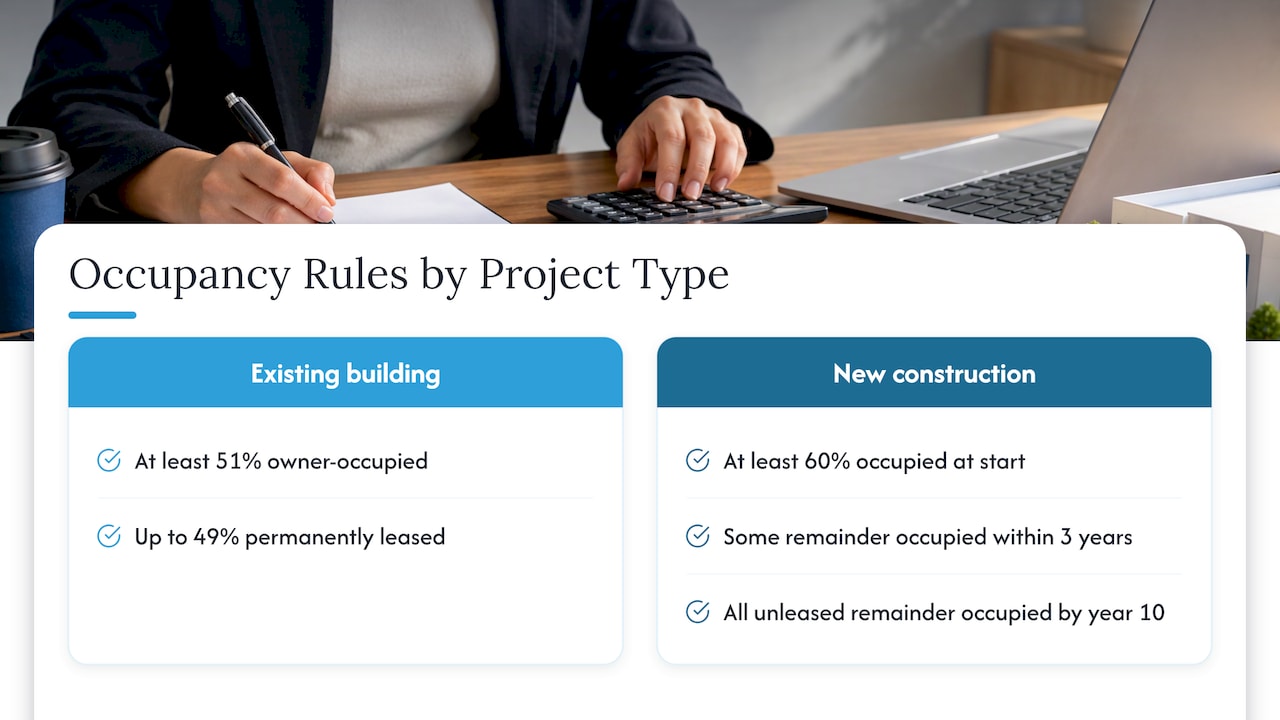
The number to know is 51%. The regulation at 13 CFR 120.131 says that when 504 financing is used to acquire, renovate or reconstruct an existing building, the borrower may permanently lease up to 49% of the rentable property, but only if it permanently occupies and uses at least 51%. The same 51/49 test applies when an Eligible Passive Company leases the whole space to one or more operating companies.
New construction has a stricter schedule. The same section calls for at least 60% occupancy at the start. It also expects you to plan to occupy some of the remaining space within three years, and all remaining space that is not permanently leased within ten years.
Here is a worked example. You buy a 20,000-square-foot existing building. To meet the 51% test, your company needs to permanently use at least 10,200 square feet. That leaves up to 9,800 square feet you can lease to tenants. If you later decide to lease more than that, say by moving half your staff to a remote arrangement and subletting a second floor, you have changed the use in a way that matters to the loan.
For a fuller explanation of how this is measured, see our guide to SBA 504 occupancy requirements and the overview of 51% occupancy eligibility for New England borrowers. If part of your plan is to rent space to others, our article on multi-tenant 504 property loans explains how those deals are structured.
Use changes that conflict with the program
The clearest conflict is turning the property into an investment. The SBA’s 504 page states that loans cannot be made to businesses engaged in passive or speculative activities, and that proceeds cannot fund investment in rental real estate. The current lender and CDC rulebook, SOP 50 10 8.1, effective October 1, 2026, restates that passive businesses owned by developers or landlords that do not actively use or occupy the assets are ineligible, with the Eligible Passive Company exception under 13 CFR 120.111.
In practice, three patterns raise the question:
- Moving out and leasing everything. Relocating your operations and renting the full building to someone else leaves you below the occupancy threshold.
- Steadily adding tenants. Each lease may seem small, but together they can push you past the 49% limit.
- Switching to an unrelated business. A new line of business inside the same building is not automatically a problem, but the eligibility of the operating company is.
This is why you should treat any of these as a conversation with your CDC. Rules on loans already in place sit with the CDC and SBA, and the right path depends on your loan documents and the facts of your change.
What happens when the project changes after approval
Plans do shift between approval and closing. Costs move, a tenant drops out, a building turns out to need more work. SOP 50 10 8.1 provides that when a CDC needs an exception to policy after loan approval, or because an approved 504 project has changed, it can request that exception from SBA through what the SOP calls a 327 action. You do not file that yourself. Your CDC does, which is one reason to work with one that knows the process.
Two practical habits follow from that:
- Tell your CDC about the change before you commit to it. A lease signed or a scope changed first can leave you with a problem that is harder to fix.
- Keep your documents in step with reality. Occupancy plans, lease terms and project budgets should match what you are actually doing.
When a project’s scope changes, insurance often needs to follow it. If you are updating coverage on a financed property, this overview of SBA loan hazard insurance is a good place to understand how the coverage fits the loan.
Expansion projects: what a 504 loan can finance
Many owners asking about a change of use are really planning an expansion. The good news is that expansion is squarely within what the program is for. 13 CFR 120.120 lists eligible uses of proceeds that include:
- Converting, expanding or renovating existing buildings
- Constructing new buildings
- Acquiring land and improving a site, with up to 5% for community improvements
- For 504 loans, acquiring fixed assets with at least 10 years of useful life at a fixed location
The SBA’s 504 loan page adds long-term machinery and equipment with at least 10 years of useful remaining life, and the refinancing of qualified debt. It also draws the line: working capital and inventory are not eligible.
Costs inside the project
Under 13 CFR 120.882, eligible costs include those directly attributable to the project, a construction contingency of up to 10% of construction cost, essential professional fees, and repayment of interim financing, including its points, fees and interest. That contingency matters if you are renovating an older building, where surprises are common.
Refinancing debt into an expansion
If you already carry debt on your property, an expansion can sometimes pull it in. The same section allows existing debt of up to 100% of the expansion’s project cost to be refinanced and added to the project if all of these hold:
- At least 75% of the original proceeds went to eligible land, building or equipment
- The debt is collateralized by fixed assets
- You have been current on payments for at least one year
- The new financing offers better terms or a lower rate
Our article on SBA 504 refinance with expansion walks through how this works, and the general process is covered in how to refinance commercial real estate with a 504 loan.
How a 504 expansion is structured
A 504 loan is originated by a CDC together with a senior lender. Per the SBA, 504 loans are available only through CDCs, and the maximum 504 loan amount is $5.5 million. The structure splits the project: a senior lender typically covers the first portion, the CDC’s SBA-backed loan covers a second portion, and you contribute the equity.
The SBA’s FY26 loan guaranty overview lists the key terms for the 504 CDC loan:
| Term | FY26 figure |
|---|---|
| Upfront guaranty fee | 0.50% |
| Annual service fee | 0.209% (waived for NAICS 31–33 manufacturers) |
| Fixed-rate terms | 10, 20 or 25 years |
| Prepayment penalty | Declining, for half the term |
| Equity required | 10%, plus 5% if the business is new or the property is special-use |
That last row is worth noticing for a change of use. If your new use makes the property a special-purpose building, or the business is new, the equity requirement rises from 10% to 15%. Raising that early avoids a funding gap at closing.
Small business size limits also apply. Under SOP 50 10 8.1, the alternative size standard is tangible net worth of $20 million or less and average net income after federal taxes of $6.5 million or less over the two full fiscal years before application. Those limits rise 25% in labor surplus areas, and size is measured as of the date the application is accepted for SBA processing.
Steps for planning a change of use or expansion
- Write down the end state. List how much space you will occupy, how much you might lease, and what you will build or buy. Express occupancy as a percentage of rentable space, because that is how the rule is measured.
- Test it against 51%. For an existing building, your occupied share must be at least 51%. For new construction, start at 60% and map the three-year and ten-year plan for the rest.
- Separate eligible costs from ineligible ones. Building work, fixed equipment with a 10-year life and certain professional fees can go in. Working capital and inventory cannot.
- Check existing debt. If you owe money on the property, find out whether it meets the 75%, one-year-current and better-terms tests for refinancing into the project.
- Plan the equity. Count 10% as the base and 15% if the business is new or the building is special-use.
- Bring the plan to your CDC before you sign leases or contracts. Any change after approval goes back through the CDC to SBA.
If you are moving rather than expanding in place, our page on SBA 504 relocation rules covers how a move is treated. Weighing a different route for the property altogether? Compare a sale-leaseback with a 504 loan or see why some owners pick 504 financing over a construction loan.
Rules that have changed recently
Program rules shift, and SBA’s lender rulebook is updated periodically. The current edition, SOP 50 10 8.1, takes effect October 1, 2026. The occupancy and passive-business provisions discussed above are restated in it. Because fee waivers, limits and size standards are set by year and by SBA notice, check the SBA’s 504 page and your CDC for what applies on the day you apply.
Our perspective
Most change-of-use problems we hear about start the same way: an owner builds a plan around the building, then asks whether the loan allows it. We think the order should be reversed. A 504 loan is designed for businesses that use the property they finance, and when the plan starts from how you will use each square foot, the structure usually follows naturally.
That is where a regional CDC earns its place. With more than 70 years of experience and more than $2.3 billion invested in New England businesses, we have built our process around helping owners get the space they need with a 10% down payment and fixed rates for up to 25 years. Our Premier Certified status is meant to speed approvals, and our Down Payment Assistance and VetLoan Advantage programs are there for owners whose equity or circumstances need extra support.
If your plans might change, bring them to us early. We would rather help you design the project to fit your growth than help you repair it later.
PHENYX
Financing your expansion with CDC New England
If your project involves buying or expanding a building or adding equipment, our published rates as of September 2026 were 6.58% for the Equipment 10-Year Fixed, 6.73% for the Real Estate 20-Year Fixed and 6.77% for the Real Estate 25-Year Fixed. Rates move with the market, so see the current figures on our rates page. We also offer a SBA 504 Refinance Program for existing debt, a Down Payment Assistance Program for commercial property acquisition, and the VetLoan Advantage Program for veterans and their spouses, which carries a 1.0% processing fee.
We serve businesses in Massachusetts, Rhode Island, Vermont, New Hampshire and Connecticut.
FAQ
Can I lease part of my 504-financed building to tenants?
Yes. For an existing building, you may permanently lease up to 49% of the rentable property if you permanently occupy and use at least 51%. For new construction, the occupancy starts at 60% with a plan to fill the rest over time.
Can I use a 504 loan to expand a building I already own?
Yes. Converting, expanding and renovating existing buildings are eligible uses under 13 CFR 120.120. Existing debt on the property may also be refinanced into the project if it meets the program’s tests.
Do I need approval to change the project after my loan is approved?
Talk to your CDC first. When an approved project changes, the CDC can request an exception from SBA through a 327 action under SOP 50 10 8.1. Your CDC manages that request.
Can a 504 loan pay for working capital or inventory?
No. The SBA states that 504 proceeds cannot fund working capital or inventory. They are for fixed assets such as buildings, land and long-term equipment.
Sources
- 504 loans, U.S. Small Business Administration
- 13 CFR 120.131, Leasing part of new construction or existing building
- 13 CFR Part 120 Subpart H, Loan-Making Policies for 504 loans
- 13 CFR 120.120, Eligible uses of loan proceeds
- 13 CFR 120.882, Eligible project costs for 504 loans
- SOP 50 10 8.1, Lender and Development Company Loan Programs
- Quick Overview of SBA Loan Guaranty Programs, FY26