

If your business is expanding and you carry existing debt on commercial real estate or equipment, an SBA 504 loan can finance the new project and refinance that debt in the same transaction. The key rule: the debt you refinance can be as much as 100% of the cost of the expansion. The result is long-term, fixed-rate financing for both pieces, with as little as 10% equity from you.
Below, we explain how the rule works, what debt qualifies, how the loan is structured, and how to prepare. We are CDC New England, and we work with owner-occupants across Massachusetts, Rhode Island, Vermont, New Hampshire and Connecticut.
TL;DR
- A 504 refinance with expansion lets you roll existing eligible debt into the project, up to 100% of the expansion cost.
- Since November 15, 2024, at least 75% of the original debt proceeds must have gone to 504-eligible assets, and the old 10% savings test no longer applies.
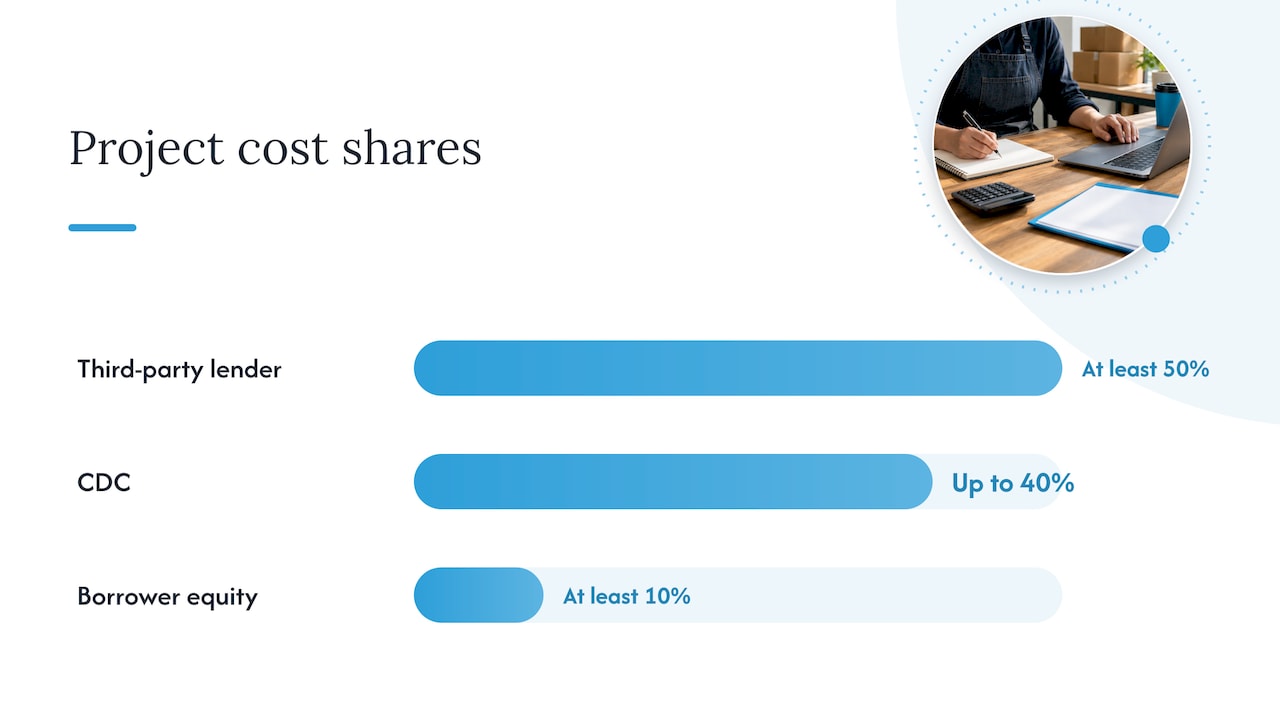
- The usual structure is 50% senior lender, up to 40% CDC debenture, and at least 10% borrower equity.
- The business must be a small, for-profit operating company that will occupy the property.
- Our published rates are 6.58% (equipment, 10-year fixed), 6.73% (real estate, 20-year fixed) and 6.77% (real estate, 25-year fixed).
Table of Contents
- What a 504 refinance with expansion means
- The 100% rule, with a worked example
- What changed in November 2024
- Which existing debt qualifies
- How the loan is structured
- Who is eligible
- Why the refinance can be worth it
- Our perspective
- How to prepare your application
- Start your refinance with CDC New England
- FAQ
- Sources
What a 504 refinance with expansion means
The SBA 504 program provides long-term, fixed-rate financing for major fixed assets that promote business growth and job creation, and it is available only through Certified Development Companies like ours (SBA.gov). Most people think of it as a purchase or construction loan. It also has a refinance track, and there are two versions.
- Refinance without expansion, for businesses that simply want to replace qualifying debt.
- Refinance with expansion, where the project includes real growth: a building purchase, an addition, new construction, major renovation or new equipment.
This article covers the second. Under the federal rule, when a 504 project involves expansion of the small business, existing indebtedness that does not exceed 100 percent of the expansion project cost may be refinanced and added to the project cost (Federal Register, 504 Debt Refinancing).
If you want the version without expansion, see our guide on how to refinance commercial real estate with an SBA 504 loan.
The 100% rule, with a worked example
The 100% rule caps the amount of old debt you can fold in. It compares the debt to the cost of the expansion, not to the value of the property.
Suppose your company owes $1,200,000 on the building it occupies, and you want to add a $1,500,000 production wing. Your existing debt ($1,200,000) is below 100% of the expansion cost ($1,500,000), so all of it can be refinanced. The total project cost is then about $2,700,000, before eligible closing costs.
Now change the numbers. You owe $2,000,000 and the expansion costs $1,500,000. Debt above the 100% limit cannot be included in the 504 project. Lenders have described cases where the excess is consolidated into the third-party lender’s permanent note when it is on the same property, which is a point to settle with your bank early. These figures are illustrations, not a quote, and every deal depends on appraisal, underwriting and SBA policy.

The practical takeaway: the larger your growth plan, the more existing debt you can bring along. Size the expansion honestly and build the numbers from there.
What changed in November 2024
The SBA published a direct final rule on October 1, 2024, effective November 15, 2024. It did three things that matter to you (Federal Register):
- It set the “substantially all” standard for refinancing with expansion at 75%, down from 85%. At least 75% of the proceeds of the debt you refinance must have been used for 504-eligible assets.
- It eliminated the 10% substantial benefit test on refinancing other government debt.
- It allowed certain “other secured debt” to be included as an eligible business expense.
The SBA explained that the 10% test was seen as overly burdensome in a high interest rate environment (Federal Register, Volume 89). If you looked at a 504 refinance in the past and walked away because the numbers did not clear a savings threshold, the rules are different now. For additional commentary on these 2024 refinancing rule changes, including how other secured debt is treated, that page is worth a read.
The regulation still requires that refinancing provide a substantial benefit to the borrower. That benefit is judged in your loan file, for example through a lower payment or a better term structure, but there is no longer a fixed percentage hurdle on government debt. For loans with seasonal payments, the SBA’s procedural notice looks at the average of payments over the most recent twelve months when it compares the old and new installments (SBA Procedural Notice).
Which existing debt qualifies
Under 13 CFR 120.882(e), eligible debt has to meet each of these conditions (eCFR):
- Substantially all (75% or more) of the proceeds were used for 504-eligible assets.
- The debt is collateralized by fixed assets.
- It was incurred for the benefit of the small business.
- The new financing is used only to refinance existing debt or for project-related costs.
- The refinancing provides a substantial benefit to the borrower.
Typical candidates include a conventional mortgage on the building you occupy, a loan used to buy equipment, or a short-term bridge loan used to acquire the property. Existing SBA 7(a) loans and 504 loans may also be refinanced under SBA policies and procedures.
Two details trip up borrowers:
- Collateral. The 504-eligible fixed assets securing the debt you refinance must also secure the new 504 loan, unless the SBA approves a waiver for extraordinary circumstances (eCFR).
- Same-institution debt. If the debt being refinanced is owed to your new senior lender or its affiliate, that lender must certify in its commitment letter that it is not in a position to sustain a loss and shift it to the SBA (SBA Procedural Notice). Ask your bank about this before you apply.
How the loan is structured
A 504 project has three participants. The Federal Register describes them this way: a private-sector lender holding a first lien for at least 50% of the project cost, a CDC holding a second lien for up to 40%, funded by a 100% SBA-guaranteed debenture, and a borrower contribution of at least 10% equity (Federal Register).
| Participant | Share of project | Role |
|---|---|---|
| Third-party lender | At least 50% | First lien, usually a bank |
| CDC (us) | Up to 40% | Second lien, SBA-backed debenture, long-term fixed rate |
| Borrower | At least 10% | Equity, which can include equity in the property being refinanced |
The maximum 504 loan amount is $5.5 million per the SBA’s 504 page. Our 504 portion runs on a 10, 20 or 25-year fixed rate and is fully amortizing, with no balloon payment. For a deeper look at who pays what and when, read our 50/40/10 structure guide.
Some projects bring in additional equity requirements, for instance for special-purpose properties or newer businesses. Your loan officer will confirm what applies. Startups and newer companies should also read about combining 7(a) and 504 financing.
Who is eligible
The borrower must be an operating business, organized for profit, located in the United States, and small under SBA size requirements. Under the alternative size standard, tangible net worth cannot exceed $20 million and average net income after federal income taxes for the two full fiscal years before application cannot exceed $6.5 million (SBA SOP 50 10 8). Size standards increase by 25 percent when the applicant agrees to use all of the financial assistance within a labor surplus area designated by the Department of Labor, per the same SOP.
The program is for owner-occupants. Passive, speculative and nonprofit activities are not eligible. Occupancy is the rule most borrowers ask about: see our explanation of the 51% occupancy requirement for existing buildings.
Why the refinance can be worth it
We see four situations where a refinance with expansion fits well.
- A balloon payment is coming. The 504 portion is fully amortizing, so there is no refinance cliff on that part of the debt.
- Your current rate is variable or high. A fixed rate for up to 25 years makes your occupancy cost predictable.
- You need cash for the growth project itself. Folding old debt into the project can free working capital rather than consuming it. Our guide on consolidating business debt at a long-term fixed rate covers the idea.
- You are comparing loan types. If you are weighing 504 against a 7(a), our comparison for New England businesses lays out the trade-offs.
Our perspective
We built our work around one idea: a growing business should not have to choose between the building it needs and the cash it needs to operate.
A 504 refinance with expansion is one of the clearest ways to act on that. The 10% equity requirement keeps capital in your business. The fixed rate, up to 25 years, lets you plan payroll, inventory and hiring around a cost that will not move. And because the rule ties refinanced debt to the size of your expansion, the strongest applications are the ones with a real growth plan behind them.
With over 70 years of experience and more than $2.3 billion invested in New England businesses, we have seen how much a local, hands-on CDC changes the process. Our Premier Certified status is designed to support faster approvals, and we work directly with your bank so that the first lien, the debenture and your equity fit together from the first conversation.
If your equity is tight, our Down Payment Assistance Program is designed to help. If you or your spouse served, the VetLoan Advantage Program offers special terms. Bring us the project and the existing debt, and we will show you how they can be combined.
PHENYX
How to prepare your application
Strong applications are organized before the first call. A practical sequence:
- List your existing debt. For each loan, note the lender, balance, rate, payment, original purpose and collateral. The 75% test depends on what the original proceeds paid for.
- Define the expansion. Get contractor bids, equipment quotes or a purchase contract. The expansion cost sets the ceiling on the debt you can refinance.
- Talk to your bank. The senior lender provides at least half the project, so you need its commitment. Raise any same-institution debt issues now.
- Estimate your equity. The 10% can include equity in the property being refinanced. An appraisal will confirm it.
- Gather financials. Expect tax returns, interim statements, a debt schedule and a business plan. Our walkthrough of what goes into the Form 1244 application shows the documents.
- Plan the timeline. Interim financing and debenture timing affect your costs. We explain how to avoid interim interest on SBA 504 debentures.
A note on rates: the figures below are those we published on our site, and they change with the market. Confirm the current rate with us before you budget.
| Program | Term | Published rate |
|---|---|---|
| Equipment | 10-year fixed | 6.58% |
| Real estate | 20-year fixed | 6.73% |
| Real estate | 25-year fixed | 6.77% |
Start your refinance with CDC New England
If you have a growth project and existing fixed-asset debt, we can show you how much of it fits under the 100% rule and what your blended payment could look like. Our SBA 504 Refinance Program page explains the process, and our home page lists current rates.
Veterans and their spouses can ask about our VetLoan Advantage Program, which lists a 1.0% processing fee. If the equity requirement is your obstacle, see our Down Payment Assistance Program.
FAQ
Can I refinance an SBA 504 loan without expanding my business?
Yes. There is a separate refinance track for projects without expansion, with its own eligibility tests, and it has been permanent since Congress reauthorized it. It follows different rules from the expansion version, so ask us which one fits your situation.
How much debt can I refinance if I expand?
The existing debt you refinance cannot exceed 100 percent of the cost of the expansion. A $1,000,000 expansion can bring in up to $1,000,000 of eligible existing debt (eCFR). The total 504 project is still subject to the program’s loan limits.
Is the 10% savings test still required?
No. The SBA eliminated the 10% substantial benefit test on refinancing other government debt effective November 15, 2024. The regulation still requires that refinancing provide a substantial benefit to the borrower, which your lender will document in the file.
What is the maximum 504 loan amount?
The SBA lists $5.5 million as the maximum for a 504 loan (SBA.gov). Total project size can be larger because the senior lender and your equity sit on top of the CDC portion.
Sources
- Federal Register: 504 Debt Refinancing
- Federal Register, Volume 89, Issue 190 (October 1, 2024)
- eCFR: 13 CFR 120.882, Eligible project costs for 504 loans
- SBA SOP 50 10 8, effective June 1, 2025
- SBA Procedural Notice on 504 debt refinancing
- SBA.gov: 504 loans


