

For most owner-occupied construction projects, the SBA 504 loan beats a conventional construction loan on cost, because it typically requires just 10% down and locks a portion of the debt at a fixed rate for up to 25 years. The tradeoffs are real: stricter occupancy rules, a longer closing timeline, and a two-stage process that conventional financing avoids. If you need speed, plan to lease out most of the building, or want working capital bundled into the same loan, conventional or SBA 7(a) financing usually fits better.
TL;DR:
- SBA 504 loans require only 10% down compared to 20-30% for conventional construction loans, significantly reducing initial capital requirements.
- The fixed interest rate on the CDC debenture portion lasts up to 25 years, providing long-term payment stability unlike variable-rate conventional loans.
- Qualification depends on occupancy plans, with at least 60% occupancy for new construction and higher minimums for existing buildings, affecting eligibility.
- The SBA 504 process involves two stages: interim construction financing during build and post-CO debenture funding, which can take several weeks and impact cash flow.
- Choosing between SBA 504 and conventional loans hinges on occupancy goals, timeline flexibility, cost sensitivity, and eligibility, with 504 suited for stable, long-term projects.
Table of Contents
- Construction Loan vs. 504: The Dimensions That Matter
- Who Actually Qualifies for SBA 504 Construction Financing?
- How Does the Construction-to-504 Financing Process Actually Work?
- What Will This Actually Cost You?
- Decision Checklist: 504, Conventional, or 7(a)?
- Why the CDC You Choose Actually Matters
- Getting Started: Documents and Timing
- What Gets Overlooked in Most 504-vs-Construction Loan Comparisons
- Ready to Finance Your Construction Project?
- Sources
Construction Loan vs. 504: The Dimensions That Matter
A conventional construction loan and an SBA 504 loan solve the same basic problem, getting a building built, in structurally different ways. Understanding the mechanics upfront makes the rest of this comparison easier to apply to your own project.
The SBA 504 program splits financing into three pieces: a bank first mortgage covering roughly 50% of the project, a CDC/SBA-backed debenture covering roughly 40%, and borrower equity making up the remaining 10%. That debenture piece carries a fixed rate for the life of its term, insulating you from rate swings on nearly half your project cost. A conventional construction loan, by contrast, is usually a single-lender interim loan. One bank carries the whole balance during the build, then either converts it to permanent financing or requires you to refinance, often at a floating or reset rate.
The comparison comes down to a handful of variables, so it’s helpful to master essential industry terms for real estate investors when navigating these options:
- Down payment: 10% baseline for 504 versus 20% to 30% for most conventional construction loans.
- Rate stability: fixed CDC debenture rate for 504 versus variable or reset risk on a single conventional loan.
- Occupancy requirement: 504 requires you to occupy the building; conventional lenders don’t care how you use the space.
- Timeline: 504 involves two closings and a debenture funding window; conventional loans typically close faster.
- Use restrictions: 504 excludes speculative investment and working capital; conventional loans are more flexible on use.
Who Actually Qualifies for SBA 504 Construction Financing?
SBA 504 eligibility starts with the basics: your business must operate for profit and meet SBA size standards, which vary by industry but generally cap net worth and average net income. Beyond size, the program’s defining rule for construction is occupancy.
If you’re renovating or purchasing an existing building, you need to occupy at least 51% of the space. New construction raises that bar to 60% occupancy at closing, with a plan to occupy 80% within a set period as detailed in 13 CFR § 120.882. That distinction trips up a lot of borrowers who assume the rules are identical for ground-up builds and existing-building purchases.
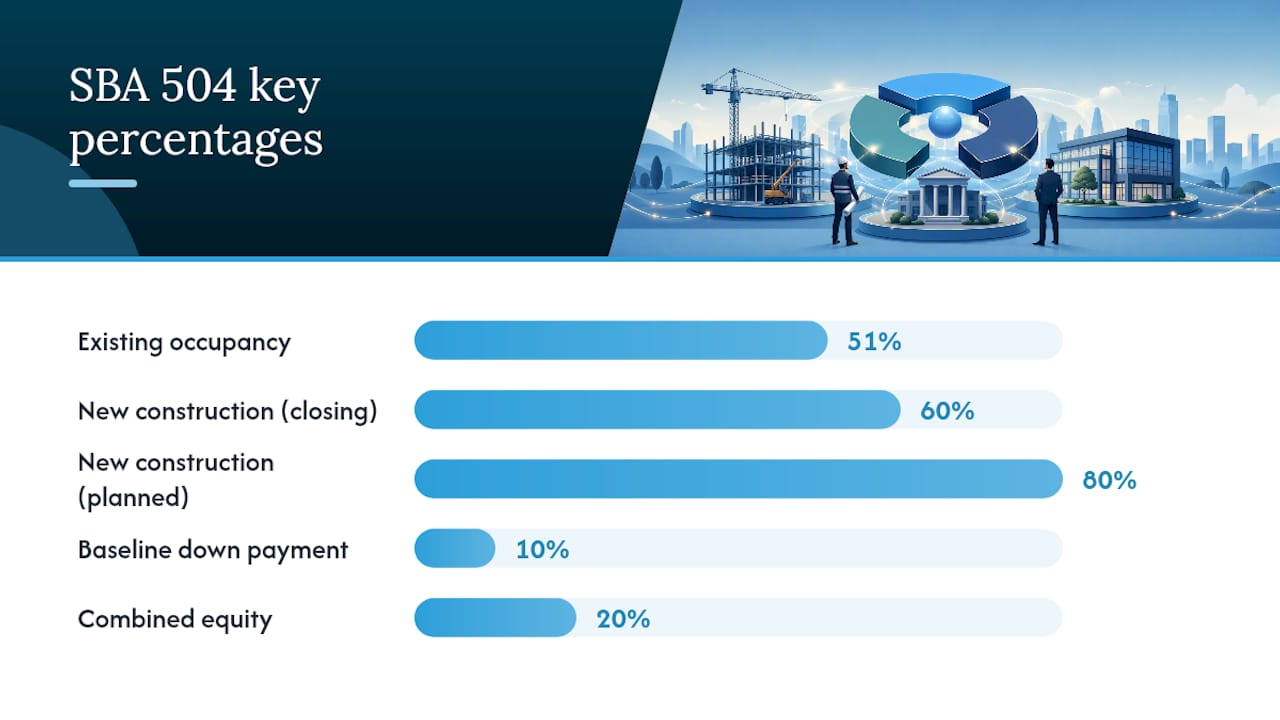
Down payment requirements can also climb above the 10% baseline. Startups (businesses less than two years old) and special-purpose properties, think car washes, hotels, or gas stations, commonly face 15% or higher equity requirements, and combining both factors can push equity to 20%.
What 504 will finance:
- New construction, ground-up builds, and major renovations
- Long-term equipment tied to the facility
- Soft costs like architectural and engineering fees
What it won’t touch:
- Working capital or inventory
- Speculative or investment real estate you don’t occupy
- Refinancing unrelated debt outside specific program rules
How Does the Construction-to-504 Financing Process Actually Work?
Here’s what surprises a lot of first-time 504 borrowers: you don’t get 504 financing during construction itself. You get it after.
The process runs in two stages. A bank carries an interim construction loan for the entire build, disbursing funds through a draw schedule tied to completed work, a mechanic construction finance guides describe in detail. You, your contractor, and the bank’s inspector sign off on each draw before money moves.
- Interim construction phase: The bank funds the build in stages, typically holding retainage until substantial completion.
- Certificate of occupancy (CO): Once the building passes final inspection and earns its CO, the permanent takeout process begins.
- CDC debenture funding: The CDC places the debenture, which pays off the bank’s interim construction balance and converts your project into permanent 504 financing, a workflow industry guides confirm is standard across most 504 construction deals.
You can structure this as a single closing (one set of documents covering both phases) or two separate closings. Single-close structures save on closing costs and paperwork but require the bank and CDC to coordinate eligibility and terms upfront. Two-close structures give more flexibility but mean paying closing costs twice.
Pro Tip: Ask your CDC about the gap between certificate of occupancy and debenture funding early. That window can run several weeks, and if you’re not prepared for the carrying cost, it can catch you off guard right when you’re trying to open your doors.
What Will This Actually Cost You?
Money is where the 504-versus-conventional decision gets concrete. Start with equity: a 504 deal typically asks for 10% down, while conventional construction lenders commonly want 20% to 30%, according to construction financing primers covering standard lender practice. On a $2 million project, that’s the difference between writing a $200,000 check and writing a $500,000 one.

Rate structure matters just as much as the down payment gap. The CDC debenture portion of a 504 loan is fixed for its full term, commonly structured across 10, 20, or 25 years, while the bank’s first-mortgage piece may carry its own fixed or variable terms subject to periodic resets, a structural distinction detailed in industry guides to the program. That fixed CDC piece is what makes 504 attractive for long-term cost certainty. A conventional construction loan that converts to permanent financing typically resets to market rates, which means your payment can shift with the broader rate environment.
Timeline-wise, budget for the interim construction period (project-dependent) plus a debenture funding window after CO that commonly runs several weeks. A 504 loan calculator can help you model blended payments once you know your project’s rough construction timeline.
Decision Checklist: 504, Conventional, or 7(a)?
Run your project against these criteria before you pick a lender.
Choose SBA 504 if:
- You plan to occupy at least 60% of a newly constructed building (or 51% of an existing one).
- Preserving cash matters more than closing speed.
- You want a fixed rate locked in for decades, not years.
- Your project size fits comfortably within practical CDC debenture caps.
Choose conventional or SBA 7(a) if:
- You need to close fast, before a purchase option expires or a contractor’s bid lapses.
- The project is speculative or investment property you won’t primarily occupy.
- You need working capital, inventory financing, or business acquisition costs bundled into the same loan, something 7(a) handles better than 504.
- Your occupancy plan realistically falls under the 504 thresholds.
Red flags that should send you toward the alternative route: a contractor unwilling to work with staged SBA draws, a business under two years old without extra equity to offer, or a timeline that can’t absorb a debenture funding window.
Why the CDC You Choose Actually Matters
The 504 program’s structure looks straightforward on paper. In practice, coordinating a bank, a CDC, and a construction timeline takes real expertise, and the CDC you work with directly affects how smoothly that coordination goes.
CDC New England has placed more than $2.3 billion in regional business financing over more than 70 years, working specifically with businesses across Massachusetts, Rhode Island, Vermont, New Hampshire, and Connecticut. That track record translates into practical value during a construction deal:
- Coordinating debenture placement so the CO-to-funding window doesn’t leave you carrying interim debt longer than necessary.
- Advising on occupancy percentage tracking before you break ground, not after.
- Offering down payment assistance for borrowers who need help hitting the equity requirement.
- Structuring specialized terms for veteran-owned businesses navigating their first commercial construction project.
A CDC that has closed hundreds of these deals catches eligibility pitfalls before they become closing delays.
Getting Started: Documents and Timing
Assemble these before you contact anyone:
- Three years of business and personal tax returns.
- Current profit and loss statement and balance sheet.
- A detailed project budget, including hard and soft construction costs.
- Your signed construction contract, plus your contractor’s license and bonding documentation.
Contact your bank and a CDC at the same time, not sequentially. Parallel conversations let both parties assess eligibility together, which shortens the overall process compared to bouncing between them one at a time. Expect several weeks for underwriting and approval, plus your construction period, plus the post-CO debenture funding window. Businesses new to the process routinely underestimate that last stretch. Building it into your budget now prevents a cash crunch later.
What Gets Overlooked in Most 504-vs-Construction Loan Comparisons
Most comparisons treat this decision as a pure interest-rate contest, and that framing misses the point. The real value of SBA 504 isn’t the rate itself, it’s what a fixed, long-term debenture does for your cash flow certainty over 20 or 25 years. A business that locks in predictable debt service can plan hiring, inventory, and expansion decisions without worrying about a rate reset derailing the budget three years in.
Where conventional advice falls short is treating the 504 timeline as a pure drawback. Yes, two closings and a debenture funding window take longer than a single conventional close. But that timeline exists because the program does real underwriting on occupancy and eligibility, the same rigor that protects you from overextending on a speculative build you can’t actually fill.
If you’re weighing this decision, prioritize your occupancy plan first, before you shop rates. A project that clearly hits the 60% new-construction threshold should lean 504. A project riding the edge of that threshold, or one with real speed pressure, deserves a harder look at conventional financing before you assume 504 is automatically the better answer.
— PHENYX
Ready to Finance Your Construction Project?
If the numbers above make the case for SBA 504, the next question is who helps you execute it.
A CDC lender has placed over $2.3 billion into regional businesses with fixed rates locked for up to 25 years on the debenture portion of SBA 504 loans. If your equity is tight, down payment assistance can help close the gap, and veteran-owned businesses have access to dedicated benefits built around their specific situation. Before you commit to a construction lender, run your numbers through the 504 loan calculator to see the blended payment on your actual project, then start a conversation about your SBA 504 construction financing options directly with the team.
Sources
- 504 loans - Small Business Administration
- Ecfr
- SBA Loan for Commercial Construction (2026) | FundMySBA
- AGC Guide to Construction Financing (AGC)


