A sale-leaseback and an SBA 504 loan solve different problems. A 504 loan helps you buy, build, renovate or refinance a fixed asset and keep owning it, with 10% down and a fixed rate on the largest piece of the loan. A sale-leaseback converts a building you already own into cash by selling it to an investor and renting it back. If your goal is to own your location for the long term, the 504 is built for that. If your goal is to pull out the most capital from property you hold and you accept becoming a tenant, a sale-leaseback is the tool.
This guide compares the two on ownership, proceeds, repayment, cost, risk and fit, so you can see where each belongs in your plan.
TL;DR
- Ownership: with an SBA 504 loan you own the property and build equity. With a sale-leaseback you sell the title and become a tenant.
- Proceeds: a sale-leaseback can monetize the full value of a property. A 504 loan finances a purchase, construction, equipment or qualified debt refinance, and is not a cash-out or working-capital product.
- Terms: 504 debentures run 10, 20 or 25 years at a fixed rate. Sale-leaseback leases often start at 15 to 25 years with extension options.
- Down payment: the 504 structure asks the borrower for 10%, and our Down Payment Assistance Program can help with that piece.
- Fit: buying or refinancing owner-occupied property points to the 504. Raising maximum capital from a building you already own is where a sale-leaseback comes in.
Table of Contents
- How each option works
- Side-by-side comparison
- Ownership and appreciation
- Proceeds and what you can spend them on
- Repayment terms and cost
- Risks and tax considerations
- Who qualifies for an SBA 504 loan
- When each option fits
- A worked example
- Our perspective
- How we can help
- FAQ
- Sources
How each option works
How an SBA 504 loan works
The 504 program provides fixed-rate, long-term financing for major fixed assets such as real estate and machinery, with a maximum loan amount of $5.5 million according to the SBA. The project is financed in three parts. A bank typically lends about 50% in a first-lien position. A Certified Development Company (CDC) like ours provides about 40% through an SBA-guaranteed debenture at a fixed rate. You contribute about 10%. Our guide to the 50/40/10 structure shows who pays what and when.
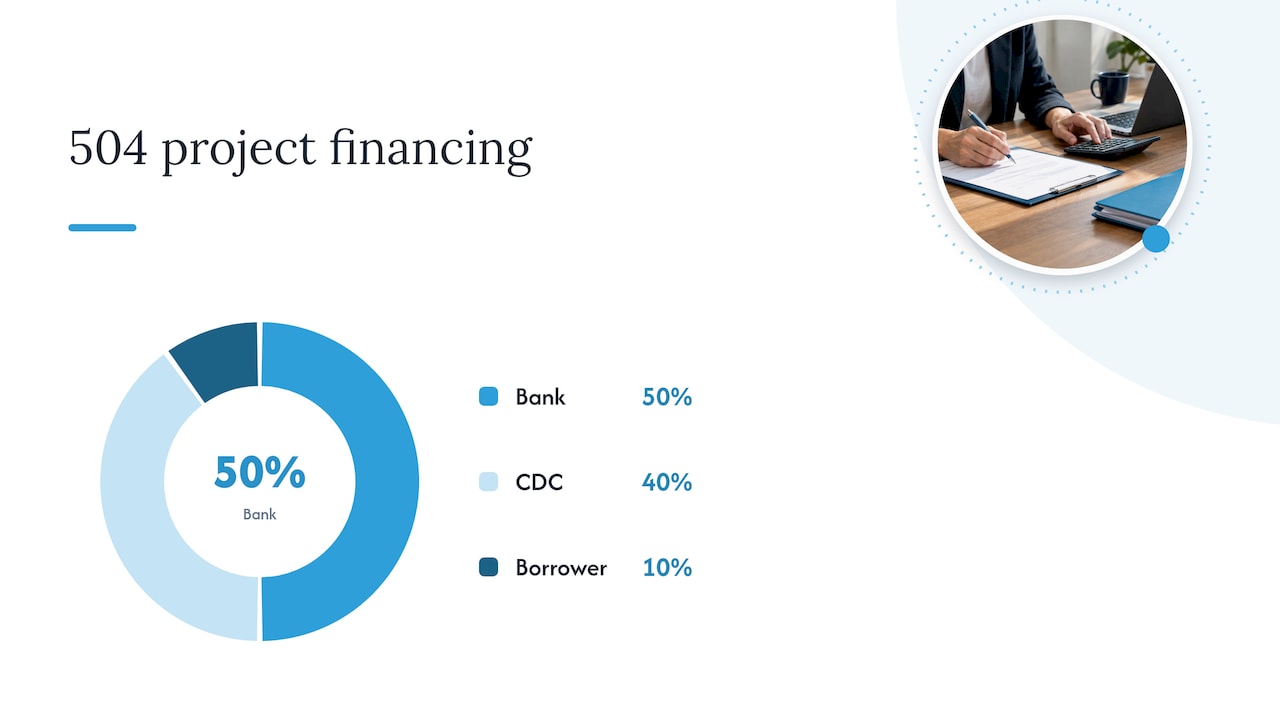
Because the CDC portion is fixed for up to 25 years and the down payment is modest, the 504 is designed to preserve your working capital while you acquire an asset you plan to keep.
How a sale-leaseback works
In a sale-leaseback, the seller-lessee sells the property to a buyer-lessor, who receives legal title and the seller’s promise to pay rent over a term of years. The seller receives immediate financing equal to the sale price and keeps beneficial use of the asset for the lease term. The buyer is usually an investor who wants a stable rental income stream from a tenant already operating in the building.
The lease is typically triple-net. The lessee keeps exclusive control of the property, can alter improvements and can sublet or assign, but remains responsible for the rent throughout the term. Taxes, insurance and maintenance fall on the tenant as well, which shields the investor from swings in those operating costs.
Side-by-side comparison
| Factor | SBA 504 loan | Sale-leaseback |
|---|---|---|
| Who holds title | You | The investor-buyer |
| Typical use | Buy, build or renovate real estate, buy long-life equipment, refinance qualified debt | Release the value of property you already own |
| Down payment | About 10% of the project | None, because you are selling |
| Share of value accessed | Finances the project, with the bank and CDC covering roughly 90% | Can monetize the full property value |
| Term | 10, 20 or 25 years | Often 15 to 25 years plus extension options |
| Rate or rent | Fixed on the CDC portion | Rent set in the lease, often with escalations |
| Appreciation | Yours | Passes to the buyer |
| Property costs | You pay as owner | Tenant pays under a triple-net lease |
The rest of this article explains the rows that matter most.
Ownership and appreciation
With a 504 loan, you are the owner. Every principal payment builds equity, and any increase in the property’s value belongs to you. You can also depreciate the building and deduct interest as the tax rules allow, which you should review with your CPA.
With a sale-leaseback, you receive cash and give up the title. A CommercialSearch analysis of the current market describes the trade-off as permanent: you give up future appreciation and accept a long-term occupancy obligation. For a business that sees its building as a core asset, such as a manufacturer, a medical practice or a distributor with specialized space, that trade deserves a hard look.
Proceeds and what you can spend them on
This is where the two products differ most.
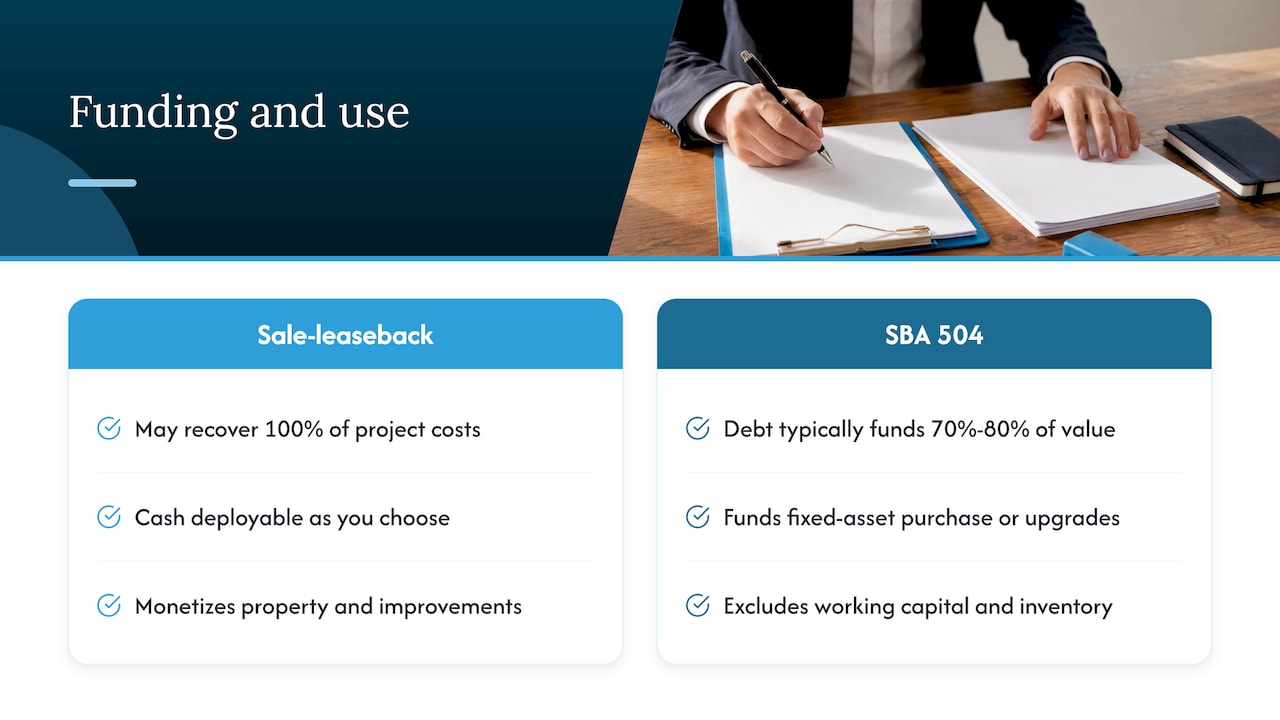
In a sale-leaseback, the entire value of the property and improvements can be monetized, so a seller may recover 100% of acquisition and development costs, including soft costs, while debt financing typically lands at 70% to 80% of value. Once the sale closes, the cash is generally yours to deploy as you choose.
An SBA 504 loan is more focused. Proceeds go to the purchase, construction or renovation of existing buildings or land, long-term machinery and equipment with a remaining useful life of at least 10 years, and refinancing of qualified debt. They cannot fund working capital, inventory, or speculation or investment in rental real estate.
So the question to ask first is simple: do you need to acquire or improve a fixed asset, or do you need general-purpose cash from an asset you already own? If it is the first, the 504 fits directly. If it is the second, a sale-leaseback is one route, and our SBA 504 refinance option is another when the goal is to restructure qualified debt on property you keep.
Repayment terms and cost
The 504 side
SBA 504 repayment terms are 10, 20 and 25 years, with rates pegged to an increment above the current market rate for 10-year U.S. Treasury issues. Our published fixed rates on the CDC portion, as listed on our site in September 2026, are:
- Equipment, 10-year fixed: 6.58%
- Real estate, 20-year fixed: 6.73%
- Real estate, 25-year fixed: 6.77%
Rates move with the market, so confirm the current figures on our rates page before you plan around them. Our overview of 10, 20 and 25 year 504 terms explains which term suits which asset.
Because the CDC portion is fixed for its full term, your payment on that 40% does not change. The bank’s first-lien portion can be structured differently, so ask your lender how that piece is set up and what happens at its maturity, and build that into your long-term projections.
The sale-leaseback side
Typical leases have initial terms of 15 to 25 years with several options to extend, and some allow extensions of up to an additional 50 years. Your cost is the rent, plus the triple-net expenses you already pay as an owner. When you compare the two, line up the following:
- Annual rent versus annual debt service on your 504 structure.
- Escalation clauses in the lease versus the fixed 504 payment.
- Property taxes, insurance and repairs, which you carry under either structure.
- What you give up: appreciation and, at lease end, control of the space.
The CommercialSearch piece notes that a sale-leaseback suits a business needing maximum proceeds whose credit and lease term can support a 10 to 15-year NNN commitment. That commitment is the number to stress-test against your cash flow.
Risks and tax considerations
A sale-leaseback is a tax-sensitive transaction. Academic review of the topic finds that sale-leasebacks with business reasons beyond tax deductions are more likely to be respected for tax purposes, which is why careful planning matters. The Supreme Court’s Frank Lyon decision held that tax treatment should respect a genuine transaction with economic substance and real attributes of lessor status. Before you sign a sale-leaseback, have a tax attorney or CPA review how the sale gain, the rent deduction and any depreciation recapture would be treated for your entity.
The key risks on the sale-leaseback side are the long occupancy commitment, rent escalations and loss of appreciation. On the 504 side, the key considerations are the down payment, owner-occupancy requirements and the need to plan for the bank loan’s maturity. Neither is a surprise when you plan for it, and our team walks borrowers through that planning.
Who qualifies for an SBA 504 loan
Eligibility requires an operating, for-profit U.S. business that is small under SBA size standards and not otherwise ineligible. The property is expected to be primarily occupied by your business. Our guide to 504 requirements in New England covers the details region by region.
A 504 loan may also repay or refinance debt that qualifies under 13 CFR 120.882. If you own your building and carry a shorter-term or higher-cost loan on it, refinancing may let you lock a fixed rate for up to 25 years while keeping title. Our walkthrough on refinancing commercial real estate with a 504 loan shows the steps. When you are weighing several financing routes for property, it also helps to see how DSCR loan costs are modeled, so every option is compared on the same footing.
When each option fits
A 504 loan tends to fit when you:
- are buying a building or land for your own operations;
- want to keep the appreciation and build equity;
- are purchasing equipment with at least a 10-year useful life;
- want a fixed payment for up to 25 years on most of the loan;
- own property with qualified debt you would like to restructure.
A sale-leaseback tends to fit when you:
- already own the property and need the highest possible cash release;
- are comfortable renting the space for 10 to 15 years or longer;
- do not need the real estate as a long-term equity holding;
- have credit strong enough to support a long triple-net lease.
There is also a middle path some owners consider: restructuring existing property debt through a 504 refinance to improve cash flow while keeping the asset. Our comparison with conventional loans shows how the 10% down structure stacks up against standard bank terms, and our 504 vs 7(a) guide covers the other major SBA option.
A worked example
Consider a hypothetical Rhode Island machine shop that wants a $2,000,000 building for its own use. The numbers are illustrative only, not a quote.
Under a 504 structure, the bank would cover roughly $1,000,000, the CDC roughly $800,000 and the company roughly $200,000 as its 10% down payment. The company owns the building from day one, and the CDC portion carries a fixed rate for its term.
Now take the same shop several years later, owning that building outright and needing cash for a second location. A sale-leaseback could release the value of the building, in exchange for rent and the loss of ownership. A 504 loan on the new location, with a similar 10% down structure, would keep the first building in the company’s hands. Which path wins depends on how much the shop values equity and appreciation against the speed and size of the cash release.
Our perspective
We see the same pattern with New England owners again and again. The business that plans to stay in its building for decades usually wants to own it, and the 504 is the program built for that. A 10% down payment, a fixed rate for up to 25 years and the chance to refinance qualified debt let owners keep their equity and keep their working capital in the business.
A sale-leaseback has a legitimate place, but it transfers the long-term value of the property to someone else. We prefer to start with a different question: can you reach your goal while keeping the asset? With our Premier Certified status, our focus on regional borrowers and programs such as down payment assistance and VetLoan Advantage, we aim to make ownership reachable for more of them.
If you are weighing the two, bring us the building, the debt and the plan, and we will map the 504 structure against your numbers.
PHENYX
How we can help
CDC New England has more than 70 years of experience and has invested more than $2.3 billion in regional businesses. We offer SBA 504 loans for commercial real estate and equipment, a refinance program for existing debt, a Down Payment Assistance Program for the 10% contribution, and the VetLoan Advantage Program for veterans and their spouses, which lists a 1.0% processing fee.
If you are choosing between owning and selling your location, start with the current rates and programs at cdcnewengland.com and talk with our team about your project. Our guide to the down payment on an SBA 504 loan is a good place to size your contribution first.
FAQ
Can an SBA 504 loan replace a sale-leaseback?
In many cases, yes, when your goal is to buy a property or refinance qualified debt on one you own. The 504 is not a working-capital loan, though, because proceeds are limited to fixed assets and qualified debt refinancing. If you need general-purpose cash, discuss the structure with your CDC and your tax adviser.
Do I give up ownership with a 504 loan?
No. You hold title to the property and the bank and CDC hold liens that are released as you repay. Equity builds with each payment, and appreciation remains yours.
How long is a sale-leaseback lease compared with a 504 term?
Sale-leaseback leases commonly start at 15 to 25 years with extension options. SBA 504 debentures run 10, 20 or 25 years. The difference is that the 504 term ends with you owning the property free of those loans, while the lease ends with you still a tenant.
Does a sale-leaseback have tax implications?
Yes. The sale can trigger a taxable gain, and the rent deduction depends on the transaction being respected as a true sale and lease. Review the structure with a tax attorney or CPA before you commit.
Sources
- 504 loans, U.S. Small Business Administration
- Sale-Leasebacks: A Search for Economic Substance, Indiana Law Journal
- Sale-Leasebacks: Cash Out but Keep Control, Mintz
- Sale-Leasebacks: Cash Out but Keep Control, CFO.com
- Sale-Leaseback or Commercial Loan: Which Path Works Best, CommercialSearch
- Federal Tax Implications of Sale-Leaseback Transactions, Georgia State University