For most borrowers, the SBA 504 down payment is 10% of the project cost. It rises to 15% if your business has operated for two years or less or if you are buying a limited- or single-purpose building, and to 20% if both apply. That percentage is your equity in the deal. The rest is split between a bank and a Certified Development Company (CDC), which is why a 504 often needs far less cash up front than a conventional commercial loan.
Cdcnewengland
Plan Your SBA 504 Down Payment
CDC New England provides SBA 504 financing for commercial real estate and equipment, with a 10% down payment requirement.
TL;DR
Table of Contents
The standard SBA 504 down payment: 10%
The rule sits in the SBA’s regulations. Under 13 CFR 120.910, the borrower contribution is at least 10% of project cost, excluding administrative costs, in all situations not covered by the higher-equity rules. Most established businesses buying an owner-occupied building or heavy equipment fall into this category.
“Project cost” is broader than a purchase price. It generally includes what you pay for the property or equipment plus related costs such as closing costs, and construction or renovation where those are part of the plan. Ask your CDC to build the full project budget early, because your 10% is calculated on that total and not on the contract price alone.
How the 10% fits in the capital stack
A 504 loan is a partnership. The SBA describes a typical project as a private-sector first-lien loan covering up to 50% of project cost, a CDC/SBA junior-lien loan covering up to 40%, and at least 10% borrower equity, according to SBA’s lender guidance. The regulation describes the same arrangement: a Third Party Loan for the balance, and a CDC debenture of up to 40% of project costs plus certain administrative costs, as laid out in Subpart H of Part 120.
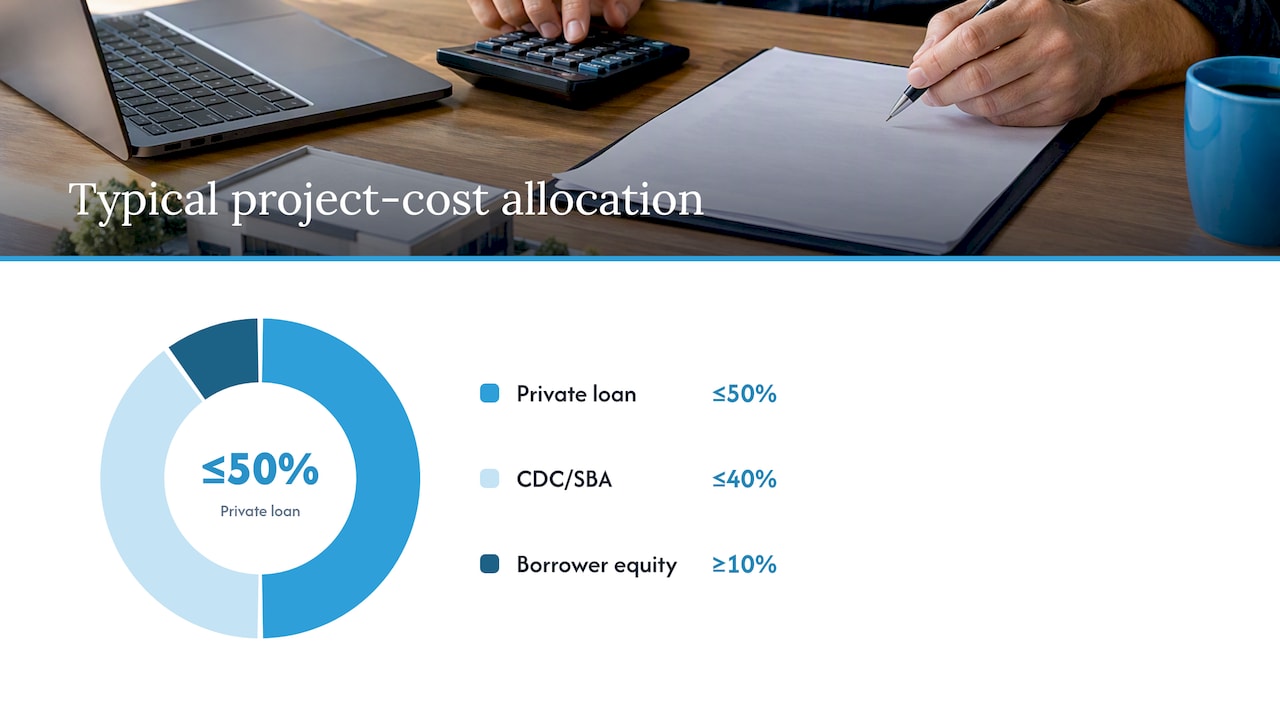
We walk through who funds what, and when, in our guide to the 50/40/10 SBA 504 structure.
A worked example
Say you are buying a building and doing modest improvements, and the CDC and your bank agree the total project cost is $2,000,000. These figures are illustrations of the arithmetic, not a quote.
ComponentShareAmountBank first-lien loan50%$1,000,000CDC/SBA junior-lien loan40%$800,000Your down payment10%$200,000
Compare that with a conventional loan that asks for 20% to 30% down on the same building. On a $2,000,000 project, a 25% down payment would be $500,000, which is $300,000 more cash tied up in the property instead of staying in your business.
When the down payment is 15% or 20%
The regulation adds equity when the lender and the SBA see more risk. The two triggers are:
These tiers come straight from 13 CFR 120.910.
SituationMinimum down paymentOn a $2,000,000 projectEstablished business, general-use property or equipment10%$200,000Business operating two years or less15%$300,000Limited- or single-purpose building15%$300,000New business and single-purpose building20%$400,000
As equity rises, the CDC share of the structure shrinks to keep the total at 100%. On the 20% example, the bank and CDC together fund $1,600,000 instead of $1,800,000.
What counts as a new business
The SBA’s current procedural notice, Procedural Notice 5000-872764, treats a business operating two years or less at loan approval as a New Business. It also says a longer-established company may be treated as new after a change of ownership that brings new, unproven ownership or management and added debt unrelated to operations. In that case, the CDC must review management and debt levels to decide whether an additional 5% borrower contribution is needed.
If you are buying an existing company and its real estate together, raise this with your CDC before you commit to a purchase price. The equity you need can change the deal.
What counts as a special-purpose property
The regulation uses the phrase “limited- or single-purpose building.” Think of facilities built or fitted for one particular use, where converting to another business would be costly. Whether your property qualifies is a judgment made during underwriting, so describe the building to your CDC early and ask how it will be classified.
Startups are not shut out. Our article on SBA 504 for startups covers how newer companies pair a 504 with other SBA financing.
What can count toward your down payment
The contribution is not limited to cash from your checking account. According to the regulation’s section on the borrower’s contribution, it may consist of:
The same section says the contribution may come from a CDC or another source, with the exception of an SBA business-loan program, subject to a separate SBIC exception in 13 CFR 120.913. It also allows you to borrow the contribution from the CDC or a third party. If that loan is secured by project assets, it must be subordinate to the 504 liens, and it cannot be repaid faster than the 504 loan without SBA approval.
Land you already own
If you bought the lot last year and now want to build, the land can serve as equity. This is a common route for owners who have held a site for a while. Have the land valued and talk to the CDC about how it will be credited before you break ground.

Borrowed down payments
Borrowing part of your equity is permitted, but the conditions matter. A lender who takes a lien on the project assets has to accept a junior position, and the repayment schedule cannot outpace the 504 loan itself. Anyone offering you a second loan for your equity should be able to confirm both points in writing. Keeping personal and business funds clearly separated also makes it easier to document where your cash came from, and how personal and business accounts affect loans is worth a look when you assemble your records.
Optional extra injection
SBA’s 504 loan authorization guidance separates the required project equity from an optional additional borrower injection, meaning money beyond the required amount. You are free to put in more than the minimum, but it is a choice, not a rule.
Our perspective: put the cash where it works hardest
At CDC New England, we have spent more than 70 years financing growth in New England, and we have invested over $2.3 billion in regional businesses. The pattern we see most is this: owners who could technically afford a 25% down payment on a conventional loan often should not spend it that way. Cash that stays in the business pays for inventory, hiring, marketing and the surprises that follow a move.
That is the practical value of the 10% structure. It preserves working capital while giving you a fixed rate and a long term on the CDC portion. When a project lands in the 15% or 20% tier, we encourage owners not to read it as a rejection. It is a structural requirement, and we help you plan for it: with the right timing, land contributions, or support from our Down Payment Assistance Program, the gap is usually something you can manage.
The mistakes we see are avoidable. Owners calculate 10% on the purchase price and forget closing and improvement costs. Owners buy a company without asking whether the change of ownership triggers the new-business tier. And owners wait until the contract is signed before they talk to a CDC. A short call at the start of the search saves weeks later.
Helping with the down payment
If the equity requirement is what stands between you and a building, ask us about our Down Payment Assistance Program. It is designed for commercial property acquisitions where the borrower’s contribution is the sticking point.
Veteran business owners and their spouses can also look at our VetLoan Advantage Program, which lists a 1.0% processing fee. Our published fixed rates, last read from our site in September 2026, are 6.58% for the 10-year equipment loan, 6.73% for the 20-year real estate loan and 6.77% for the 25-year real estate loan. Rates move, so confirm today’s figures on our home page or with our team. If you already own the property and carry higher-cost debt, our SBA 504 Refinance Program is the place to start.
How the down payment affects your terms and size
The equity requirement works alongside the program’s size and term limits. SBA’s 504 page describes long-term, fixed-rate financing for major fixed assets and states a maximum loan amount of $5.5 million. The agency’s lender guidance lists loan sizes of $25,000 to $5.5 million, with 25-year maturities for real estate and 10-year maturities for equipment. The regulation separately says a 504 loan must not be less than $25,000.
That same section generally limits the 504 loan to 40% of total project cost plus 100% of eligible administrative costs. SBA may authorize up to 50% of project costs for good cause, and no more than 50% of eligible project costs may come from federal sources. If you want to see how larger projects reach the program ceiling, read our explanation of the combined SBA cap.
For equipment, the shorter 10-year term matches the useful life of the asset. For the choice between a 504 and other equipment financing, see our comparison of 504 and equipment loans.
Steps to plan your down payment
If your project is in Rhode Island, our Rhode Island 504 guide covers the local picture.
FAQ
What percent down payment do I need for an SBA 504 loan?
Most projects need at least 10% of project cost, excluding administrative costs. Your percentage rises to 15% for a business operating two years or less or for a limited- or single-purpose building, and to 20% if both apply. Your CDC confirms which tier fits during underwriting.
Can I use a gift, a loan, or land for the down payment?
Often yes. The contribution can be cash, acceptable property obtained with cash, or project land, and it may be borrowed from a CDC or a third party. A loan secured by project assets must be subordinate to the 504 liens and cannot be repaid faster than the 504 loan without SBA approval. SBA business-loan programs cannot be the source.
Is the down payment calculated on the purchase price?
No, it is calculated on total project cost, excluding administrative costs. That figure can include closing costs and improvements in addition to the price. Build the full budget with your CDC before you estimate your cash needs.
Does buying an existing business change the down payment?
It can. SBA’s current procedural notice says a longer-established business can be treated as new after a change of ownership that brings unproven management and added debt. The CDC then reviews whether an additional 5% contribution is necessary.