If you run a business in Rhode Island and you have been writing a rent check for years, ownership may be closer than the numbers suggest. SBA 504 loans in Rhode Island let business owners buy, build, or renovate owner-occupied commercial property with as little as 10 percent down, at a rate fixed for as long as 25 years. Very little else in the commercial market combines a low equity requirement with that kind of payment certainty.
This guide walks through how the program actually works on the ground: the 50/40/10 structure, the eligibility rules as they stand in 2026 including this year's ownership changes, what 504 proceeds can and cannot cover, how the fixed rate gets set each month, the fees you should budget for, and the third-party report details that quietly delay more projects than any credit issue. It is written for both business owners weighing a purchase and the bankers who refer them.
Quick Summary
- SBA 504 loans finance owner-occupied commercial real estate and long-term equipment for Rhode Island small businesses with as little as 10 percent down.
- The standard structure is 50/40/10: a bank or credit union funds 50 percent in first position, a Certified Development Company funds 40 percent through an SBA-guaranteed debenture, and the borrower contributes 10 percent.
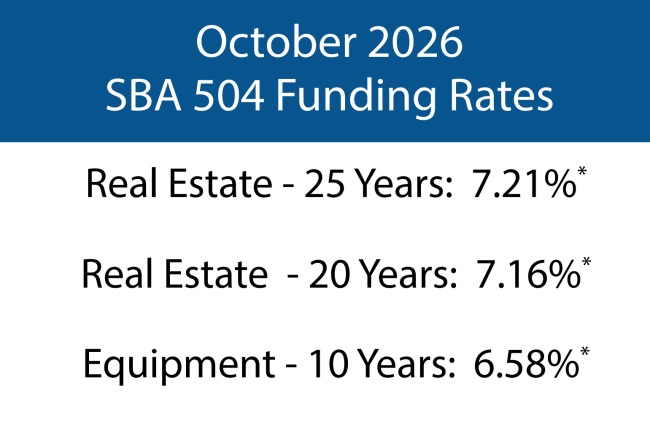
- The CDC portion is fixed for the full 10, 20, or 25 year term with no balloon and no rate resets. Rates are set at a monthly debenture sale, so they move month to month.
- The maximum CDC debenture is $5 million, or $5.5 million for small manufacturers and certain energy projects. Effective July 4, 2026, a borrower can hold up to $10 million combined across the SBA 7(a) and 504 programs.
- You must occupy at least 51 percent of an existing building, or 60 percent of a building you construct.
- Eligibility requires a for-profit business with tangible net worth under $20 million and average net income under $6.5 million after federal taxes for the prior two fiscal years. If you exceed these amounts, there are alternative size standards. As of March 1, 2026, all direct and indirect owners must be U.S. citizens or U.S. nationals whose principal residence is in the United States, its territories, or possessions.
- 504 proceeds cannot fund working capital, inventory, or goodwill. The separate 504 refinance program can replace existing fixed-asset debt and, in some cases, free up cash.
- Rhode Island projects are supported by SBA's Rhode Island District Office in Providence and delivered through a CDC licensed to lend in the state.
What Is an SBA 504 Loan?
An SBA 504 loan is long-term, fixed-rate financing for major fixed assets, most often owner-occupied commercial real estate or heavy equipment. A bank or credit union provides a conventional first mortgage covering roughly half the project. A Certified Development Company provides a second-position loan for up to 40 percent, funded through a debenture guaranteed by the U.S. Small Business Administration. The business contributes as little as 10 percent. The CDC portion is fixed for the life of the loan, so there is no balloon payment and no rate reset in year five or year ten.
The program exists to promote business growth and job creation, which is why it is restricted to fixed assets and to businesses that occupy the property they finance. It is not a general-purpose business loan.
How the 50/40/10 Structure Works in a Rhode Island Deal
Three parties fund one project, and each has a different job.
- Bank or credit union first mortgage, typically 50 percent of the project. Held in first lien position. The bank sets its own rate and term, which may be fixed or variable.
- CDC debenture, up to 40 percent of the project. Held in second lien position and guaranteed by SBA. Fixed for the full term.
- Borrower equity, 10 percent in most cases. Your cash or existing equity contribution to the project.
The structure works because each participant takes a risk it is comfortable with. The bank ends up at roughly 50 percent loan-to-value in first position, which is conservative enough to clear most credit policies without an exception. The borrower keeps cash in the business instead of putting 25 or 30 percent down, which is closer to what conventional commercial financing usually requires.
Worked example: a $1.5 million Warwick industrial building
Assume a growing distributor buys a $1.5 million building and needs $100,000 of interior work, for a total project cost of $1.6 million. The financing breaks down as follows:
- Bank first mortgage at 50 percent: $800,000
- 504 debenture at 40 percent: $640,000
- Borrower equity at 10 percent: $160,000
- Total project cost: $1,600,000
Conventional financing on the same building at 75 percent loan-to-value would have required roughly $400,000 down. The 504 structure frees up about $240,000 that stays in the business. Eligible soft costs such as the appraisal, environmental reports, title work, and certain construction period interest can usually be rolled into the total project cost rather than paid out of pocket.
This example is an illustration of how the structure works, not a quote. Actual eligible project costs and equity depend on the property, the business, and underwriting.
SBA 504 Loan Requirements in Rhode Island
To qualify, your business generally must:
- Operate as a for-profit entity located in the United States
- Have tangible net worth of no more than $20 million
- Have average net income of no more than $6.5 million after federal income taxes for the two fiscal years before application. If exceeded, there are alternative size standards.
- Occupy at least 51 percent of an existing building, or 60 percent of new construction
- Show the ability to repay from business cash flow
- Have qualified management experience and a workable business plan
- Support job creation or retention, or meet one of SBA's community development or public policy goals
- Be owned entirely by U.S. citizens or U.S. nationals whose principal residence is in the United States, its territories, or possessions
Nonprofits, passive real estate holdings, and speculative ventures are not eligible. Businesses that earn a third or more of gross income from packaging SBA loans are also excluded.
The 2026 ownership rule change
This one has caught several deals off guard. Effective March 1, 2026, SBA requires 100 percent of all direct and indirect owners of an applicant to be U.S. citizens or U.S. nationals with a principal residence in the United States, its territories, or possessions. The prior narrow allowance for up to 5 percent foreign or non-resident ownership was rescinded, and lawful permanent residents are no longer eligible to hold any ownership interest in an applicant, operating company, or eligible passive company.
If your ownership structure includes a green card holder or a partner living abroad, raise it in the first conversation rather than at underwriting. Conventional commercial financing remains available and is often the right path in that situation. In some cases, the non-U.S.Citizen owner can divest.
Owner-occupancy in practice
Occupancy is measured on usable square footage, and it is an ongoing obligation, not a one-time test at closing.
- Existing building: occupy at least 51 percent. You may lease out up to 49 percent.
- New construction: occupy at least 60 percent immediately. You may permanently lease out 20 percent, and temporarily lease another 20 percent with the intent to occupy some of that space within three years and 80% within ten years.
- Eligible passive company structures: a real estate holding entity may own the property and lease it to your operating company, provided the lease and rent meet SBA requirements.
A common misstep is buying a building, selling the operating business a few years later, and keeping the property as a rental. That can put the loan out of compliance. Talk to your CDC before restructuring.
Job creation and public policy goals
Each 504 project needs to support job creation or retention, measured against a dollar-per-job benchmark SBA sets and updates periodically. If a project does not hit that benchmark, it can still qualify by meeting one of SBA's community development or public policy goals, which cover categories such as revitalizing a business district, expanding exports, energy reduction, and support for veteran-owned, woman-owned, or minority-owned businesses. Your CDC runs this calculation. It is rarely the obstacle borrowers expect it to be.
How Much Down Payment Do You Actually Need?
Ten percent is the headline number, and it applies to most projects. Two factors can raise it:
- 10 percent. An established business buying general purpose property.
- 15 percent. Either a startup, generally meaning under two years in operation, or a special purpose property.
- 20 percent. Both a startup and a special purpose property.
Special purpose properties are those built for a single use and hard to repurpose. Common examples include hotels, gas stations, car washes, bowling alleys, self-storage, and certain medical or food processing facilities. Rhode Island's hospitality and marine service sectors produce a fair number of these, so it is worth confirming the classification early.
In a refinance, equity you already hold in the property can typically count toward the equity requirement, which means many refinances require no new cash.
SBA 504 Loan Rates and Terms in 2026
The 504 debenture rate is set at a monthly sale, priced at a spread above U.S. Treasury yields. The rate you get is the rate locked when your debenture funds, and it stays fixed for the entire term.
A few mechanics worth understanding:
- Terms available. 10, 20, and 25 years, fully amortizing. Real estate typically uses 20 or 25 years, and equipment typically uses 10.
- Funding cadence. 20 and 25 year debentures fund every month. Ten year debentures fund every other month, which can affect timing on equipment-only projects.
- Effective rate. The rate quoted to borrowers usually includes the ongoing SBA guarantee fee, the CDC servicing fee, and the central servicing agent fee, so it is higher than the raw debenture coupon. Ask whether a quote is a debenture rate or an all-in effective rate before comparing.
- The bank's half. The first mortgage is priced independently by your bank or credit union and may be fixed or variable with its own term and any balloon it chooses.
Because rates reset monthly, do not rely on a figure you read in an article. Current SBA 504 rates for New England are published and updated on the CDC New England rates page, and any CDC can give you a same-day quote.
What SBA 504 Loans Can and Cannot Finance
Eligible uses:
- Purchasing land and existing buildings
- Ground-up construction
- Renovations, expansions, and building improvements
- Leasehold and tenant improvements to space your business occupies
- Long-term machinery and equipment with a remaining useful life of at least 10 years
- Furniture and fixtures tied to the project
- Eligible soft costs, including appraisals, environmental reports, title, legal, architectural and engineering fees, and certain construction period interest
- Refinancing qualifying fixed-asset debt through the 504 refinance program with or without cash out.
Not eligible:
- Working capital or general operating expenses in a standard 504 project
- Inventory
- Goodwill or intangibles in a business acquisition
- Investment or rental real estate held for income
- Debt refinancing outside the specific 504 refinance rules
- Vehicles and equipment with a short useful life
SBA 504 vs SBA 7(a) for Rhode Island Commercial Real Estate
Both programs finance real estate, and Rhode Island borrowers are often quoted both. They solve different problems.
- Best use. The 504 is built for owner-occupied real estate and long-term equipment. The 7(a) is built for working capital, business acquisition, and mixed needs.
- Structure. A 504 combines a bank first mortgage, a CDC debenture, and borrower equity. A 7(a) is a single loan from one lender carrying an SBA guarantee.
- Rate on the SBA portion. The 504 debenture is fixed for the full term. The 7(a) is commonly variable and tied to prime.
- Maximum SBA piece. The 504 debenture caps at $5 million, or $5.5 million for small manufacturers and certain energy projects. The 7(a) caps at $5 million.
- Total project size. The 504 is effectively uncapped, because the bank's 50 percent share is not limited by SBA. A 7(a) project is capped by the loan amount.
- Typical equity. 10 percent on a 504. On a 7(a), 10 percent and up depending on the use of proceeds.
- Working capital. Not eligible under the 504. Eligible under the 7(a).
One meaningful change this year: effective July 4, 2026, SBA doubled the cumulative limit a single borrower and its affiliates can hold across both programs, from $5 million to $10 million. A business can now carry up to $5 million in 7(a) balances and up to $5 million in 504 balances at the same time. In practice that means a Rhode Island manufacturer can finance a facility with a 504 loan and still access a 7(a) loan for working capital or an acquisition, a combination that was largely blocked before. SBA set this out in Policy Notice 5000-879058. In addition, manufacturers and certain energy efficiency projects can do up to $5.5 million per project with no limit on how many projects can be done.
Refinancing Existing Commercial Debt with the 504 Program
Many Rhode Island owners already hold the building and are staring at a balloon payment or a rate reset on a loan written in a very different market. The 504 refinance program addresses exactly that.
Two paths exist:
- Refinance without expansion. Replace qualifying commercial mortgage or equipment debt with long-term fixed-rate financing. In some cases the transaction can also fund eligible business expenses, which puts working capital back on the balance sheet.
- Refinance with expansion. Fold existing qualified debt into a project that also includes new acquisition, construction, or improvement.
A November 2024 final rule loosened several constraints, raising loan-to-value limits, reducing the share of the original debt that must have been used for fixed assets, and easing the benefit test the transaction has to satisfy. The specifics are detailed and they change, so treat any figure you find online as a starting point and confirm the current parameters with your CDC against your actual note and appraisal.
The refinance program has its own eligibility criteria, including minimum seasoning on the existing debt and a payment history requirement. If your loan matures in the next 18 months, start the conversation now.
SBA 504 Fees: What to Budget
SBA reviews 504 fees annually and publishes a schedule for each federal fiscal year, which runs October 1 through September 30. For fiscal year 2026, covering loans approved between October 1, 2025 and September 30, 2026:
- Most 504 loans carry a 0.50 percent upfront guarantee fee and an annual service fee of 0.209 percent of the outstanding balance.
- Loans under the 504 Debt Refinance Without Expansion program carry a slightly higher annual service fee of 0.2115 percent.
MPORTANT: For 504 loans to certain qualifying businesses, SBA is waiving both the upfront guaranty fee and the annual service fee – this includes loans made under 504 Debt Refinance with Expansion option and 504 Debt Refinance without Expansion program. This includes –
- Manufacturers – NAICS Codes 31, 32, 33
- Food supply chain – NAICS Codes 1111, 1112, 1113, 1121, 1122, 1123, 1124, 1125, 1129, 1141, 1151, 1152, 423820, 4244, 4245, 424910, 445110, 484220*, 484230*, 493120, 493130
* NAICS 484220 and 484230 are limited to refrigerated and frozen trucking, farm products, grain products, and livestock - Businesses Located in a Rural Area – NADCO will coordinate with SBA to clarify how the agency defines a “rural area” for purposes of this requirement and will provide additional guidance to the industry in a future communication
On top of SBA's fees, expect a CDC processing fee, a funding fee, underwriters' fees, and closing costs. Most of these are financed into the debenture rather than paid in cash at closing, which is one reason the 10 percent equity figure holds up in practice.
Two cautions. First, fee schedules are set by fiscal year, so always confirm the schedule in effect for the year your loan will be approved rather than assuming last year's numbers carry over. Second, the manufacturing fee waiver is a fiscal year program. If you are a manufacturer, ask where your project sits relative to the current fiscal year deadline.

How to Apply for an SBA 504 Loan in Rhode Island
- Call a CDC before you sign anything. A short conversation confirms occupancy, size, and ownership eligibility, and can save you a deposit on a property that will not qualify.
- Loop in your bank or credit union. The 504 needs a first mortgage lender. If you already bank locally, start there. A CDC can also introduce you to participating Rhode Island lenders.
- Assemble financials. Three years of business tax returns, interim statements, a debt schedule, personal financial statements for owners of 20 percent or more, and three years of personal returns.
- Get the property under agreement. Build enough time into the purchase and sale agreement for the appraisal and environmental work. Thirty days is usually not enough on a commercial deal.
- Underwriting and SBA authorization. The CDC underwrites the debenture and secures SBA approval. CDCs with Premier Certified Lender status can approve 504 loans unilaterally, which removes the SBA review queue from the timeline.
- Third-party reports. Appraisal and environmental investigation are ordered here. See the appraisal section below, because this is where avoidable delays happen.
- Close the bank loan and interim financing. The bank closes its first mortgage. Because the debenture funds after closing, the project usually needs interim or bridge financing on the SBA portion.
- Debenture funds at the monthly sale. The 504 loan funds, the interim financing is repaid, and your fixed rate is set.
Most 504 real estate projects run roughly 60 to 90 days from a complete application to closing. Construction projects and deals waiting on environmental follow-up take longer.
Appraisal Requirements That Delay Rhode Island 504 Projects
Appraisals are where otherwise clean deals lose two or three weeks. The report has to satisfy SBA, not just the bank, and an appraiser who has never done a 504 assignment will frequently miss a required element. Send these requirements to the appraiser at engagement rather than after the draft comes back.
Commercial real estate appraisal requirements
- Address. Must match the address on the SBA Authorization exactly, including the number of parcels and the unit number for a condominium.
- Approaches to value. Must include at least two of the three recognized approaches to value.
- Intended users. Must name the CDC and the U.S. Small Business Administration as intended users.
- Occupancy. Must state the exact owner-occupancy percentage of usable square footage, supporting at least 51 percent, or 60 percent for new construction or substantial renovation.
- Remaining useful life. Must state remaining useful or economic life of at least 25 years.
- Purchase price. Must match the purchase and sale agreement.
Equipment appraisal requirements
- Value basis. Must state the in-place fair market value of the subject equipment.
- Inspection. The appraiser must physically inspect the equipment.
- Remaining useful life. Must state remaining useful or economic life of at least 10 years.
- Intended users. Must name the CDC and the U.S. Small Business Administration as intended users.
- Equipment list. Must list all equipment, including serial numbers where applicable.
The intended user requirement is the single most common miss. A report addressed only to the bank has to be reissued, and reissues cost days.
Rhode Island Specifics Worth Knowing Before You Apply
Environmental review on older industrial and mill properties
SBA requires an environmental investigation on every 504 real estate project, with the depth of review scaled to the property's history and use. Rhode Island's inventory of former mill and manufacturing buildings, concentrated in places like Pawtucket, Central Falls, Woonsocket, and the Blackstone Valley, means a Phase I environmental site assessment more often leads to a Phase II than it would in a market of newer construction. That is manageable, but it is a scheduling reality. If you are buying a former industrial property, assume the environmental work drives your timeline and build the purchase and sale agreement accordingly.
Flood zones and coastal property
Waterfront and low-lying commercial property is common across Newport, Bristol, Warwick, and the South County shoreline. If the building sits in a designated special flood hazard area, flood insurance is required and the premium becomes part of your debt service coverage analysis. Coastal projects may also involve Coastal Resources Management Council review, which sits outside the loan process but can affect construction timing. Get the flood determination early, because it can change the economics of a deal more than a quarter point on the rate will.
Leased land and ground leases
Rhode Island has a meaningful amount of business activity on leased land, including tenants at Quonset Business Park in North Kingstown and various port and municipal parcels. The 504 program can finance improvements on leased land, but SBA generally expects the remaining lease term, including renewal options the tenant controls, to run at least as long as the loan. Exceptions exist and require SBA sign-off. If your site is a ground lease, that lease document should be one of the first things your CDC reviews.
Where to get local help
SBA's Rhode Island District Office is at 380 Westminster Street, Room 511, in Providence, and serves all five counties. The office does not make loans directly, but it maintains lender lists and connects businesses with resource partners including the Rhode Island Small Business Development Center and SCORE. For the loan itself, you will work with a bank or credit union and a CDC licensed to make 504 loans in Rhode Island.
Working With a Certified Development Company in Rhode Island
Every 504 loan runs through a CDC, and not every CDC operates the same way. Two things are worth asking about.
The first is approval authority. A CDC with Premier Certified Lender Program status can approve 504 loans unilaterally rather than sending each file to SBA and waiting in line. On a competitive purchase with a tight due diligence period, that difference is measured in weeks.
The second is what happens when a deal does not fit neatly. Interim financing on the SBA portion is the usual sticking point, since the debenture funds after closing and not every bank can bridge it within policy. CDCs affiliated with a broader lender can sometimes provide that bridge themselves, along with tools like asset-based lines or subordinated debt when a project needs more than a 504 alone.
CDC New England, part of the BDC Capital family, has been making SBA 504 loans since 1981 and maintains a Providence office alongside offices elsewhere in the region. We hold Premier Certified Lender status, work with dozens of member banks and credit unions across New England, and can bring affiliate financing to the table when a project calls for it. Enhanced benefits are available to veteran-owned businesses through our VetLoan Advantage program.
Key Takeaways and Next Steps
The SBA 504 program is the most cost-effective way for most Rhode Island business owners to move from leasing to owning. Ten percent down, a fixed rate for up to 25 years, and no balloon payment is a combination the conventional market does not match. The trade-off is a more structured process with occupancy rules, third-party reports, and a fixed-asset restriction that rules out working capital.
Practical next steps:
- Confirm your ownership structure meets the 2026 citizenship and residency requirement before you spend money on diligence.
- Get a real number on your equity requirement, which depends on whether the property is special purpose and how long you have been in business.
- Ask a CDC for today's rate rather than relying on a published figure, since the debenture prices monthly.
- If your existing commercial mortgage matures within 18 months, look at the 504 refinance program now rather than later.
- Build appraisal and environmental timelines into any purchase and sale agreement from the start.
To talk through a specific Rhode Island property or a refinance, reach out through www.cdcnewengland.com/contact-us. A short call is usually enough to tell you whether the 504 is the right structure.
Frequently Asked Questions
How much do you need for a down payment on an SBA 504 loan in Rhode Island?
Most borrowers put down 10 percent of total project cost. The requirement rises to 15 percent if the business is a startup with less than roughly two years of operating history, or if the property is special purpose such as a hotel, car wash, gas station, or self-storage facility. It rises to 20 percent when both apply. In a refinance, existing equity in the property typically counts toward the requirement, so no new cash may be needed.
What is the maximum SBA 504 loan amount in 2026?
The CDC debenture is capped at $5 million for most businesses, and $5.5 million for small manufacturers and certain energy-related public policy projects. Because the bank's roughly 50 percent share is not capped by SBA, total project size can comfortably exceed $12.5 million. Effective July 4, 2026, a borrower and its affiliates can also hold up to $10 million combined across the 7(a) and 504 programs, doubling the previous $5 million cumulative limit.
Can I use an SBA 504 loan to buy a building and lease it to tenants?
Only partially. You must occupy at least 51 percent of the usable square footage of an existing building, which means up to 49 percent can be leased to third parties. For a building you construct, you must occupy at least 60 percent immediately, may permanently lease 20 percent, and may temporarily lease another 20 percent with a plan to occupy it over time. Pure investment or rental property is not eligible, and occupancy remains an ongoing obligation for the life of the loan.
How long does an SBA 504 loan take to close in Rhode Island?
Plan on roughly 60 to 90 days from a complete application to closing for a straightforward real estate purchase. Construction projects, older industrial properties that require deeper environmental review, and equipment-only deals tied to the every-other-month 10 year debenture cycle can take longer. Working with a CDC that holds Premier Certified Lender status removes SBA queue time from the schedule.
Can I refinance an existing commercial mortgage with an SBA 504 loan?
Yes, through the 504 refinance program, which operates both with and without an expansion component. It is designed for owners facing a balloon payment or a rate reset on debt originally used for real estate or major equipment, and in some cases it can also fund eligible business expenses. Seasoning and payment history requirements apply, and the parameters were revised in a November 2024 final rule, so confirm current details against your specific note and appraisal.
SBA 504 loans are made in partnership with the U.S. Small Business Administration. All loans are subject to credit approval, SBA eligibility requirements, and program availability. Rates, fees, and program terms change and are not guaranteed. CDC New England is a Certified Development Company licensed by the U.S. Small Business Administration.