There is no single “SBA 504 insurance” product. The phrase refers to the policies your lender and the SBA require to protect the property or equipment you finance: hazard (property) insurance on pledged collateral, flood insurance when the property sits in a mapped flood zone, and, in some cases, life insurance on a key owner. You pay for these policies, you keep them in force for the life of the loan, and you should line them up before closing, not the week of it.
This guide walks through each type, what triggers it, who has to be named on the policy and what happens if coverage lapses. It is written for New England owner-occupants buying commercial real estate or major equipment with a 504 loan.
TL;DR
- Hazard insurance is required on collateral for 504 projects above the SBA’s dollar threshold, written at full replacement cost where available, with the lender named on the policy.
- Flood insurance is required when a financed building, or the equipment and fixtures inside it, sits in a Special Flood Hazard Area.
- Life insurance is not required on every 504 loan. It applies when the business depends on specific individuals and the loan is not fully collateralized.
- You pay all premiums, and the policies must be in place and verified before funds are disbursed.
- Ask for quotes early: your insurance agent needs the exact property details and lender wording.
Table of Contents
- How insurance fits into a 504 loan
- Hazard insurance on 504 collateral
- Flood insurance: when a flood zone triggers coverage
- Life insurance: not required on every loan
- Quick reference: which insurance applies when
- What happens if coverage is missing or lapses
- A practical checklist before closing
- Our perspective
- Financing your property with CDC New England
- Related reading
- FAQ
- Sources
How insurance fits into a 504 loan
A typical 504 project is split between a first-lien loan from a bank and a second-lien loan from a Certified Development Company (CDC), backed by an SBA-guaranteed debenture. Because two lenders hold liens on the same assets, insurance protects both positions. If a fire, storm or other covered loss damages the collateral, the insurance proceeds repair or replace it, and the loan keeps performing.
Three layers of rules shape what you buy:
- Federal regulation. The SBA’s business loan rules in 13 CFR Part 120 set the baseline for hazard and flood insurance.
- SBA policy. The Standard Operating Procedure (SOP) for the 504 program fills in the details, including life insurance.
- Your lenders. The bank and the CDC can add endorsements, name specific clauses and set deadlines for proof of coverage.
The practical result: the SBA sets the floor, and your closing documents tell you the exact wording your policies must carry.
Hazard insurance on 504 collateral
Hazard insurance covers physical damage to the property you pledge, such as fire, wind and vandalism, depending on your policy. Under the SBA’s loan conditions rule, hazard insurance is required for 504 projects greater than $500,000 on all collateral. Most commercial real estate purchases clear that threshold easily. For smaller projects, your lender may still set its own insurance conditions, so confirm what applies to your deal.
What the policy should look like
Expect your lenders to ask for the following:
- Coverage amount: full replacement cost on the pledged assets. If replacement-cost coverage is not available for a particular asset, lenders typically look to the maximum insurable value instead.
- Mortgagee clause (real estate): the lender or CDC is listed as mortgagee, so it receives notice and a share of proceeds if there is a loss.
- Loss payee clause (equipment and other personal property): the same protection for pledged machinery, fixtures and similar assets.
- Notice of cancellation: the insurer must notify the lender before cancelling. Notice periods are set in your loan documents.
These details are why you should not simply forward your current business owner’s policy to the closer and hope. Send the lender’s insurance requirements sheet to your agent and ask them to confirm each item in writing.
Equipment projects
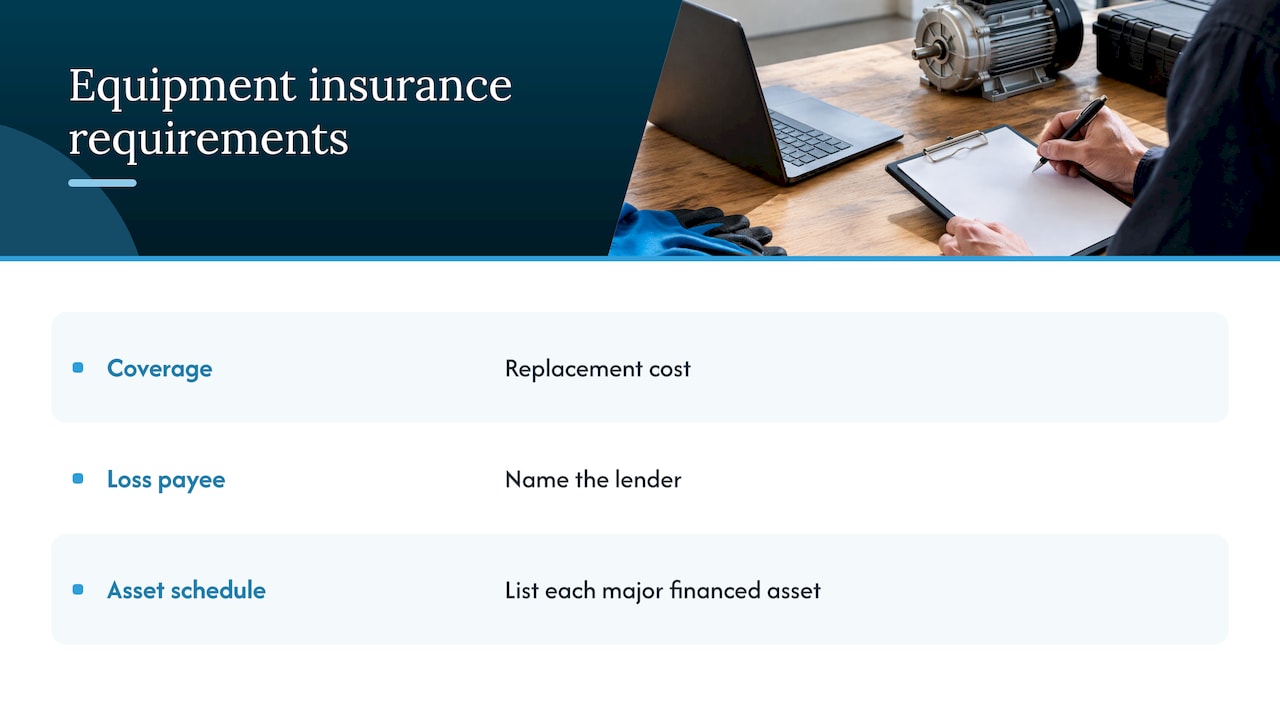
If you are financing equipment rather than a building, the same logic applies: the equipment is collateral, so your policy needs to cover its replacement cost with the lender named as loss payee. Our Equipment 10-Year Fixed program, published at 6.58% on our site, is a good example of a project where the insurance schedule has to list each major asset financed.
Flood insurance: when a flood zone triggers coverage
Flood damage is typically excluded from standard property policies, so flood coverage is a separate purchase. The SBA requires it when location demands it. Under 13 CFR § 120.170, a borrower must obtain flood insurance if a building, machinery or equipment acquired, installed, improved, constructed or renovated with SBA financial assistance is in a special flood hazard area. The requirement also reaches inventory, fixtures and furnishings contained in that building.
What this means in practice:
- Check the flood map early. Your lender will order a flood zone determination, but ask your agent to review the property’s FEMA flood zone during due diligence, before you are committed to the purchase.
- Budget for it. Flood premiums vary widely by property, and they can influence which building makes financial sense, particularly in coastal and river-adjacent areas of New England.
- Match coverage to your lender’s formula. Coverage generally has to be at least the outstanding loan balance, up to the maximum available under the National Flood Insurance Act. Your closer will tell you the figure for your file.
If the property is outside a Special Flood Hazard Area, the SBA’s flood requirement does not apply, though you may still choose coverage for your own protection.
Life insurance: not required on every loan
This is the requirement that surprises owners most, and it is often misunderstood. Life insurance is not automatic. Under the SBA’s current procedures, CDCs must assess whether the business’s viability is tied to specific individuals, and life insurance is required for listed owner-dependent businesses when the loan is not fully collateralized. That version of the SOP took effect October 1, 2026.
How it works when it applies:
- Amount: the required amount equals the difference between the net debenture amount and the discounted value of available collateral. The stronger your collateral, the smaller that gap.
- Who pays: you do. The same SOP says the borrower pays the premiums.
- Assignment: the CDC must make sure the policy includes a collateral assignment acknowledged by the insurer’s home office.
- If a principal is uninsurable: the CDC must obtain written documentation from the insurer rather than simply waiving the requirement.
Businesses that depend heavily on one person, such as a medical practice, a specialty contractor or a professional services firm, are the ones most likely to see this condition. A manufacturer or distributor with a deep management team and strong real estate collateral is less likely to. Your CDC will tell you early whether it applies, so ask during the first conversation rather than at closing.
Quick reference: which insurance applies when
| Insurance type | When it applies | Who is named | Who pays |
|---|---|---|---|
| Hazard (property) | 504 projects above the SBA threshold, on all pledged collateral | Lender or CDC as mortgagee (real estate) or loss payee (equipment) | Borrower |
| Flood | Financed building, equipment or contents in a Special Flood Hazard Area | Lender or CDC per closing instructions | Borrower |
| Life | Owner-dependent business, loan not fully collateralized | CDC via collateral assignment | Borrower |
What happens if coverage is missing or lapses
Insurance is a condition of the loan, not a formality. Before funds are disbursed, closers need to confirm that policies have been obtained, endorsed and verified. Failure to address required insurance can lead to an SBA repair or denial of the guaranty, which is the risk lenders work hard to avoid. That is why they are strict about timing.
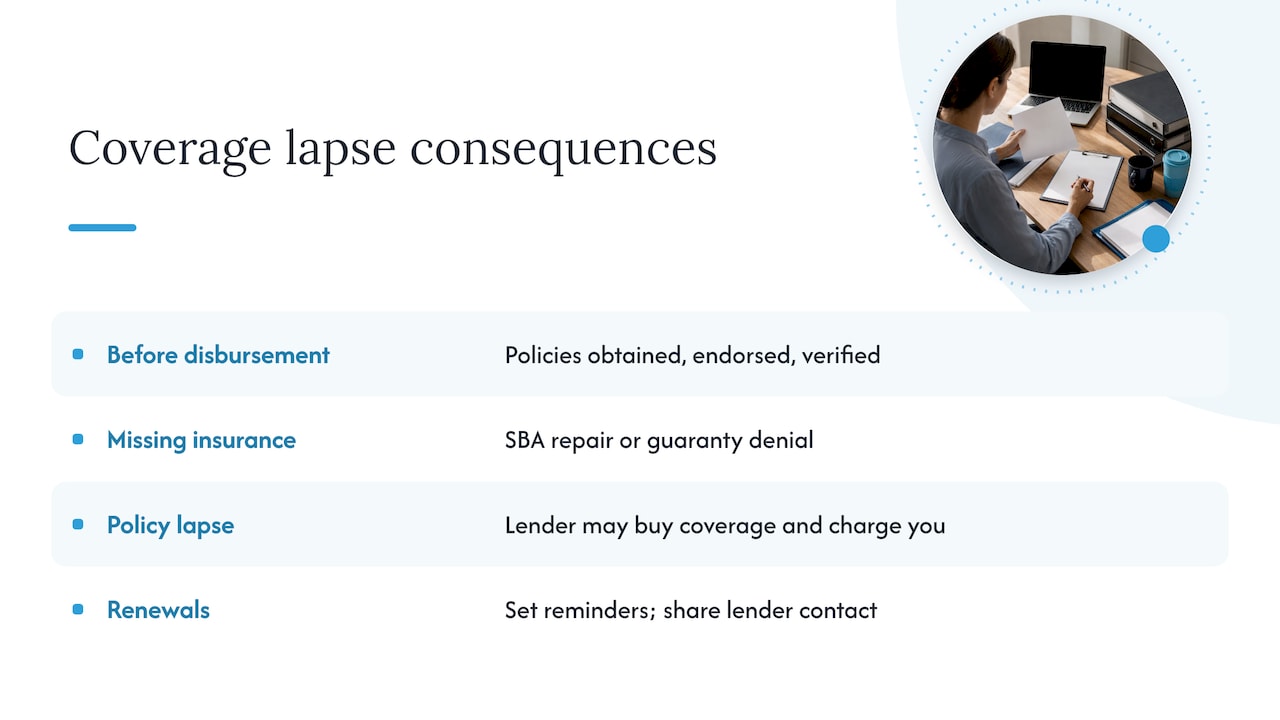
After closing, the same logic continues. If a policy lapses, your lender can generally buy coverage on your behalf and charge you for it, usually at a higher cost and with less protection for you than a policy you shop yourself. Set renewal reminders, and give your agent the lender’s contact information so they send notices to the right place.
A practical checklist before closing
- Get the requirements in writing. Ask your CDC and the participating bank for their insurance specifications.
- Share them with a commercial insurance agent who handles property, flood and, if needed, life coverage.
- Request quotes early, especially for flood and older buildings, where underwriting can take longer.
- Confirm named parties and wording for the mortgagee or loss payee clause, including the correct legal names and addresses.
- Match coverage to the full project. If you are buying a building and equipment together, make sure each is scheduled.
- Deliver evidence of coverage to the closer ahead of the closing date, not on it.
- Calendar renewals for the full term of your loan.
If your project includes an appraisal, your insurance values should be reviewed alongside it. Our guide to SBA 504 appraisal rules explains how valuation works, and our overview of business loan collateral shows how pledged assets are counted, which matters because collateral value drives the life insurance calculation.
Our perspective
We close 504 loans for New England businesses every year, and insurance is rarely what stops a deal. Late paperwork is. Owners who bring their agent into the process at the same time they bring in their accountant almost always reach closing without a delay.
We also think insurance is part of what makes the 504 structure work well for owners. The program lets you buy property with as little as 10% down and lock in a fixed rate for up to 25 years. A solid insurance program protects that investment, so a single loss does not undo years of growth.
Our approach is to tell you what to expect on day one: which policies your project needs, who to name and how the numbers are calculated. We have invested more than $2.3 billion in regional businesses over more than 70 years, and clear communication on conditions like these is part of how we do it.
PHENYX
Financing your property with CDC New England
If you are planning to buy owner-occupied commercial real estate or major equipment, we can walk you through the full cost picture, including the insurance conditions above. Our published fixed rates are 6.58% for Equipment 10-Year Fixed, 6.73% for Real Estate 20-Year Fixed and 6.77% for Real Estate 25-Year Fixed, as listed on our site.
We also offer a SBA 504 refinance program for existing debt, a down payment assistance program, and a VetLoan Advantage program for veterans and their spouses.
To see which program fits your project, start at cdcnewengland.com and tell us what you plan to buy.
Related reading
Insurance is one piece of the 504 picture. These guides cover the rest:
- Who qualifies for SBA 504 loans in New England
- The 51% occupancy rule for eligibility
- 10, 20 and 25 year SBA 504 terms
- How SBA 504 compares with 7(a) loans
FAQ
Does an SBA 504 loan require life insurance?
Not on every loan. The CDC assesses whether the business depends on particular individuals, and life insurance is required for listed owner-dependent businesses when the loan is not fully collateralized. If it applies, the amount is tied to the gap between the net debenture and the discounted collateral value. Ask your CDC early whether your file is affected.
Who pays for the insurance on an SBA 504 loan?
You do. The borrower pays the premiums on required policies, including any life insurance. Your lender names itself on the policies as mortgagee, loss payee or assignee, but it does not cover the cost.
Do I need flood insurance for my 504 property?
Only if the financed building, or the equipment and fixtures inside it, are located in a Special Flood Hazard Area. Your lender will determine the flood zone for the property. You can look up the zone yourself during due diligence so the premium is part of your purchase budget.
When should I arrange insurance for my 504 closing?
As soon as you have your lenders’ insurance requirements, which is well before the closing date. Policies must be obtained, endorsed and verified before funds are disbursed, so quotes and endorsements should be ready ahead of time.
Sources
- 13 CFR § 120.160, Loan conditions (Cornell Legal Information Institute)
- 13 CFR § 120.170, Flood insurance (Cornell Legal Information Institute)
- SBA SOP 50 10 8.1, Life insurance for 504 loans
- SBA insurance compliance under SOP 50 10 8 (Coleman Report)