Most for-profit U.S. businesses that stay under SBA size limits and plan to occupy the real estate they’re financing can prequalify for an SBA 504 loan. Prequalification comes from a Certified Development Company (CDC) or participating lender, not the SBA itself, and it’s a non-binding read on your fit. Your next move: pull your last two years of tax returns and call a CDC.
TL;DR:
- Prequalification from a CDC or lender is an early assessment, not a binding approval, and SBA final eligibility is only confirmed after full application review.
- Eligibility requires operating profit, U.S. location, SBA small business standards, and project use limits, with real estate loans requiring at least 51% occupancy by the borrower.
- A business generally qualifies if it has a net worth of $20 million or less and an average net income of $6.5 million or less over two years.
- The prequalification process typically takes hours to days for a soft review and up to 90 days for full approval, depending on appraisal and environmental reviews.
- Preparing key documents upfront—tax returns, financial statements, ownership details, and project costs—can significantly reduce delays and speed up the process.
Table of Contents
- What Does SBA 504 Prequalification Actually Mean?
- Do You Meet the Basic SBA 504 Eligibility Rules?
- What Does a CDC or Lender Check During Prequalification?
- What Documents Should You Gather First?
- How Long Does Prequalification Take?
- How Can You Speed Up Prequalification?
- How Does a CDC Like CDC New England Support Your Application?
- Three Steps I’d Take Before Calling a CDC
- Ready to Prequalify With CDC New England?
- Sources
What Does SBA 504 Prequalification Actually Mean?
Prequalification is a preliminary assessment, not a loan commitment. A CDC, participating lender, or broker reviews your basics and tells you whether you look like a fit for the 504 program. The SBA does not prequalify borrowers directly — it makes the final eligibility call once a full application lands on its desk.
- Prequalification: a CDC or lender’s early read on fit
- Approval: the SBA’s binding eligibility determination
- CDC role: guides you through both stages and packages your file for submission
Private marketplaces sometimes issue their own “prequalification” letters based on general SBA guidelines. Those aren’t SBA commitments either, so treat them as a starting point, not a green light.
Do You Meet the Basic SBA 504 Eligibility Rules?
Before you contact anyone, check yourself against the core gates. These come straight from SBA program rules and the regulatory text behind them.
- Your business operates for profit and is physically located in the U.S.
- You’re authorized to do business in your state
- You qualify as “small” under SBA size standards
- If financing real estate, you (or your operating company) will occupy at least 51% of the space
- Proceeds go toward fixed assets like real estate or equipment, not working capital or speculative investment
The size test has real numbers behind it. Your business generally needs a tangible net worth of $20 million or less and average net income of $6.5 million or less over the two years before you apply. These thresholds get restated periodically on SBA program pages, so a quick check before you apply is worth the five minutes. The regulatory backbone for all of this sits in 13 CFR § 120.110, which spells out applicant eligibility and location requirements. Nonprofits, passive real estate holding without an operating business, and financial speculation don’t qualify under any reading of the rules.
What Does a CDC or Lender Check During Prequalification?
Lenders and CDCs look past your credit score to whether your business can actually carry the debt. Expect scrutiny in four areas:
- Credit history, both personal and business. A single late payment years ago rarely sinks you, but unresolved collections or recent bankruptcies raise flags.
- Cash flow and debt service coverage. Lenders want to see your business generates enough net income to comfortably cover the new loan payment on top of existing debt.
- Management experience. A first-time owner buying a building needs a credible operating history or industry background to back the plan.
- Ownership disclosures. Every owner with 20% or more equity has to be listed, per SBA Form 1244 requirements under the SOP 50 10 series.
Pro Tip: If your credit report shows a blemish, write a one-paragraph explanatory memo before the CDC asks for one. Lenders read a proactive explanation very differently than a defensive one.
What Documents Should You Gather First?
Getting your paperwork organized before you call a CDC turns a multi-week back-and-forth into a same-week conversation. Prioritize in this order:
- Tax returns. Personal and business returns for the last two to three years, plus current interim financials if your fiscal year is partway through.
- Financial statements. Profit and loss statement, balance sheet, and a cash-flow statement covering recent operations.
- Personal financial statement. Covers all owners with 20% or greater stake.
- Organizational documents. Articles of incorporation or organization, operating agreements, and ownership records.
- Project documentation. A signed purchase contract or equipment quotes, plus a cost breakdown for the project.
A few smaller items matter too:
- Photo ID and Social Security numbers for all listed owners
- A brief written description of how proceeds will be used
- Any existing appraisal or environmental reports for the property, if available
How Long Does Prequalification Take?
A soft prequal conversation with a CDC can happen in hours to a few days once you’ve handed over your documents. Full SBA 504 processing from application to funding commonly runs 30 to 90 days, depending on appraisal timing and environmental review.
- CDC reviews your file and confirms eligibility fit
- Senior lender underwrites its portion of the deal
- Appraisal and environmental reviews run in parallel
- CDC submits the full package to the SBA
- SBA issues its determination, and the debenture funds
While you wait, keep working. Fill any documentation gaps the CDC flagged, and confirm your purchase contract has financing contingencies that protect you if timing runs long.
How Can You Speed Up Prequalification?
Delays almost always trace back to the same handful of causes, and most are fixable before you ever submit anything.
- Clean, current bookkeeping beats stale year-end statements every time
- A written memo explaining any credit issue, submitted proactively
- Resolved tax liens or a documented payment plan if one exists
- Complete ownership disclosures for every 20%+ owner up front
- A clear, itemized project cost breakdown instead of a rough estimate
Assembling a clean cost breakdown and complete ownership disclosures up front removes the two most common sources of delay in 504 files.
Pro Tip: Avoid anything that reads as speculative, like buying property with no defined operating use. CDCs and the SBA both scrutinize proceeds that don’t tie directly to your business operations.
How Does a CDC Like CDC New England Support Your Application?
CDCs do more than pass paperwork along. They assemble your full package, coordinate directly with the SBA, order appraisals and environmental reviews, and walk veteran-owned businesses through specialized benefit programs.
CDC New England brings over 70 years of regional lending experience and has invested more than $2.3 billion in New England businesses. Its programs include:
- A 10% down payment requirement, lower than most conventional commercial financing
- Fixed rates for up to 25 years
- Veteran-specific benefits and priority processing
- A 504 loan calculator so you can estimate payments before you ever pick up the phone
That kind of track record shortens the guesswork on what documents to prepare and what a realistic timeline looks like.
Three Steps I’d Take Before Calling a CDC
Gather your top four documents first: tax returns, financial statements, personal financial statement, and project cost breakdown. Run your own soft credit and cash-flow check so you’re not surprised by what a lender finds. Then contact a CDC with a one-page project summary in hand.
Doing this early work yourself preserves your negotiating leverage on the purchase contract and shortens how long your contingency period needs to stay open. Prequalification is non-binding either way, but arriving prepared cuts the number of surprises later.
— PHENYX
Ready to Prequalify With CDC New England?
CDC New England gives you a faster path to financing than a traditional bank loan for owner-occupied real estate or equipment, thanks to a 10% down payment requirement instead of the 20 to 30% conventional lenders often demand.
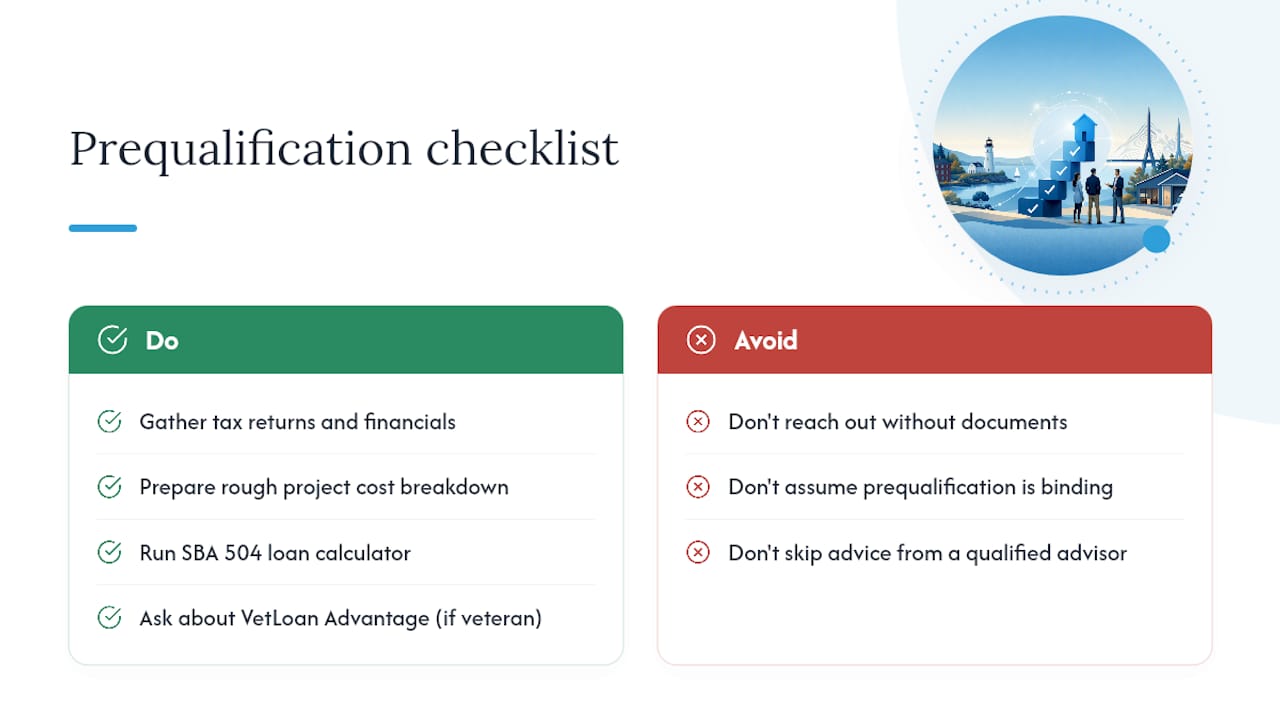
Before you reach out, have your tax returns, financial statements, and a rough project cost breakdown ready. Run the numbers yourself first using the SBA 504 loan calculator to see what a realistic payment looks like at current fixed rates for up to 25 years. If you’re a veteran-owned business, ask about the VetLoan Advantage program when you call.
Reach out to CDC New England with your project summary and documents in hand. Prequalification is a non-binding conversation, not a commitment, so there’s no downside to finding out where you stand now.
This article is general information, not a substitute for advice from a qualified financial advisor. Consult a qualified financial professional about your own circumstances before acting on anything here.
Recommended
- How to Buy Commercial Real Estate in New England with Just 10% Down
- SBA 504 Loan Program Explained: How Small Businesses Can Buy Commercial Real Estate With Just 10% Down
- Do You Qualify for 90% Commercial Real Estate Financing?
- SBA 504 Loan Appraisal Requirements: What New England Business Owners Need to Know