Yes, an SBA 504 loan can be assumed, but only with the SBA’s prior written approval under 13 CFR § 120.937. Assumption usually involves the CDC debenture portion of the loan, while the third-party lender portion may require a separate agreement. Below, we walk through the regulatory basis, the CDC and SBA review process, the documents you will need, realistic timing, and where CDC New England fits into the picture.
TL;DR:
- The CDC debenture is the portion usually assumed, while the third party lender may prohibit transfer or require separate underwriting, negotiation, or refinancing.
- Contact both lenders before signing a binding agreement; SBA approval must be written, and a complete package reduces resubmissions that can add weeks.
- The CDC reviews repayment ability, management experience, collateral, guarantors, and owner occupancy; most properties must retain at least 51% qualifying occupancy.
- Straightforward assumptions can take several weeks, while incomplete paperwork or an appraisal can stretch processing to a few months; fees can approach 1.0% of the balance.
Table of Contents
- Legal Basis and SBA Rules Governing Assumption
- Which Part of a 504 Loan Actually Transfers
- How the SBA 504 Assumption Process Works Step by Step
- Documents and Underwriting Criteria for the New Borrower
- Timing, Fees, and What Commonly Causes Delays
- How CDC New England Supports Assumptions
- What to Prioritize First
- Ready to Discuss Your SBA 504 Assumption?
- FAQ
- Sources
Legal Basis and SBA Rules Governing Assumption
The starting point for any 504 assumption is 13 CFR § 120.937, the federal regulation that permits a borrower to transfer a 504 loan to a new party, but only with the SBA’s prior written approval. That single requirement shapes everything else in the process. You cannot simply hand over the keys and the debt alongside them. The SBA has to review the new borrower, the collateral, and the terms of the transfer before the assumption becomes effective.
Beyond the regulation itself, SBA operating guidance fills in the practical details. SOP 50 10, the agency’s Lender and Development Company Loan Programs manual, governs how CDCs originate and service 504 loans, and recent SOP notices have updated provisions tied to change-of-ownership lending. An SBA Information Notice announcing SOP 50 10 8.1 identifies appendices addressing change-of-ownership procedures, so a CDC handling an assumption today works from current SOP language rather than older guidance that may no longer apply.
In servicing terms, the CDC and the SBA play distinct roles:
- The CDC acts as the frontline contact, gathering financials, reviewing the proposed assumptor, and preparing the assumption package.
- The SBA’s Commercial Loan Service Center reviews servicing actions tied to the debenture, including assumption requests, and issues the prior written approval the regulation requires.
- CDCs coordinate with the Commercial Loan Service Center throughout, since the center’s sign-off is what finalizes the transfer.
Because 504 loans are long-term, fixed-rate financing originated through Certified Development Companies, the CDC that originated your loan typically stays involved through servicing, including any later assumption. If we originated your loan, we remain your point of contact for walking the assumption through SBA review. You can read more about what a Certified Development Company does if you want background on that role before diving into a transaction.
Which Part of a 504 Loan Actually Transfers

A 504 project typically involves two loans: a first mortgage from a third-party lender, usually covering about half the project cost, and a second mortgage, the CDC debenture, backed by the SBA. When people talk about assuming a 504 loan, they usually mean the CDC debenture portion, since that is the piece governed directly by 13 CFR § 120.937.
The third-party lender’s loan is a separate matter. Its assumability depends entirely on the terms in that lender’s own note and mortgage, not on SBA rules.
- The CDC/debenture portion is the piece most directly addressed by SBA assumption rules and requires SBA’s prior written approval.
- Even when the CDC portion is approved for assumption, the buyer may still need to independently negotiate, refinance, or qualify for the first mortgage with the third-party lender.
- Check the original loan agreement with the senior lender early, since some notes prohibit assumption outright or require separate underwriting.
A practical consequence: a buyer can clear SBA’s side of the process and still face a wall on the conventional first mortgage, so both tracks need attention from day one.
How the SBA 504 Assumption Process Works Step by Step
Once you know an assumption is the right path, the process follows a fairly predictable sequence. Timing and paperwork vary by case, but the order of operations rarely changes.
- Notify your CDC and the third-party lender. Reach out as soon as a sale or ownership change is on the table, and ask both lenders to confirm whether the loan and collateral are eligible for assumption under current terms.
- Prepare the assumption agreement and assemble the package. This includes the signed assumption agreement, financial statements for the proposed assumptor, and the documentation your CDC requires to begin underwriting.
- CDC underwriting review. Your CDC evaluates the new borrower’s credit, financial capacity, management experience, and whether the property’s occupancy still meets SBA rules, then submits the completed package to the SBA once it is ready.
- SBA review for prior written approval. The SBA, through the Commercial Loan Service Center, reviews the submission against current underwriting standards and SOP requirements before issuing its approval.
- Finalize signatures and update servicing records. Once approved, all parties sign final documents, the CDC updates ETRAN records to reflect the new borrower, and an effective date is set for interest and fee reporting going forward.
The CDC’s role in step three is where most of the practical work happens. According to CDC servicing practice described in the 504 Assumption Control Worksheet, CDCs use a standardized checklist to confirm the assumption agreement, ACH authorization, W-9, and proof of SBA acknowledgment are all present before submission. Missing even one of these small items commonly triggers a resubmission, which adds weeks to the timeline.
Step four, the SBA’s own review, is the stage you have the least control over, but you can influence how quickly it moves. A complete, accurate package from your CDC reduces the chance of a request for additional information, which is the single biggest cause of delay once a file reaches the Commercial Loan Service Center. Because the SBA’s prior written approval is mandatory under 13 CFR § 120.937, there is no way to shortcut this step, but early CDC involvement and a clean submission keep the review on track.
Pro Tip: Loop in your CDC the moment a sale conversation starts, even before you have a signed purchase agreement, so underwriting questions surface while you still have time to address them.
Step five closes the loop operationally. Updating ETRAN matters because it is how the SBA and CDC track the loan’s status, reporting history, and who is legally responsible for payments going forward. Setting the correct effective date also affects how interest and any assumption fees are calculated for the transition period.
Documents and Underwriting Criteria for the New Borrower
A complete assumption package moves faster through CDC and SBA review, so it helps to know exactly what gets requested before you start. The 504 Assumption Control Worksheet lays out the core checklist CDCs use to verify a submission is ready.
- A signed assumption agreement between the current borrower, the new borrower, and the CDC.
- Proof of SBA approval or formal SBA acknowledgment of the assumption.
- A completed ACH authorization form and an updated W-9 reflecting the new borrower’s taxpayer identification number.
- Recent personal and business tax returns along with current financial statements for the assumptor.
- Evidence of the ownership transfer, plus updated insurance and title documents for the property or equipment involved.
- A new appraisal, when the CDC or SBA determines the collateral value needs to be reconfirmed.
On the underwriting side, your CDC looks at the same fundamentals that mattered when the loan was first approved. Can the new borrower demonstrate the ability to repay the debt based on current financials? Does management have relevant experience operating the business or property? If the collateral is owner-occupied real estate, does the new borrower still meet the 51% occupancy requirement that applies to most 504-financed properties? CDCs also confirm the collateral remains adequately preserved and work through any guarantor substitution needed when the original guarantors are no longer part of the business.
Once underwriting is complete, CDCs document everything through ETRAN and standard servicing workflows, which keeps the file consistent with how the SBA tracks every 504 loan in its portfolio. If you want a sense of what the original application process required, our overview of Form 1244 covers much of the same documentation territory that resurfaces during an assumption.
Timing, Fees, and What Commonly Causes Delays
Assumption timelines depend on how complete the initial package is and how quickly the third-party lender responds, but a realistic range runs from several weeks for a straightforward file to a few months when documentation is incomplete or the collateral needs reappraisal.
CDCs commonly report processing fees for servicing actions like assumptions up to around 1.0% of the outstanding balance, though the exact amount and which party pays it (buyer, seller, or a negotiated split) is typically settled in the purchase agreement rather than dictated by the SBA.
A few recurring issues slow assumptions down more than anything else:
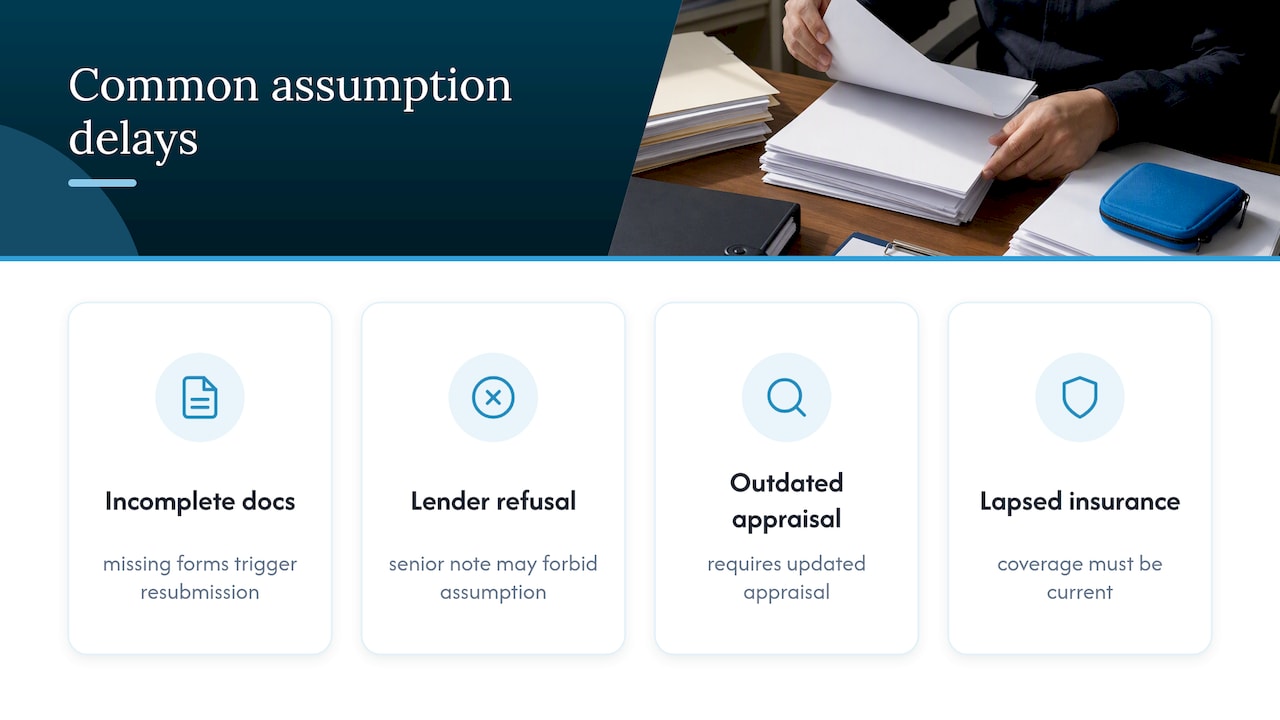
An incomplete package is the most common holdup, since missing a single form, such as the ACH authorization or updated W-9, sends the file back for resubmission. Third-party lender refusals create a separate bottleneck when the senior lender’s note does not permit assumption, forcing the buyer into a refinance of that portion instead. Outdated appraisals or lapses in required insurance coverage also stall SBA review, since the Commercial Loan Service Center will not issue approval until collateral documentation is current.
Planning around these milestones, rather than being surprised by them, is the difference between a transaction that closes on schedule and one that drags for months.
How CDC New England Supports Assumptions
We specialize in SBA 504 financing across New England, and that regional focus extends directly to assumption transactions.
When an assumption is on the table, our role goes beyond paperwork review:
- We coordinate the assumption agreement between the current borrower, the prospective buyer, and our servicing team.
- We prepare the ETRAN updates that keep the loan’s servicing record accurate once SBA approval comes through.
- We liaise directly with the SBA Commercial Loan Service Center to track the file and respond quickly to any follow-up requests.
- We work to assemble a complete package upfront, since that single factor does more to speed approval than anything else in the process.
If you are a buyer stepping into an existing 504 loan or a seller trying to understand what happens to your financing, reach out to us for an assumption consultation. We will walk through your specific loan, the third-party lender situation, and what the SBA will expect to see.
What to Prioritize First
If you are starting down this path, sequence matters more than speed. Notify your CDC and the third-party lender before you sign anything binding, since both will tell you quickly whether assumption is realistic for your loan. Next, start collecting financials and ownership documents for the proposed buyer, because that preparation determines how fast underwriting moves. Finally, check the senior lender’s note for assumption language, since that is the piece most often overlooked until late in a transaction.
Early CDC involvement is the single factor that most reduces surprises. A CDC that knows about a potential sale months ahead can flag occupancy or collateral issues while there is still time to fix them, rather than after a purchase agreement is already signed.
— PHENYX
Ready to Discuss Your SBA 504 Assumption?
If you are buying a business with an existing 504 loan, selling one, or simply trying to understand your options, we can walk you through what applies to your situation. Beyond assumptions, we offer the SBA 504 Refinance Program for borrowers who find refinancing makes more sense than transferring an existing loan, along with our VetLoan Advantage Program and Down Payment Assistance Program for buyers who need extra support closing the gap on a new acquisition.
Contact CDC New England to schedule a consultation and find out whether your loan qualifies for assumption, what documentation you will need, and how our team can help move the process along with the SBA.
This article is general information, not a substitute for advice from a qualified financial advisor. Consult a qualified financial professional about your own circumstances before acting on anything here.
FAQ
Is an SBA 504 loan assumable?
Yes, a 504 loan can be assumed, but only with the SBA’s prior written approval under 13 CFR § 120.937. The process typically applies to the CDC debenture portion, while the third-party lender’s portion depends on that lender’s own note terms.
Can I assume an SBA EIDL loan?
SBA EIDL loans are a different program from 504 loans and follow their own servicing and transfer rules rather than 13 CFR § 120.937. If you are dealing with an EIDL balance tied to a business sale, that question is best directed to the SBA office or servicing center handling that specific loan.
Is it hard to get an SBA 504 loan?
A 504 loan is approachable for most established small businesses that meet occupancy and size standards, though it does require a complete financial package and CDC underwriting. Working with a CDC that understands the 51% occupancy requirement and documentation standards from the start tends to make the process considerably smoother.
Sources
- 13 CFR § 120.937 - Assumption. | LII / e-CFR
- CDC - 504 ASSUMPTION CONTROL WORKSHEET
- Commercial Loan Service Center - Small Business Administration