If you plan to buy a building or major equipment in Massachusetts, the SBA 504 loan is usually the strongest fit: a 10% down payment, a fixed rate and terms up to 25 years. It is not the right tool for every need, though. Working capital, inventory and buying a business call for other products. Below we compare the main commercial loan options side by side, so you can match the loan to the project.
TL;DR
- SBA 504 suits owner-occupied real estate and long-life equipment. It typically needs about 10% down, carries a fixed rate and runs up to 25 years.
- SBA 7(a) suits working capital, acquisitions and mixed-use deals. It is more flexible, but rates are usually variable.
- Conventional commercial mortgages can close quickly, but they commonly ask for 20% to 30% down and often reprice or balloon.
- Equipment loans and lines of credit cover short-life assets and cash flow gaps that a 504 cannot fund.
- Our published rates are 6.58% for 10-year equipment, 6.73% for 20-year real estate and 6.77% for 25-year real estate.
Table of Contents
- How the main commercial loan options compare
- SBA 504: the structure that makes 10% down possible
- SBA 7(a): the flexible alternative
- Conventional commercial mortgages
- Equipment loans and lines of credit
- What a 504 costs
- Our perspective: where we see the 504 win and where it does not
- Refinancing existing debt with a 504
- Choosing the right loan: a short checklist
- Ready to price a 504 project?
- FAQ
- Sources
How the main commercial loan options compare
Most Massachusetts owners choose among four types of financing. The table shows how they differ on the points that decide a deal.
| Loan type | Best for | Typical down payment | Rate structure | Longest term |
|---|---|---|---|---|
| SBA 504 | Owner-occupied real estate, major equipment | About 10% | Fixed on the CDC portion | 25 years |
| SBA 7(a) | Working capital, business purchase, mixed uses | Varies by lender | Usually variable | Varies by use |
| Conventional commercial mortgage | Real estate, including investment property | Often 20% to 30% | Fixed or adjustable, often with a balloon | Often shorter amortization |
| Equipment loan or line of credit | Short-life assets, cash flow | Varies | Varies | Matched to asset life |
The rest of this guide explains why each row looks the way it does.
SBA 504: the structure that makes 10% down possible
The SBA describes the 504 program as long-term, fixed-rate financing for major fixed assets. It is delivered by two parties working together. A bank or other lender provides a first lien, usually around half the project. A Certified Development Company (CDC) provides a second portion, backed by an SBA-guaranteed debenture, usually around 40%. You contribute the remaining 10%, according to this 2026 comparison of the 504 and 7(a).
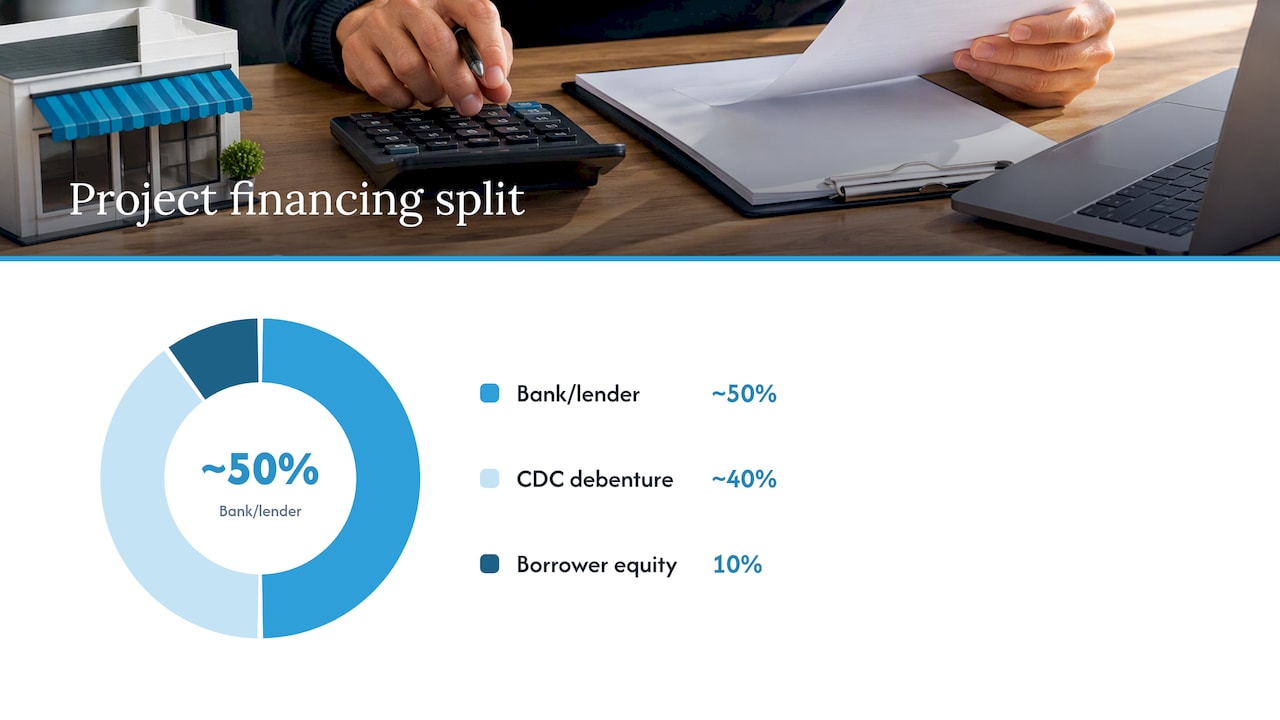
That split is why the program is so useful for owner-occupants. The SBA notes that financing up to 90% of project cost preserves working capital, and the 10% equity requirement is often well below the 20% to 30% typical of conventional commercial mortgages.
What a 504 can and cannot pay for
Eligible uses are fixed assets:
- Purchase of an existing commercial building
- New construction or major renovation
- Long-term machinery and equipment with a useful life of at least 10 years
- Refinancing existing commercial debt under specific conditions
It cannot fund working capital, inventory or the purchase of a business. If your project mixes real estate with any of those, a 7(a) is typically the right structure.
Size limits
The SBA states that the 504 program provides up to $5 million for major fixed assets. Small manufacturers and certain energy projects can reach $5.5 million, and because the cap applies to the SBA debenture only, the total project can run larger. Your business must operate for profit, be located in the U.S. and meet SBA size standards, generally tangible net worth under $15 million and average net income under $5 million after taxes over the previous two years.
Occupancy rules
This is where applications most often stall. For an existing building, your business must occupy at least 51% of the property. For new construction, you must occupy at least 60% at the start and plan to reach 80% within 10 years. The rules exist so the loan supports an operating business and not passive real estate investment. If you are buying a building to lease out entirely, a 504 is not the vehicle. Our guide to 51% occupancy and SBA 504 eligibility walks through typical scenarios.
SBA 7(a): the flexible alternative
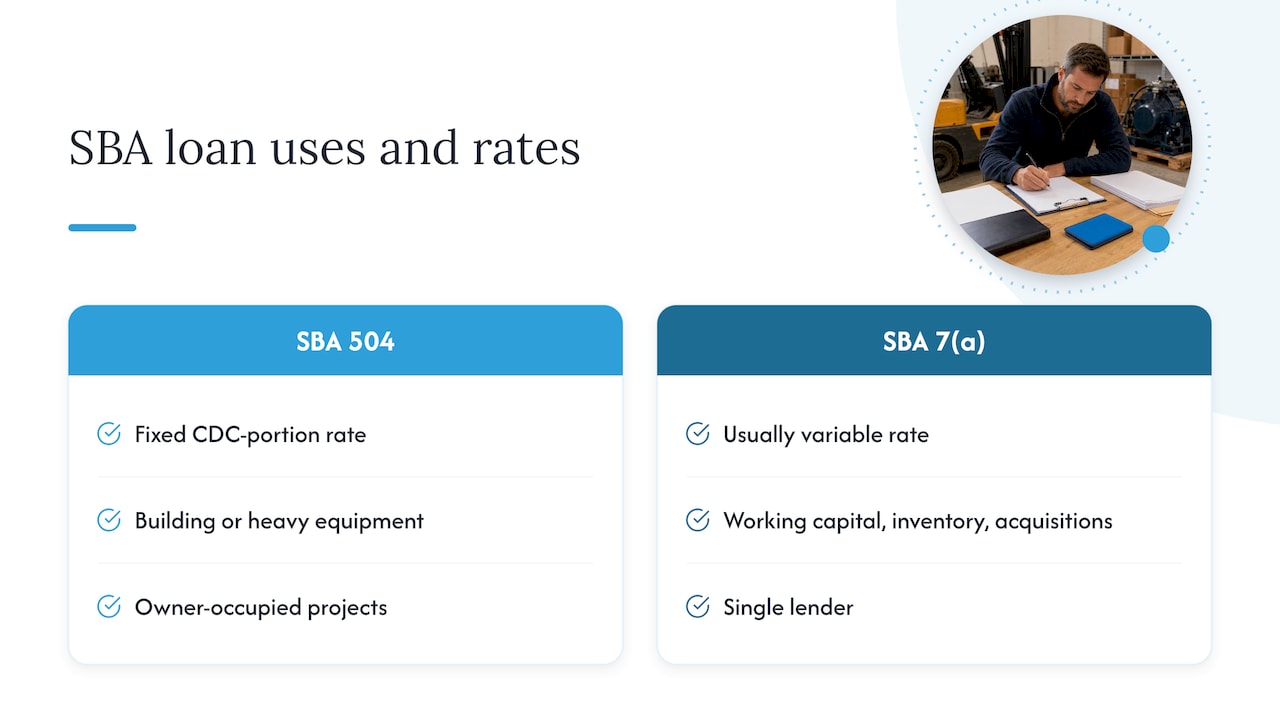
The 7(a) program is the SBA’s primary business loan program. It works through a single lender and can fund almost any legitimate business purpose: working capital, inventory, equipment, real estate or buying an existing company. That flexibility is its strength.
The trade-off is structure. 7(a) rates are usually variable, set as prime plus a spread, as the 2026 comparison linked above explains. If your payment can move with the market, a large real estate loan becomes harder to budget. A 504’s fixed rate gives you a payment that stays put for the life of the CDC portion.
A practical rule: if the money mostly goes into a building or heavy equipment you will occupy and use, start with a 504. If the money goes into people, stock, marketing or an acquisition, start with a 7(a). If you are buying a business that comes with its real estate, ask a lender whether the deal should be split between the two.
Conventional commercial mortgages
A conventional loan from a local bank or credit union has real advantages. Underwriting can be simpler, and you can use the property for any purpose, including leasing space to tenants. Banks also tend to know their local markets well.
The costs are on the equity side and the rate side. A 20% to 30% down payment on a Massachusetts commercial property can tie up a large share of the cash you would otherwise use to hire, stock up or invest. Many conventional loans also amortize over a shorter period or carry a balloon, so you refinance in five to ten years at whatever rates prevail then. Our comparison of SBA 504 and conventional financing puts numbers on that difference.
If you are weighing how much cash a property purchase really requires, this explanation of low and no down payment approaches to buying rental property shows how down payment rules differ for investors. Owner-occupied commercial buyers have a different route in the 504, but it helps to see why investment purchases ask for more.
Equipment loans and lines of credit
A 504 can finance equipment, but only equipment with a useful life of at least 10 years. Vehicles, computers, software and other fast-depreciating assets usually belong in a standard equipment loan, where the term matches the asset’s life. Lines of credit cover seasonal swings, payroll timing and inventory. Neither replaces a real estate loan, and many owners use a 504 for the building alongside a line of credit for day-to-day cash. We cover the dividing line in SBA 504 versus equipment financing.
What a 504 costs
The 504’s rate on the CDC portion is tied to a debenture sold monthly and priced above Treasury yields. According to one 2026 rate breakdown, the July 2026 sale priced the 25-year debenture at 5.04%, and ongoing program fees bring the effective fixed rate to around 6%. That article also lists one-time costs: an upfront SBA guaranty fee of 0.5% and a lender participation fee of 0.5%, both financed into the loan, plus third-party closing costs. Debenture rates move each month, so check current figures before you budget.
Our own published rates for borrowers are:
| Program | Fixed rate |
|---|---|
| Equipment, 10-year | 6.58% |
| Real estate, 20-year | 6.73% |
| Real estate, 25-year | 6.77% |
These are the rates posted on our site, and your final terms depend on your project and underwriting. Comparing the 25-year fixed figure with a conventional loan that adjusts or balloons after five years is the fairest test, because the 504 fixes the payment for the full term. For more on the term options, see 10, 20 or 25 year SBA 504 terms.
Our perspective: where we see the 504 win and where it does not
We are a CDC, so we see this decision every week, and we would rather tell you early when a 504 does not fit. Here is what experience across New England has taught us.
The 504 wins when you are an owner-occupant with a stable operating history and a project that is mostly real estate or heavy equipment. The 10% down payment keeps cash in the business, and the long fixed rate removes the refinance risk that catches many borrowers with shorter conventional loans. Over more than 70 years, we have invested more than $2.3 billion in regional businesses, and the pattern holds: the owners who do best are those who lock a payment they can plan around.
The 504 does not win when you need working capital in the same transaction, when you plan to lease most of the building, or when you need money in a few weeks with minimal paperwork. In those cases, say so at the first conversation and we will point you to the better structure.
Three things we do differently. We offer a Down Payment Assistance Program for owners whose 10% is the barrier. We run the VetLoan Advantage Program for veterans and their spouses. And as a Premier Certified lender, we aim for faster approvals than a standard process.
— PHENYX
Refinancing existing debt with a 504
Many owners do not know a 504 can refinance existing commercial debt under specific conditions. If you are carrying variable-rate or high-interest debt on a building or equipment, you may be able to consolidate it and lock a long fixed rate, particularly as part of an expansion. Eligibility rules apply, and a CDC should confirm them with you up front. Our SBA 504 Refinance Program is built for this, and the post on debt consolidation with a 25-year fixed rate explains the mechanics.
Choosing the right loan: a short checklist
- Define the use of funds. Building or heavy equipment points to a 504. Cash, stock or an acquisition points to a 7(a) or a line of credit.
- Check occupancy. Will you occupy at least 51% of an existing building?
- Count your cash. If 20% to 30% down would drain your reserves, compare it with 10%.
- Weigh rate risk. Ask whether the payment is fixed for the full term or resets.
- Ask about timing. If you are on a tight closing date, discuss it with a lender who understands the process.
- Ask about special programs. Veterans and borrowers short on down payment may qualify for dedicated options.
For a Massachusetts-specific look at property financing, see our guide to commercial real estate loans for Massachusetts small businesses.
Ready to price a 504 project?
If you are buying a building or equipment in Massachusetts and want to see how a 10% down payment and a fixed rate up to 25 years would look for your numbers, start with CDC New England. We will tell you plainly whether a 504 is the right fit.
FAQ
What is the difference between a 7(a) and a 504 loan?
A 7(a) is general purpose and can fund working capital, inventory or a business purchase, usually at a variable rate. A 504 is limited to major fixed assets such as real estate and long-life equipment, and it pairs a bank loan with a fixed-rate CDC portion. Many owners use a 504 for the building and another product for cash needs.
Can I use a 504 loan to buy a small business?
No, not on its own. The 504 funds real estate and major equipment, not business acquisitions or goodwill. If you are buying a company, a 7(a) is typically the starting point, and a lender can advise on splitting a deal that includes real estate.
How much down payment does an SBA 504 loan require?
The standard is about 10% of the project, compared with 20% to 30% often required for conventional commercial mortgages. Specific requirements depend on the project and your business, so confirm with a CDC during your first consultation.
Do veterans get better terms on a 504?
Some programs reduce or waive certain upfront fees for veterans, though details differ by lender. Our VetLoan Advantage Program lists a 1.0% processing fee on its page, so review that page and confirm terms directly with us before you apply.
Sources
- SBA: 504 loans
- SBA: 7(a) loans
- SBA 7(a) vs. 504 Loan: How to Choose in 2026
- SBA 504 Interest Rates and Costs
- How to Buy a Rental Property With No Money Down