If your business is carrying commercial real estate or long-lived equipment debt across multiple loans, SBA 504 refinancing is likely the consolidation route worth exploring. It works when your debt qualifies as fixed-asset debt tied to owner-occupied property or equipment with a long useful life. Pull your loan documents and talk to a Certified Development Company or your accountant to confirm your qualified-debt status before you go further.
TL;DR:
- SBA 504 refinancing requires at least 85% of original loan proceeds to have been used for eligible fixed-asset costs, with the remaining debt tied to owner-occupied property or equipment.
- A substantial benefit is only approved if the new monthly payment is significantly lower than current payments after accounting for fees and prepayment penalties.
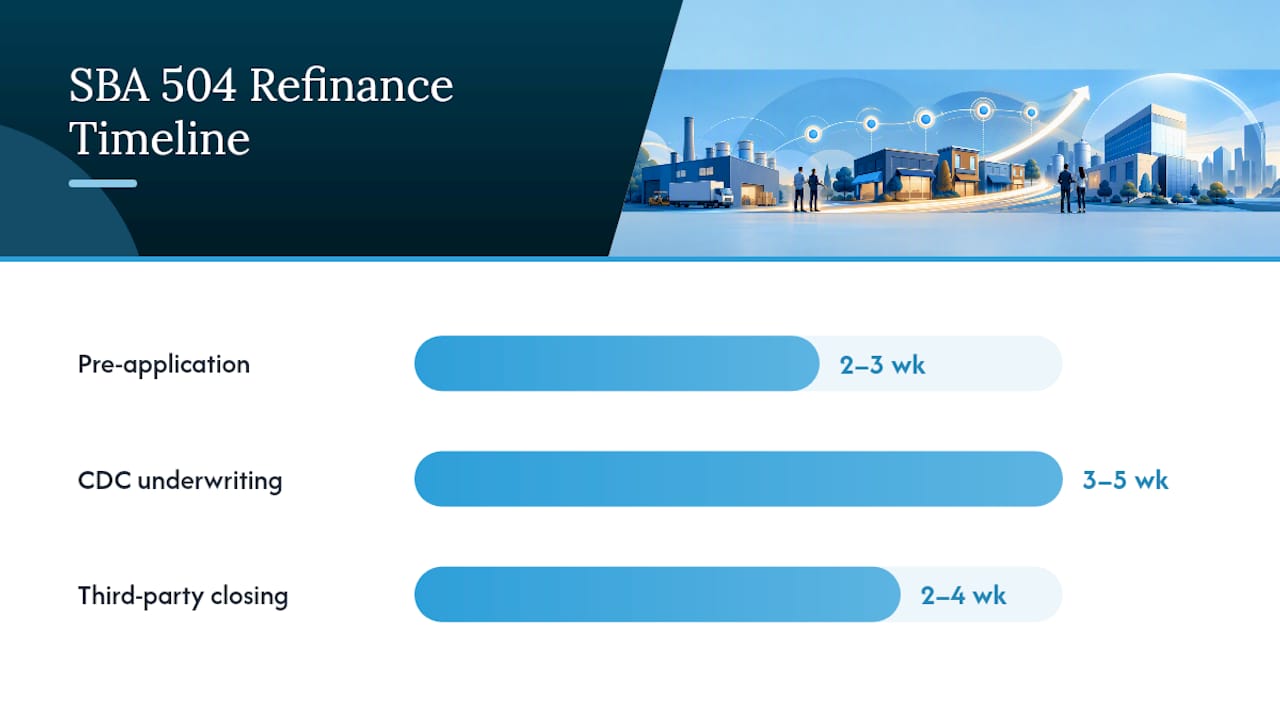
- The full refinancing process can take between 8 and 12 weeks, involving multiple stages of documentation, underwriting, and lien negotiations.
- Recent rule changes have increased loan-to-value limits and clarified eligibility, making more businesses potentially eligible for refinancing.
- It is most beneficial for businesses holding fixed-rate, long-term debt on real estate or equipment, especially if their current rate is variable or nearing reset.
Table of Contents
- What Counts as Business Debt Consolidation Under SBA 504?
- How Do You Know If Refinancing Will Actually Save You Money?
- What Documents and Steps Does a 504 Refinance Require?
- SBA 504 Refinancing vs. Other Consolidation Options
- Benefits and Risks of Consolidating Through SBA 504 Refinancing
- How Does a 504 Refinance Affect Your Business Credit?
- What Does a 504 Debt Consolidation Actually Cost?
- When Does SBA 504 Refinancing Make Sense, and When Doesn’t It?
- Questions to Ask Before You Start a 504 Refinance
- How CDC New England Supports Your Refinancing Project
- Where to Verify Program Rules Before Applying
- Ready to See What SBA 504 Refinancing Could Save You?
- Sources
What Counts as Business Debt Consolidation Under SBA 504?
Business debt consolidation, in the SBA 504 sense, means rolling qualified debt tied to fixed assets into a new SBA-backed loan with better terms. It’s not a tool for combining credit card balances or working capital lines. The SBA’s 504 loan program exists to finance major fixed assets, buildings you occupy, and equipment with a useful life of at least 10 years, and that same structure applies when you’re refinancing existing debt on those assets.
“Qualified debt” is the gatekeeper term here. Under 13 CFR 120.882, debt generally qualifies if it was used to acquire, construct, or improve eligible fixed assets, and if it has been outstanding for a set period before your refinance application. The “substantially all” test matters too: the SBA generally wants to see that at least 85% of the original loan proceeds went toward eligible fixed-asset costs, not working capital or inventory.
Recent rule changes loosened some of the constraints that used to disqualify otherwise strong candidates:
- The 2023 Federal Register final rule revised how qualified debt is defined and adjusted timing requirements, opening the door for loans that previously fell outside the window.
- The 2024 direct final rule, effective November 15, 2024, raised certain loan-to-value limits, clarified Eligible Business Expenses, and streamlined parts of the application process.
- SBA’s own procedural notice updating SOP 50 10 7.1 rewrote internal underwriting steps CDCs follow when processing these files.
A CDC handles the origination and packaging side of a 504 loan, and its designation matters. A Premier Certified Lender has demonstrated a track record of sound underwriting and SBA compliance, which typically means fewer back-and-forth requests once your file is submitted.
How Do You Know If Refinancing Will Actually Save You Money?
The SBA requires a “substantial benefit” test before it will approve a 504 refinance, and understanding this calculation up front saves you weeks of wasted effort. In plain terms, your new monthly payment on the refinanced portion has to be meaningfully lower than what you’re paying now, after you account for prepayment penalties and closing costs, not before. Skip this step and you risk chasing a refinance that looks good on paper but barely breaks even once fees hit the ledger.
Gather these numbers before you call anyone:
- Your current monthly payment on each loan you want to consolidate.
- Remaining principal balance on each loan.
- The exact prepayment penalty or defeasance cost, in dollars, not a percentage estimate.
- Any origination, legal, or appraisal fees tied to the existing loans.
- Whether your current rate is fixed or variable, and where it resets.
- A recent appraised fair market value for the real estate or equipment involved.
- Estimated closing costs for the new 504 loan, typically covering CDC fees, SBA guarantee fees, and third-party lender charges.
Once you have those figures, run a simple break-even calculation: divide your total refinancing costs (fees plus prepayment penalties) by your monthly payment savings. That gives you the number of months it takes to recoup the cost of refinancing. If you plan to hold the property or equipment well beyond that break-even point, the math tends to favor moving forward.
Pro Tip: If your current loan carries a variable rate that resets soon, run the break-even math against the worst-case reset rate, not today’s rate. A 504 refinance that looks marginal against your current payment can look far stronger once you price in where your variable rate is headed.
Prepayment penalties are often the deciding factor, and they get underestimated more than any other line item in this analysis.
What Documents and Steps Does a 504 Refinance Require?
A 504 refinance moves through several distinct stages, and knowing what’s coming at each one keeps the process from stalling. Expect the CDC, a third-party lender, and often your accountant to be involved simultaneously.
Start by pulling together your documentation:
- Loan statements for every debt you want refinanced, showing current balance and payment history.
- Payoff letters and lien releases (or subordination agreements) from existing lienholders.
- Title documentation for the real estate, or ownership records for equipment.
- Proof of owner-occupancy, such as a business license tied to the property address.
- Two to three years of business financials and tax returns.
- An itemized equipment list if machinery is part of the refinance.
- Paid invoices and bank statements supporting any Eligible Business Expenses you want rolled into the new loan, since the 2024 rule requires substantiation for these items.
Coordination with your third-party lender is where many refinances slow down. If a federally guaranteed loan is part of the package, the rules generally require that either the third-party loan and the 504 loan both get refinanced together, or the third-party loan gets paid off entirely. Lien subordinations have to be negotiated and executed correctly, and that paperwork often takes longer than borrowers expect.
A realistic timeline looks something like this: two to three weeks for pre-application financial analysis and gathering documents, three to five weeks for CDC underwriting and SBA review, and another two to four weeks for third-party lender closing coordination and debenture funding. Total time from first conversation to funded loan typically runs 8 to 12 weeks, though complex files with multiple lienholders can run longer. You can see how a refinance timeline plays out in more detail before you start.
SBA 504 Refinancing vs. Other Consolidation Options
Bank refinance loans can work if you have strong existing banking relationships and don’t need the fixed 25-year rate structure, but they usually require more collateral and offer shorter fixed-rate periods before a reset. Commercial debt management programs, the kind that renegotiate terms with existing creditors, tend to focus on unsecured or short-term obligations and aren’t built for fixed-asset debt tied to real estate or equipment. Factoring, which advances cash against receivables, addresses a completely different problem: it solves cash flow gaps, not the principal balance sitting on your mortgage or equipment note.
SBA 504 refinancing stands apart because it’s purpose-built for exactly this situation: fixed-rate, long-term debt secured by real estate or equipment with a useful life of at least 10 years. The 10% down payment structure that makes 504 attractive for new purchases carries over to refinancing in a modified form, and the up-to-25-year fixed rate eliminates the reset risk that comes with most bank refinance products.
The tradeoff is process. A 504 refinance takes longer to close than a straightforward bank refinance, and it comes with more documentation. If your debt doesn’t meet the qualified-debt definition, or if you’re trying to consolidate short-term or unsecured obligations, a 504 refinance isn’t the tool. But for a business sitting on a variable-rate commercial mortgage or a five-year equipment note coming due, nothing else on this list matches the rate stability a 504 refinance locks in.
Benefits and Risks of Consolidating Through SBA 504 Refinancing
The upside centers on payment predictability. Locking a fixed rate for up to 25 years on real estate debt removes the guesswork that comes with variable-rate commercial mortgages, and it often reduces your monthly payment enough to free up working capital for other parts of the business. Consolidating multiple loans into one debenture also simplifies your books: one payment, one maturity schedule, one lender relationship to manage instead of several.

The risk side deserves equal attention. Prepayment penalties on your existing loans can erode savings if you haven’t modeled them correctly, and the closing costs on a 504 refinance, while often financed into the loan, still add to your total debt load. There’s also a timing risk: the 504 process takes longer than a conventional bank refinance, and if your existing loan matures before the new one closes, you need a bridge plan.
Collateral requirements matter too. The SBA generally requires a lien on the real estate or equipment being refinanced, and if your business already has other liens in place, subordination negotiations can add friction. None of these risks are dealbreakers on their own, but they’re exactly why the substantial benefit calculation isn’t optional. A refinance that saves you $400 a month but costs $18,000 in penalties and fees only makes sense if you’re confident you’ll hold the asset long enough to recoup that cost.
How Does a 504 Refinance Affect Your Business Credit?
Consolidating debt through a 504 refinance changes your credit profile in ways that are generally favorable, though not automatically. Replacing several loans with one fixed-rate debenture typically reduces the number of open trade lines reporting to business credit bureaus, which can simplify how lenders read your file on future applications. A single, consistently paid loan often looks cleaner than three or four accounts with varying payment histories, even when the total debt load is similar.
Your debt service coverage ratio, the metric lenders use to judge whether your cash flow supports your debt, often improves after a 504 refinance because the lower fixed payment frees up cash relative to your obligations. That improvement can matter significantly if you plan to seek additional financing down the road, whether that’s a line of credit, an equipment loan, or a second property acquisition.
There’s a short-term consideration worth flagging: closing new debt and paying off old accounts simultaneously creates a flurry of credit report activity, and that can cause a temporary dip in some scoring models before the benefits show up. Lenders evaluating a 504 refinance application also look closely at your existing payment history, so any late payments on the debt being refinanced can complicate approval, not just your credit score. The net effect for most businesses that qualify is a stronger, more stable credit position within one to two reporting cycles.
What Does a 504 Debt Consolidation Actually Cost?
Total costs on an SBA 504 refinance break into a few predictable categories, and knowing them up front prevents surprises at closing. CDC processing fees typically run in the range most 504 transactions carry, covering the CDC’s underwriting and packaging work. SBA guarantee fees apply to the debenture portion, and third-party lender fees, if a bank or credit union is providing a portion of the financing alongside the CDC, add another line item.
Interest rates on the 504 portion are fixed for the life of the loan, up to 25 years, and tied to the current market rate for Treasury securities at the time your debenture is priced, plus a spread. You can estimate expected debenture pricing before you commit to a full application, which helps you compare against your current rate with real numbers rather than guesswork.
Prepayment penalties on the loans you’re replacing are the wildcard. These vary enormously depending on your original loan terms, how much time remains on any penalty period, and whether your lender uses a fixed percentage or a yield-maintenance formula. Closing costs, including appraisal fees, legal review, and title work, are often financed into the new loan rather than paid out of pocket, which reduces upfront cash need but slightly increases the total repayment amount over the life of the loan. Run the full math, penalties included, before assuming the lower rate alone tells the whole story.
When Does SBA 504 Refinancing Make Sense, and When Doesn’t It?
A 504 refinance tends to make the most sense when you’re holding a variable-rate commercial mortgage that’s about to reset higher, when you have equipment debt with several years of useful life left, or when you’re juggling two or three separate loans on the same property and want to simplify to one payment. Businesses planning to hold their property for a decade or more get the most value from the long amortization, since the fixed rate has more time to pay off the upfront closing costs and any prepayment penalties absorbed into the deal.
It makes less sense in a few specific situations. If your remaining loan balance is small and close to being paid off, the closing costs and paperwork burden of a 504 refinance can outweigh any rate savings. If you’re planning to sell the property or replace the equipment within the next two to three years, the break-even math from the financial test rarely works in your favor. And if your debt doesn’t meet the qualified-debt definition, working capital lines, inventory financing, or short-term operating debt, a 504 refinance simply isn’t available to you regardless of how attractive the rate looks.
There’s a middle case worth mentioning: businesses with strong banking relationships and modest financing needs sometimes find a conventional bank refinance closes faster and with less documentation, even if the rate isn’t fixed as long. That tradeoff between speed and long-term rate certainty is one only you can weigh against your specific plans for the asset.
Questions to Ask Before You Start a 504 Refinance
Before you submit anything, get clear answers to a handful of questions that determine whether this process is worth starting. Does your existing debt meet the qualified-debt definition, and can you document that at least 85% of the original loan proceeds went toward eligible fixed-asset costs? What exactly will your prepayment penalty cost in dollars, not as a rough percentage, and has your current lender confirmed that figure in writing?
Ask your CDC directly what your realistic closing timeline looks like given your specific lienholder situation, since subordination negotiations vary widely in complexity. Confirm whether any portion of your existing debt qualifies as an Eligible Business Expense that can be rolled into the new loan, since that determination affects both your final loan amount and your documentation requirements.
Finally, ask what your debt service coverage ratio looks like under the new payment structure, and whether that improvement changes your capacity to pursue other financing down the road. A CDC with genuine 504 experience should be able to walk through each of these with specific numbers, not general reassurance, before you commit time to a full application.
How CDC New England Supports Your Refinancing Project
CDC New England has spent more than 70 years financing fixed assets for businesses across the region, and has invested over $2.3 billion in regional projects to date. As a Premier Certified Lender, the CDC handles the pieces of a 504 refinance that trip up borrowers working alone: confirming qualified-debt status, running the substantial benefit calculation with your actual prepayment penalties factored in, and managing lien subordination discussions with your existing lenders.
Beyond the core underwriting, CDC New England offers down payment assistance for borrowers who want to preserve more working capital during a refinance, and specific benefits for veteran-owned businesses navigating the same process. If you want a first look at potential savings before committing to a full application, the 504 loan calculator gives you a starting estimate based on your current balances and payment terms.
If you’re carrying commercial real estate or equipment debt that feels harder to manage than it should be, a project-specific assessment from a CDC with decades of regional lending experience is the most direct way to find out whether refinancing actually pencils out for your situation.
— PHENYX
Where to Verify Program Rules Before Applying
Confirm every detail here against the primary sources, since program rules shift and your underwriter will check them anyway.
- Federal Register (2023) — 504 Debt Refinancing Final Rule, covering the qualified-debt definition and initial 2023 changes.
- Federal Register (2024) — 504 Debt Refinancing Direct Final Rule, covering LTV changes and Eligible Business Expenses.
- SBA — 504 Loans Program Page, for current program scope and exclusions.
- SBA Procedural Notice — SOP 50 10 7.1 Revisions, for underwriting procedure updates.
Keep copies of these citations on hand for your underwriter and legal counsel during the application.
Ready to See What SBA 504 Refinancing Could Save You?
Compared to a conventional bank refinance or a debt management program that only touches unsecured obligations, an SBA 504 refinance gives you a fixed rate locked for up to 25 years on the real estate or equipment debt actually weighing down your monthly cash flow. Cdcnewengland has spent more than 70 years underwriting exactly these transactions across New England, and the firm’s Premier Certified Lender status means your file gets the qualified-debt review and substantial benefit calculation done by people who do this every week, not once a year.
If you’re a veteran-owned business, dedicated benefits apply on top of standard 504 terms, and if preserving cash matters more than anything else right now, the down payment assistance program can reduce what you need at closing. Start by running your numbers through the SBA 504 loan calculator to see a realistic estimate, then reach out to Cdcnewengland for a project-specific review of your existing debt.
Sources
- Federal Register (2023) — 504 Debt refinancing final rule
- Federal Register (2024) — 504 debt refinancing direct final rule
- SBA — 504 loans program page
Recommended
- Securing Fixed-Rate Financing in a Volatile Market
- SBA 504 Loan Program Explained: How Small Businesses Can Buy Commercial Real Estate With Just 10% Down
- SBA 504 Loan Appraisal Requirements: What New England Business Owners Need to Know
- SBA 504 vs. 7A Loans: Which is Right for Your Commercial Real Estate Purchase?